2016 MITSUBISHI OUTLANDER engine
[x] Cancel search: enginePage 33 of 464

Front seats
Seat and restraint systems 4-7
4
Operate the switch in the direction of the arrows to raise or
lower the seat.
1- Raise 2- LowerPower seat adjustment
NOTE
To prevent the battery from completely dis- charging, operate the
power seat with the
engine running.
1- Raise or lower the
front end of the seat
2- Raise or lower the back end of the seat
3- Raise or lower the entire seat
BK0223400US.book 7 ページ 2015年2月13日 金曜日 午後12時15分
Page 77 of 464

5
Features and controlsBreak-in recommendations ..............................................................5-3 Keys .................................................................................................5-3 Electronic immobilizer (Anti-theft starting system) ........................5-4Keyless entry system (if so equipped) ..............................................5-7 Free-hand Advanced Security Tr
ansmitter (F.A.S.T.-key) (if so
equipped).....................................................................................5-12Door locks ......................................................................................5-33 Power door locks ......
...........
...........
...........
...........
...........
.........
.....5-35
Child safety locks for rear door ..........
...........
.........
.........
.........
.....5-36
Liftgate (except for vehi
cles equipped with the
power liftgate) ....5-36
Power liftgate (if so equipped) .......................................................5-38 Inside liftgate release .....................................................................5-44Theft-alarm system ........................................................................5-45 Power window control ...................................................................5-49 Sunroof (if so equipped) .................................................................5-51Parking brake .................................................................................5-53 Steering wheel height and reach adjustment ..................................5-54 Inside rearview mirror ...................................................................5-55Outside rearview mirrors ...............................................................5-57 Ignition switch ...............................................................................5-60 Steering wheel lock (if so equipped) ..............................................5-62Starting the engine .........................................................................5-62 Automatic transaxle (if so equipped)..............................................5-64 Continuously variable transmission
(CVT) (if so equipped)..........5-71
Electronically controlled
4WD system (if so equipped).................5-79
S-AWC (Super-All Wheel Control) (if
so equipped) .....................5-81
4-wheel drive operation .................................................................5-85Inspection and maintenance followi
ng rough road operation ........5-87
Cautions on the handling of 4-wheel dr
ive vehicles ..................... 5-88
Service brake ................................................................................. 5-89 Hill start assist (if so equipped) ...................................................... 5-89Brake assist system ........................................................................ 5-90 Anti-lock braking system .............................................................. 5-91 Electric power steering system (EPS) ........................................... 5-93Active stability control (ASC) ....................................................... 5-94 Cruise control (if so equipped) ....................................................... 5-96 Adaptive Cruise Control System (ACC)
(if so equipped) ............ 5-100
Forward Collision Mitigation System
(FCM) (if so equipped) .... 5-111
Lane Departure Warning System (LDW
) (if so equipped)........... 5-116
Tire pressure monitoring system ................................................. 5-119Rear-view camera (if so equipped)............................................... 5-124 Instrument cluster ........................................................................ 5-126 Multi Information display - Type 1 ............................................. 5-128Multi Information display - Type 2 ............................................. 5-146 Indicator light, warning light, and
information screen display list
(multi information display - Type 1) ....................................... 5-154Indicator and warning light package
(multi information display - Type
2) .............................................................................................. 5-171 Indicators ..................................................................................... 5-172Warning lights .............................................................................. 5-173 Information screen display (Vehicle equipped with the multi informa- tion display - Type 1) ............................................................... 5-175Combination headlights and dimmer switch ............................... 5-177 Headlight leveling switch (if so equipped)................................... 5-182 Turn signal lever .......................................................................... 5-183Hazard warning flasher switch .................................................... 5-184
BK0223400US.book 1 ページ 2015年2月13日 金曜日 午後12時15分
Page 79 of 464
Break-in recommendations
Features and controls 5-3
5
N00508701366
Advanced automobile
manufacturing tech-
niques permit you to operate your new vehi- cle without requiring a long break-in periodof low-speed driving. However, you can add to the future perfor- mance and economy of your vehicle byobserving the following precautions during the first 300 miles (500 km). Drive your vehicle at m
oderate speeds during
the break-in period. Avoid revving the engine. Avoid rough driving such as sudden starts, sudden accelerati
on, prolonged high-
speed driving and sudden braking. These actions would have a detrimental effect onthe engine and lead to increased fuel and oil consumption; th
is could ultimately
result in the malfunction of engine com-ponents. Be particularly careful to avoid full acceleration while in low shift posi- tion (low gears). Do not overload the vehicle. Stay within the seating capacity. (Refer to “Cargo load precautions” on page 6-10.) Refrain from towing a trailer or other vehicle (Refer to “T
railer towing” on page
6-11).
N00508801628
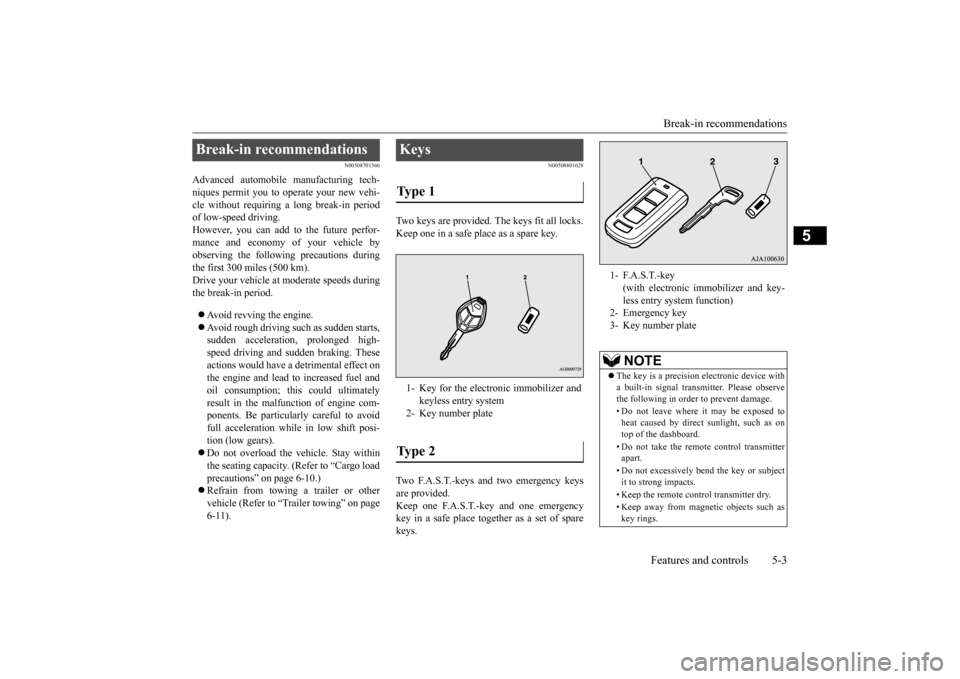
Two keys are provided. The keys fit all locks. Keep one in a safe place as a spare key. Two F.A.S.T.-keys and two emergency keys are provided. Keep one F.A.S.T.-key and one emergency key in a safe place together as a set of sparekeys.
Break-in recommendations
Keys Ty p e 1 1- Key for the electronic immobilizer and
keyless entry system
2- Key number plateTy p e 2
1- F.A.S.T.-key
(with electronic im
mobilizer and key-
less entry system function)
2- Emergency key3- Key number plate
NOTE
The key is a precision
electronic device with
a built-in signal transm
itter. Please observe
the following in order to prevent damage. • Do not leave where it may be exposed to heat caused by direct
sunlight, such as on
top of the dashboard. • Do not take the remote
control transmitter
apart. • Do not excessively bend the key or subject it to strong impacts. • Keep the remote control transmitter dry. • Keep away from magne
tic objects such as
key rings.
BK0223400US.book 3 ページ 2015年2月13日 金曜日 午後12時15分
Page 80 of 464
![MITSUBISHI OUTLANDER 2016 3.G Owners Manual Electronic immobilizer (Anti-theft starting system) 5-4 Features and controls
5
N00509101790
[For vehicles equippe
d with the Free-hand
Advanced Security Transmitter (F.A.S.T.-key)] For information](/manual-img/19/7535/w960_7535-79.png "MITSUBISHI OUTLANDER 2016 3.G Owners Manual Electronic immobilizer (Anti-theft starting system) 5-4 Features and controls
5
N00509101790
[For vehicles equippe
d with the Free-hand
Advanced Security Transmitter (F.A.S.T.-key)] For information")
Electronic immobilizer (Anti-theft starting system) 5-4 Features and controls
5
N00509101790
[For vehicles equippe
d with the Free-hand
Advanced Security Transmitter (F.A.S.T.-key)] For information on ope
rations for vehicles
equipped with the Free-hand Advanced Secu-rity Transmitter (F.A
.S.T.-key), refer to
“Free-hand Advanced
Security Transmitter
(F.A.S.T.-key): Electr
onic immobilizer (Anti-
theft starting system)” on page 5-18. [Except for vehicles e
quipped with the Free-
hand Advanced Secu
rity Transmitter
(F.A.S.T.-key)]The electronic immobilize
r is designed to sig-
nificantly reduce the
possibility of vehicle
theft. The purpose of the system is to immo-bilize the vehicle if an invalid start is
attempted. A valid st
art attempt can only be
achieved (subject to ce
rtain conditions) using
a key “registered” to the immobilizer system. All of the keys provided with your new vehi- cle have been program
med to the vehicle’s
electronics.
• Keep away from devi
ces that produce mag-
netism, such as audio systems, computersand televisions. • Keep away from devices that emit strong electromagneti
c waves, such as cellular
phones, wireless devices and high fre- quency equipment (i
ncluding medical
devices). • Do not clean with
ultrasonic cleaners.
• Do not leave the key where it may be exposed to high temperature or high humid- ity.
If you lose your key, to prevent the theft of the vehicle immediatel
y contact an autho-
rized Mitsubishi Motors dealer. If you notify an authorized Mitsubishi Motors dealer of the key number, they canmake a new key. The key number is stamped on the key number plate. Keep the key num- ber plate in a safe pl
ace separate from the
key itself. No keys other than those registered in advance can be used to start the engine. Refer to “Electronic immobilizer (Anti-theft starting system)” on page 5-4.Refer to “Free-hand Advanced Security Transmitter (F.A.S.T.-key): “Electronic immobilizer (Anti-theft starting system)” onpage 5-18.NOTE
When the theft-alarm is in the system opera- tional status, the alarm operates if a door orliftgate is opened after using the key, thedoor lock knob or the power door lock switch to unlock the vehicle. The system does not enter the preparation status if the keyless entry system or the F.A.S.T.-key operation was not used to lockthe vehicle.
Electronic immobilizer (Anti-theft starting system)
NOTE
NOTE
In the following cases, the vehicle may not be able to recognize
the registered ID code
from the key. This mean
s the engine will not
start even when the key is turned to the “START” position. • When the key contacts a key ring or other metallic or ma
gnetic object
BK0223400US.book 4 ページ 2015年2月13日 金曜日 午後12時15分
Page 81 of 464
Electronic immobilizer (Ant
i-theft starting system)
Features and controls 5-5
5
Only keys that have been programmed to the vehicle’s electronics can be used to start the vehicle. If you lose the key, you can order a key from your authorized Mitsubi
shi Motors dealer by
referring to the key number. To prevent vehicle theft, the ID code for thevehicle keys must be changed.
Take your vehicle and
all remaining keys to
your authorized Mitsubishi Motors dealer tohave your ID code changed. To add a key, you must already have 2 regis- tered keys. You need to register the ID code to the vehicle. Registering the ID code can be done by your- self (except for vehicles
sold in Canada), or
by your authorized Mitsubishi Motors dealer.For you to register the ID code yourself, fol- low the “Customer key programming” proce- dure below.If you choose to have
your authorized Mit-
subishi Motors dealer register the ID code, take your vehicle and
all remaini
ng keys to
your authorized Mitsubishi Motors dealer.
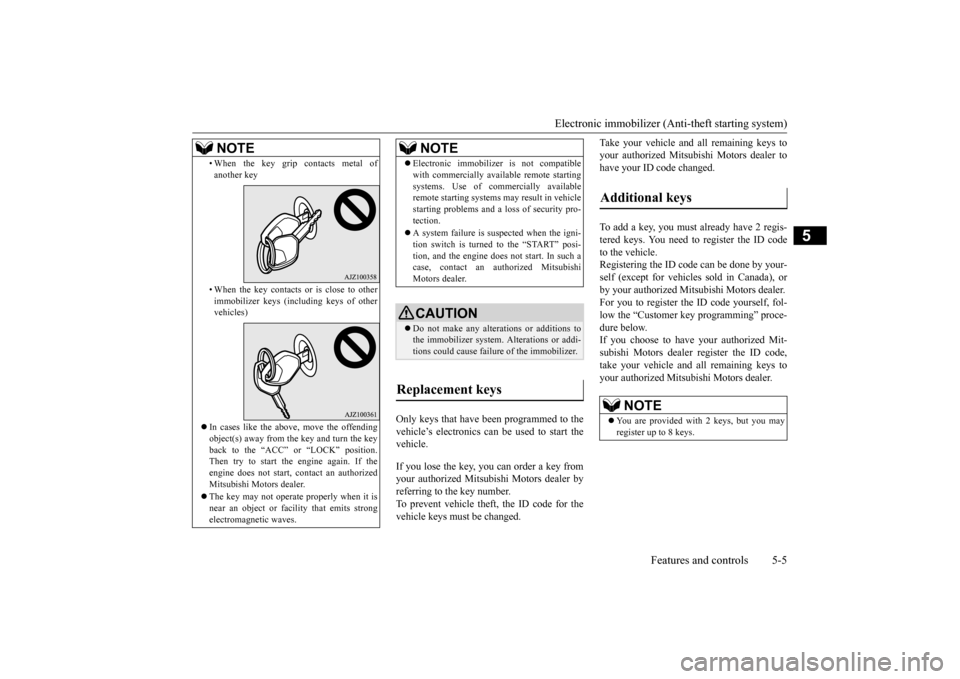
• When the key grip
contacts metal of
another key • When the key contacts
or is close to other
immobilizer keys (inc
luding keys of other
vehicles)
In cases like the a
bove, move the offending
object(s) away from the key and turn the keyback to the “ACC” or “LOCK” position. Then try to start the engine again. If the engine does not start,
contact an authorized
Mitsubishi Motors dealer. The key may not operate
properly when it is
near an object or faci
lity that emits strong
electromagne
tic waves.
NOTE
Electronic immobilize
r is not compatible
with commercially available remote startingsystems. Use of commercially availableremote starting systems may result in vehicle starting problems
and a loss of security pro-
tection. A system failure is suspected when the igni- tion switch is turned to the “START” posi-tion, and the engine does
not start. In such a
case, contact an au
thorized Mitsubishi
Motors dealer.CAUTION Do not make any altera
tions or additions to
the immobilizer system.
Alterations or addi-
tions could cause failure
of the immobilizer.
Replacement keys
NOTE
Additional keys
NOTE
You are provided with 2 keys, but you may register up to 8 keys.
BK0223400US.book 5 ページ 2015年2月13日 金曜日 午後12時15分
Page 88 of 464

Free-hand Advanced
Security Transmitter (F.A.S
.T.-key) (if so equipped)
5-12 Features and controls
5
N00544100064
1. Before replacing the
battery, remove static
electricity from your body by touching a metal grounded object. 2. With the Mitsubishi mark facing you,insert the cloth-cov-ered tip of a flat blade screwdriver into the notch in the remote control transmitter case and use it to open the case.
3. Remove the remote control transmitter from the remote control transmitter case.Then, open the remote control transmitter using the method described in step 1. 4. Remove the old battery. 5. Install a new battery with the +side (A) down. 6. Close the remote control transmitter firmly.
7. Place the remote control transmitter in the remote control transmitter case, thensecurely close the remote control trans- mitter case. 8. Check the keyless entry system to see thatit works.
N00503101121
The Free-hand Advanced Security Transmit-ter (F.A.S.T.-key) enables the doors and the liftgate to be locked and unlocked, the engine to be started and the operation mode to bechanged simply by carrying it.
Procedure for replacing the remote control transmitter bat-tery
NOTE
Be sure to perform the procedure with the Mitsubishi mark faci
ng you. If the Mitsubi-
shi mark is not facing you when you open the remote control transm
itter case, the buttons
may come out.
+ side - side
Coin type bat- tery CR1620
NOTE
You may purchase a replacement battery at an electric appliance store. An authorized Mitsubishi Motors dealer can replace the battery for you if you prefer.CAUTION When the remote control transmitter case is opened, be careful to
keep water, dust, etc.
out. Also, do not touch the internal compo- nents.
Free-hand Advanced Secu- rity Transmitter (F.A.S.T.-key)
(if so equipped)
BK0223400US.book 12 ページ 2015年2月13日 金曜日 午後12時15分
Page 89 of 464
Free-hand Advanced Securi
ty Transmitter (F.A.S.T.-key) (if so equipped)
Features and controls 5-13
5
The F.A.S.T.-key can also be used as the remote control transmitter of the keylessentry system. Refer to “Free-hand
Advanced Security
Transmitter (F.A.S.T.-key): Keyless entrysystem” on page 5-29.
The operations possible with the F.A.S.T.- key can be modified as stated below.(Keyless entry operations are possible.) For details, contact an
authorized Mitsubi-
shi Motors dealer.• Enabling only the locking and unlocking of the doors and the liftgate • Enabling only the starting of the engine• Deactivating the F.A.S.T.-key
The F.A.S.T.-key must be carried by the driver. The F.A.S.T.-key is required for vehicle operations su
ch as locking and
unlocking the doors and the liftgate, starting the engine
and changing the
operation mode. When
leaving the vehi-
cle, make sure you are carrying the F.A.S.T.-key and then lock the vehicle.
WA R N I N G Individuals who use
implantable pace-
makers or implanta
ble cardiovascular-
defibrillators
should keep away from the
external and internal
transmitters. The
electromagnetic w
aves used in the
F.A.S.T.-key may affect the operation ofimplantable pacemakers and implantable cardiovascular-defibrillators.
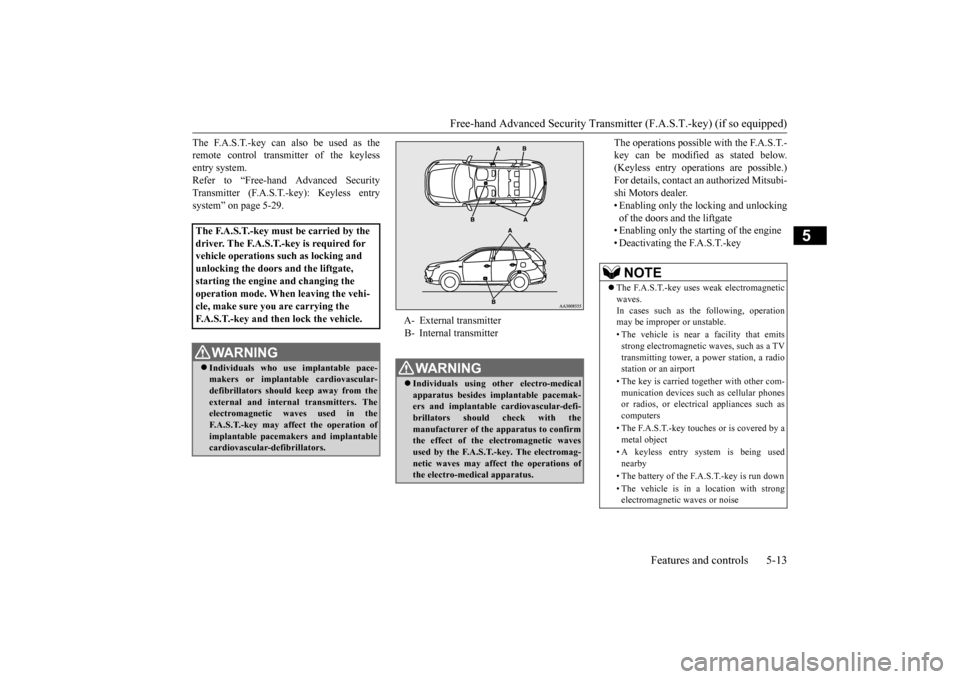
A- External transmitter B- Internal transmitterWA R N I N G Individuals using ot
her electro-medical
apparatus besides implantable pacemak- ers and implantable
cardiovascular-defi-
brillators should check with themanufacturer of the apparatus to confirm the effect of the electromagnetic waves used by the F.A.S.T.-key. The electromag-netic waves may affect
the operations of
the electro-medical apparatus.
NOTE
The F.A.S.T.-key uses weak electromagnetic waves.In cases such as the following, operation may be imprope
r or unstable.
• The vehicle is near a facility that emits strong electroma
gnetic waves, such as a TV
transmitting tower, a po
wer station, a radio
station or an airport • The key is carried t
ogether with other com-
munication devices such
as cellular phones
or radios, or electric
al appliances such as
computers • The F.A.S.T.-key touches or is covered by a metal object • A keyless entry system is being used nearby • The battery of the F.A.S.T.-key is run down • The vehicle is in a location with strong electromagnetic
waves or noise
BK0223400US.book 13 ページ 2015年2月13日 金曜日 午後12時15分
Page 90 of 464
Free-hand Advanced
Security Transmitter (F.A.S
.T.-key) (if so equipped)
5-14 Features and controls
5
N00503201177
When a person enters the operating range of the F.A.S.T.-key while carrying the F.A.S.T.- key and presses the driver’s or front passen- ger’s door lock/unlock switch, the liftgateLOCK switch or the li
ftgate OPEN switch,
verification of the ID
code is performed.
The doors and the liftgate can be locked andunlocked and the engine can be started only when the ID codes of the vehicle and F. A . S . T. - k e y m a t c h .
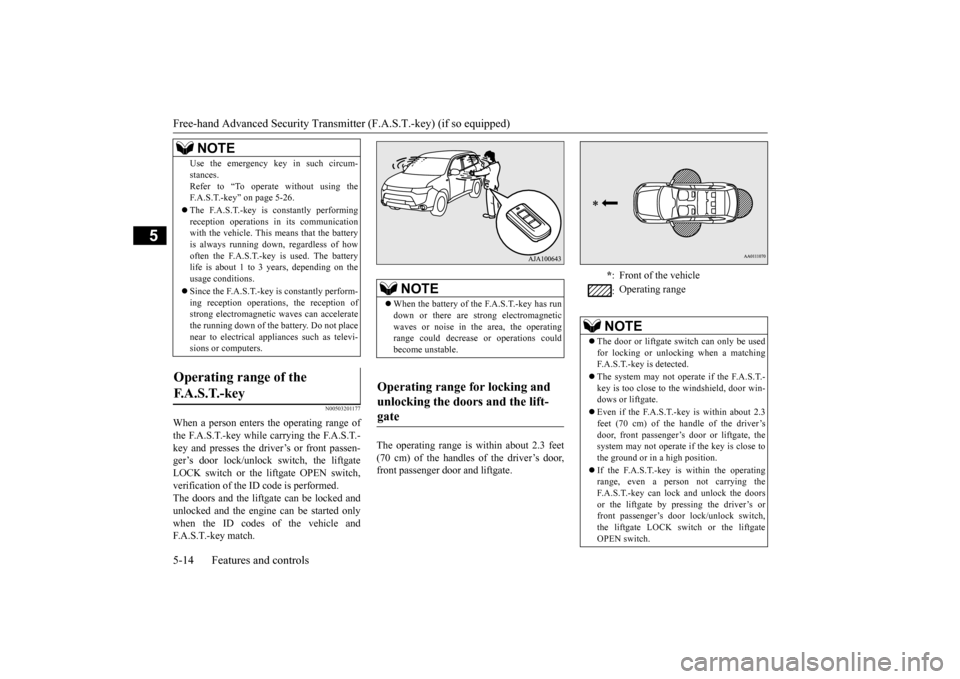
The operating range is
within about 2.3 feet
(70 cm) of the handles of the driver’s door, front passenger door and liftgate.
Use the emergency key in such circum- stances.Refer to “To operate
without using the
F.A.S.T.-key” on page 5-26. The F.A.S.T.-key is constantly performing reception opera
tions in its communication
with the vehicle. This means that the battery is always running down, regardless of howoften the F.A.S.T.-key is used. The battery life is about 1 to 3 years, depending on the usage conditions. Since the F.A.S.T.-key is constantly perform- ing reception operati
ons, the reception of
strong electrom
agnetic waves
can accelerate
the running down of the ba
ttery. Do not place
near to electrical appliances such as televi-sions or computers.
Operating range of the F. A . S . T. - k e y
NOTE
NOTE
When the battery of the F.A.S.T.-key has run down or there are st
rong electromagnetic
waves or noise in the area, the operating range could decrease
or operations could
become unstable.
Operating range for locking and unlocking the doors and the lift- gate
* : Front of the vehicle : Operating range
NOTE
The door or liftgate switch can only be used for locking or unlocking when a matching F.A.S.T.-key is detected. The system may not operate if the F.A.S.T.- key is too close to the windshield, door win- dows or liftgate. Even if the F.A.S.T.-key is within about 2.3 feet (70 cm) of the handle of the driver’sdoor, front passenger’s door or liftgate, the system may not operate
if the key is close to
the ground or in a high position. If the F.A.S.T.-key is within the operating range, even a person not carrying theF.A.S.T.-key can lock and unlock the doors or the liftgate by pressing the driver’s or front passenger’s door lock/unlock switch,the liftgate LOCK switch or the liftgate OPEN switch.
BK0223400US.book 14 ページ 2015年2月13日 金曜日 午後12時15分