2016 MITSUBISHI OUTLANDER III remove seats
[x] Cancel search: remove seatsPage 38 of 464
Making a cargo area 4-12 Seat and restraint systems
4
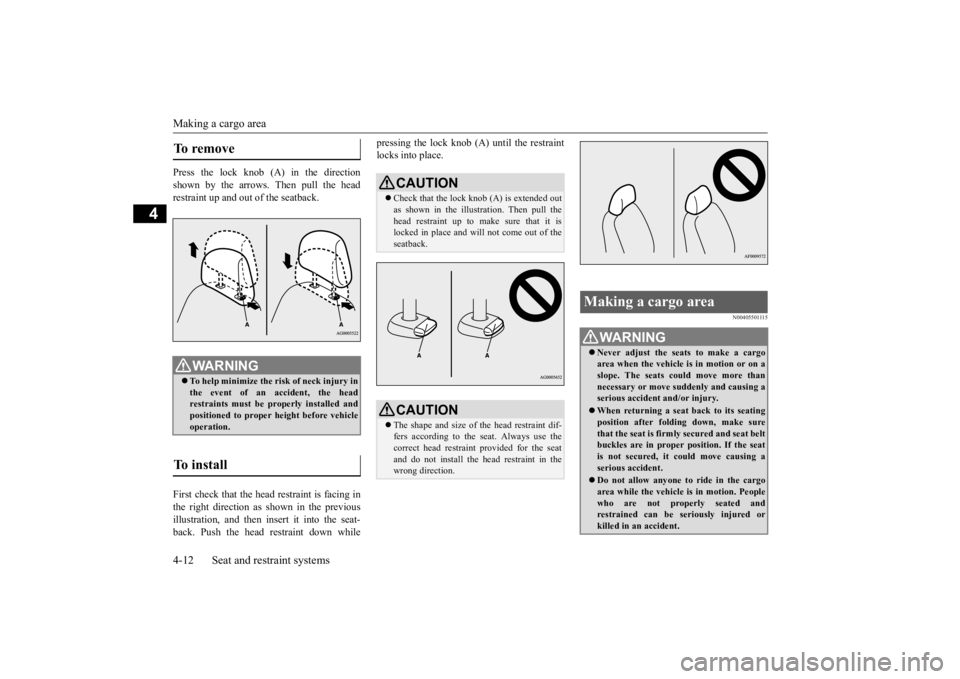
Press the lock knob (A) in the direction shown by the arrows. Then pull the head restraint up and out of the seatback. First check that the head restraint is facing in the right direction as
shown in the previous
illustration, and then insert it into the seat- back. Push the head restraint down while
pressing the lock knob (A) until the restraint locks into place.
N00405501115
To remove
WA R N I N G To help minimize the risk of neck injury in the event of an
accident, the head
restraints must be properly installed and positioned to proper height before vehicle operation.
To install
CAUTION Check that the lock knob (A) is extended out as shown in the illustration. Then pull the head restraint up to make sure that it is locked in place and will
not come out of the
seatback.CAUTION The shape and size of the head restraint dif- fers according to the seat. Always use the correct head restrain
t provided for the seat
and do not install the he
ad restraint in the
wrong direction.
Making a cargo area
WA R N I N G Never adjust the seats to make a cargo area when the vehicle is
in motion or on a
slope. The seats could move more thannecessary or move suddenly and causing a serious accident
and/or injury.
When returning a seat back to its seating position after folding down, make sure that the seat is firmly secured and seat beltbuckles are in proper position. If the seat is not secured, it could move causing a serious accident. Do not allow anyone to ride in the cargo area while the vehicle
is in motion. People
who are not properly seated and restrained can be seriously injured or killed in an accident.
BK0223400US.book 12 ページ 2015年2月13日 金曜日 午後12時15分
Page 41 of 464
Making a cargo area
Seat and restraint systems 4-15
4
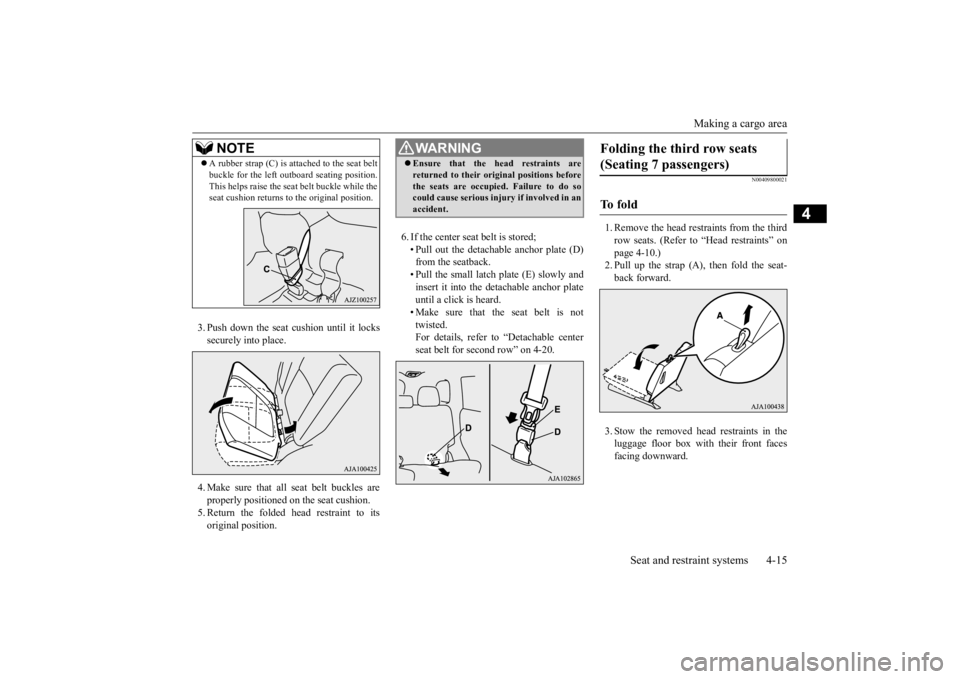
3. Push down the seat cushion until it locks securely into place. 4. Make sure that all
seat belt buckles are
properly positioned on the seat cushion. 5. Return the folded head restraint to itsoriginal position.
6. If the center seat belt is stored; • Pull out the detachable anchor plate (D) from the seatback.• Pull the small latch plate (E) slowly and insert it into the detachable anchor plate until a click is heard.• Make sure that the seat belt is not twisted. For details, refer to “Detachable centerseat belt for second row” on 4-20.
N00409800021
1. Remove the head restraints from the third row seats. (Refer to
“Head restraints” on
page 4-10.)2. Pull up the strap (A), then fold the seat- back forward. 3. Stow the removed head restraints in the luggage floor box with their front faces facing downward.
NOTE
A rubber strap (C) is attached to the seat belt buckle for the left out
board seating position.
This helps raise the seat
belt buckle while the
seat cushion returns to the original position.
WA R N I N G Ensure that the head restraints are returned to their original positions beforethe seats are occupied. Failure to do socould cause serious inju
ry if involved in an
accident.
Folding the third row seats (Seating 7 passengers) To f o l d
BK0223400US.book 15 ページ 2015年2月13日 金曜日 午後12時15分
Page 42 of 464
Making a flat seat 4-16 Seat and restraint systems
4
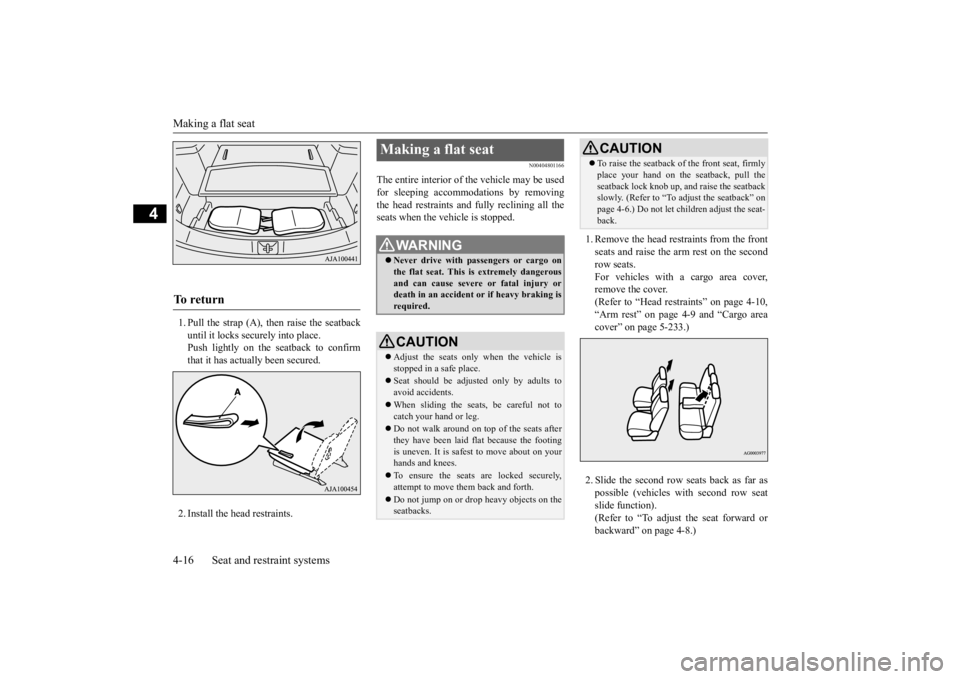
1. Pull the strap (A), then raise the seatback until it locks securely into place.Push lightly on the seatback to confirm that it has actually been secured. 2. Install the head restraints.
N00404801166
The entire interior of the vehicle may be used for sleeping accomm
odations by removing
the head restraints and fully reclining all theseats when the vehicle is stopped.
1. Remove the head re
straints from the front
seats and raise the arm rest on the secondrow seats. For vehicles with a cargo area cover, remove the cover.(Refer to “Head restraints” on page 4-10, “Arm rest” on page 4-9 and “Cargo area cover” on page 5-233.) 2. Slide the second row seats back as far as possible (vehicles with second row seat slide function).(Refer to “To adjust the seat forward or backward” on page 4-8.)
To r e t u r n
Making a flat seat
WA R N I N G Never drive with passengers or cargo on the flat seat. This is extremely dangerousand can cause severe or fatal injury or death in an accident
or if heavy braking is
required.CAUTION Adjust the seats only
when the vehicle is
stopped in a safe place. Seat should be adjusted only by adults to avoid accidents. When sliding the seat
s, be careful not to
catch your hand or leg. Do not walk around on t
op of the seats after
they have been laid fl
at because the footing
is uneven. It is safe
st to move about on your
hands and knees. To ensure the seats are locked securely, attempt to move them back and forth. Do not jump on or drop heavy objects on the seatbacks.
To raise the seatback of the front seat, firmly place your hand on th
e seatback, pull the
seatback lock knob up,
and raise the seatback
slowly. (Refer to “To adjust the seatback” on page 4-6.) Do not let ch
ildren adjust the seat-
back.CAUTION
BK0223400US.book 16 ページ 2015年2月13日 金曜日 午後12時15分
Page 50 of 464
Seat belt use during pregnancy 4-24 Seat and restraint systems
4
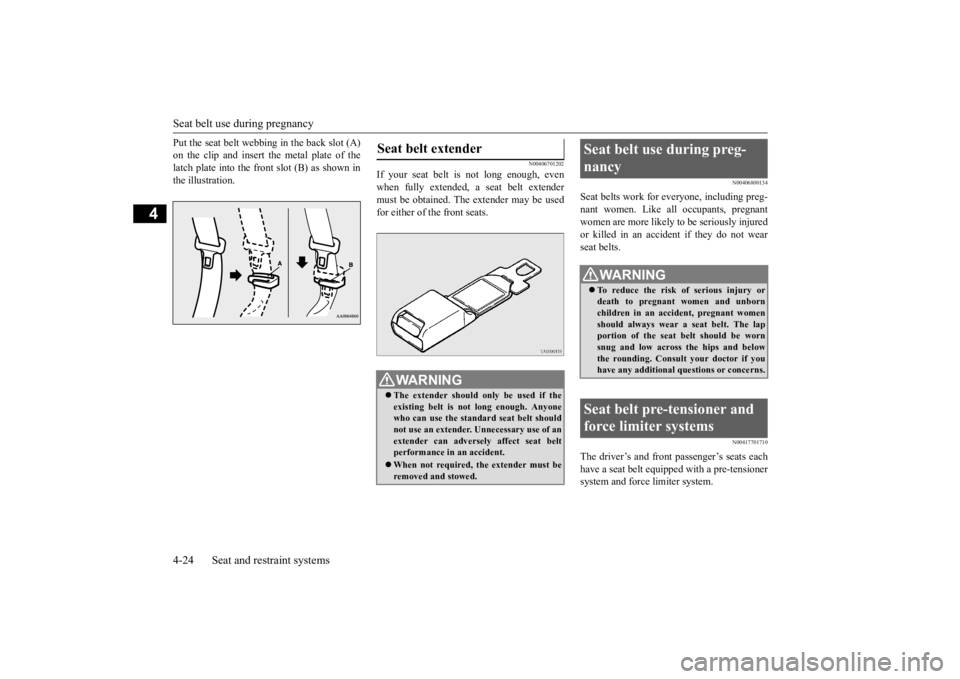
Put the seat belt webbing in the back slot (A) on the clip and insert the metal plate of thelatch plate into the front slot (B) as shown in the illustration.
N00406701202
If your seat belt is
not long enough, even
when fully extended,
a seat belt extender
must be obtained. Th
e extender may be used
for either of the front seats.
N00406800134
Seat belts work for
everyone, including preg-
nant women. Like al
l occupants, pregnant
women are more likely to be seriously injuredor killed in an accide
nt if they do not wear
seat belts.
N00417701710
The driver’s and front passenger’s seats each have a seat belt equippe
d with a pre-tensioner
system and force limiter system.
Seat belt extender
WA R N I N G The extender should only be used if the existing belt is not long enough. Anyone who can use the standard seat belt shouldnot use an extender.
Unnecessary use of an
extender can adversel
y affect seat belt
performance in an accident. When not required, the extender must be removed and stowed.
Seat belt use during preg- nancy
WA R N I N G To reduce the risk of serious injury or death to pregnant women and unborn children in an accident, pregnant womenshould always wear
a seat belt. The lap
portion of the seat belt should be worn snug and low across the hips and belowthe rounding. Consult your doctor if you have any additional qu
estions or concerns.
Seat belt pre-tensioner and force limiter systems
BK0223400US.book 24 ページ 2015年2月13日 金曜日 午後12時15分
Page 55 of 464
Child restraint systems
Seat and restraint systems 4-29
4
N00418801167
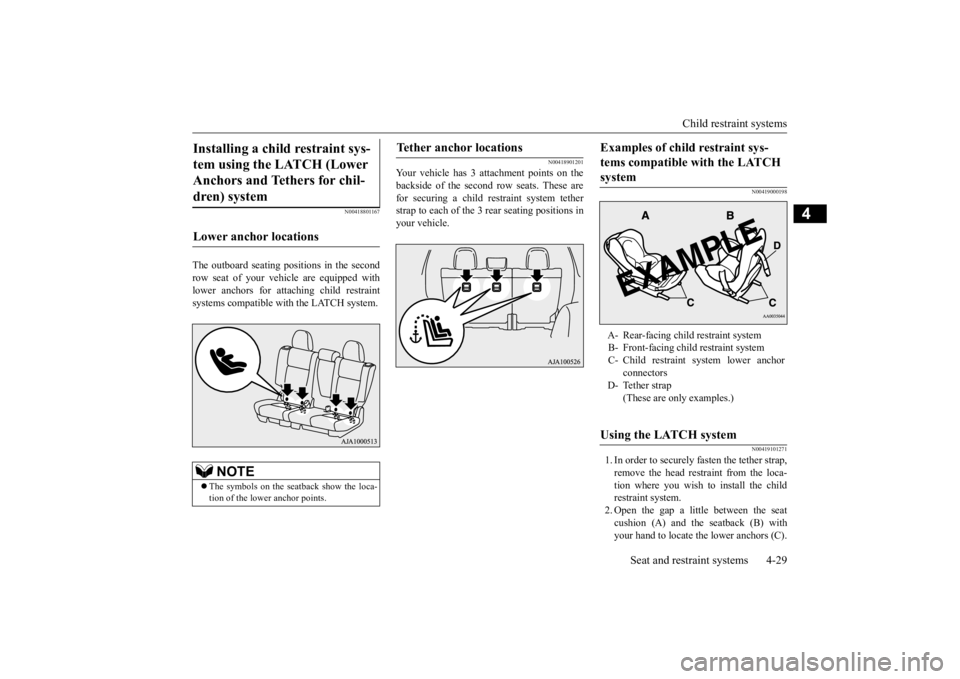
The outboard seating
positions in the second
row seat of your vehicle are equipped with lower anchors for atta
ching child restraint
systems compatible with the LATCH system.
N00418901201
Your vehicle has 3 attachment points on thebackside of the second row seats. These are for securing a child restraint system tetherstrap to each of the 3
rear seating positions in
your vehicle.
N00419000198 N00419101271
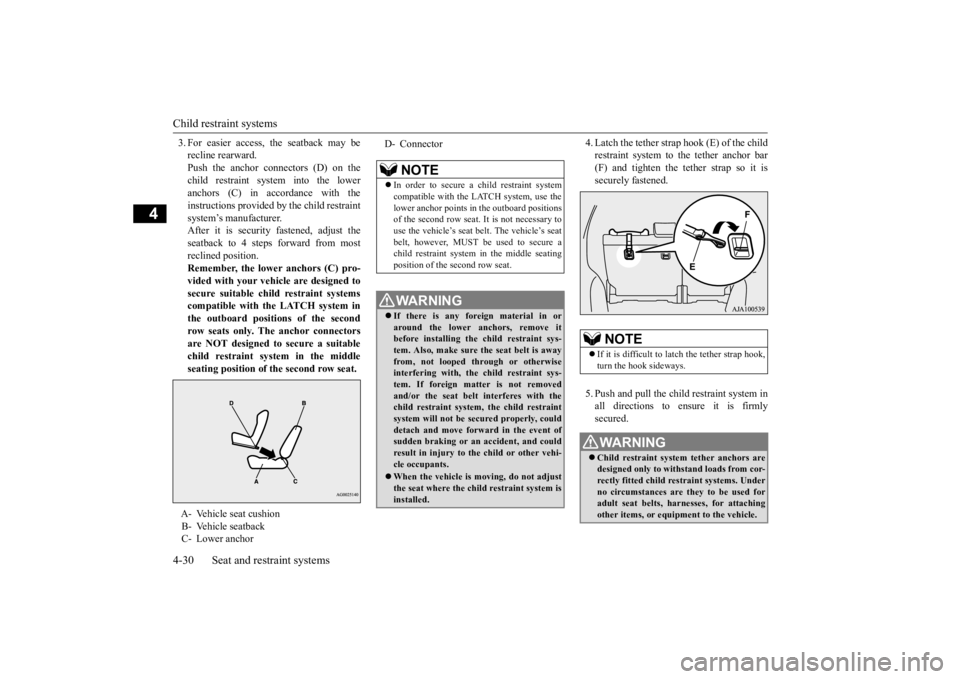
1. In order to securely fasten the tether strap, remove the head restraint from the loca- tion where you wish to install the child restraint system.2. Open the gap a little between the seat cushion (A) and the seatback (B) with your hand to locate the lower anchors (C).
Installing a child restraint sys- tem using the LATCH (Lower Anchors and Tethers for chil- dren) system Lower anchor locations
NOTE
The symbols on the seatback show the loca- tion of the lower anchor points.
Tether anchor locations
Examples of child restraint sys- tems compatible with the LATCH system A- Rear-facing child
restraint system
B- Front-facing child restraint system C- Child restraint system lower anchor
connectors
D- Tether strap
(These are only examples.)
Using the LATCH system
BK0223400US.book 29 ページ 2015年2月13日 金曜日 午後12時15分
Page 56 of 464
Child restraint systems 4-30 Seat and restraint systems
4
3. For easier access, the seatback may be recline rearward.Push the anchor connectors (D) on the child restraint system into the lower anchors (C) in accordance with theinstructions provided by
the child restraint
system’s manufacturer. After it is security fastened, adjust theseatback to 4 steps forward from most reclined position. Remember, the lower anchors (C) pro- vided with your vehi
cle are designed to
secure suitable child restraint systemscompatible with the LATCH system in the outboard positions of the second row seats only. The anchor connectorsare NOT designed to
secure a suitable
child restraint system in the middle seating position of the second row seat.
4. Latch the tether strap hook (E) of the child restraint system to the tether anchor bar(F) and tighten the tether strap so it is securely fastened. 5. Push and pull the child restraint system in all directions to ensure it is firmlysecured.
A- Vehicle seat cushion B- Vehicle seatback C- Lower anchor
D- Connector
NOTE
In order to secure a child restraint system compatible with the LATCH system, use thelower anchor points in
the outboard positions
of the second row seat.
It is not necessary to
use the vehicle’s seat
belt. The vehicle’s seat
belt, however, MUST be
used to secure a
child restraint system in the middle seating position of the second row seat.WA R N I N G If there is any foreign material in or around the lower anchors, remove it before installing the child restraint sys- tem. Also, make sure the seat belt is awayfrom, not looped through or otherwise interfering with, the child restraint sys- tem. If foreign matter is not removedand/or the seat belt interferes with the child restraint system, the child restraint system will not be secured properly, coulddetach and move forward in the event of sudden braking or an
accident, and could
result in injury to the child or other vehi-cle occupants. When the vehicle is moving, do not adjust the seat where the child restraint system isinstalled.
NOTE
If it is difficult to la
tch the tether strap hook,
turn the hook sideways.WA R N I N G Child restraint system tether anchors are designed only to with
stand loads from cor-
rectly fitted child restraint systems. Underno circumstances are they to be used for adult seat belts, harnesses, for attaching other items, or equipment to the vehicle.
BK0223400US.book 30 ページ 2015年2月13日 金曜日 午後12時15分
Page 64 of 464

Supplemental Restraint System (SRS) - airbag 4-38 Seat and restraint systems
4
bag control unit controls deployment of the passenger’s front airbag in accordance withthe information it receives from this system. The passenger’s front airbag will not deploy in an impact when the system senses no occu-pant on the front passenger’s seat or a child in a child restraint system. In this case, the pas- senger airbag off indi
cator will come on.
Refer to “Passenger’s ai
rbag off indicator” on
page 4-38. If there is a problem involving the passen- ger’s seat occupant cl
assification sensor sys-
tem, the SRS warning light in the instrumentpanel will come on. Refer to “SRS warning light/display” on page 4-39.
N00418101346
The passenger’s airbag off indicator is located in the instrument panel. The indicator normally comes on when the ignition switch is turned to the “ON” position or the operation mode is put in ON, and goes out a few seconds later.
In the following situ-
ations, the indicator will stay on to show that the passenger front airb
ag is not operational.
The front passenger’s seat is not occupied.
WA R N I N GIf any of the follow
ing conditions occur,
you should immediatel
y have your vehicle
inspected by an au
thorized Mitsubishi
Motors dealer as soon as possible:• The SRS warning light does not initiallycome on when the ignition switch or the operation mode is under the followingconditions. [Except for vehicles equipped with the F. A . S . T. - k e y ]The ignition switch is in the “ON” or “START” position. [Vehicles equipped with the F.A.S.T.-key]The operation mode is in ON.• The SRS warning light does not go outafter several seconds.
• The SRS warning li
ght comes on while
you are driving.
To ensure that the passenger’s seat occu- pant classification sensor system can sense correctly, observe the following instruc-tions. Failure to follow these instructions can adversely affect
the performance of
the passenger’s airbag system.• Adjust the seat to the correct position,and sit well back
against the seatback.
Refer to “Front seats” on page 4-4.• Do not recline the seatback more thannecessary.• Never have more th
an one person (adult
or child) sitting on the seat.• Do not place anything between the seatand the floor console.• When attaching a child restraint system,secure it firmly.• Do not place luggage or other objects onthe seat.• Do not use a seat cover or a cushion.• Do not modify or re
place the seat and
seat belt.• Do not place luggage or other objectsunder the seat.• Do not place and use
an electronic device
such as a computer on the seat.• Do not place heavy obje
cts on the seat or
stick pins, needles, or other objects intoit.• Do not remove the seat cushion skin.WA R N I N G
• If any liquid is spilled on the seat, wipe itand dry the seat immediately.
If the vehicle is involved in a severe impact, have the SRS sensors inspected by an authorized
Mitsubishi Motors dealer as
soon as possible.
Passenger’s airbag off indicator
WA R N I N G
BK0223400US.book 38 ページ 2015年2月13日 金曜日 午後12時15分
Page 75 of 464
Supplemental Restraint System (SRS) - airbag
Seat and restraint systems 4-49
4
N00408500669
SRS servicing
WA R N I N G Any maintenance performed on or near the components of the SRS should be per-formed only by an
authorized Mitsubishi
Motors dealer. Do not permit anyone else to do any service, inspection, maintenanceor repair on any SR
S components or wir-
ing. Similarly, no part of the SRS should ever be handled, removed or disposed byanyone except an au
thorized Mitsubishi
Motors dealer. Improper work meth
ods on the SRS com-
ponents or wiring could result in an acci- dental airbag deployment or could make the SRS inoperable. Ei
ther of these situa-
tions could result in serious injury or death. Do not modify your steering wheel or any other SRS component or related vehicle part. For example, replacement of thesteering wheel, or modifications to the front bumper or body structure can adversely affect SR
S performance and
may lead to injury. If your vehicle has
received any damage,
you should have the
SRS inspected by an
authorized Mitsubishi
Motors dealer to
make sure it is in
proper work
ing order.
Do not modify your front seats, center pil- lar or center console. Such modificationscan adversely affect
SRS performance and
may lead to injury. Also, if you discove
r any tear or open
seam in the seat fabr
ic near the side air-
bag, have the seat in
spected by an autho-
rized Mitsubishi Motors dealer. If you have found an
y scratch, crack or
damage to the portion of the front and rear pillars and roof
side rail, you should
have the SRS inspected by an authorized Mitsubishi Motors dealer.NOTE
When you transfer ownership of the vehicle to another person, we
urge you to alert the
new owner that it is
equipped with the SRS
and refer that owner to the applicable sec- tions in this owner’s manual. If you decide to junk or scrap your vehicle, we urge you to first take it to an authorized Mitsubishi Motors dealer so that the SRS canbe made safe for disposal. If any of the following parts needs to be modified for use by a handicapped person,the advanced airbag sy
stem will be greatly
affected. Please consult an authorized Mit- subishi Motors dealer. • Driver’s seat • Front passenger seat • Front seat beltWA R N I N G
• Steering wheel • Instrument panel[For vehicles so
ld in U.S.A.]
To contact Mitsubi
shi Motors North
America, Inc. call 1-888-648-7820 or write to: Mitsubishi Motors North America, Inc.Customer Relations Department P.O. Box 6400 Cypress, CA 90630-0064 [For vehicles so
ld in Canada]
To contact Mitsubishi Motor Sales ofCanada, Inc. call 1-888-576-4878 or write to: Mitsubishi Motor Sales of Canada, Inc.Customer Relations Department P.O. Box 41009 4141 Dixie RoadMississauga, ON L4W 5C9NOTE
BK0223400US.book 49 ページ 2015年2月13日 金曜日 午後12時15分