2016 MERCEDES-BENZ S CLASS display
[x] Cancel search: displayPage 240 of 438

R
the radar sensors in the front or rear bumpers
or the radiator trim are dirty, e.g. obscured by
snow R
there are no, several or unclear lane markings
for a lane, e.g. in areas with road construction
work R
the lane markings are worn away, dark or cov-
ered up, e.g. by dirt or snow R
the distance to the vehicle in front is too small
and the lane markings thus cannot be detec-
ted R
the lane markings change quickly, e.g. lanes
branch off, cross one another or merge R
the road is narrow and winding R
there are strong shadows cast on the road
If no vehicle is detected in the adjacent lane and
broken lane markings are detected, no lane-cor-
recting brake application is made.
Warning vibration in the steering wheel A warning may be given if a front wheel passes
over a lane marking. It will warn you by means of
intermittent vibration in the steering wheel for
up to 1.5 second s.
In orde r that you are warned only when neces-
sary and in good time if you cross the lane mark-
ing, the system recognizes certain conditions
and warns you accordingly.
The warning vibration occurs earlier if: R
you approach the outer lane marking on a
bend. R
the road has very wide lanes, e.g. a highway. R
the system recognizes solid lane markings.
The warning vibration occurs later if: R
the road has narrow lanes R
you cut the corner on a bend
Lane-correcting brake application
If you leave your lane, under certain circumstan-
ces the vehicle will brake briefly on one side.
This is meant to assist you in bringing the vehicle
back to the original lane.
G WARNING
A lane-correcting brake application cannot
always bring the vehicle back into the original
lane. There is a risk of an accident.
Always steer, brake or accelerate yourself,
especially if Active Lane Keeping Assist warns you or makes a lane-correcting brake appli-
cation.
G WARNING
Active Lane Keeping Assist does not detect
traffic conditions or road users. In very rare
cases, the system may make an inappropriate
brake application, e.g. after intentionally driv-
ing over a solid lane marking. There is a risk of
an accident.
An inappropriate brake application may be
interrupted at any time if you steer slightly in
the opposite direction. Always make sure that
there is sufficient distance on the side for
other traffic or obstacles.
If a lane-correcting brake application occurs,
display C appears in the multifunction display.
The brake application also slightly reduces vehi-
cle speed.
A lane-correcting brake application can be made
after driving over a lane marking recognized as
being solid or broken. Before this, a warning
must be given by means of intermittent vibration
in the steering wheel. In addition, a lane with
lane markings on both sides must be recog-
nized.
In the case of a broken lane marking being
detected, a lane-correcting brake application
can only be made if a vehicle has been detected
in the adjacent lane. The following vehicles can
have an influence on brake application: oncom-
ing traffic, vehicles that are overtaking and vehi-
cles that are driving parallel to your vehicle.
i A further lane-correcting brake application
can only occur after your vehicle has returned
to the original lane.238
Driving systems
Driving and parking
Page 241 of 438

No lane-correcting brake application occurs if: R
you clearly and actively steer, brake or accel-
erate. R
you cut the corner on a sharp bend. R
you have switched on the turn signal. R
a driving safety system intervenes, e.g. ESP ®
,
PRE-SAFE ®
Brake or Active Blind Spot Assist.R
you have adopted a sporty driving style with
high cornering speeds or high rates of accel-
eration. R
ESP ®
is switched off.R
the transmission is not in position D .R
a loss of tire pressure or a defective tire has
been detected and displayed. R
an obstacle in the lane in which you are driving
has been detected.
Active Lane Keeping Assist may not detect other
road users or traffic situations. An inappropriate
brake application may be interrupted at any time
if you: R
steer slightly in the opposite direction R
switch on the turn signal R
clearly brake or accelerate
A lane-correcting brake application is interrup-
ted automatically if: R
a driving safety system intervenes, e.g. ESP ®
,
PRE-SAFE ®
Brake or Active Blind Spot Assist.R
lane markings can no longer be recognized.
Switching on Active Lane Keeping Assist
X
Press button D .
Indicator lamp C lights up. The Lane Keep‐
ing Assist On message appears in the mul-
tifunction display. If all conditions have been
satisfied, a warning or steering intervention
may be made.
If you drive at speeds above 40 mph
(60 km/h) and lane markings are detected, the lines in the assistance graphics display
( Y
page 268) are shown in green. Active Lane
Keeping Assist is ready for use. X
To switch off: press button D .
Indicator lamp C goes out. The Active Lane
Keeping Assist is deactivated. The Lane
Keeping Assist Off message appears in
the multifunction display.
Selecting Standard or Adaptive setting X
In the DriveAssist menu on the on-board
computer, select the Active Lane Keep‐
ing Assist function ( Y
page 271).X
Select Standard or Adaptive .
When Standard is selected, no warning vibra-
tion occurs if: R
you switch on the turn signals. In this event,
the warnings are suppressed for a certain
period of time. R
a driving safety system intervenes, such as
ABS, BAS or ESP ®
.
When Adaptive
is selected, no warning vibra-
tion occurs if: R
you switch on the turn signals. In this event,
the warnings are suppressed for a certain
period of time. R
a driving safety system intervenes, e.g.
ABS, BAS or ESP ®
. R
you accelerate hard, e.g. kickdown. R
you brake hard. R
you steer actively, e.g. swerve to avoid an
obstacle or change lanes quickly. R
you cut the corner on a sharp bend.
In order that you are warned only when neces-
sary and in good time if you cross the lane mark-
ing, the system recognizes certain conditions
and warns you accordingly.
The warning vibration occurs earlier if: R
you approach the outer lane marking on a
bend. R
the road has very wide lanes, e.g. a highway. R
the system recognizes solid lane markings.
The warning vibration occurs later if: R
the road has narrow lanes R
you cut the corner on a bendDriving systems 239
Driving and parking Z
Page 242 of 438

PLUG ‑ IN HYBRID operation
Points to remember
General notes Hybrid technology combines a fuel efficient
internal combustion engine with a powerful
electric motor. In HYBRID mode, the hybrid
drive system automatically selects the most effi-
cient operating mode for every driving situation.
Drive the vehicle in the usual manner.
To save fuel in HYBRID mode, the hybrid drive
system switches off the combustion engine as
often as possible during the journey when power
output requirements are low. When power out-
put requirements are low, the electric motor
powers the vehicle. The combustion engine is
automatically activated when power output
requirements are high. The engine is usually
switched off when the vehicle is stationary. Con-
sequently, there is usually no engine idling as
with combustion engine vehicles.
For pulling away and accelerating, the electric
motor supports the internal combustion engine
using the power stored in the high-voltage bat-
tery. In addition, the power is used for partially
electric driving, operation of the electric coolant
compressor and to support the 12 V on-board
electrical system. In this way the hybrid drive
system helps to reduce your vehicle's fuel con-
sumption.
Observe the driving tips on PLUG-IN HYBRID
operation ( Y
page 251).
Recuperative Brake System If you release the accelerator pedal when the
vehicle is in motion, overrun recuperation is ini-
tiated. The electric motor is operated as a gen-
erator when in overrun mode and when you
brake. Hybrid technology converts the kinetic
energy of the vehicle into electricity and stores
it in the high-voltage battery.
Observe the important safety notes for the
Recuperative Brake System ( Y
page 44). Important safety notes If the engine is switched off by the ECO start/
stop function and you open the driver's door: R
a message appears in the multifunction dis-
play and R
a warning tone sounds
Further information ( Y
page 297).
All of the vehicle's systems remain active, if: R
the vehicle is stationary R
the combustion engine is switched off and R
the READY indicator in the instrument cluster
lights up
If you remove your foot from the brake pedal
while in transmission position D or R, the vehicle
may pull away automatically.
Observe the notes on the READY display of the
ECO start/stop function ( Y
page 252).
Vehicles with an electric motor generate much
less driving noise than vehicles with internal
combustion engines. As a result, your vehicle
may not be heard by other road users in certain
situations.
Depending on the vehicle's equipment and
country-specific regulations, the vehicle can be
equipped with Acoustic Vehicle Indication.
Acoustic Vehicle Indication generates a certain
sound at a speed between 0 and 19 mph
(30 km/h). This helps other road users, partic-
ularly pedestrians and cyclists, to hear your
vehicle better. The sound can also be heard
inside the vehicle.
The volume depends on the engine speed. The
faster you accelerate, the louder the sound is. At
a speed of over 19 mph (30 km/h) the sound is
switched off. Above this speed, the natural
sounds from the vehicle are sufficient that it can
be heard in good time by other road users.240
PLUG ‑ IN HYBRID operation
Driving and parking
Page 244 of 438

Instrument cluster
C
Recuperative Brake Syste m warning lamp ( Y
page 315)D
Electric motor performance display ( Y
page 242)
Page 246 of 438

E-SAVE R
Electric mode or driving
with the internal combus-
tion engine is possible R
Automatic selection of
drive mode with electric
mode as often as possi-
ble R
The current condition of
charge of the high-volt-
age battery is maintained
so the electrical energy
can be used at a later
time.
CHARGE R
Electric drive is not pos-
sible R
The high-voltage battery
is charging while driving
with the combustion
engine
In automatic drive program S ( Y
page 250) and
in manual drive program M ( Y
page 250), only
HYBRID operating mode is available.
If you switch from automatic drive program S to
automatic drive program E or E+ , HYBRID oper-
ating mode continues to be selected.
If manual drive program M is deactivated, the
automatic transmission shifts: R
into the automatic drive program that was last
selected R
into the driving mode that was last selected
Each time the engine is started, HYBRID mode
is automatically selected.
Power meter The power meter supports you in electric mode
and displays the output obtained.
If you select the E-MODE operating mode, the
instrument cluster will display the power meter
instead of the tachometer.
i The tachometer appears again if: R
you select HYBRID , E-SAVE or CHARGER
the current state of charge of the high-volt-
age battery is too low to drive the vehicle in
the E-MODE electrical operating mode The power meter is divided into the following
areas: R
Limit C (OFF):
If the needle reaches limit C , the electric
motor and the combustion engine are
switched off. R
Area D to
Page 250 of 438

Charging the high-voltage battery when
stationary
The engine and electric motor are switched off.
The arrows for the energy flow are not shown.
Further information on charging the high-volt-
age battery via: R
a mains socket ( Y
page 183)R
a charging station ( Y
page 186)R
a wallbox ( Y
page 185)
Displaying the total range and electrical
range
The approximate range is based on the current
driving style. X
Use
Page 251 of 438

Displaying fuel consumption an d generated electricit y
C
Fue l consumptionD
Electrical energ y generate d
Every bar of th e graph displays th e averag e valu e fo r on e minute.
Fue l consumption indicator C may diffe r from th e indicator in th e Fro m Start trip compute r in th e
Tri p menu.
To reset th e values: th e values are reset alon g wit h th e Fro m Start
trip compute r ( Y
page 262).X
To selec t Consumption : turn and press th e controller .
Fue l consumption C and electrical energ y D generate d fo r th e last 15 minutes are shown in th e
COMAN D display.
Starting th e engin eThe vehicle start s in electric mode without th e
internal combustion engin e (noiseles s start).
The internal combustion engin e start s only after
th e powe r demanded by th e driver exceeds th e
available powe r that th e electric moto r can cur -
rentl y provide.
Noiseless start operation is dependen t on th e
outsid e temperature and th e operatin g temper-
ature of th e internal combustion engine. If no t all
condition s fo r noiseles s start operation are ful-
filled, th e vehicle start s wit h th e internal com-
bustion engine. X
Switc h on th e ignition .X
Depress th e brake pedal. X
Observ e th e note s on startin g th e engin e
( Y
page 164). X
Start th e vehicle ( Y
page 164).
The vehicle is operational when READY indi-
cator C lights up.PLUG ‑ IN HYBRID operation 24 9
Driving an d parking Z
Page 252 of 438
Pulling away X
Depress the brake pedal and keep it
depressed. X
Shift the transmission to position D or R .X
If the Apply Brake to Shift from 'P'
display message appears in the multifunction
display, depress the brake pedal more firmly
and select the desired transmission position. X
Release the brake pedal. X
Carefully depress the accelerator pedal.
For further information on pulling away
( Y
page 165).
Driving
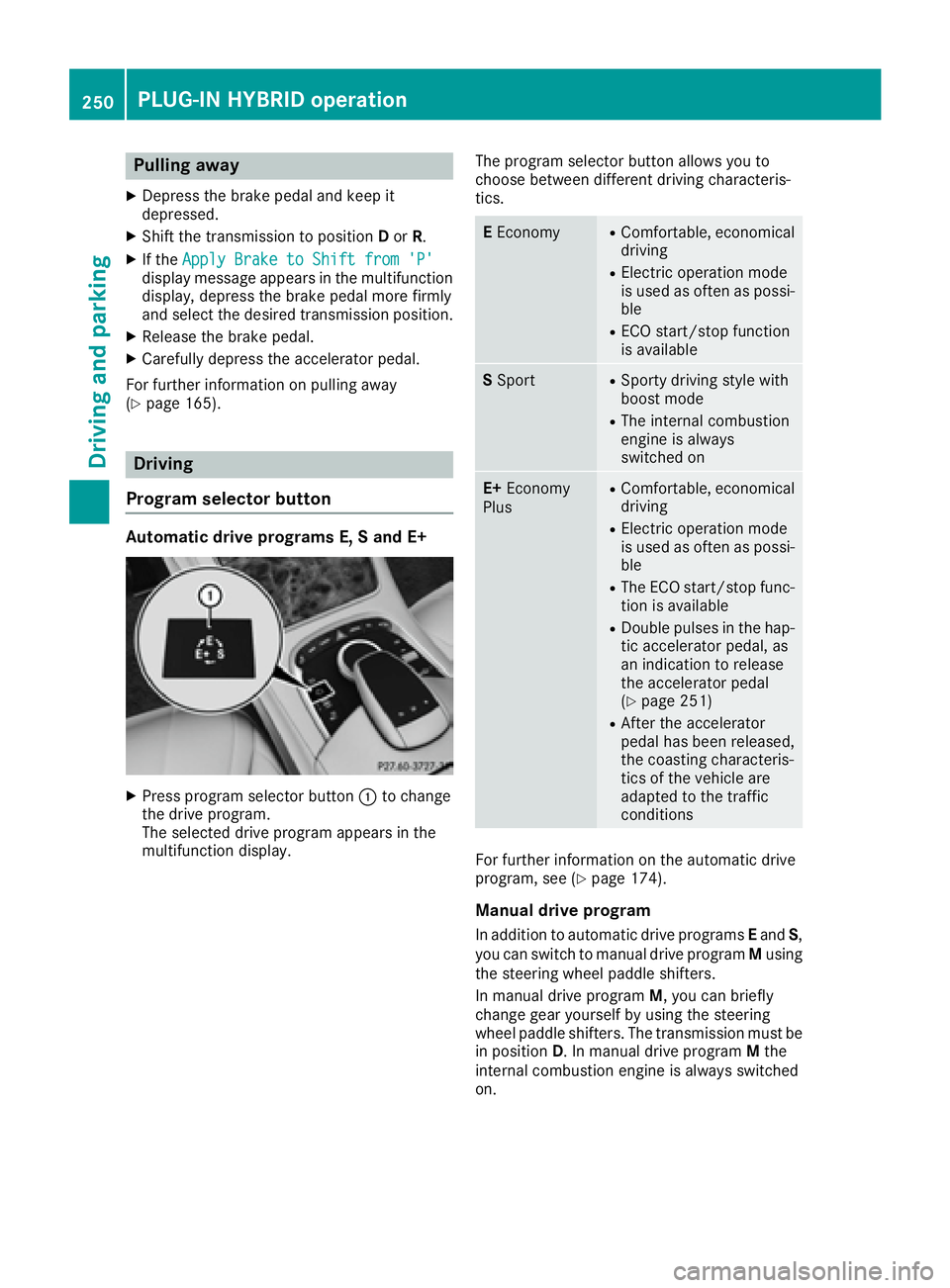
Program selector button Automatic drive programs E, S and E+
X
Press program selector button C to change
the drive program.
The selected drive program appears in the
multifunction display. The program selector button allows you to
choose between different driving characteris-
tics.
E Economy R
Comfortable, economical
driving R
Electric operation mode
is used as often as possi-
ble R
ECO start/stop function
is available
S Sport R
Sporty driving style with
boost mode R
The internal combustion
engine is always
switched on
E+ Economy
Plus R
Comfortable, economical
driving R
Electric operation mode
is used as often as possi-
ble R
The ECO start/stop func-
tion is available R
Double pulses in the hap-
tic accelerator pedal, as
an indication to release
the accelerator pedal
( Y
page 251) R
After the accelerator
pedal has been released,
the coasting characteris-
tics of the vehicle are
adapted to the traffic
conditions
For further information on the automatic drive
program, see ( Y
page 174).
Manual drive program
In addition to automatic drive programs E and S ,
you can switch to manual drive program M using
the steering wheel paddle shifters.
In manual drive program M , you can briefly
change gear yourself by using the steering
wheel paddle shifters. The transmission must be
in position D . In manual drive program M the
internal combustion engine is always switched
on.250
PLUG ‑ IN HYBRID operation
Driving and parking