2016 MERCEDES-BENZ GLE ESP
[x] Cancel search: ESPPage 27 of 450
Protection of the environment
General notes
H Environmental note
Daimler's declared policy is one of compre-
hensive environmental protection.
The objectives are for the natural resources
that form the basis of our existence on this
planet to be used sparingly and in a manner
that takes the requirements of both nature
and humanity into account.
You too can help to protect the environment
by operating your vehicle in an environmen-
tally responsible manner.
Fuel consumption and the rate of engine,
transmission, brake and tire wear are affected
by these factors: R
operating conditions of your vehicle R
your personal driving style
You can influence both factors. You should
bear the following in mind:
Operating conditions: R
avoid short trips as these increase fuel con-
sumption. R
always make sure that the tire pressures
are correct. R
do not carry any unnecessary weight. R
remove roof racks once you no longer need
them. R
a regularly serviced vehicle will contribute
to environmental protection. You should
therefore adhere to the service intervals. R
always have service work carried out at a
qualified specialist workshop.
Personal driving style: R
do not depress the accelerator pedal when
starting the engine. R
do not warm up the engine when the vehicle
is stationary. R
drive carefully and maintain a safe distance
from the vehicle in front. R
avoid frequent, sudden acceleration and
braking. R
change gear in good time and use each gear
only up to
Page 31 of 450
Declarations of conformity
Vehicl e component s which receive
and/o r transmit radi o wavesUSA: "The wireles s devices of this vehicle com-
ply wit h Par t 15 of th e FCC Rules . Operation is
subjec t to th e tw o followin g tw o conditions: 1)
These devices may no t cause harmful interfer-
ence , and 2) These devices mus t accept any
interferenc e received, includin g interferenc e
that may cause undesired operation . Changes
or modification s no t expressl y approved by th e
party responsible fo r compliance could void th e
user’s authorit y to operat e th e equipment. "
Canada: "The wireles s devices of this vehicle
compl y wit h Industry Canada license-exemp t
RSS standard(s) . Operation is subjec t to th e fol-
lowing tw o conditions: (1) These devices may
no t cause interference, and (2) These devices
mus t accept any interference, includin g inter-
ference that may cause undesired operation of
th e device. "
Diagnostics connection The diagnostic s connection is only intended fo r
th e connection of diagnostic equipmen t at a
qualified specialis t workshop .
G WARNING
If you connec t equipmen t to th e diagnostic s
connection in th e vehicle, it may affec t th e
operation of th e vehicle systems . As a result ,
th e operatin g safet y of th e vehicle could be
affected. There is a ris k of an accident.
Do no t connec t any equipmen t to a diagnos-
tics connection in th e vehicle.
G WARNING
Objects in th e driver's footwell can restric t th e
peda l trave l or obstruct a depressed pedal.
The operatin g and road safet y of th e vehicle is
jeopardized. There is a ris k of an accident.
Mak e sur e that all objects in th e vehicle are
stowed correctly, and that they canno t ente r
th e driver's footwell. Install th e floormat s
securely and as specifie d in order to ensur e
sufficien t clearanc e fo r th e pedals. Do no t use loose floormat s and do no t plac e floormat s on
to p of on e another.
! If th e engin e is switched of f and equipmen t
on th e diagnostic s connection is used , th e
starter battery may discharge.
Connectin g equipmen t to th e diagnostic s con-
nection can lead to emission s monitorin g infor-
mation bein g reset , fo r example. Thi s may lead
to th e vehicle failin g to mee t th e requirements of
th e next emission s test durin g th e main inspec-
tion .
Qualified specialist workshop An authorized Mercedes-Ben z Cente r is a quali-
fie d specialis t workshop . It has th e necessary
specialis t knowledge , tools and qualification s to
correctl y carry out th e wor k require d on your
vehicle. Thi s is especially th e cas e fo r wor k rel -
evant to safety.
Observ e th e note s in th e Maintenance Booklet .
Always hav e th e followin g wor k carrie d out at an
authorized Mercedes-Ben z Center:R
wor k relevant to safet yR
servic e and maintenance wor kR
repair wor k R
alterations, installation wor k and modifica-
tion s R
wor k on electronic component s
Correct us eIf you remov e any warnin g stickers , you or oth-
ers could fail to recogniz e certain dangers.
Leave warnin g stickers in position .
Observ e th e followin g information when drivin g
your vehicle: R
th e safet y note s in this manual R
th e vehicle technical dat aR
traffic rule s and regulation sR
laws and safet y standard s pertainin g to moto r
vehicles
Problem s wit h you r vehicle
If you should experience a problem wit h your
vehicle, particularly on e that you believe mayIntroduction 29
Z
Page 34 of 450
dent claims and vehicle safety. Since the Crash
Data Retrieval CDR tool that is used to extract
data from the EDR is commercially available,
Mercedes-Benz USA, LLC ("MBUSA") expressly
disclaims any and all liability arising from the
extraction of this information by unauthorized
Mercedes-Benz personnel.
MBUSA will not share EDR data with others
without the consent of the vehicle owners or, if
the vehicle is leased, without the consent of the
lessee. Exceptions to this representation
include responses to subpoenas by law enforce-
ment; by federal, state or local government; in
connection with or arising out of litigation involv-
ing MBUSA or its subsidiaries and affiliates; or,
as required by law.
Warning: The EDR is a component of the
Restraint System Module. Tampering with, alter-
ing, modifying or removing the EDR component
may result in a malfunction of the Restraint Sys-
tem Module and other systems.
State laws or regulations regarding EDRs that
conflict with federal regulation are pre-empted.
This means that in the event of such conflict, the
federal regulation governs. As of February 2013,
13 states have enacted laws relating to EDRs.
Information on copyright
General information Information on license for free and open-source
software used in your vehicle and its electronic
components is available on the following web-
site:
http://www.mercedes-benz.com/opensource32
Introduction
Page 46 of 450
X
Observe the warning notes on the risk of elec-
tric shock ( Y
page 42).X
Observe the warning notices about the hood
( Y
page 356).
RBS driving safety system (Recupera-
tive Brake System) The Recuperative Brake System supports you
when braking with an electronically-controlled
brake boost mode and enables the recovery of
kinetic energy (recuperation).
Further information about the Recuperative
Braking System ( Y
page 242).
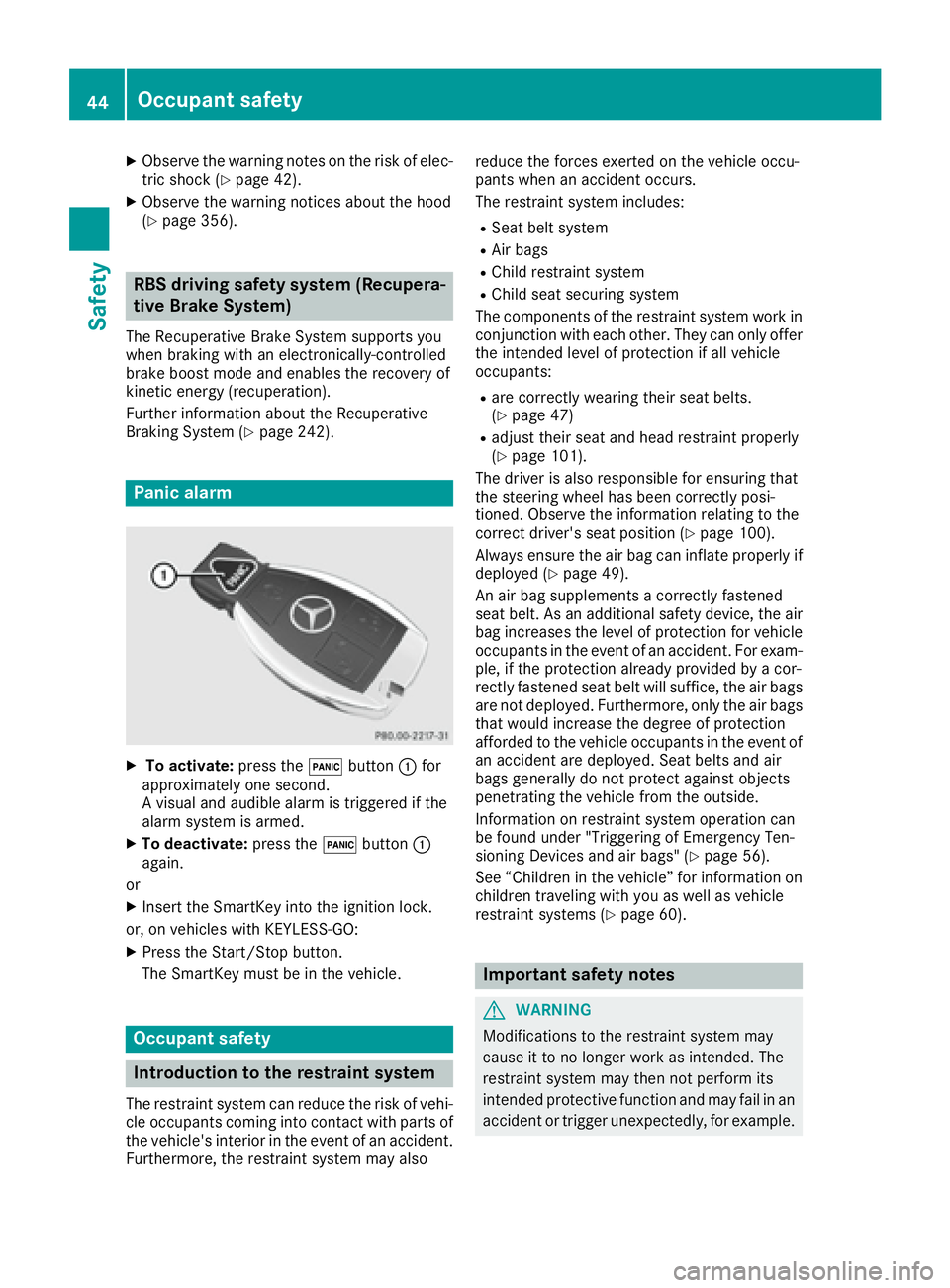
Panic alarm
X
To activate: press the 3 button C for
approximately one second.
A visual and audible alarm is triggered if the
alarm system is armed. X
To deactivate: press the 3 button C
again.
or X
Insert the SmartKey into the ignition lock.
or, on vehicles with KEYLESS ‑ GO:X
Press the Start/Stop button.
The SmartKey must be in the vehicle.
Occupant safety
Introduction to the restraint system
The restraint system can reduce the risk of vehi-
cle occupants coming into contact with parts of
the vehicle's interior in the event of an accident.
Furthermore, the restraint system may also reduce the forces exerted on the vehicle occu-
pants when an accident occurs.
The restraint system includes: R
Seat belt system R
Air bags R
Child restraint system R
Child seat securing system
The components of the restraint system work in
conjunction with each other. They can only offer
the intended level of protection if all vehicle
occupants: R
are correctly wearing their seat belts.
( Y
page 47) R
adjust their seat and head restraint properly
( Y
page 101).
The driver is also responsible for ensuring that
the steering wheel has been correctly posi-
tioned. Observe the information relating to the
correct driver's seat position ( Y
page 100).
Always ensure the air bag can inflate properly if
deployed ( Y
page 49).
An air bag supplements a correctly fastened
seat belt. As an additional safety device, the air
bag increases the level of protection for vehicle
occupants in the event of an accident. For exam-
ple, if the protection already provided by a cor-
rectly fastened seat belt will suffice, the air bags
are not deployed. Furthermore, only the air bags
that would increase the degree of protection
afforded to the vehicle occupants in the event of
an accident are deployed. Seat belts and air
bags generally do not protect against objects
penetrating the vehicle from the outside.
Information on restraint system operation can
be found under "Triggering of Emergency Ten-
sioning Devices and air bags" ( Y
page 56).
See “Children in the vehicle” for information on
children traveling with you as well as vehicle
restraint systems ( Y
page 60).
Important safety notes
G WARNING
Modifications to the restraint system may
cause it to no longer work as intended. The
restraint system may then not perform its
intended protective function and may fail in an
accident or trigger unexpectedly, for example.44
Occupant safety
Safety
Page 53 of 450
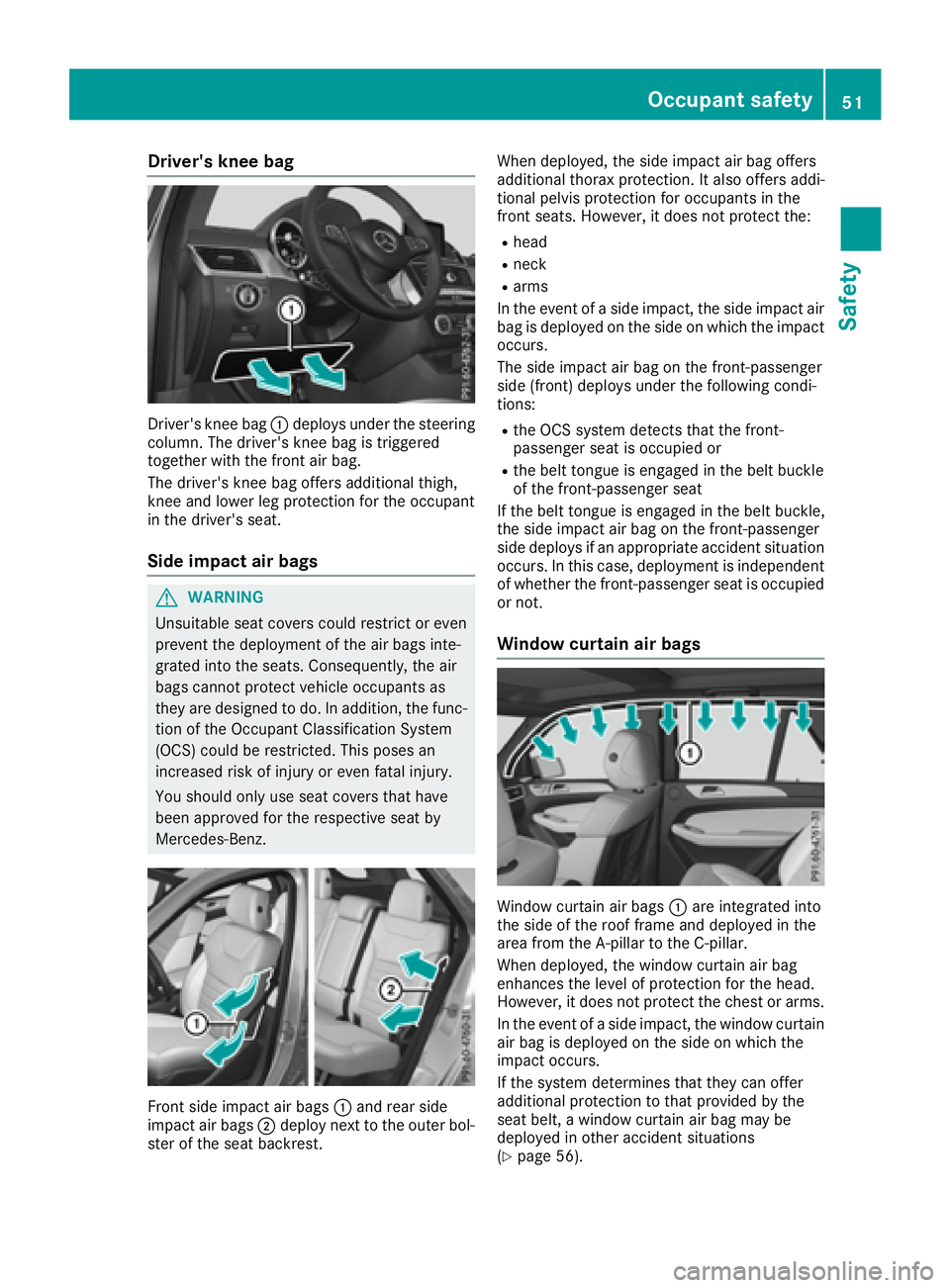
Driver's kne e ba g
Driver' s knee bag C deploys under th e steerin g
column . The driver's knee bag is triggere d
together wit h th e fron t air bag.
The driver's knee bag offers additional thigh ,
knee and lowe r leg protection fo r th e occupant
in th e driver's seat .
Sid e impact air bags
G WARNING
Unsuitable seat cover s could restric t or eve n
preven t th e deploymen t of th e air bags inte -
grated into th e seats. Consequently, th e air
bags canno t protect vehicle occupant s as
they are designed to do. In addition , th e func-
tion of th e Occupant Classification Syste m
(OCS ) could be restricted. Thi s poses an
increase d ris k of injury or eve n fatal injury.
You should only use seat cover s that hav e
bee n approved fo r th e respective seat by
Mercedes-Benz.
Fron t sid e impact air bags C and rea r sid e
impact air bags D deploy next to th e outer bol-
ster of th e seat backrest . Whe n deployed , th e sid e impact air bag offers
additional thorax protection . It also offers addi-
tional pelvis protection fo r occupant s in th e
fron t seats. However, it doe s no t protect the:R
head R
neck R
arm s
In th e event of a sid e impact , th e sid e impact air
bag is deployed on th e sid e on whic h th e impact
occurs.
The sid e impact air bag on th e front-passenger
sid e (front) deploys under th e followin g condi-
tions: R
th e OCS system detects that th e front-
passenger seat is occupied or R
th e belt tongue is engage d in th e belt buckl e
of th e front-passenger seat
If th e belt tongue is engage d in th e belt buckle,
th e sid e impact air bag on th e front-passenger
sid e deploys if an appropriat e acciden t situation
occurs. In this case, deploymen t is independen t
of whether th e front-passenger seat is occupied
or not.
Window curtain air bags
Window curtain air bags C are integrated into
th e sid e of th e roof frame and deployed in th e
are a from th e A-pilla r to th e C-pillar .
Whe n deployed , th e window curtain air bag
enhance s th e level of protection fo r th e head .
However, it doe s no t protect th e chest or arms.
In th e event of a sid e impact , th e window curtain
air bag is deployed on th e sid e on whic h th e
impact occurs.
If th e syste m determines that they can offe r
additional protection to that provided by th e
seat belt , a window curtain air bag may be
deployed in other acciden t situation s
( Y
page 56).Occupant safety 51
Safety Z
Page 54 of 450
Occupant Classification System
(OCS)
Introduction The Occupant Classification System (OCS) cat-
egorizes the person in the front-passenger seat.
Depending on that result, the front-passenger
front air bag is either enabled or deactivated.
The system does not deactivate: R
the side impact air bag R
the window curtain air bag R
the Emergency Tensioning Devices
In the following situation, the side impact air bag
and the Emergency Tensioning Device are deac-
tivated: R
OCS has not categorized the person on the
front-passenger seat as an adult or a person
of corresponding stature and R
the seat belt tongue of the seat belt is not
inserted into the front-passenger seat belt
buckle
Prerequisites To be classified correctly, the front passenger
must sit: R
with the seat belt fastened correctly R
in an almost upright position with their back
against the seat backrest R
with their feet resting on the floor, if possible
If the front passenger does not observe these
conditions, OCS may produce a false classifica-
tion, e.g. because the front passenger: R
transfers their weight by supporting them-
selves on a vehicle armrest R
sits in such a way that their weight is raised
from the seat cushion
If it is absolutely necessary to install a child
restraint system on the front-passenger seat, be
sure to observe the correct positioning of the
child restraint system. Never place objects
under or behind the child restraint system, e.g.
cushions. The entire base of the child restraint
system must always rest on the seat cushion of
the front-passenger seat. The backrest of the
forward-facing child restraint system must lie as
flat as possible against the backrest of the front-
passenger seat.
The child restraint system must not touch the
roof or be subjected to a load by the head restraint. Adjust the angle of the seat backrest
and the head restraint position accordingly.
Only then can OCS be guaranteed to function
correctly. Always observe the child restraint sys-
tem manufacturer's installation instructions.
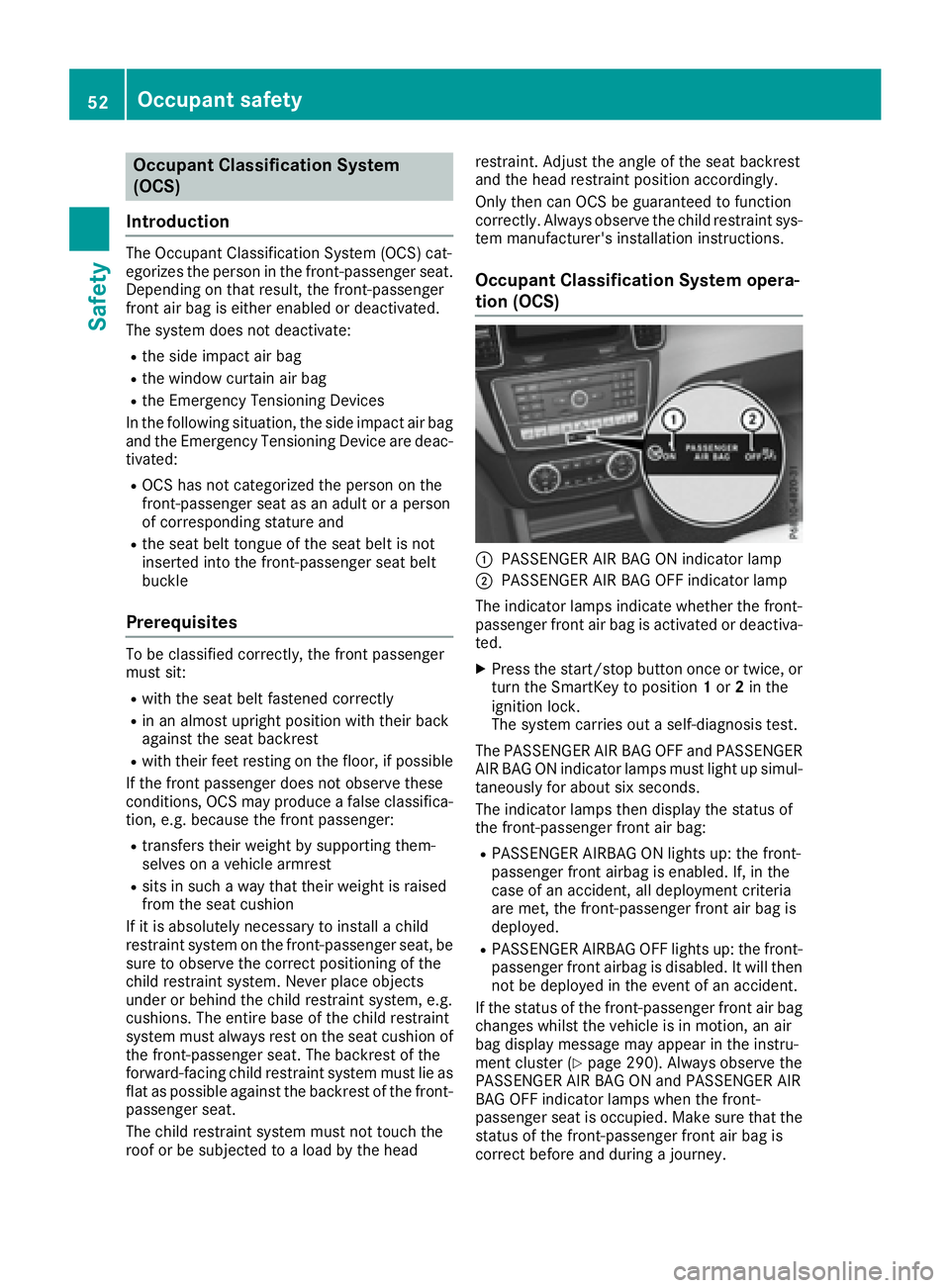
Occupant Classification System opera-
tion (OCS)
C
PASSENGER AIR BAG ON indicator lamp D
PASSENGER AIR BAG OFF indicator lamp
The indicator lamps indicate whether the front-
passenger front air bag is activated or deactiva-
ted. X
Press the start/stop button once or twice, or
turn the SmartKey to position 1 or 2 in the
ignition lock.
The system carries out a self-diagnosis test.
The PASSENGER AIR BAG OFF and PASSENGER
AIR BAG ON indicator lamps must light up simul-
taneously for about six seconds.
The indicator lamps then display the status of
the front-passenger front air bag: R
PASSENGER AIRBAG ON lights up: the front-
passenger front airbag is enabled. If, in the
case of an accident, all deployment criteria
are met, the front-passenger front air bag is
deployed. R
PASSENGER AIRBAG OFF lights up: the front-
passenger front airbag is disabled. It will then
not be deployed in the event of an accident.
If the status of the front-passenger front air bag
changes whilst the vehicle is in motion, an air
bag display message may appear in the instru-
ment cluster ( Y
page 290). Always observe the
PASSENGER AIR BAG ON and PASSENGER AIR
BAG OFF indicator lamps when the front-
passenger seat is occupied. Make sure that the
status of the front-passenger front air bag is
correct before and during a journey.52
Occupant safety
Safety
Page 55 of 450
G WARNING
If the PASSENGER AIR BAG OFF indicator
lamp is lit, the front-passenger front air bag is
disabled. It will not be deployed in the event of
an accident and cannot perform its intended
protective function. A person in the front-
passenger seat could then, for example, come
into contact with the vehicle's interior, espe-
cially if the person is sitting too close to the
dashboard. This poses an increased risk of
injury or even fatal injury.
When the front-passenger seat is occupied,
always ensure that: R
the classification of the person in the front-
passenger seat is correct and the front-
passenger front air bag is enabled or disa-
bled in accordance with the person in the
front-passenger seat R
the front-passenger seat has been moved
back as far back as possible. R
the person is seated correctly.
Make sure, both before and during the jour-
ney, that the status of the front-passenger
front air bag is correct.
G WARNING
If you secure a child in a rearward-facing child
restraint system on the front-passenger seat
and the PASSENGER AIR BAG ON indicator
lamp is lit up, the front-passenger front air bag
may deploy in an accident. The child could be
struck by the air bag. This poses an increased
risk of injury or even fatal injury.
Make sure that the front-passenger front air
bag has been disabled. The PASSENGER AIR
BAG OFF indicator lamp must be lit.
If the PASSENGER AIR BAG OFF indicator lamp
remains off and/or the PASSENGER AIR BAG
ON indicator lamp is lit, do not fit a rearward-
facing child restraint system to the front-
passenger seat. For more information, see
"Problems with the Occupant Classification Sys-
tem (OCS)" ( Y
page 56). G WARNING
If you secure a child in a forward-facing child
restraint system on the front-passenger seat
and you position the front-passenger seat too
close to the dashboard, in the event of an
accident, the child could: R
come into contact with the vehicle's inte-
rior if the PASSENGER AIR BAG OFF indi-
cator lamp is lit, for example R
be struck by the air bag if the PASSENGER
AIR BAG ON is lit up
This poses an increased risk of injury or even
fatal injury.
Move the front-passenger seat as far back as
possible. Always make sure that the shoulder
belt strap is correctly routed from the vehicle
belt outlet to the shoulder belt guide on the
child restraint system. The shoulder belt strap
must be routed forwards and downwards
from the vehicle belt outlet. If necessary,
adjust the vehicle belt outlet and the front-
passenger seat accordingly. Always observe
the child restraint system manufacturer's
installation instructions.
If OCS detects that: R
the front-passenger seat is not occupied, the
PASSENGER AIR BAG OFF indicator lamp
lights up continuously after the system's self-
diagnosis test. This indicates that the front-
passenger front air bag is deactivated. R
the front-passenger seat is occupied by a
child aged up to twelve months in a standard
child restraint system, the PASSENGER AIR
BAG OFF indicator lamp lights up continu-
ously after the system's self-diagnosis test.
This indicates that the front-passenger front
air bag is deactivated.
In the case of a twelve-month-old child in a
standard child restraint system, the
PASSENGER AIR BAG ON indicator lamp may
light up continuously after the system's self-
diagnosis test. This indicates that the front-
passenger front air bag is activated. Catego-
rization is dependent on the type of child
restraint system and the stature of the child,
for example. In this case, always install the
chi l d restraint system on a suitable rear seat.Occupant safety 53
Safety Z
Page 56 of 450
R
the front-passenger seat is occupied by a per-
son of smaller stature (e.g. a teenager or a
small adult), either the PASSENGER AIR BAG
ON or PASSENGER AIR BAG OFF indicator
lamp lights up continuously after the system's
self-diagnosis test depending on the catego-
rization. -
If the PASSENGER AIR BAG ON indicator
lamp is lit, position the front-passenger
seat as far back as possible. Alternatively, a
person of smaller stature can sit on a rear
seat. -
If the PASSENGER AIR BAG OFF indicator
lamp lights up, a person of smaller stature
should not sit on the front-passenger seat. R
the front-passenger seat is occupied by an
adult or a person of an appropriate size, the
PASSENGER AIR BAG ON indicator lamp
lights up continuously after the system's self-
diagnosis test. This indicates that the front-
passenger front air bag is activated.
If children are traveling in the vehicle, be sure to
observe the notes on "Children in the vehicle"
( Y
page 60).
If the OCS is malfunctioning, both the red u
restraint system warning lamp in the instrument
cluster and the PASSENGER AIR BAG OFF indi-
cator lamp light up simultaneously. In this case,
the front-passenger air bag is deacti vated a nd
d oes not deploy during an accident. Have the
system checked by qualified technicians as
soon as possible. Consult an authorized
Mercedes-Benz Center. Only have the front-
passenger seat repaired at an authorized
Mercedes-Benz Center.
If the front-passenger seat, the seat cover or the
seat cushion are damaged, have the necessary
repair work carried out at an authorized
Mercedes-Benz Center.
For safety reasons, Mercedes-Benz recom-
mends that you only use seat accessories that
have been approved by Mercedes-Benz.
If the driver's air bag deploys, this does not
mean that the front-passenger front air bag will
also deploy. The Occupant Classification Sys-
tem (OCS) categorizes the occupant on the
front-passenger seat. Depending on the result,
the front-passenger air bag is activated or deac-
tivated. System self-test
G DANGER
If both the PASSENGER AIR BAG OFF and
PASSENGER AIR BAG ON indicator lamps do
not light up during the system self-test, the
system is malfunctioning. The front-
passenger front air bag might be triggered
unintentionally or might not be triggered at all
in the event of an accident with high deceler-
ation. This poses an increased risk of injury or
even fatal injury.
In this case the front-passenger seat may not
be used. Do not install a child restraint system
on the front-passenger seat. Have the Occu-
pant Classification System (OCS) checked
and repaired immediately at a qualified spe-
cialist workshop.
G DANGER
If the PASSENGER AIR BAG OFF indicator
lamp remains lit after the system self-test, the
front-passenger front air bag is disabled. It will
not be deployed in the event of an accident. In
this case, the front-passenger front air bag
cannot perform its intended protective func-
tion, e.g. when a person is seated in the front-
passenger seat.
That person could, for example, come into
contact with the vehicle's interior, especially
if the person is sitting too close to the dash-
board. This poses an increased risk of injury or
even fatal injury.
When the front-passenger seat is occupied,
always ensure that: R
the classification of the person in the front-
passenger seat is correct and the front-
passenger front air bag is enabled or disa-
bled in accordance with the person in the
front-passenger seat R
the person is seated properly with a cor-
rectly fastened seatbelt R
the front-passenger seat has been moved
back as far back as possible
If the PASSENGER AIR BAG OFF indicator
lamp remains lit when it should not, the front-54
Occupant safety
Safety