2016 MERCEDES-BENZ GLA ESP
[x] Cancel search: ESPPage 25 of 390
Protection of the environment
General notes
H Environmental note
Daimler's declared policy is one of compre-
hensive environmental protection.
The objectives are for the natural resources
that form the basis of our existence on this
planet to be used sparingly and in a manner
that takes the requirements of both nature
and humanity into account.
You too can help to protect the environment
by operating your vehicle in an environmen-
tally responsible manner.
Fuel consumption and the rate of engine,
transmission, brake and tire wear are affected
by these factors: R
operating conditions of your vehicle R
your personal driving style
You can influence both factors. You should
bear the following in mind:
Operating conditions: R
avoid short trips as these increase fuel con-
sumption. R
always make sure that the tire pressures
are correct. R
do not carry any unnecessary weight. R
remove roof racks once you no longer need
them. R
a regularly serviced vehicle will contribute
to environmental protection. You should
therefore adhere to the service intervals. R
always have service work carried out at a
qualified specialist workshop.
Personal driving style: R
do not depress the accelerator pedal when
starting the engine. R
do not warm up the engine when the vehicle
is stationary. R
drive carefully and maintain a safe distance
from the vehicle in front. R
avoid frequent, sudden acceleration and
braking. R
change gear in good time and use each gear
only up to
Page 27 of 390
tacting you in a timely manner should the
need arise.
If you sell your Mercedes, please leave the
entire literature in the vehicle so that it is
available to the next owner.
If you have purchased a used car, please send
us the "Notification of Used Car Purchase" in
the Service and Guarantee booklet or simply
call the Mercedes-Benz Customer Assistance
Center (USA) at the hotline number
1-800-FOR-MERCede s(1 -800-367-6372) or
Customer Service (Canada) at
1-800-387-0100.
Operating safety
Declarations of conformity
Vehicle components which receive
and/or transmit radio waves USA: "The wireless devices of this vehicle
comply with Part 15 of the FCC Rules. Oper-
ation is subject to the following two condi-
tions: 1) These devices may not cause harm-
ful interference, and 2) These devices must
accept any interference received, including
interference that may cause undesired oper-
ation. Changes or modifications not expressly
approved by the party responsible for com-
pliance could void the user’s authority to
operate the equipment."
Canada: "The wireless devices of this vehicle
comply with Industry Canada license-exempt
RSS standard(s). Operation is subject to the
following two conditions: (1) These devices
may not cause interference, and (2) These
devices must accept any interference, includ-
ing interference that may cause undesired
operation of the device."
Diagnostics connection
The diagnostics connection is only intended
for the connection of diagnostic equipment at
a qualified specialist workshop. G WARNING
If you connect equipment to the diagnostics
connection in the vehicle, it may affect the
operation of the vehicle systems. As a result,
the operating safety of the vehicle could be
affected. There is a risk of an accident.
Do not connect any equipment to a diagnos-
tics connection in the vehicle.
G WARNING
Objects in the driver's footwell can restrict the
pedal travel or obstruct a depressed pedal.
The operating and road safety of the vehicle is
jeopardized. There is a risk of an accident.
Make sure that all objects in the vehicle are
stowed correctly, and that they cannot enter
the driver's footwell. Install the floormats
securely and as specified in order to ensure
sufficient clearance for the pedals. Do not use
loose floormats and do not place floormats on
top of one another.
! If the engine is switched off and equip-
ment on the diagnostics connection is
used, the starter battery may discharge.
Connecting equipment to the diagnostics
connection can lead to emissions monitoring
information being reset, for example. This
may lead to the vehicle failing to meet the
requirements of the next emissions test dur-
ing the main inspection.
Qualified specialist workshop
An authorized Mercedes-Benz Center is a
qualified specialist workshop. It has the nec-
essary specialist knowledge, tools and quali-
fications to correctly carry out the work
required on your vehicle. This is especially the
case for work relevant to safety.
Observe the notes in the Maintenance Book-
let. Introduction 25
Z
Page 29 of 390
COMAND/mbrace (Canada: TELEAID) If the vehicle is equipped with COMAND or
mbrace, additional data about the vehicle’s
operation, the use of the vehicle in certain
situations, and the location of the vehicle may
be compiled through COMAND or the mbrace
system.
For additional information please refer to the
COMAND User Manual and/or the mbrace
Terms and Conditions.
Event data recorders This vehicle is equipped with an event data
recorder (EDR). The main purpose of an EDR
is to record data that will assist in under-
standing how a vehicle’s systems performed
in certain crash or near crash-like situations,
such as during air bag deployment or when
hitting a road obstacle. The EDR is designed
to record data related to vehicle dynamics
and safety systems for a short period of time,
typically 30 seconds or less.
The EDR in this vehicle is designed to record
such data as: R
how various systems in your vehicle are
operating R
whether or not the driver and passenger
seat belts are fastened R
how far (if at all) the driver is depressing the
accelerator and/or brake pedal and R
how fast the vehicle is traveling
This data can help provide a better under-
standing of the circumstances in which
crashes and injuries occur. NOTE: EDR data is
recorded by your vehicle only if a non-trivial
crash situation occurs; no data is recorded by
the EDR under normal driving conditions and
no personal data (e.g., name, gender, age,
and crash location) are recorded. However,
other parties, such as law enforcement, can
combine the EDR data with the type of per-
sonal identification data routinely acquired
during a crash investigation. To read data r ecorded by an EDR, special
equipment
is required, and access to the vehi-
cle or the EDR is needed. In addition to the
vehicle manufacturer, other parties that have
the special equipment, such as law enforce-
ment, can read the information by accessing
the vehicle or the EDR.
EDR data may be used in civil and criminal
matters as a tool in accident reconstruction,
accident claims, and vehicle safety. Since the
Crash Data Retrieval CDR tool that is used to
extract data from the EDR is commercially
available, Mercedes-Benz USA, LLC
("MBUSA") expressly disclaims any and all lia-
bility arising from the extraction of this infor-
mation by unauthorized Mercedes-Benz per-
sonnel.
MBUSA will not share EDR data with others
without the consent of the vehicle owners or,
if the vehicle is leased, without the consent of
the lessee. Exceptions to this representation
include responses to subpoenas by law
enforcement; by federal, state or local gov-
ernment; in connection with or arising out of
litigation involving MBUSA or its subsidiaries
and affiliates; or, as required by law.
Warning: The EDR is a component of the
Restraint System Module. Tampering with,
altering, modifying or removing the EDR com-
ponent may result in a malfun ction of the
Restr aint System Module and other systems.
State laws or regulations regarding EDRs that
conflict with federal regulation are pre-emp-
ted. This means that in the event of such con-
flict, the federal regulation governs. As of
February 2013, 13 states have enacted laws
relating to EDRs.
Information on copyright
General information
Information on license for free and open-
source software used in your vehicle and its
electronic components is available on the fol-
lowing website: Introduction 27
Z
Page 52 of 390
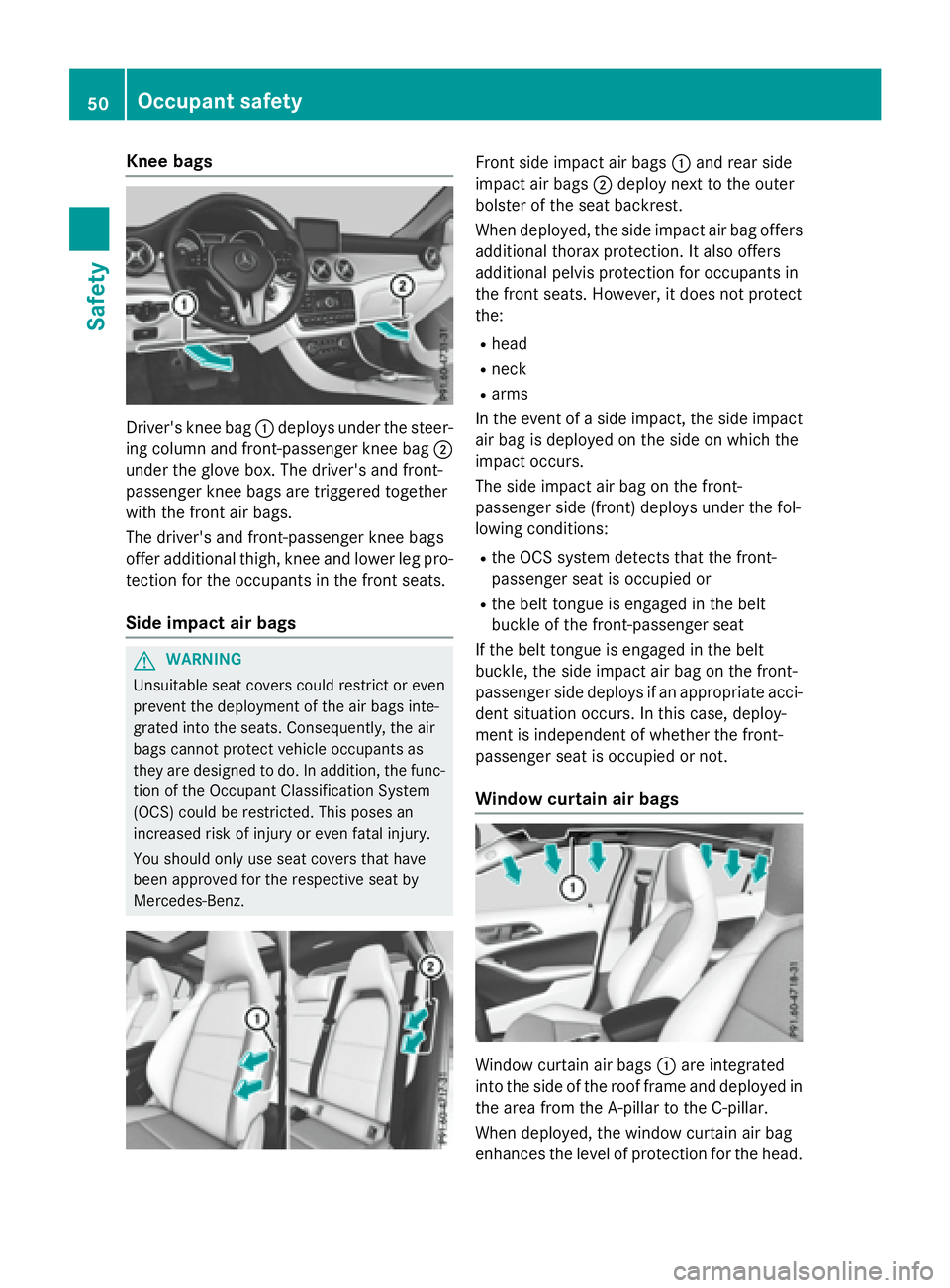
Knee bags
Driver' s knee bag C deploys under th e steer -
ing column and front-passenger knee bag D
under th e glov e box . The driver's and front-
passenger knee bags are triggered together
wit h th e fron t air bags .
The driver's and front-passenger knee bags
offer additional thigh, knee and lower leg pro -
tection for th e occupant s in th e fron t seats.
Side impact air bags
G WARNIN G
Unsuitable seat cover s could restrict or eve n
preven t th e deployment of th e air bags inte-
grate d int o th e seats. Consequently, th e air
bags canno t protect vehicl e occupant s as
they are designed to do. In addition , th e func-
tion of th e Occupant Classification Syste m
(OCS ) could be restricted. This poses an
increased ris k of injury or eve n fatal injury.
You should only use seat cover s that hav e
been approve d for th e respective seat by
Mercedes-Benz. Fron t side impact air bags C and rear side
impact air bags D deplo y next to th e outer
bolste r of th e seat backr est.
When deployed, th e side impact air bag offers
additional thorax protection . It also offers
additional pelvis protection for occupant s in
th e fron t seats. Ho wever, it does no t protect
the: R
head R
neck R
arm s
In th e event of a side impact , th e side impact
air bag is deployed on th e side on whic h th e
impact occur s.
The side impact air bag on th e front-
passenger side (front) deploys under th e fol -
lowin g conditions: R
th e OCS system detects that th e front-
passenger seat is occupied or R
th e belt tongue is engage d in th e belt
buckl e of th e front-passenger seat
If th e belt tongue is engage d in th e belt
buckle, th e side impact air bag on th e front-
passenger side deploys if an appropriat e acci-
den t situation occur s. In this case, deploy-
men t is independen t of whether th e front-
passenger seat is occupied or not.
Window curtain air bags
Window curtai n air bags C are integrated
int o th e side of th e roo f frame and deployed in
th e area from th e A-pillar to th e C-pillar .
When deployed, th e window curtai n air bag
enhance s th e level of protection for th e head .50
Occupant safety
Safety
Page 54 of 390
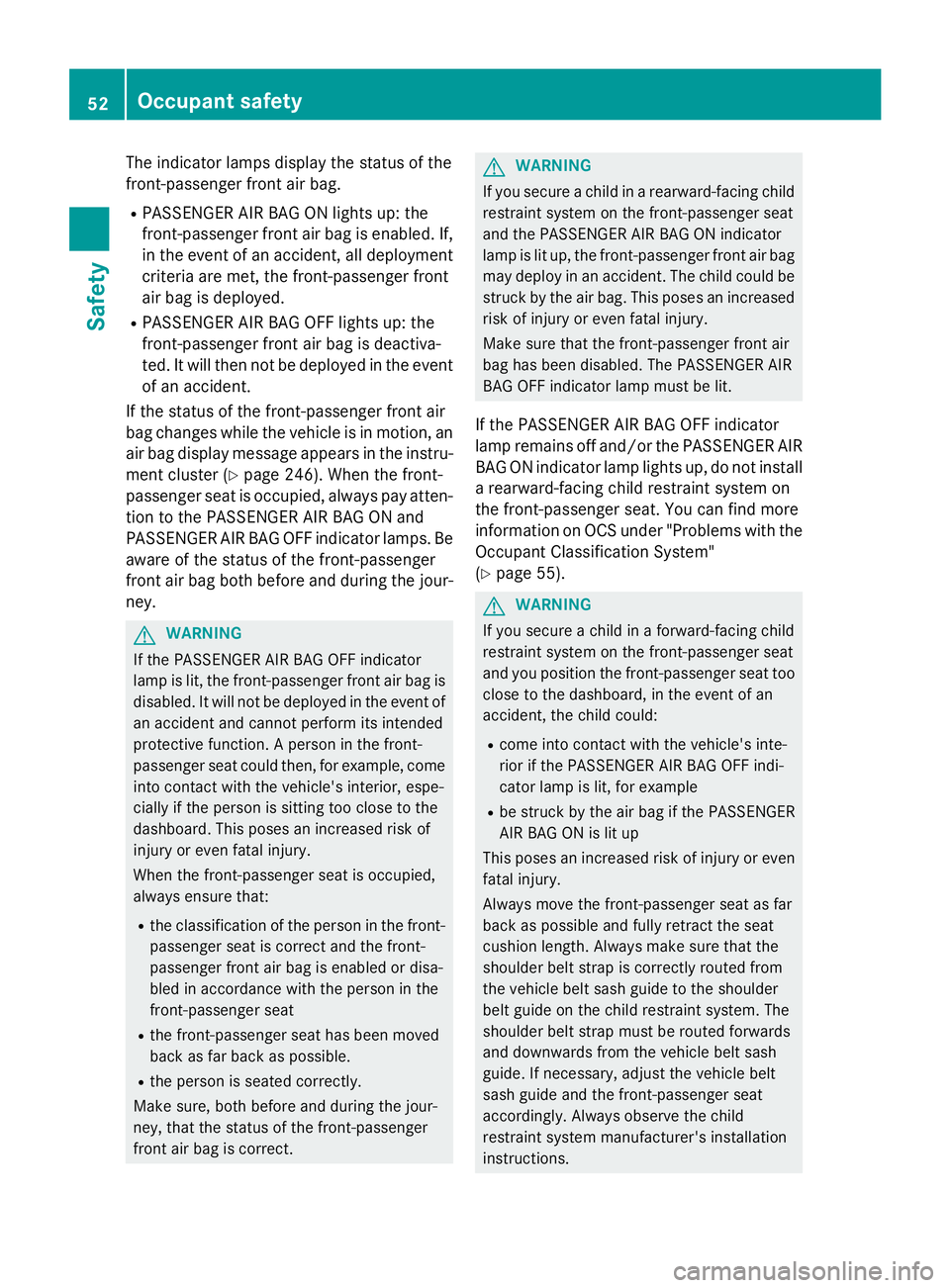
The indicator lamps display the status of the
front-passenger front air bag. R
PASSENGER AIR BAG ON lights up: the
front-passenger front air bag is enabled. If,
in the event of an accident, all deployment
criteria are met, the front-passenger front
air bag is deployed. R
PASSENGER AIR BAG OFF lights up: the
front-passenger front air bag is deactiva-
ted. It will then not be deployed in the event
of an accident.
If the status of the front-passenger front air
bag changes while the vehicle is in motion, an
air bag display message appears in the instru-
ment cluster ( Y
page 246). When the front-
passenger seat is occupied, always pay atten-
tion to the PASSENGER AIR BAG ON and
PASSENGER AIR BAG OFF indicator lamps. Be
aware of the status of the front-passenger
front air bag both before and during the jour-
ney.
G WARNING
If the PASSENGER AIR BAG OFF indicator
lamp is lit, the front-passenger front air bag is
disabled. It will not be deployed in the event of
an accident and cannot perform its intended
protective function. A person in the front-
passenger seat could then, for example, come
into contact with the vehicle's interior, espe-
cially if the person is sitting too close to the
dashboard. This poses an increased risk of
injury or even fatal injury.
When the front-passenger seat is occupied,
always ensure that: R
the classification of the person in the front-
passenger seat is correct and the front-
passenger front air bag is enabled or disa-
bled in accordance with the person in the
front-passenger seat R
the front-passenger seat has been moved
back as far back as possible. R
the person is seated correctly.
Make sure, both before and during the jour-
ney, that the status of the front-passenger
front air bag is correct. G WARNING
If you secure a child in a rearward-facing child
restraint system on the front-passenger seat
and the PASSENGER AIR BAG ON indicator
lamp is lit up, the front-passenger front air bag
may deploy in an accident. The child could be
struck by the air bag. This poses an increased
risk of injury or even fatal injury.
Make sure that the front-passenger front air
bag has been disabled. The PASSENGER AIR
BAG OFF indicator lamp must be lit.
If the PASSENGER AIR BAG OFF indicator
lamp remains off and/or the PASSENGER AIR
BAG ON indicator lamp lights up, do not install
a rearward-facing child restraint system on
the front-passenger seat. You can find more
information on OCS under "Problems with the
Occupant Classification System"
( Y
page 55).
G WARNING
If you secure a child in a forward-facing child
restraint system on the front-passenger seat
and you position the front-passenger seat too
close to the dashboard, in the event of an
accident, the child could: R
come into contact with the vehicle's inte-
rior if the PASSENGER AIR BAG OFF indi-
cator lamp is lit, for example R
be struck by the air bag if the PASSENGER
AIR BAG ON is lit up
This poses an increased risk of injury or even
fatal injury.
Always move the front-passenger seat as far
back as possible and fully retract the seat
cushion length. Always make sure that the
shoulder belt strap is correctly routed from
the vehicle belt sash guide to the shoulder
belt guide on the child restraint system. The
shoulder belt strap must be routed forwards
and downwards from the vehicle belt sash
guide. If necessary, adjust the vehicle belt
sash guide and the front-passenger seat
accordingly. Always observe the child
restraint system manufacturer's installation
instructions.52
Occupant safety
Safety
Page 56 of 390
G DANGER
If th e PASSENGER AI R BA G OF F indicator
lamp remain s lit after th e system self-test , th e
front-passenger fron t air bag is disabled. It will
no t be deployed in th e event of an accident. In
this case, th e front-passenger fron t air bag
canno t perfor m it s intended protective func-
tion , e.g. when a person is seated in th e front-
passenger seat .
That person could, for example, come int o
contact wit h th e vehicle's interior, especially
if th e person is sitting to o close to th e dash -
board. This poses an increased ris k of injury or
eve n fatal injury.
Whe n th e front-passenger seat is occupied,
always ensur e that:R
th e classification of th e person in th e front-
passenger seat is correc t and th e front-
passenger fron t air bag is enabled or disa-
bled in accordanc e wit h th e person in th e
front-passenger seat R
th e person is seated properly wit h a cor-
rectl y fastene d seatbeltR
th e front-passenger seat has been moved
bac k as far bac k as possibl e
If th e PASSENGER AI R BA G OF F indicator
lamp remain s lit when it should not, th e front-
passenger seat may no t be used . Do no t
instal l a child restrain t system on th e front-
passenger seat . Hav
e th e O ccupant Classifi-
ca tion Syste m (OCS ) checke d and repaire d
immediately at a qualified specialist work-
shop.
G WARNIN G
Objects between th e seat surfac e and th e
child restrain t system could affec t OCS oper -
ation . This could result in th e front-passenger
air bag no t functioning as intended during an
accident. This poses an increased ris k of
injury or eve n fatal injury.
Do no t plac e any objects between th e seat
surfac e and th e child restrain t system. The
entire base of th e child restrain t system mus t
always res t on th e seat cushion of th e front-
passenger seat . The backrest of th e forward - facing child restrain t system must, as far as
possible, be resting on th e backrest of th e
front-passenger seat . Always compl y wit h th e
child restrain t system manufacturer' s instal -
lation instructions.
Afte r th e system self-test , th e PASSENGER
AI R BA G OF F or PASSENGER AI R BA G ON
indicator lamp displays th e status of th e front-
passenger fron t air bag ( Y
page 51) .
Fo r mor e information about th e OCS , see
"Problem s wit h th e Occupant Classification
System" ( Y
page 55) .54
Occupant safety
Safety
Page 57 of 390
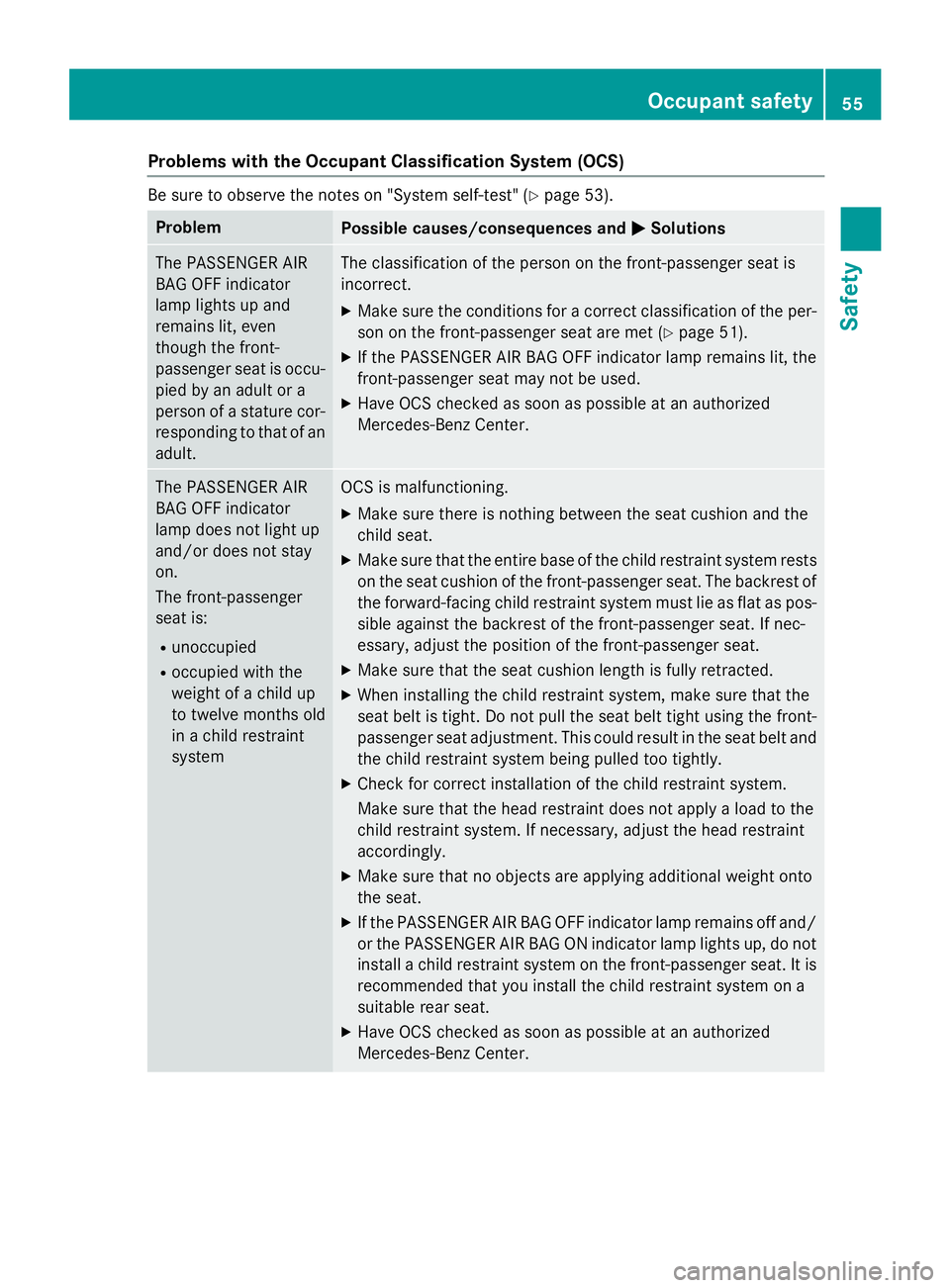
Problems with the Occupant Classification System (OCS) Be sure to observe the notes on "System self-test" ( Y
page 53).
Problem
Possible causes/consequences and P Solutions
The PASSENGER AIR
BAG OFF indicator
lamp lights up and
remains lit, even
though the front-
passenger seat is occu-
pied by an adult or a
person of a stature cor-
responding to that of an
adult. The classification of the person on the front-passenger seat is
incorrect. X
Make sure the conditions for a correct classification of the per-
son on the front-passenger seat are met ( Y
page 51).X
If the PASSENGER AIR BAG OFF indicator lamp remains lit, the
front-passenger seat may not be used. X
Have OCS checked as soon as possible at an authorized
Mercedes-Benz Center.
The PASSENGER AIR
BAG OFF indicator
lamp does not light up
and/or does not stay
on.
The front-passenger
seat is: R
unoccupied R
occupied with the
weight of a child up
to twelve months old
in a child restraint
system OCS is malfunctioning. X
Make sure there is nothing between the seat cushion and the
child seat. X
Make sure that the entire base of the child restraint system rests
on the seat cushion of the front-passenger seat. The backrest of
the forward-facing child restraint system must lie as flat as pos-
sible against the backrest of the front-passenger seat. If nec-
essary, adjust the position of the front-passenger seat. X
Make sure that the seat cushion length is fully retracted. X
When installing the child restraint system, make sure that the
seat belt is tight. Do not pull the seat belt tight using the front-
passenger seat adjustment. This could result in the seat belt and
the child restraint system being pulled too tightly. X
Check for correct installation of the child restraint system.
Make sure that the head restraint does not apply a load to the
child restraint system. If necessary, adjust the head restraint
accordingly. X
Make sure that no objects are applying additional weight onto
the seat. X
If the PASSENGER AIR BAG OFF indicator lamp remains off and/
or the PASSENGER AIR BAG ON indicator lamp lights up, do not
install a child restraint system on the front-passenger seat. It is
recommended that you install the child restraint system on a
suitable rear seat. X
Have OCS checked as soon as possible at an authorized
Mercedes-Benz Center. Occupant safety 55
Safety Z
Page 58 of 390
Deployment of Emergency Tensioning
Device s an d air bags
Important safet y notes
G WARNING
The air bag parts are hot after an air bag has
bee n deployed . There is a ris k of injury.
Do no t touch th e air bag parts . Hav e a
deployed air bag replaced at a qualified spe -
cialis t workshop as soo n as possible.
G WARNING
A deployed air bag no longer offers any pro -
tection and canno t provid e th e intended pro -
tection in an accident. There is an increase d
ris k of injury.
Hav e th e vehicle towed to a qualified special-
ist workshop in order to hav e a deployed air
bag replaced.
It is important fo r your safet y and that of your
passenger to hav e deployed air bags replaced
and to hav e any malfunctionin g air bags
repaired. Thi s will hel p to mak e sur e th e air
bags continue to perform their protective
function fo r th e vehicle occupant s in th e
event of a crash .
G WARNING
Pyrotechnic Emergency Tensioning Devices
that hav e bee n deployed are no longer opera-
tional and are unable to perform their inten-
ded protective function . Thi s poses an
increase d ris k of injury or eve n fatal injury.
Therefore, hav e pyrotechni c Emergency Ten -
sioning Devices whic h hav e bee n triggere d
immediately replaced at a qualified specialis t
workshop .
If Emergency Tensioning Devices are trig-
gered or air bags are deployed , you will hear a
bang, and a small amount of powder may also
be released. The u restrain t system warn -
in g lamp lights up.
Only in rar e cases will th e ban g affec t your
hearing. The powder that is release d gener-
ally doe s no t constitute a health hazard , but it may caus e short-term breathin g difficulties in
people wit h asthm a or other respirator y prob-
lems. Provided it is saf e to do so, you should
leav e th e vehicle immediately or ope n th e
window in order to preven t breathin g difficul-
ties.
Ai r bags and pyrotechni c Emergency Tension-
in g Devices (ETDs) contain perchlorat e mate-
rial , whic h may require special handlin g and
regard fo r th e environment. National guide-
lines mus t be observed durin g dis posa l. In
C alifornia, see www.dtsc.ca.gov/
HazardousWaste/Perchlorate/
index.cfm .
Method of operation Durin g th e first stage of a collision , th e
restrain t system contro l uni t evaluates impor -
tant physical dat a relatin g to vehicle deceler -
ation or acceleration , suc h as:R
duration R
direction R
intensit y
Based on th e evaluation of this data, th e
restrain t system contro l uni t triggers th e
Emergency Tensioning Devices durin g a fron -
ta l or rea r collision .
An Emergency Tensioning Devic e can only be
triggered, if: R
th e ignition is switched on R
th e component s of th e restrain t system are
operational. You can fin d further informa-
tion under: "Restrain t system warnin g
lamp " ( Y
page 43) R
th e belt tongue is engage d in th e buckl e on
th e respective front-passenger seat
The Emergency Tensioning Devices in th e
rea r compartmen t are triggere d independ -
entl y of th e loc k status of th e seat belts.
If th e restrain t system contro l uni t detects a
more severe accident, further component s of
th e restrain t system are activated independ -
entl y of eac h other in certain fronta l collision
situations:56
Occupant safety
Safety