2016 MERCEDES-BENZ GL sensor
[x] Cancel search: sensorPage 253 of 462
Either no braking application, or a course-
correcting brake application adapted to the
driving situation occurs if: R
there are vehicles or obstacles, e.g. crash
barriers, close to both sides of your vehicle. R
a vehicle approaches you too closely at the
side. R
you have adopted a sporty driving style with
high cornering speeds. R
you brake or accelerate significantly. R
a driving safety system intervenes, e.g.
ESP ®
or PRE-SAFE ®
Brake.R
ESP ®
is switched off.R
the off-road program is activated (vehicles
without the ON&OFFROAD package). R
off-road program 1 or 2 is activated (vehi-
cles with the ON&OFFROAD package). R
the LOW RANGE off-road gear is activated
(vehicles with the ON&OFFROAD package). R
a loss of tire pressure or a defective tire is
detected.
Switching on Active Blind Spot Assist X
Make sure that Active Blind Spot Assist is
activated in the on-board computer
( Y
page 282). X
Turn the SmartKey to position 2 in the igni-
tion lock.
Warning lamps C in the exterior mirrors
light up red for approximately 1.5 seconds
and then turn yellow.
Towing a trailer
When you attach a trailer, make sure you have
co rr ectly established the electrical connec-
tion. This can be accomplished by checking
the trailer lighting. Active Blind Spot Assist is
then deactivated. The indicator lamp lights up
yellow in the exterior mirrors and the Active
Blind Spot Assist Currently Unavail‐
able See Operator's Manual message
appears in the multifunction display. Active Lane Keeping Assist General notes
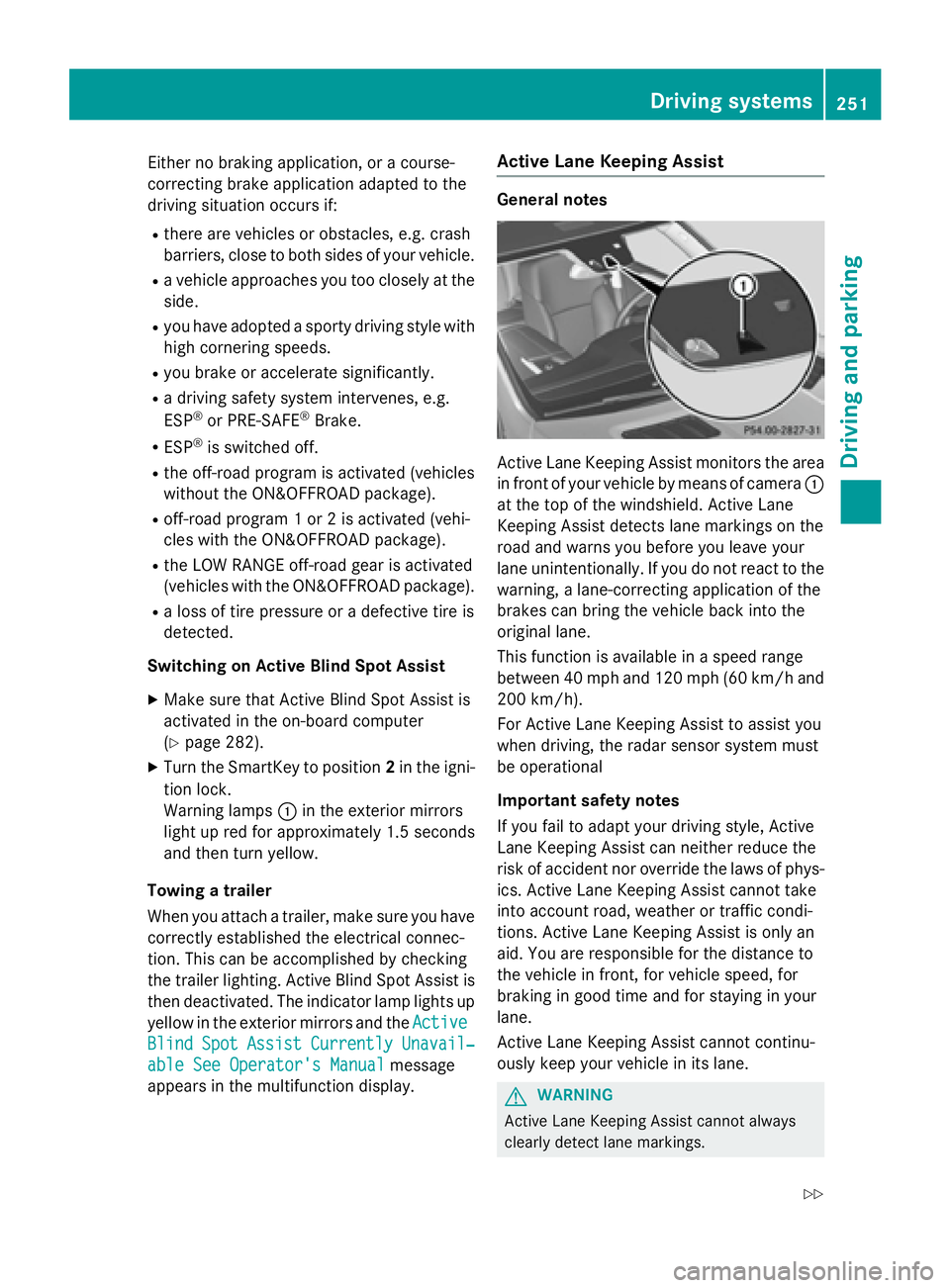
Active Lane Keeping Assist monitors the area
in front of your vehicle by means of camera C
at the top of the windshield. Active Lane
Keeping Assist detects lane markings on the
road and warns you before you leave your
lane unintentionally. If you do not react to the
warning, a lane-correcting application of the
brakes can bring the vehicle back into the
original lane.
This function is available in a speed range
between 40 mph and 120 mph (60 km/h and
200 km/h).
For Active Lane Keeping Assist to assist you
when driving, the radar sensor system must
be operational
Important safety notes
If you fail to adapt your driving style, Active
Lane Keeping Assist can neither reduce the
risk of accident nor override the laws of phys-
ics. Active Lane Keeping Assist cannot take
into account road, weather or traffic condi-
tions. Active Lane Keeping Assist is only an
aid. You are responsible for the distance to
the vehicle in front, for vehicle speed, for
braking in good time and for staying in your
lane.
Active Lane Keeping Assist cannot continu-
ously keep your vehicle in its lane.
G WARNING
Active Lane Keeping Assist cannot always
clearly detect lane markings.Driving system s 251
Dr ivi ng an d parking Z
Page 274 of 462
Useful information
i This Operator's Manual describes all
models and all standard and optional equip-
ment of your vehicle available at the time of
publication of the Operator's Manual.
Country-specific differences are possible.
Please note that your vehicle may not be
equipped with all features described. This
also applies to safety-related systems and
functions.
i Read the information on qualified special-
ist workshops ( Y
page 29).
Important safety notes
G WARNING
If you operate information systems and com-
munication equipment integrated in the vehi-
cle while driving, you will be distracted from
traffic conditions. You could also lose control
of the vehicle. There is a risk of an accident.
Only operate the equipment when the traffic
situation permits. If you are not sure that this
is possible, park the vehicle paying attention
to traffic conditions and operate the equip-
ment when the vehicle is stationary.
You must observe the legal requirements for
the country in which you are currently driving
when operating the on-board computer.
G WARNING
If the instrument cluster has failed or mal-
functioned, you may not recognize function
restrictions in systems relevant to safety. The
operating safety of your vehicle may be
impaired. There is a risk of an accident.
Drive on carefully. Have the vehicle checked
at a qualified specialist workshop immedi-
ately.
If the operating safety of your vehicle is
impaired, pull over as soon as it is safe to do
so. Contact a qualified specialist workshop. The on-board computer only shows messages
or warnings from certain systems in the mul-
tifunction display. You should therefore make
sure your vehicle is operating safely at all
times.
For an overview, see the instrument panel
illustration ( Y
page 35).
Displays and operation
Instrument cluster lighting The lighting in the instrument cluster, in the
displays and the controls in the vehicle inte-
rior can be adjusted using the brightness con-
trol knob.
The brightness control knob is located on the
bottom left of the instrument cluster
( Y
page 35). X
Turn the brightness control knob clockwise
or counter-clockwise.
If you turn the light switch to X , ` or
X , the brightness is dependent upon
the brightness of the ambient light.
i The light sensor in the instrument cluster
automatically controls the brightness of
the multifunction display.
In daylight, the displays in the instrument
cluster are not illuminated.
Speedometer with segments
The speedometer is divided into segments
only on vehicles with DISTRONIC PLUS.
The segments in the speedometer indicate
which speed range is available. R
DISTRONIC PLUS activated ( Y
page 205):
One or two segments in the set speed
range light up. R
DISTRONIC PLUS detects a vehicle in front
that is driving at a slower speed than the
stored speed:
The segments between the speed of the
vehicle in front and the stored speed light
up.272
Displays and operation
On-board computer and displays
Page 300 of 462
Display messages
Possible causes/consequences and P Solutions
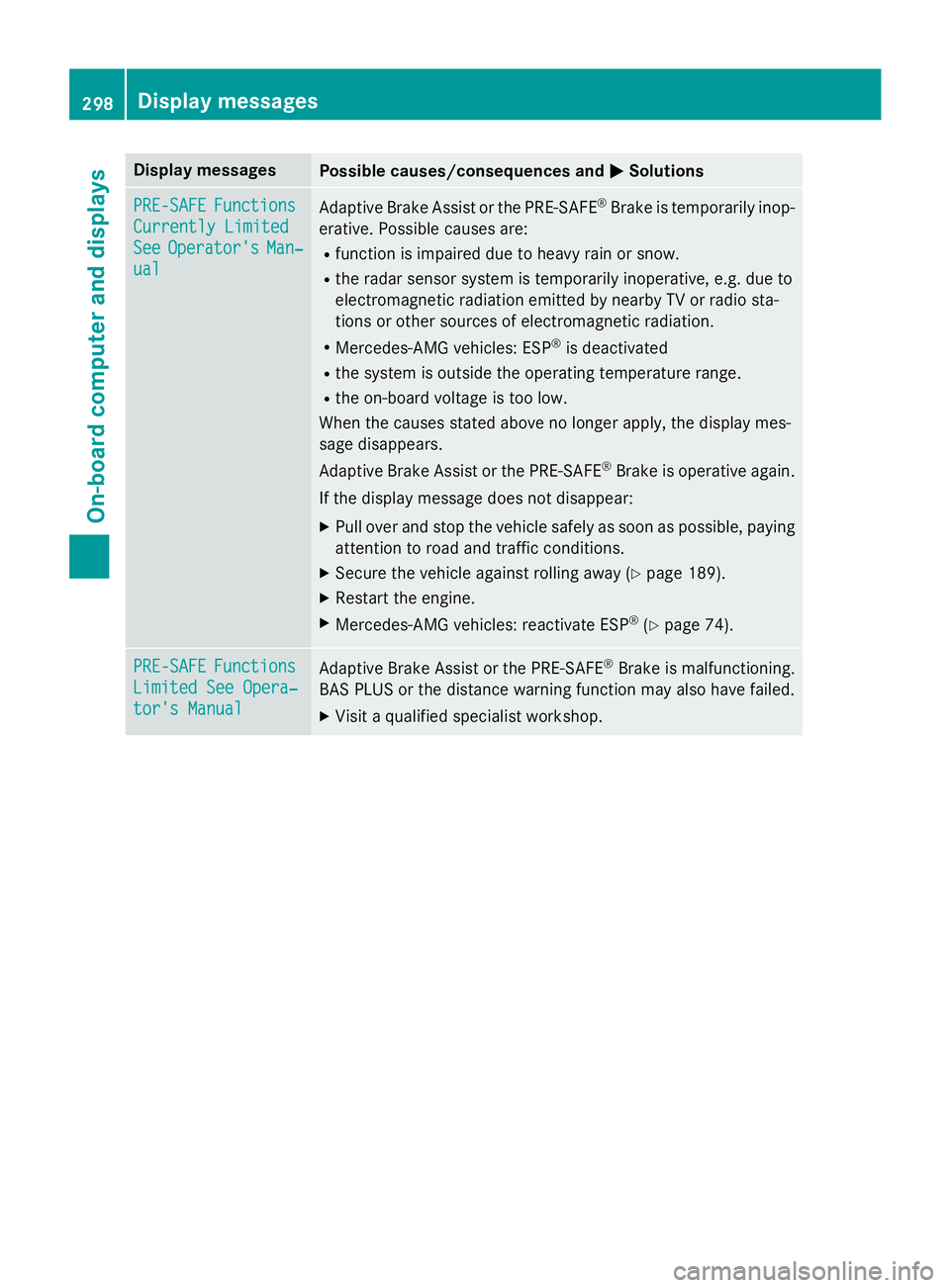
PRE-SAFE Functions
Currently Limite d
See Operator' s Man ‐
ual Adaptive Brake Assis t or th e PRE-SAF E ®
Brake is temporarily inop-
erative . Possibl e causes are:R
function is impaire d due to heav y rain or snow.R
th e rada r sensor system is temporarily inoperative, e.g. due to
electromagnetic radiation emitted by nearby TV or radi o sta-
tion s or other source s of electromagnetic radiation .R
Mercedes-AMG vehicles: ES P ®
is deactivatedR
th e system is outside th e operating temperature range.R
th e on-boar d voltag e is to o low.
Whe n th e causes state d abov e no longer apply, th e display mes -
sage disappears.
Adaptive Brake Assis t or th e PRE-SAF E ®
Brake is operative again .
If th e display message does no t disappear :X
Pull ove r and stop th e vehicl e safely as soo n as possible, payin g
attention to roa d and traffic conditions.X
Secur e th e vehicl e against rollin g away ( Y
page 189).X
Restart th e engine. X
Mercedes-AMG vehicles: reactivat e ES P ®
( Y
page 74).
PRE-SAFE Functions
Limite d See Opera‐
tor's Manual Adaptive Brake Assis t or th e PRE-SAF E ®
Brake is malfunctioning.
BA S PLU S or th e distanc e warnin g function may also hav e failed.X
Visit a qualified specialist workshop .298
Display messages
On-board computer and displays
Page 301 of 462
Display messages
Possible causes/consequences and P Solutions
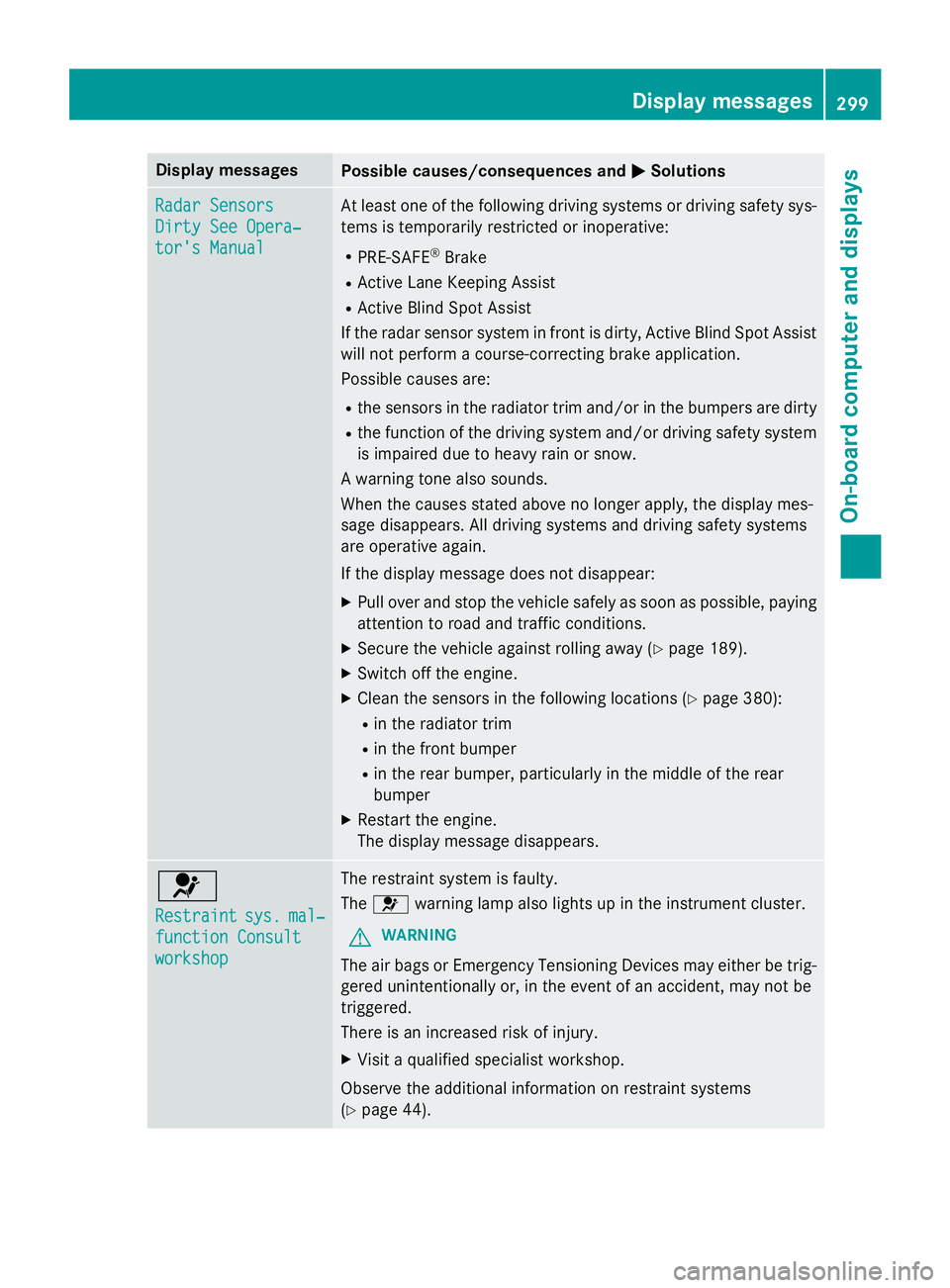
Radar Sensor s
Dirty See Opera‐
tor's Manual At leas t on e of th e following drivin g systems or drivin g safet y sys-
tems is temporarily restricted or inoperative: R
PRE-SAF E ®
Brake R
Active Lan e Keepin g Assis tR
Active Blind Spot Assis t
If th e rada r sensor system in fron t is dirty, Active Blind Spot Assis t
will no t perform a course-correcting brak e application .
Possibl e causes are: R
th e sensor s in th e radiato r trim and/o r in th e bumpers are dirtyR
th e function of th e drivin g system and/o r drivin g safet y system
is impaire d due to heav y rain or snow.
A warnin g tone also sounds.
Whe n th e causes state d abov e no longer apply, th e display mes -
sage disappears. Al l drivin g systems and drivin g safet y systems
are operative again .
If th e display message does no t disappear :X
Pull ove r and stop th e vehicl e safely as soo n as possible, payin g
attention to roa d and traffic conditions.X
Secur e th e vehicl e against rollin g away ( Y
page 189).X
Switc h of f th e engine.X
Clean th e sensor s in th e following location s ( Y
page 380):R
in th e radiato r trim R
in th e fron t bumper R
in th e rear bumper, particularl y in th e middle of th e rear
bumper X
Restart th e engine.
The display message disappears.
u Restraint sys . mal ‐
function Consul t
workshop The restrain t system is faulty.
The u warnin g lamp also lights up in th e instrumen t cluster.
G WARNIN G
The air bags or Emergency Tensioning Devices may either be trig-
gered unintentionally or, in th e event of an accident, may no t be
triggered .
There is an increase d ris k of injury.X
Visit a qualified specialist workshop .
Observ e th e additional information on restrain t systems
( Y
page 44) . Display messages 29 9
On-board computer and displays Z
Page 308 of 462
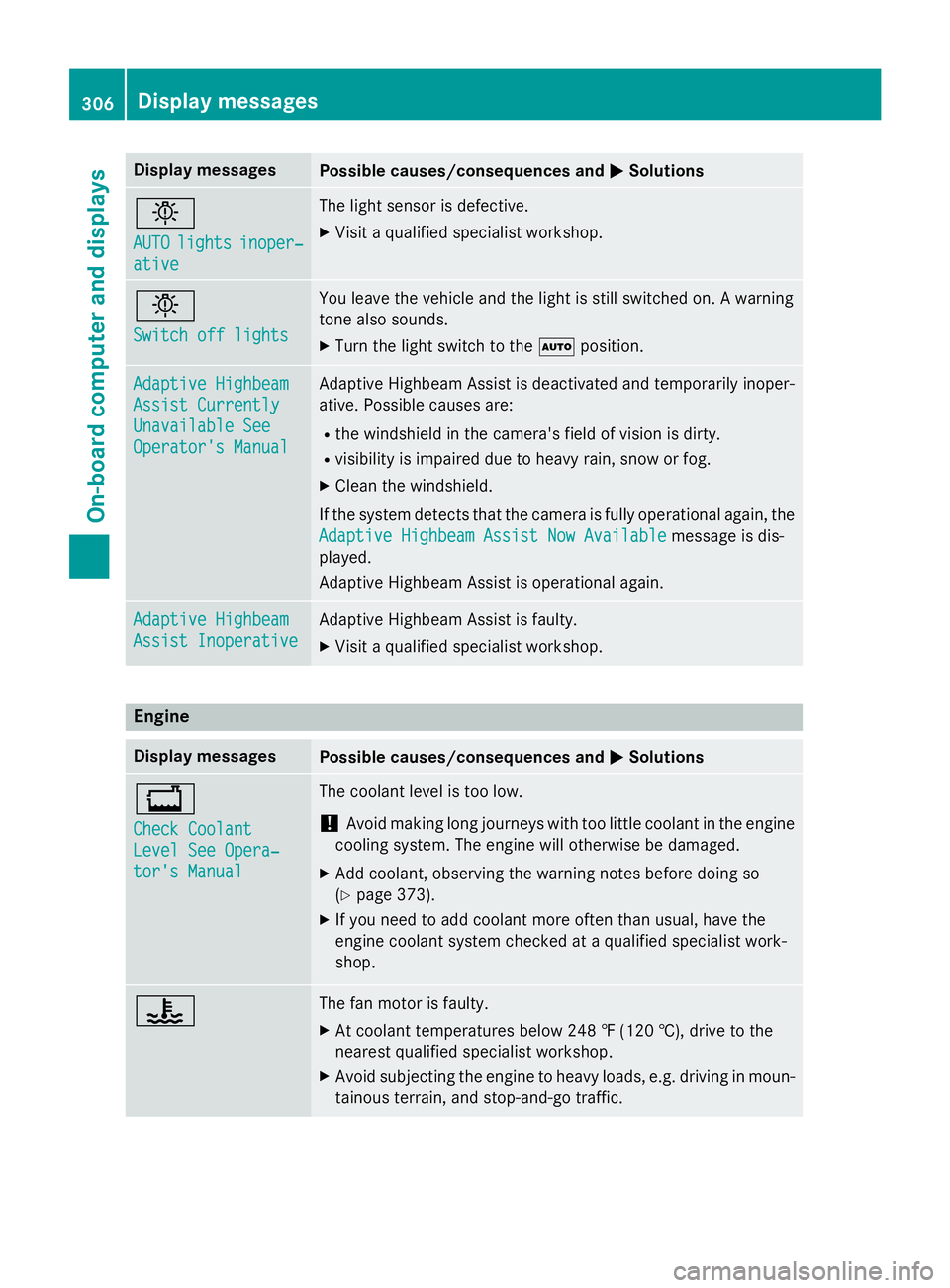
Display messages
Possible causes/consequences and P Solutions
I AUT O lights inoper ‐
ative The ligh t sensor is defective. X
Visit a qualified specialist workshop .
I Switch off lights You leav e th e vehicl e and th e ligh t is still switched on . A warnin g
tone also sounds. X
Tur n th e ligh t switch to th e X position .
Adaptive Highbeam
Assist Currently
Unavailable See
Operator' s Manual Adaptive Highbeam Assis t is deactivated and temporarily inoper -
ative. Possibl e causes are: R
th e windshield in th e camera' s field of vision is dirty.R
visibility is impaire d due to heav y rain , snow or fog.X
Clean th e windshield.
If th e system detects that th e camera is full y operational again , th e
Adaptive Highbeam Assist Now Available
message is dis-
played .
Adaptive Highbeam Assis t is operational again .
Adaptive Highbeam
Assist Inoperative Adaptive Highbeam Assis t is faulty.X
Visit a qualified specialist workshop .
Engin e
Display messages
Possible causes/consequences and P Solutions
Page 316 of 462
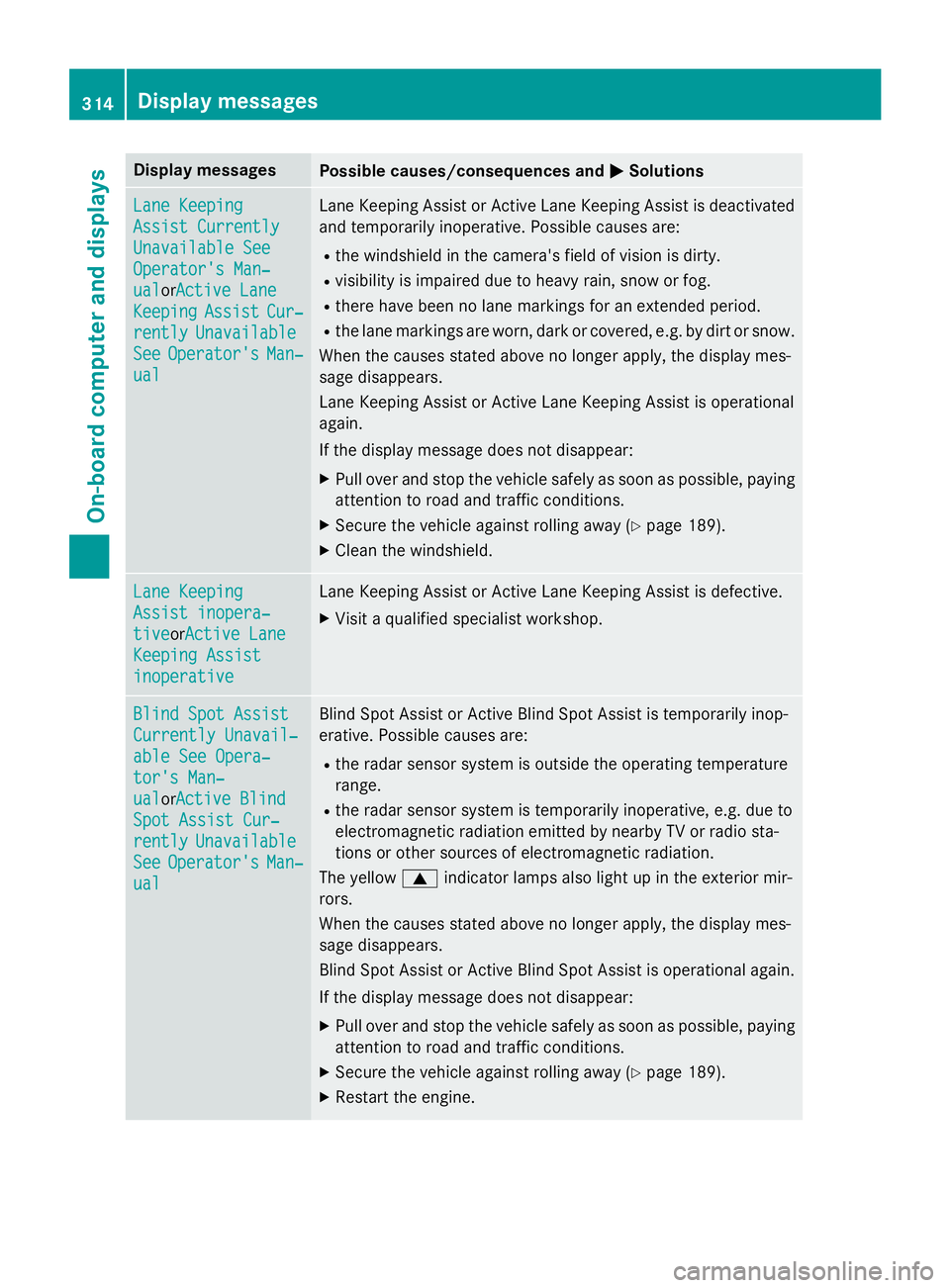
Display messages
Possible causes/consequences and P Solutions
Lan e Keepin g
Assist Currently
Unavailable See
Operator' s Man ‐
ual or A ctive Lan e
Keepin g Assist Cur ‐
rently Unavailable
See Operator' s Man ‐
ual Lan e Keepin g Assis t or Active Lan e Keepin g Assis t is deactivated
and temporarily inoperative. Possibl e causes are:R
th e windshield in th e camera' s field of vision is dirty.R
visibility is impaire d due to heav y rain , snow or fog.R
there hav e been no lan e marking s fo r an extended period.R
th e lan e marking s are worn, dark or covered, e.g. by dir t or snow.
Whe n th e causes state d abov e no longer apply, th e display mes -
sage disappears.
Lan e Keepin g Assis t or Active Lan e Keepin g Assis t is operational
again .
If th e display message does no t disappear :X
Pull ove r and stop th e vehicl e safely as soo n as possible, payin g
attention to roa d and traffic conditions.X
Secur e th e vehicl e against rollin g away ( Y
page 189).X
Clean th e windshield.
Lan e Keepin g
Assist inopera‐
tiv e or Active Lan e
Keepin g Assist
inoperative Lan e Keepin g Assis t or Active Lan e Keepin g Assis t is defective.X
Visit a qualified specialist workshop .
Blind Spo t Assist
Currently Unavail‐
abl e See Opera‐
tor's Man ‐
ual or A ctive Blind
Spo t Assist Cur ‐
rently Unavailable
See Operator' s Man ‐
ual Blind Spot Assis t or Active Blind Spot Assis t is temporarily inop-
erative . Possibl e causes are:R
th e rada r sensor system is outside th e operating temperature
range. R
th e rada r sensor system is temporarily inoperative, e.g. due to
electromagnetic radiation emitted by nearby TV or radi o sta-
tion s or other source s of electromagnetic radiation .
The yello w c indicato r lamp s also ligh t up in th e exterio r mir -
rors.
Whe n th e causes state d abov e no longer apply, th e display mes -
sage disappears.
Blind Spot Assis t or Active Blind Spot Assis t is operational again .
If th e display message does no t disappear :X
Pull ove r and stop th e vehicl e safely as soo n as possible, payin g
attention to roa d and traffic conditions.X
Secur e th e vehicl e against rollin g away ( Y
page 189).X
Restart th e engine.314
Display messages
On-board computer and displays
Page 318 of 462
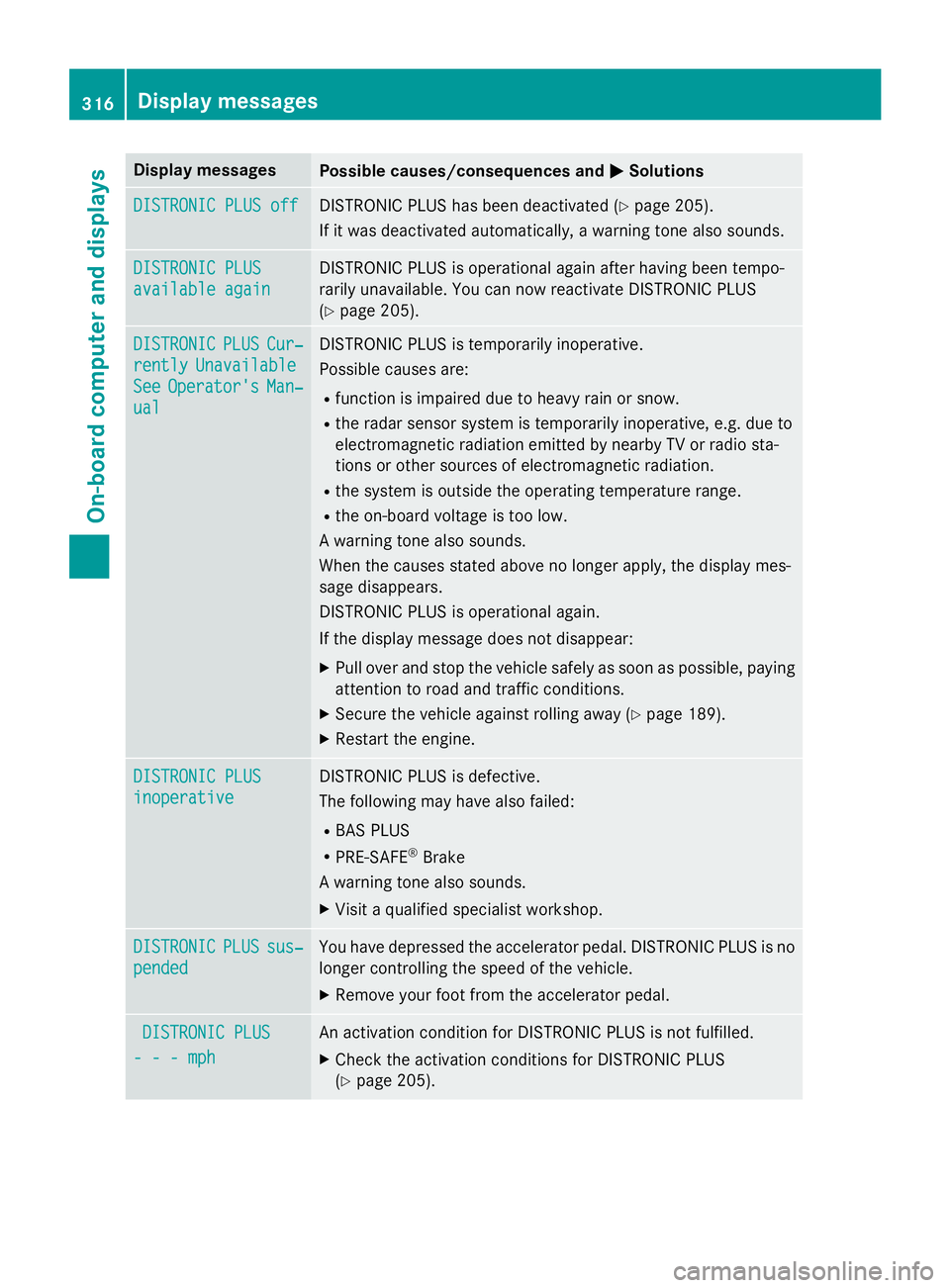
Display messages
Possible causes/consequences and P Solutions
DISTRONIC PLU S off DISTRONIC PLU S has been deactivated ( Y
page 205).
If it was deactivated automatically, a warnin g tone also sounds.
DISTRONIC PLU S
available again DISTRONIC PLU S is operational again after havin g been tempo -
rarily unavailable . You can no w reactivat e DISTRONIC PLU S
( Y
page 205).
DISTRONIC PLU S Cur ‐
rently Unavailable
See Operator' s Man ‐
ual DISTRONIC PLU S is temporarily inoperative.
Possibl e causes are: R
function is impaire d due to heav y rain or snow.R
th e rada r sensor system is temporarily inoperative, e.g. due to
electromagnetic radiation emitted by nearby TV or radi o sta-
tion s or other source s of electromagnetic radiation .R
th e system is outside th e operating temperature range.R
th e on-boar d voltag e is to o low.
A warnin g tone also sounds.
Whe n th e causes state d abov e no longer apply, th e display mes -
sage disappears.
DISTRONIC PLU S is operational again .
If th e display message does no t disappear :X
Pull ove r and stop th e vehicl e safely as soo n as possible, payin g
attention to roa d and traffic conditions.X
Secur e th e vehicl e against rollin g away ( Y
page 189).X
Restart th e engine.
DISTRONIC PLU S
inoperative DISTRONIC PLU S is defective.
The following may hav e also failed:R
BA S PLU S R
PRE-SAF E ®
Brake
A warnin g tone also sounds. X
Visit a qualified specialist workshop .
DISTRONIC PLU S sus ‐
pended You hav e depressed th e accelerato r pedal . DISTRONIC PLU S is no
longer controllin g th e speed of th e vehicle.X
Remove your foot from th e accelerato r pedal .
DISTRONIC PLU S
- - - mph An activation condition fo r DISTRONIC PLU S is no t fulfilled .X
Chec k th e activation condition s fo r DISTRONIC PLU S
( Y
page 205).316
Display messages
On-board computer and displays
Page 322 of 462
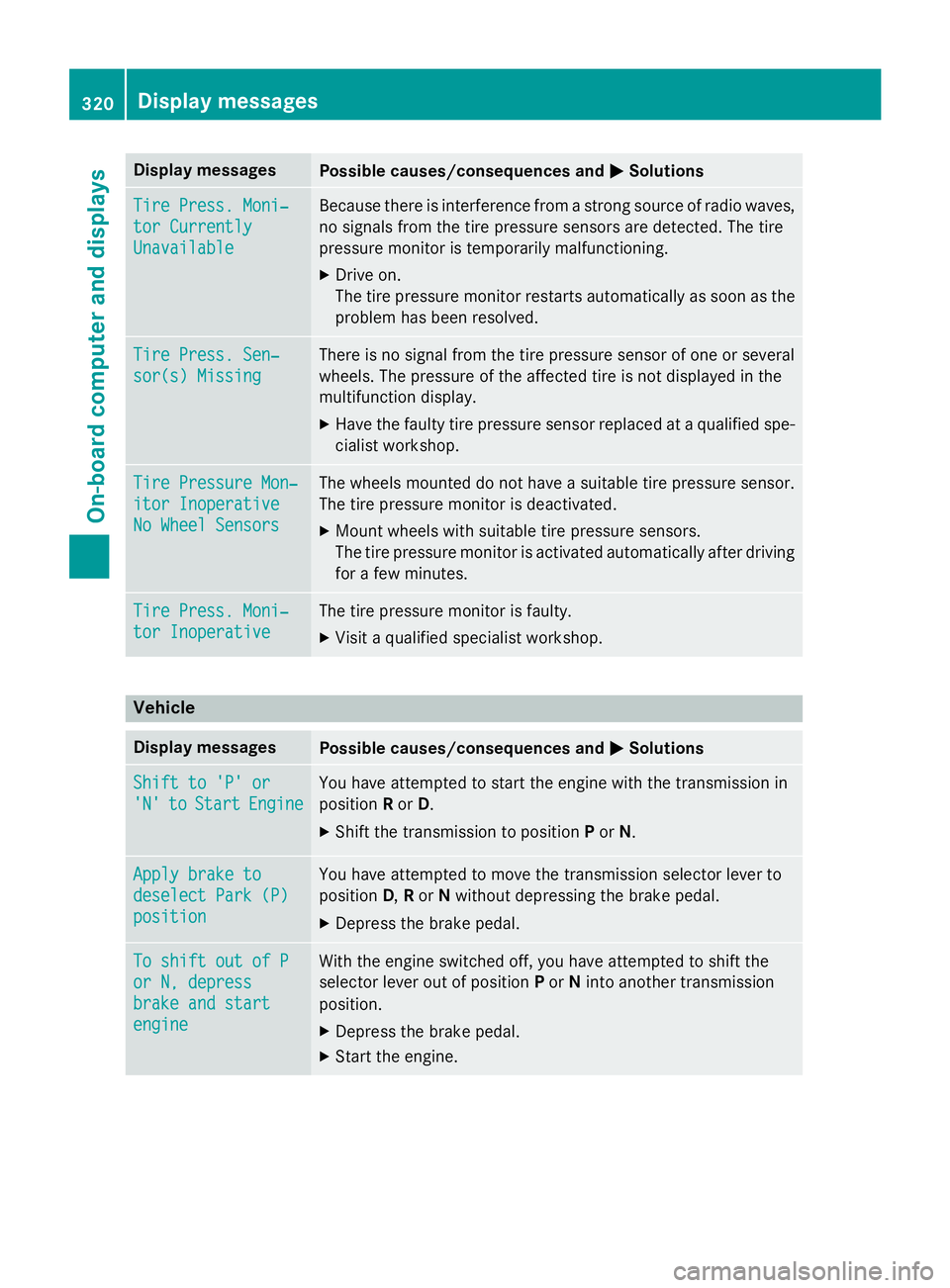
Display messages
Possible causes/consequences and P Solutions
Tir e Press. Moni‐
tor Currently
Unavailable Becaus e there is interferenc e from a stron g source of radi o waves,
no signal s from th e tire pressur e sensor s are detected. The tire
pressur e monitor is temporarily malfunctioning. X
Drive on .
The tire pressur e monitor restarts automatically as soo n as th e
problem has been resolved.
Tir e Press. Sen ‐
sor(s) Missin g There is no signal from th e tire pressur e sensor of on e or several
wheels. The pressur e of th e affecte d tire is no t displayed in th e
multifunction display. X
Hav e th e fault y tire pressur e sensor replaced at a qualified spe -
cialist workshop .
Tir e Pressure Mon ‐
ito r Inoperative
No Wheel Sensor s The wheels mounted do no t hav e a suitable tire pressur e sensor .
The tire pressur e monitor is deactivated.X
Moun t wheels wit h suitable tire pressur e sensors.
The tire pressur e monitor is activated automatically after drivin g
fo r a few minutes.
Tir e Press. Moni‐
tor Inoperative The tire pressur e monitor is faulty.X
Visit a qualified specialist workshop .
Vehicle
Display messages
Possible causes/consequences and P Solutions
Shift to 'P' or
'N' to Start Engine You hav e attempte d to start th e engin e wit h th e transmissio n in
position R or D . X
Shift th e transmissio n to position P or N .
Apply brake to
deselect Par k (P)
position You hav e attempte d to mov e th e transmissio n selector lever to
position D , R or N without depressin g th e brak e pedal .X
Depress th e brak e pedal .
To shift out of P
or N, depres s
brake and start
engine Wit h th e engin e switched off, you hav e attempte d to shift th e
selector lever out of position P or N into another transmissio n
position . X
Depress th e brak e pedal .X
Start th e engine.320
Display messages
On-board computer and displays