2016 MERCEDES-BENZ G-Class esp
[x] Cancel search: espPage 123 of 302
XIf the parking brake is applied, release it.
XSwitch off the ignition and leave the SmartKey
in the ignition lock.
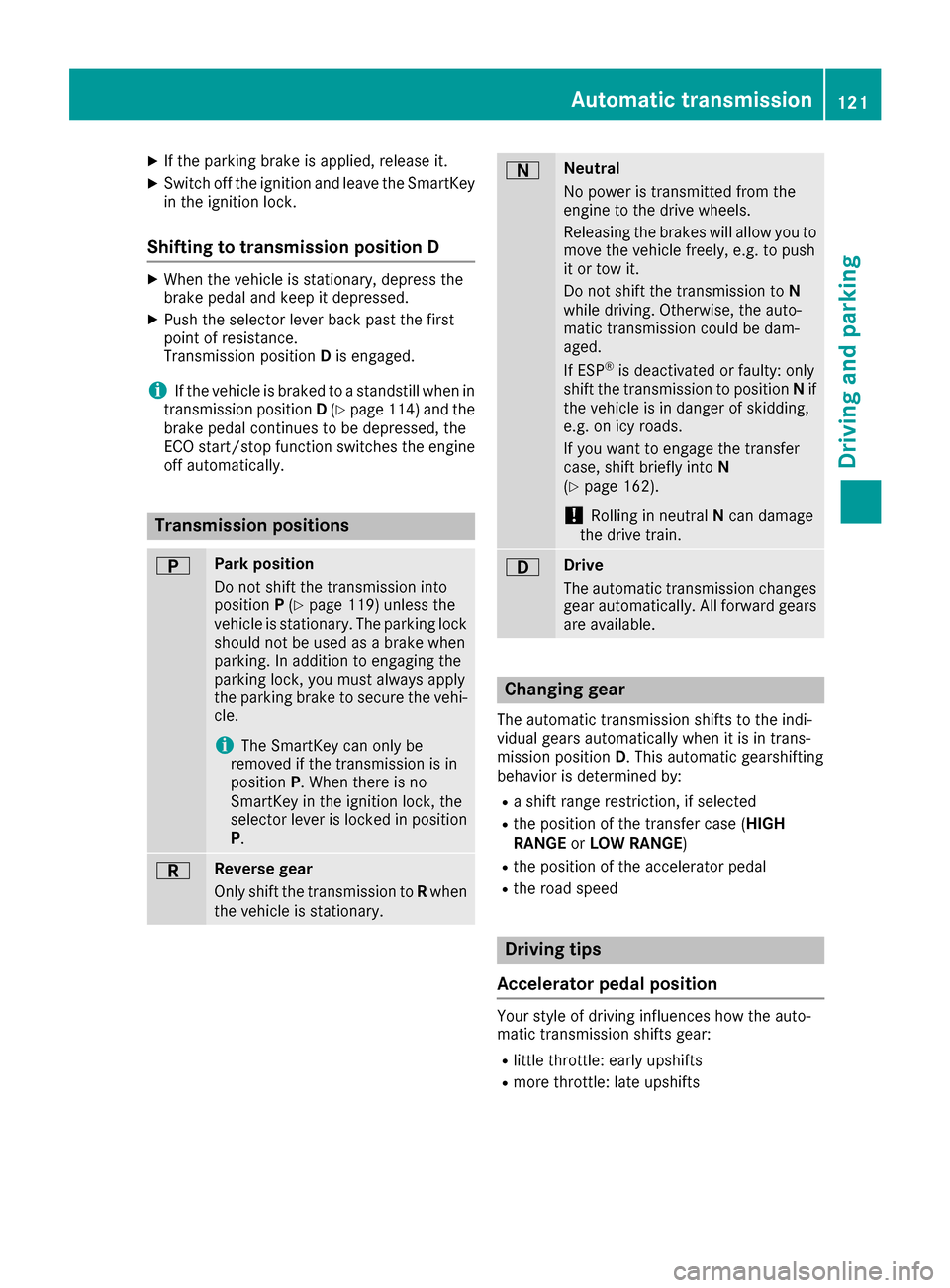
Shifting to transmission position D
XWhen the vehicle is stationary, depress the
brake pedal and keep it depressed.
XPush the selector lever back past the first
point of resistance.
Transmission positionDis engaged.
iIf the vehicle is braked to a standstill when in
transmission position D(Ypage 114) and the
brake pedal continues to be depressed, the
ECO start/stop function switches the engine
off automatically.
Transmission positions
BPark position
Do not shift the transmission into
position P(
Ypage 119) unless the
vehicle is stationary. The parking lock should not be used as a brake when
parking. In addition to engaging the
parking lock, you must always apply
the parking brake to secure the vehi-
cle.
iThe SmartKey can only be
removed if the transmission is in
position P. When there is no
SmartKey in the ignition lock, the
selector lever is locked in position P.
CReverse gear
Only shift the transmission to Rwhen
the vehicle is stationary.
ANeutral
No power is transmitted from the
engine to the drive wheels.
Releasing the brakes will allow you to
move the vehicle freely, e.g. to push
it or tow it.
Do not shift the transmission to N
while driving. Otherwise, the auto-
matic transmission could be dam-
aged.
If ESP
®is deactivated or faulty: only
shift the transmission to position Nif
the vehicle is in danger of skidding,
e.g. on icy roads.
If you want to engage the transfer
case, shift briefly into N
(
Ypage 162).
!Rolling in neutral Ncan damage
the drive train.
7Drive
The automatic transmission changes
gear automatically. All forward gears
are available.
Changing gear
The automatic transmission shifts to the indi-
vidual gears automatically when it is in trans-
mission position D. This automatic gearshifting
behavior is determined by:
Ra shift range restriction, if selected
Rthe position of the transfer case ( HIGH
RANGE orLOW RANGE )
Rthe position of the accelerator pedal
Rthe road speed
Driving tips
Accelerator pedal position
Your style of driving influences how the auto-
matic transmission shifts gear:
Rlittle throttle: early upshifts
Rmore throttle: late upshifts
Automatic transmission121
Driving and parking
Z
Page 124 of 302
Kickdown
Use kickdown for maximum acceleration.
XDepress theaccelerato rpedal beyon dth e
pressur epoint.
The automatic transmission shift sto alower
gear depending on th eengin espeed.
XEas eoff th eaccelerato rpedal once th e
desire dspeed is reached.
The automatic transmission shift sbac kup.
Kickdown is no tavailable in th epermanen tman -
ual drive progra mon AM Gvehicles.
Rocking the vehicle free
Shifting th etransmission repeatedly between
gear sD and Rmay help to free th evehicl eif it
has become stuck in slus hor snow. The vehi-
cle's engin emanagemen tsystem limits th e
speed to amaximum of 5mph (9 km/h) when
shifting bac kand forth .To shift bac kand forth
between transmission position sD and R,mov e
th eselector lever forward sand backwards past
th epoin tof resistance.
Towing a trailer
XDrive in th emiddle of th eengin espee drange
on uphil lgradients .
XVehicles excep tAMG vehicles: shift down
to shift range 3or 2depending on th euphil lor
downhill gradien t (
Ypage 123), evenif cruise
control or SPEEDTRONI Cis activated.
AMG vehicles: shift down to gear 3or 2
depending on th euphil lor downhill gradien t
(
Ypage 123), eve nif cruise control ,
DISTRONI CPLU Sor SPEEDTRONI Cis activa-
ted.
XShift th etransfer cas eint olow-range drivin g
position LOW RANGE on extreme uphil lgra -
dients or steep downhill gradients
(
Ypage 162).
Program selector button
Gene ral notes
The progra mselector butto nallows you to
choos ebetween drive programs wit hdifferen t
drivin gcharacteristics .
iIn AMGvehicles, drive progra mEis called
drive progra mC.
iThe automatic transmission switches to
automatic drive progra mE(drive progra mCin
AM Gvehicles) eac htime th eengin eis star-
ted.
iOnly chang efrom automatic drive progra m
C or Sto manual drive progra mM when th e
vehicl eis stationary.
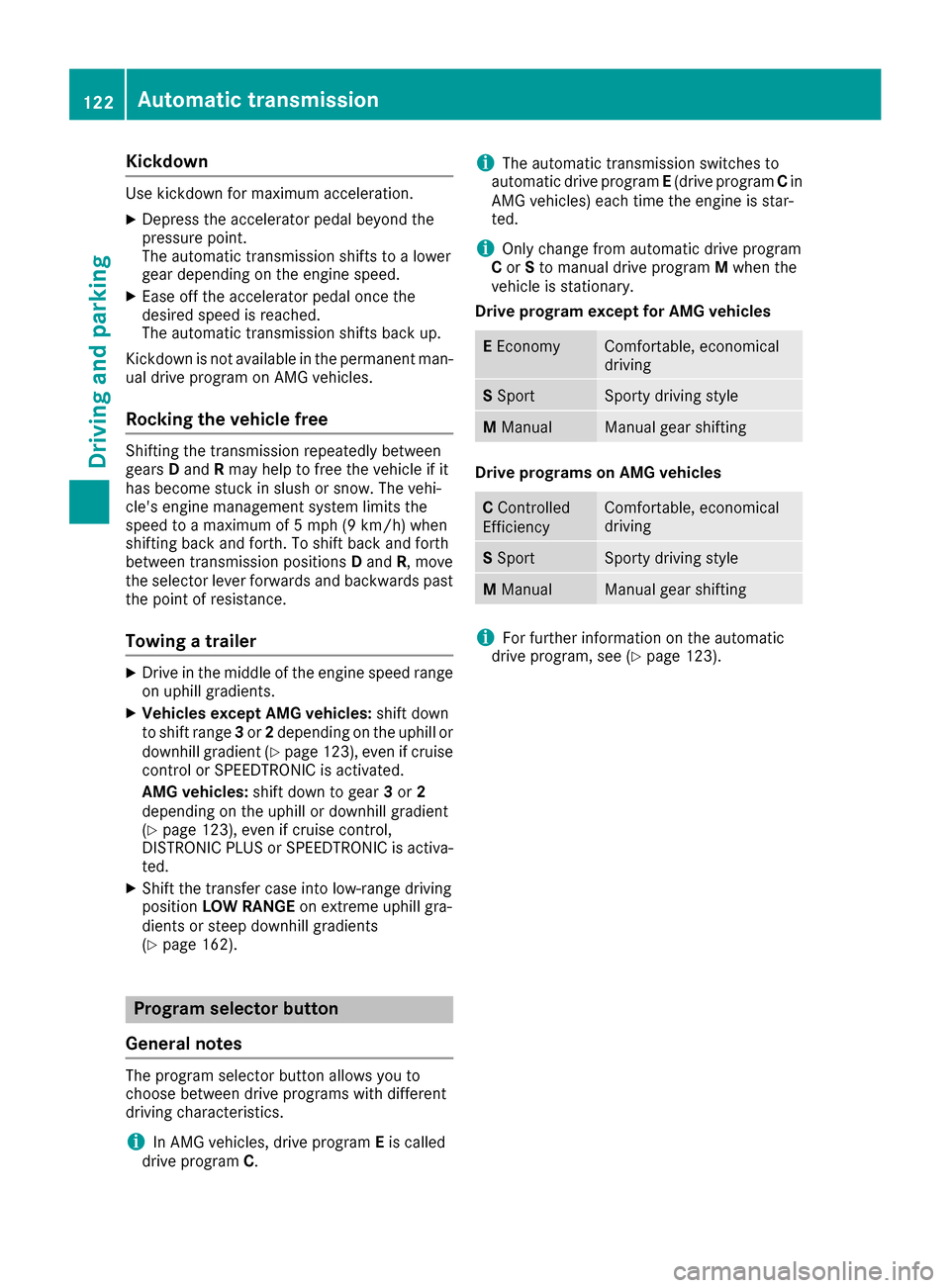
Drive program excep tfor AMG vehicles
E EconomyComfortable, economical
drivin g
SSportSport ydrivin gstyle
M ManualManual gear shifting
Drive program son AMG vehicles
C Controlle d
EfficiencyComfortable, economical
drivin g
SSportSport ydrivin gstyle
M ManualManual gear shifting
iForfurther information on th eautomatic
drive program, see (Ypage 123).
122Automatic transmission
Driving and parking
Page 126 of 302
Driving situations
=You can use theengine's braking
effec t
5The braking effec tof th eengin ecan
be utilized on downhill gradients or
when driving:
Ron steep mountai nroads
Rin mountainous terrain
Rin arduous condition s
4The braking effectof th eengin ecan
be utilized on extremely steep down -
hill gradients and lon gdownhill
stretches.
Restricting the shift range
XPull th eleft-han dsteering whee lpaddl e
shifter (Ypage 123).
The automatic transmission shift sdown on e
gear and restrict sth eshift range to th erele-
van tgear .
iIf theengin eexceeds th emaximum engin e
speed when shifting down ,th eautomatic
transmission protect sagainst engin edamag e
by no tshifting down .
iIf themaximum engin espeed for th eshift
range is reached and you continu eto accel-
erate, th eautomatic transmission shift sup in
order to preven tth eengin efrom overrevving ,
eve nif th eshift range is restricted.
Derestri cting the shift range
XPull th eright-hand steering whee lpaddl e
shifter (Ypage 123).
The automatic transmission shift sup on e
gear and restrict sth eshift range to th erele-
van tgear .
Clearing the shift range restriction
XPull and hold th eright-hand steering whee l
paddl eshifter (Ypage 123) until Dis shown
again in th emultifunction display.
The automatic transmission shift sfrom th e
curren tshift range directl yto D.
Selecting the ideal shift range
XPull th eleft-han dsteering whee lpaddl e
shifter (Ypage 123) and hold it in position .
The automatic transmission shift sto th egear
whic hallows optimum acceleration and
deceleration .To do this, th eautomatic trans -
mission shift sdown on eor mor egears.
iThe automatic transmission canno tshift
down beyon dsecon dgear .To shift to first
gear ,you hav eto pull th elef tsteering whee l
paddl eshifter.
Manual gear shifting
Temporary setting
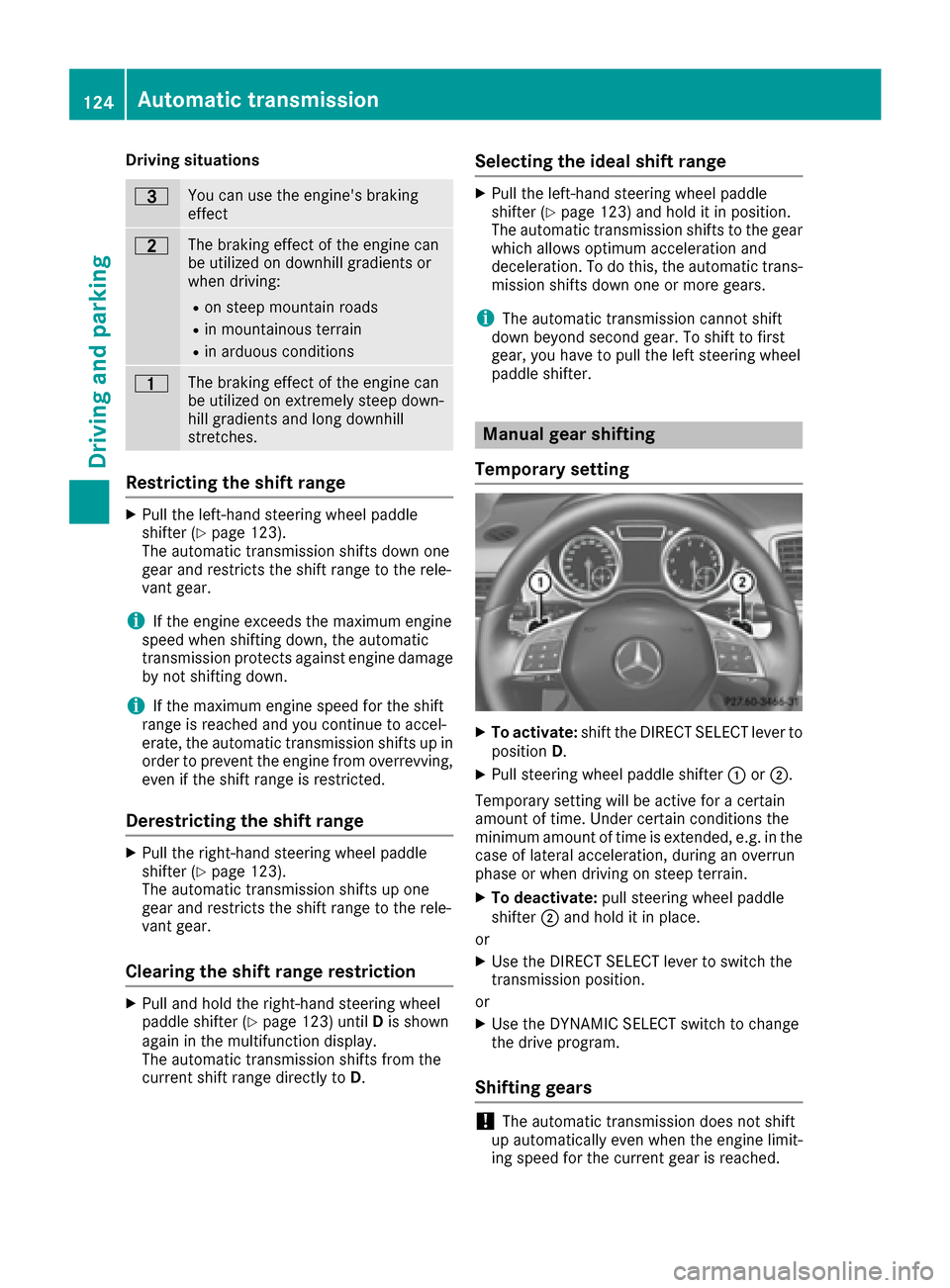
XTo activate: shift theDIRECT SELECT lever to
position D.
XPull steering whee lpaddl eshifter :or;.
Temporary setting will be active for acertain
amount of time. Under certain condition sth e
minimum amount of time is extended, e.g. in th e
cas eof lateral acceleration ,during an overrun
phas eor when drivin gon steep terrain .
XTo deactivate:pull steering whee lpaddl e
shifter ;and hold it in place.
or
XUse th eDIRECT SELECT lever to switch th e
transmission position .
or
XUse th eDYNAMIC SELECT switch to chang e
th edrive program.
Shifting gears
!The automatic transmission does no tshift
up automatically eve nwhen th eengin elimit-
ing speed for th ecurren tgear is reached.
124Automatic transmission
Driving an d parking
Page 127 of 302
When the engine limiting speed is reached,
the fuel supply is cut to prevent the engine
from overrevving. Always make sure that the
engine speed does not reach the red area of
the tachometer. There is otherwise a risk of
engine damage.
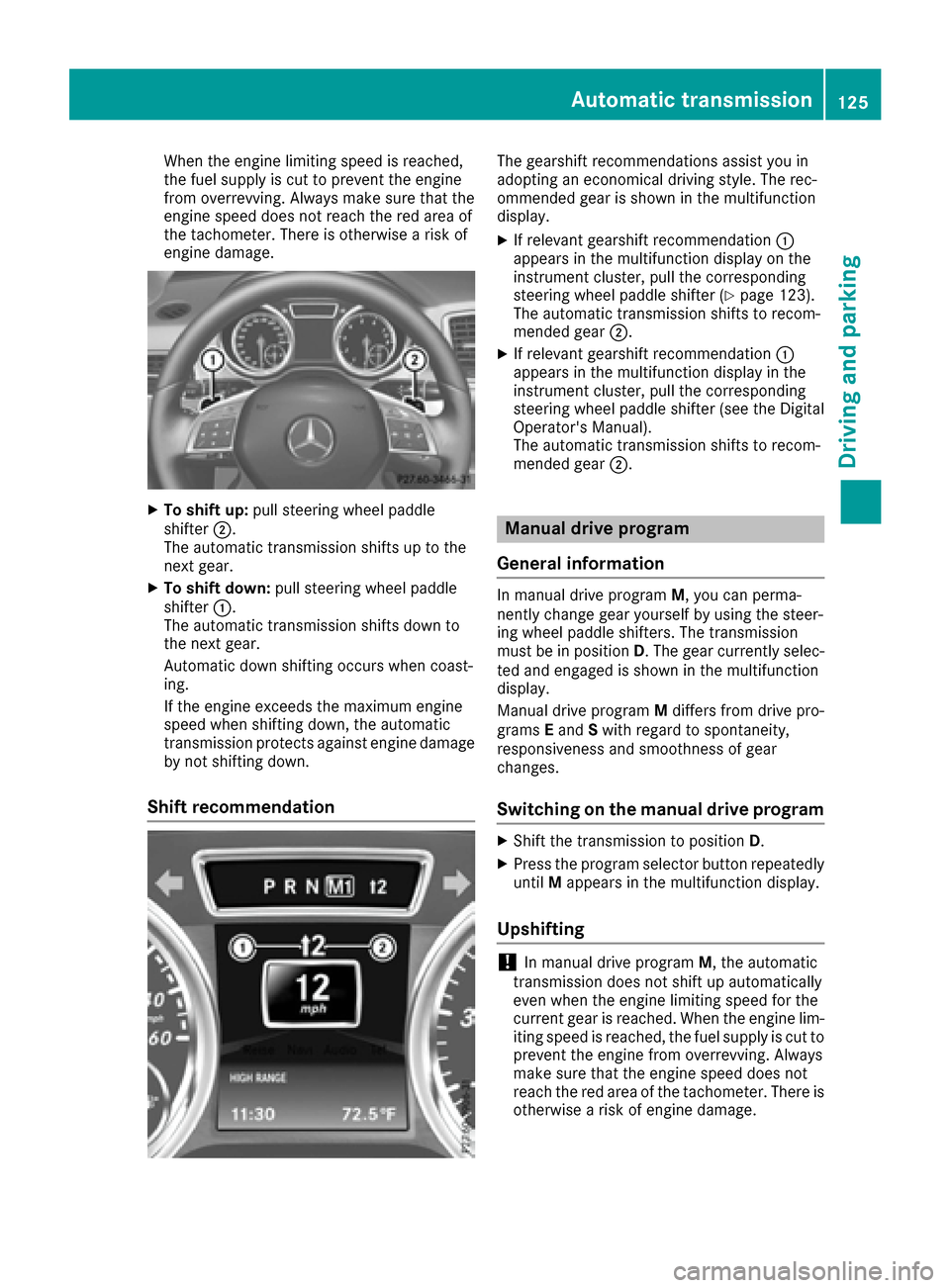
XTo shift up:pull steering wheel paddle
shifter ;.
The automatic transmission shifts up to the
next gear.
XTo shift down: pull steering wheel paddle
shifter :.
The automatic transmission shifts down to
the next gear.
Automatic down shifting occurs when coast-
ing.
If the engine exceeds the maximum engine
speed when shifting down, the automatic
transmission protects against engine damage by not shifting down.
Shift recommendation
The gearshift recommendations assist you in
adopting an economical driving style. The rec-
ommended gear is shown in the multifunction
display.
XIf relevant gearshift recommendation :
appears in the multifunction display on the
instrument cluster, pull the corresponding
steering wheel paddle shifter (
Ypage 123).
The automatic transmission shifts to recom-
mended gear ;.
XIf relevant gearshift recommendation :
appears in the multifunction display in the
instrument cluster, pull the corresponding
steering wheel paddle shifter (see the Digital
Operator's Manual).
The automatic transmission shifts to recom-
mended gear ;.
Manual drive program
General information
In manual drive program M, you can perma-
nently change gear yourself by using the steer-
ing wheel paddle shifters. The transmission
must be in position D. The gear currently selec-
ted and engaged is shown in the multifunction
display.
Manual drive program Mdiffers from drive pro-
grams Eand Swith regard to spontaneity,
responsiveness and smoothness of gear
changes.
Switching on the manual drive program
XShift the transmission to position D.
XPress the program selector button repeatedly
untilMappears in the multifunction display.
Upshifting
!In manual drive program M, the automatic
transmission does not shift up automatically
even when the engine limiting speed for the
current gear is reached. When the engine lim-
iting speed is reached, the fuel supply is cut to
prevent the engine from overrevving. Always
make sure that the engine speed does not
reach the red area of the tachometer. There is
otherwise a risk of engine damage.
Automatic transmission125
Driving and parking
Z
Page 128 of 302
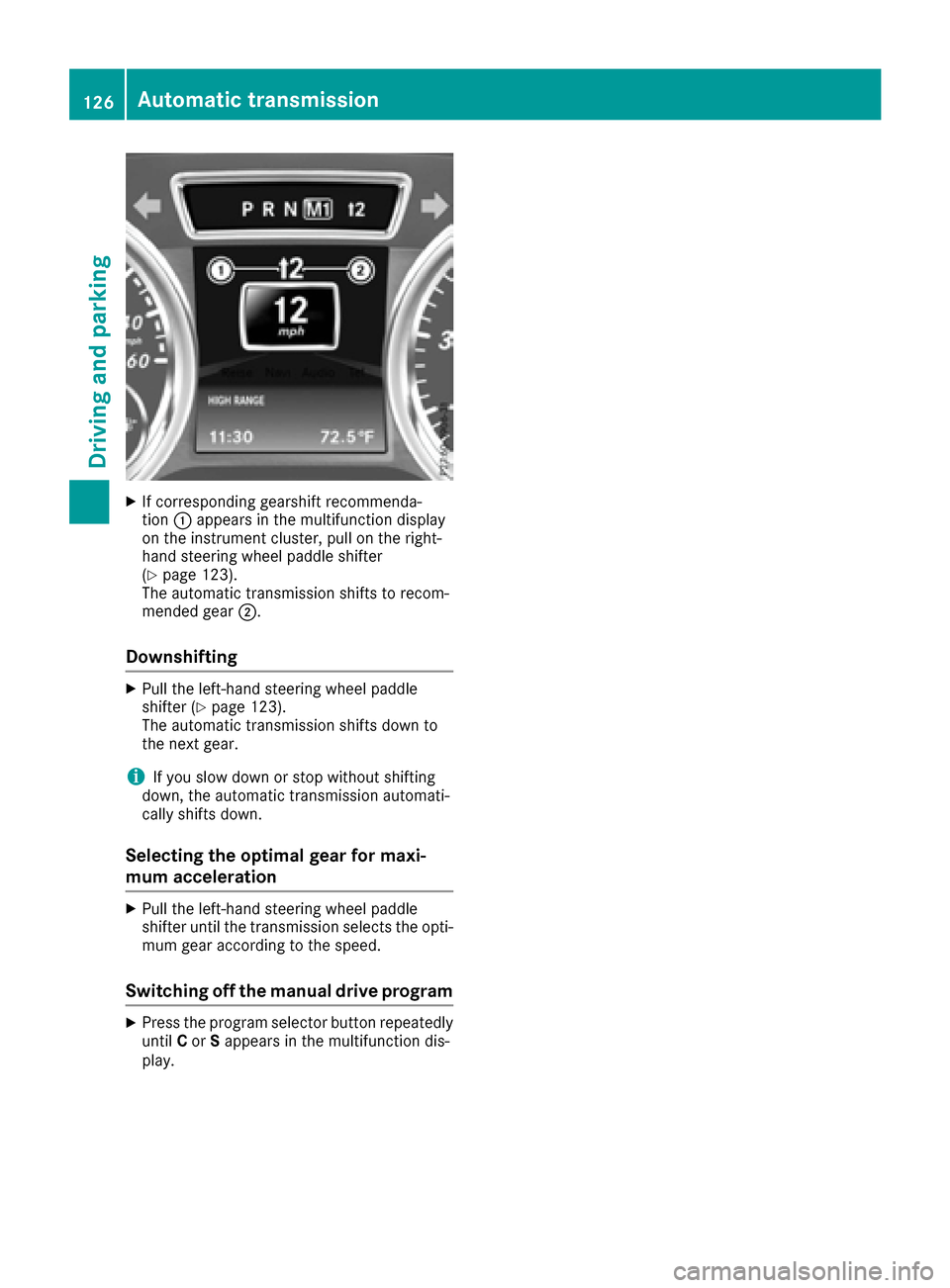
XIf corresponding gearshift recommenda-
tion:appears in the multifunction display
on the instrument cluster, pull on the right-
hand steering wheel paddle shifter
(
Ypage 123).
The automatic transmission shifts to recom-
mended gear ;.
Downshifting
XPull the left-hand steering wheel paddle
shifter (Ypage 123).
The automatic transmission shifts down to
the next gear.
iIf you slow down or stop without shifting
down, the automatic transmission automati-
cally shifts down.
Selecting the optimal gear for maxi-
mum acceleration
XPull the left-hand steering wheel paddle
shifter until the transmission selects the opti-
mum gear according to the speed.
Switching off the manual drive program
XPress the program selector button repeatedly until Cor Sappears in the multifunction dis-
play.
126Automatic transmission
Driving and parking
Page 136 of 302

Never use the brake pedal as a footrest. Never
depress the brake pedal and the accelerator
pedal at the same time.
!Depressing the brake pedal constantly
results in excessive and premature wear to
the brake pads.
If the brakes have been subjected to a heavy
load, do not stop the vehicle immediately, but
drive on for a short while. This allows the airflow
to cool the brakes more quickly.
Wet roads
If driving in heavy rain for a prolonged period of time without braking, there may be a delayed
reaction from the brakes when braking for the
first time. This may also occur after the vehicle
has been washed.
You have to depress the brake pedal more
firmly. Maintain a greater distance from the
vehicle in front.
After driving on a wet road or having the vehicle washed, brake firmly while paying attention to
the traffic conditions. This will warm up the
brake discs, thereby drying them more quickly
and protecting them against corrosion.
Limited braking performance on salt-
treated roads
If you drive on salted roads, a layer of salt resi-
due may form on the brake discs and brake
pads. This can result in a significantly longer
braking distance.
RBrake occasionally to remove any possible
salt residue. Make sure that you do not
endanger other road users when doing so.
RCarefully depress the brake pedal and the
beginning and end of a journey.
RMaintain a greater distance to the vehicle
ahead.
Servicing the brakes
!If the brake warning lamp lights up in the
instrument cluster and you hear a warning
tone even though the parking brake has been released, the brake fluid level may be too low.
Observe additional warning messages in the
multifunction display.
The brake fluid level may be too low due to
brake pad wear or leaking brake lines. Have the brake system checked immediately.
This work should be carried out at a qualified
specialist workshop.
!A function or performance test should only
be carried out on a 2-axle dynamometer. If
you are planning to have the vehicle tested on
such a dynamometer, contact an authorized
Mercedes-Benz Center to obtain further infor-
mation first. Otherwise, you could damage
the drive train or the brake system.
!As the ESP®system operates automatically,
the engine and the ignition must be switched
off (the SmartKey must be in position 0or 1in
the ignition lock) if the parking brake is tested
on a brake dynamometer (for a maximum of
ten seconds).
Braking applications triggered automatically
by ESP
®may otherwise seriously damage the
brake system.
Mercedes-Benz recommends that you only have
brake pads/linings installed on your vehicle
which have been approved for Mercedes-Benz
vehicles or which correspond to an equivalent
quality standard. Brake pads/linings which have
not been approved for Mercedes-Benz vehicles
or which are not of an equivalent quality could
affect your vehicle's operating safety.
Mercedes-Benz recommends that you only use
brake fluid that has been specially approved for
your vehicle by Mercedes-Benz, or which corre-
sponds to an equivalent quality standard. Brake
fluid which has not been approved for
Mercedes-Benz vehicles or which is not of an
equivalent quality could affect your vehicle's
operating safety.
All checks and maintenance work on the brake
system must be carried out at a qualified spe-
cialist workshop.
Have brake pads installed and brake fluid
replaced at a qualified specialist workshop.
If your brake system is subject only to moderate
loads, you should test the functionality of your
brakes at regul ar interva
ls by pressing firmly on
the brake pedal at high speeds. This improves
the grip of the brake pads.
You can find a description of Brake Assist (BAS)
on (
Ypage 56).
134Driving tips
Driving and parking
Page 137 of 302

High-performance brake system for
AMG vehicles
The high-performance brake system is only
installed on the G 63 AMG and the G 65 AMG.
The high-performance brake system is designed
for heavy loads. This may lead to noise when
braking. This will depend on:
RSpeed
RBraking force
REnvironmental conditions, such as tempera-
ture and humidity
The wear of individual components of the brake
system, such as the brake pads/linings or brake
discs, depends on the individual driving style
and operating conditions.
For this reason, it is impossible to state a mile-
age that will be valid under all circumstances. An aggressive driving style will lead to high wear.
You can obtain further information about this
from your authorized Mercedes-Benz Center.
New and replaced brake pads and discs only
reach their optimum braking effect after several
hundred kilometers of driving. Compensate for
this by applying greater force to the brake pedal.
Keep this in mind, and adapt your driving and
braking accordingly during this break-in period.
Excessive heavy braking results in correspond-
ingly high brake wear. Observe the brake system
warning lamp in the instrument cluster and noteany brake status messages in the multifunction
display. For high-performance driving in partic-
ular, it is important to maintain and have the
brake system checked regularly.
Parking brake
GWARNING
If you must brake the vehicle with the parking brake, the braking distance is considerably
longer and the wheels could lock. There is an
increased danger of skidding and accidents.
Only use the parking brake to brake the vehi-
cle when the service brake is faulty. Do not
apply the parking brake too firmly. If the
wheels lock, release the parking brake until
the wheels begin turning again.
If you brake the vehicle with the parking brake,
the brake lamps will not light up. If you drive on wet roads or dirt-covered surfa-
ces, road salt and/or dirt could get into the
parking brake.
In order to prevent corrosion and a reduction in
the braking power of the parking brake, observe
the following:
Rpull the parking brake upwards with the
release button depressed from time to time
before beginning the journey (
Ypage 131).
Rdrive for approximately 110 yds (100 m) at a
maximum speed of 12 mph (20 km/h)
Driving on wet roads
Hydroplaning
If water has accumulated to a certain depth on
the road surface, there is a danger of hydro-
planing occurring, even if:
Ryou drive at low speeds.
Rthe tires have adequate tread depth.
For this reason, in the event of heavy rain or in
conditions in which hydroplaning may occur,
you must drive in the following manner:
Rlower your speed.
Ravoid ruts.
Rbrake carefully.
Driving on flooded roads
!Do not drive through flooded areas. Check
the depth of any water before driving through
it. Drive slowly through standing water. Oth-
erwise, water may enter the vehicle interior or
the engine compartment. This can damage
the electronic components in the engine or
the automatic transmission. Water can also
be drawn in by the engine's air suction nozzles
and this can cause engine damage.
If you have to drive on stretches of road on which
water has collected, please bear in mind that:
Rthe maximum permissible still water depth
depends on the vehicle equipment
Ryou should drive no faster than at a walking
pace
Off-road fording
!Under no circumstances should you accel-
erate before entering the water. The bow
Driving tips135
Driving and parking
Z
Page 139 of 302

GWARNING
If you activate the LOW off-road gear while
driving on a slippery road surface, the wheels
may lose traction:
Rif you remove your foot from the accelera-
tor pedal when driving
Rif off road ABS intervenes when braking
If the wheels lose traction. the vehicle can no
longer be steered. There is an increased dan- ger of skidding and accidents.
Never activate the LOW off-road gear while
driving on a slippery road surface.
Drive particularly carefully on slippery road sur-
faces. Avoid sudden acceleration, steering and
braking maneuvers. Do not use cruise control.
If the vehicle threatens to skid or cannot be
stopped when moving at low speed:
XShift the transmission to position N.
XTry to bring the vehicle under control using
corrective steering.
The outside temperature indicator is not
designed to serve as an ice-warning device and
is therefore unsuitable for that purpose.
Changes in the outside temperature are dis-
played after a short delay.
Indicated temperatures just above the freezing
point do not guarantee that the road surface is
free of ice. The road may still be icy, especially in
wooded areas or on bridges. You should pay
special attention to road conditions when tem-
peratures are around the freezing point.
For more information on driving with snow
chains, see (
Ypage 264).
Off-road driving
Important safety notes
GWARNING
Do not load items on the basic carrier bars. It
may cause instability during some maneuvers
which could result in an accident.
Drive slowly in unknown terrain. This will
make it easier to recognize unexpected obsta-
cles and avoid damage to the vehicle.
To help avoid the vehicle rolling over, never
turn it around on steep inclines. If the vehicle cannot complete the attempted climb, back it
down in reverse gear.
Do not drive along the side of a slope. The
vehicle might otherwise rollover. If in doing so
the vehicle begins to show a tendency to roll,immediately steer into a line of gravity
(straight up or downhill).
Never let the vehicle roll backwards in idle.
You may lose control of the vehicle if you use
only the service brake. For information on
driving downhill, see "Driving downhill".
When driving off-road, sand, mud and water,
possibly mixed with oil, for example, could get
into the brakes. This could result in a reduced
braking effect or in total brake failure and also in
increased wear and tear. The braking charac-
teristics change depending on the material
ingressing the brakes. Clean the brakes after
driving off-road. If you detect a reduced braking
effect or grinding noises, have the brake system checked in a qualified specialist workshop as
soon as possible. Adapt your driving style to the
different braking characteristics.
Driving off-road increases the likelihood of dam-
age to the vehicle, which, in turn, can lead to
failure of the mechanical assembly or systems.
Adapt your driving style to suit the terrain con-
ditions. Drive carefully. Have damage to the
vehicle rectified immediately at a qualified spe-
cialist workshop.
General notes
HEnvironmental note
Protection of the environment is of primary
importance. Treat nature with respect.
Observe all prohibiting signs.
Read this section carefully before driving your
vehicle off-road. Practice by driving over more
gentle off-road terrain first.
Familiarize yourself with the characteristics of
your vehicle and the gear shift operation before driving through difficult terrain.
Driving tips137
Driving and parking
Z