2016 MERCEDES-BENZ B-Class ELECTRIC parking brake
[x] Cancel search: parking brakePage 135 of 342
Vehicles with an electric motor generate
much less driving noise than vehicles with
internal combustion engines. As a result, your
vehicle may not be heard by other road users
in certain situations. This can happen, for
example, when you are parking and your vehi-
cle is not seen by other road users. This
requires you to adopt a particularly anticipa-
tory driving style, as it is necessary to allow
for the possibility that other road users may
behave erratically.
The vehicle is equipped with a sound gener-
ator. The sound generator is activated so that
other road users can hear your vehicle better.
The sound generator is activated at speeds of
under 20 mph (30 km/h) and switches off
automatically at higher speeds.
Starting procedure with the Start/Stop
button
The Start/Stop button can be used to start
the vehicle manually without inserting the
SmartKey into the ignition lock. The Start/
Stop button must be inserted in the ignition
lock and the SmartKey must be in the vehicle.
You can start the drive system if a valid key is
in the vehicle. Switch off the drive system and
always take the key with you when leaving the
vehicle, even if you only leave it for a short
time. Pay attention to the important safety
notes.
XDepress the brake pedal and keep it
depressed.
XPress the Start/Stop button once
(
Ypage 131).
The drive system is started. Once the vehi-
cle is ready to be driven, the Ready
display
(
Ypage 182) appears in the lower part of
the multifunction display.
Starting procedure with the SmartKey
To start the drive system using the key
instead of the Start/Stop button, pull the
Start/Stop button out of the ignition lock.
XTurn the SmartKey to position 3
(
Ypage 131) in the ignition lock and release
it.
The drive system is started. Once the vehi-
cle is ready to be driven, the Ready
display
(
Ypage 182) appears in the lower part of
the multifunction display.
Pulling away
The vehicle is equipped with a sound gener-
ator. At low speeds, an electric vehicle makes
less noise than a vehicle with a combustion
engine. The sound generator is activated so
that other road users can hear your vehicle
better. The sound generator is activated at
speeds of under 20 mph (30 km/h) and
switches off automatically at higher speeds.
XDepress the brake pedal and keep it
depressed.
XMove the DIRECT SELECT lever to position
D or R.
XRelease the brake pedal.
XCarefully depress the accelerator pedal.
The electric parking brake is automatically
released (
Ypage 155).
The red F(USA only) or !(Canada
only) indicator lamp in the instrument clus-
ter goes out.
The vehicle locks centrally once you have
pulled away. The locking knobs in the doors
drop down. You can open the doors from the
inside at any time.
It is only possible to move the DIRECT SELECT
selector lever from position Pto the desired
selector lever position if you depress the
brake pedal. The parking lock is then deacti-
vated and the electrical parking brake is
released automatically. If the brake pedal is
not depressed, the DIRECT SELECT lever can
still be moved but the parking lock remains
engaged.
Make sure that no charging cable is plugged
in. The parking lock cannot be released if a
charging cable is plugged in.
Driving133
Driving and parking
Z
Page 136 of 342
Hill start assist
Hill start assist will aid you when pulling away
on a hill. It holds the vehicle for a short time
after you have removed your foot from the
brake pedal. This gives you enough time to
move your foot from the brake pedal to the
accelerator pedal and depress it before the
vehicle begins to roll.
GWARNING
After a short time, hill start assist will no lon-
ger brake your vehicle and it could roll away.
There is a risk of an accident and injury.
Therefore, quickly move your foot from the
brake pedal to the accelerator pedal. Never
leave the vehicle when it is held by hill start
assist.
Hill start assist is not active if:
Ryou are pulling away on a level road or on a downhill gradient.
Rthe DIRECT SELECT lever is in position N.
Rthe electric parking brake is applied.
RESP®is malfunctioning.
Further information on holding the vehicle
stationary on uphill gradients (
Ypage 137).
Transmission
Important safety notes
Shift the DIRECT SELECT lever to position P
when the drive system is switched off and the vehicle is stationary. Park position Pis
engaged and the electric parking brake is
applied automatically:
If the DIRECT SELECT lever cannot be
engaged in park position P, the parking brake
is engaged automatically.
Observe the important safety notes on
switching ESP
®on and off (Ypage 67).
DIRECT SELECT lever
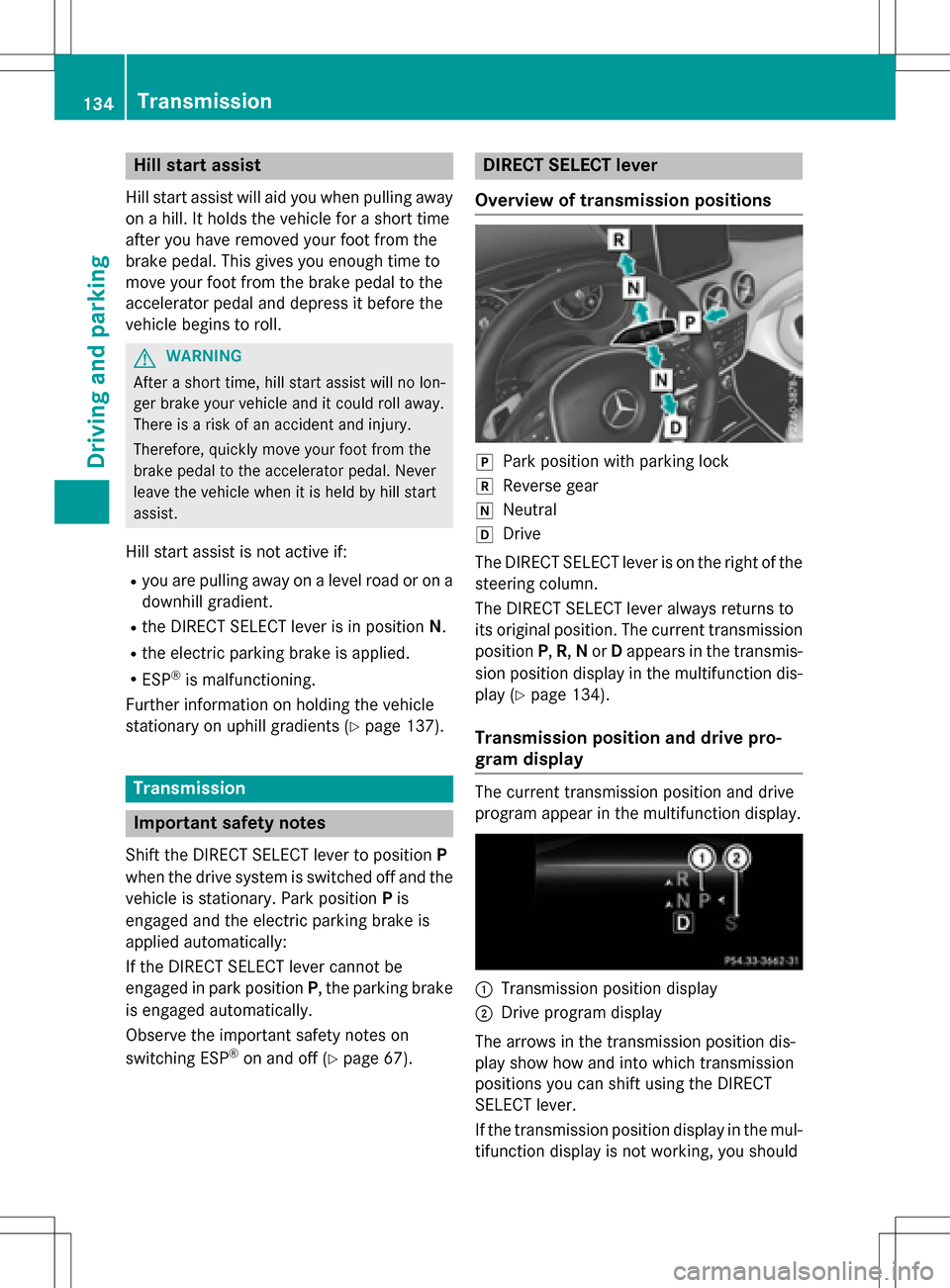
Overview of transmission positions
jPark position with parking lock
kReverse gear
iNeutral
hDrive
The DIRECT SELECT lever is on the right of the
steering column.
The DIRECT SELECT lever always returns to
its original position. The current transmission
position P,R, Nor Dappears in the transmis-
sion position display in the multifunction dis-
play (
Ypage 134).
Transmission position and drive pro-
gram display
The current transmission position and drive
program appear in the multifunction display.
:Transmission position display
;Drive program display
The arrows in the transmission position dis-
play show how and into which transmission
positions you can shift using the DIRECT
SELECT lever.
If the transmission position display in the mul-
tifunction display is not working, you should
134Transmission
Driving and parking
Page 137 of 342
pull away carefully to check whether the
desired transmission position is engaged.
Ideally, you should select transmission posi-
tionD.
Engaging park position P
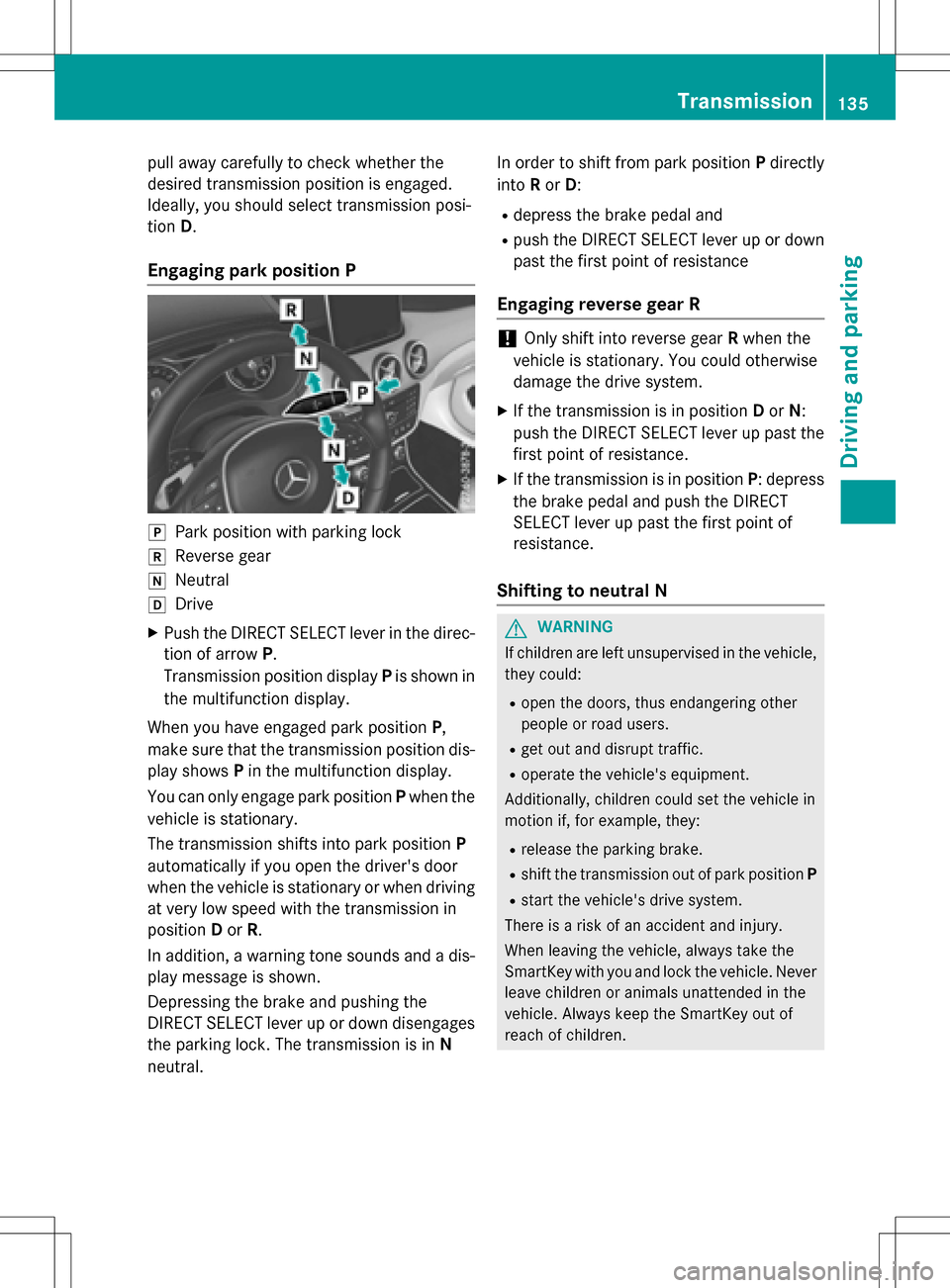
jPark position with parking lock
kReverse gear
iNeutral
hDrive
XPush the DIRECT SELECT lever in the direc-
tion of arrow P.
Transmission position display Pis shown in
the multifunction display.
When you have engaged park position P,
make sure that the transmission position dis-
play shows Pin the multifunction display.
You can only engage park position Pwhen the
vehicle is stationary.
The transmission shifts into park position P
automatically if you open the driver's door
when the vehicle is stationary or when driving
at very low speed with the transmission in
position Dor R.
In addition, a warning tone sounds and a dis-
play message is shown.
Depressing the brake and pushing the
DIRECT SELECT lever up or down disengages
the parking lock. The transmission is in N
neutral. In order to shift from park position
Pdirectly
into Ror D:
Rdepress the brake pedal and
Rpush the DIRECT SELECT lever up or down
past the first point of resistance
Engaging reverse gear R
!Only shift into reverse gear Rwhen the
vehicle is stationary. You could otherwise
damage the drive system.
XIf the transmission is in position Dor N:
push the DIRECT SELECT lever up past the
first point of resistance.
XIf the transmission is in position P: depress
the brake pedal and push the DIRECT
SELECT lever up past the first point of
resistance.
Shifting to neutral N
GWARNING
If children are left unsupervised in the vehicle,
they could:
Ropen the doors, thus endangering other
people or road users.
Rget out and disrupt traffic.
Roperate the vehicle's equipment.
Additionally, children could set the vehicle in
motion if, for example, they:
Rrelease the parking brake.
Rshift the transmission out of park position P
Rstart the vehicle's drive system.
There is a risk of an accident and injury.
When leaving the vehicle, always take the
SmartKey with you and lock the vehicle. Never
leave children or animals unattended in the
vehicle. Always keep the SmartKey out of
reach of children.
Transmission135
Driving and parking
Z
Page 138 of 342
XIf the transmission is in positionDor R:
push the DIRECT SELECT lever up or down to the first point of resistance.
XIf the transmission is in position P: depress
the brake pedal and push the DIRECT
SELECT lever up or down to the first point of resistance.
When the drive system is switched off, the
transmission shifts to Nautomatically.
With the SmartKey: if you then open the
driver's door or the front-passenger door or
remove the SmartKey from the ignition, the
transmission automatically shifts to P.
With the Start/Stop button: if you then
open the driver's door or the front-passenger
door, the transmission automatically shifts to
P.
If you want the transmission to remain in neu-
tral N, e.g. when having the vehicle cleaned in
an automatic car wash with a towing system:
Using the SmartKey:
XSwitch on the ignition.
XDepress the brake pedal and keep it
depressed.
XShift to neutral N.
XRelease the brake pedal.
XRelease the electric parking brake.
XSwitch off the ignition and leave the Smart-
Key in the ignition lock.
With the Start/Stop button:
XRemove the Start/Stop button from the
ignition lock.
XInsert the SmartKey into the ignition lock.
XSwitch on the ignition.
XDepress the brake pedal and keep it
depressed.
XShift to neutral N.
XRelease the brake pedal.
XRelease the electric parking brake.
XSwitch off the ignition and leave the Smart-
Key in the ignition lock.
Engaging drive position D
XIf the transmission is in position Ror N:
push the DIRECT SELECT lever down past
the first point of resistance.
XIf the transmission is in position P: depress
the brake pedal and push the DIRECT
SELECT lever down past the first point of
resistance.
Transmission positions
BPark position
This prevents the vehicle from roll-
ing away when stopped. Only move
the DIRECT SELECT lever to Pwhen
the vehicle is stationary.
The SmartKey can only be removed
when the DIRECT SELECT lever is in
position P. When there is no Smart-
Key in the ignition lock, the DIRECT
SELECT lever is locked in position
P.
CReverse gear
Only move the DIRECT SELECT
lever to Rwhen the vehicle is sta-
tionary.
ANeutral
No power is transmitted from the
drive system to the drive wheels.
Releasing the brakes will allow you
to move the vehicle freely.
If ESP
®is faulty: only move the
DIRECT SELECT lever to Nif the
vehicle is in danger of skidding, e.g.
on icy roads.
7Drive
For driving forwards
136Transmission
Driving and parking
Page 139 of 342
Drivingtips
Holding th e vehicle stationary on uphill
gradients
Do no t hold the vehicle stationary on uphill
gradients by depressing the accelerator
pedal. Instead, only ever hold the vehicle sta-
tionary on uphill gradients by:
Rdepressing the brake pedal
Rengaging the electric parking brake
Kickdown
Use kickdown for maximum acceleration.
XDepress th e accelerator pedal beyond the
pressure point.
The needle in the power display points to
th e boost are a(
Ypage 183).
XEase offthe accelerator pedal once the
desired speed is reached.
iMaximum acceleration is available fo ra
limited time.
Rocking the vehicle free
Shiftin gth e transmission repeatedly between
gears Dand Rmay help to free the vehicle if it
has become stuck in slush or snow. The vehi-
cle's engine management system limits the
speed to a maximum of 5 mph (9 km/h) when shifting back and forth. To shift back and forth
between transmission positions Dand R,
move th eDIREC T SELECT lever up and down
past the point of resistance.
Program selector button
The program selector button allows you to
choose between drive programs with differ-
ent driving characteristics .
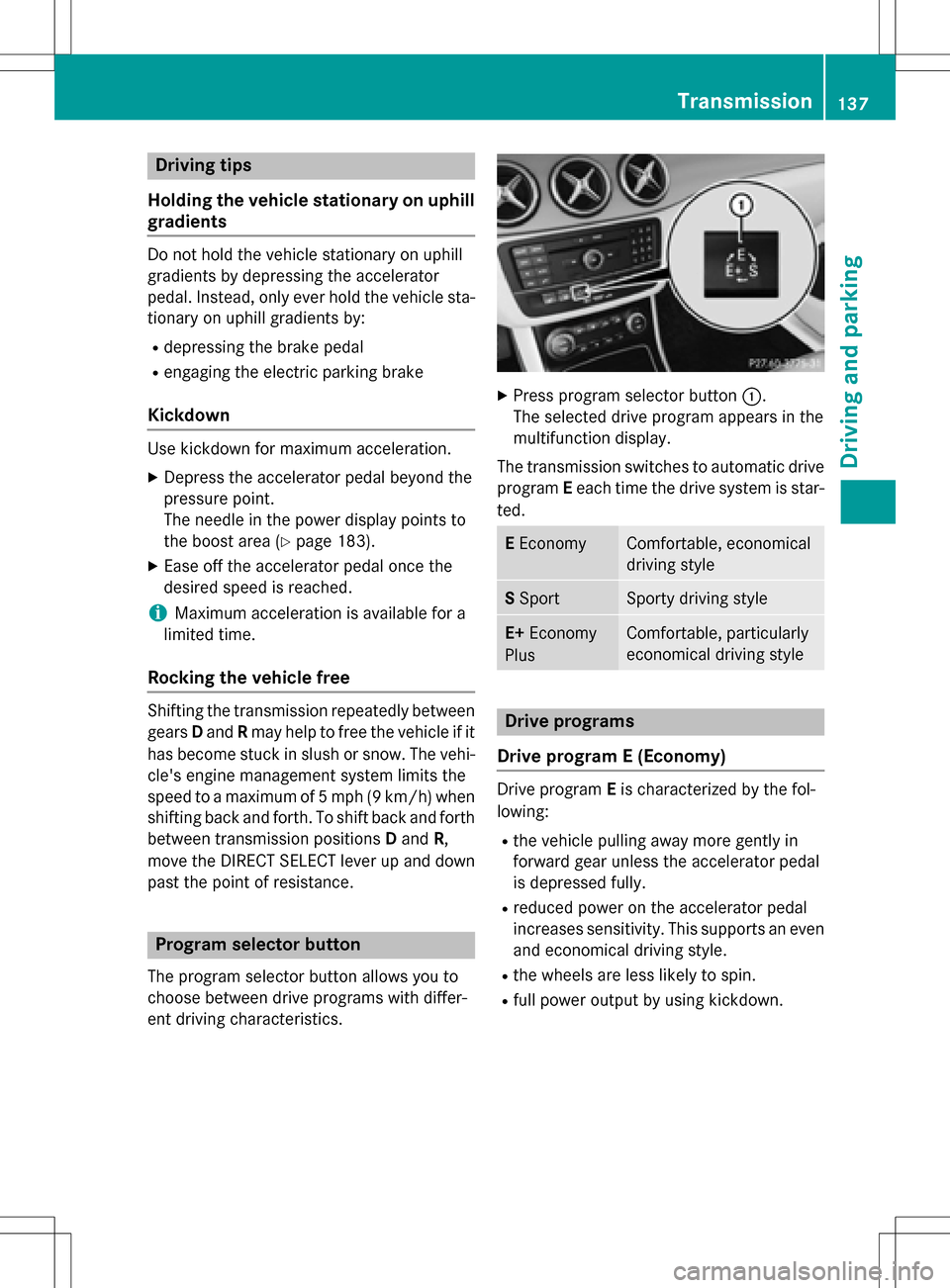
XPress program selector button :.
The selected drive program appears in the
multifunction display.
The transmission switches to automatic drive
program Eeach time th e drive system is star-
ted.
E EconomyComfortable, economical
driving style
S Spor tSporty driving style
E+Economy
PlusComfortable, particularly
economical driving style
Drive programs
Drive program E (Economy)
Drive program Eis characterized by the fol-
lowing:
Rth e vehicle pulling away more gently in
forward gear unless the accelerator pedal
is depressed fully.
Rreduced power on the accelerator pedal
increases sensitivity. This supports an even
and economical driving style.
Rth e wheels are less likely to spin.
Rfull power output by using kickdown.
Transmission137
Driving and parking
Z
Page 140 of 342
Drive program S (Sport)
Drive programSis characterized by the fol-
lowing:
Rth e vehicle exhibits sporty driving charac-
teristics .
Rthe entire power output can be utilized by
depressing the accelerator pedal.
E+ Economy Plus
Drive program E+is characterized by the fol-
lowing:
Rreduced torque and significantly reduced
power. This supports an especially efficient
and even driving style and results in a
reduction in speed to approximately
70 mph (110km/ h).
Rthe vehicle pulling away more gently in
forward gear unless the accelerator pedal
is depressed fully.
Rthe wheels are less likely to spin.
Rparticularly efficient overrun.
Rfull power output by using kickdown.
Rthe performance of air-conditioning system
and heating are reduced.
Steering wheel paddle shifters
Manually adjustable recuperation
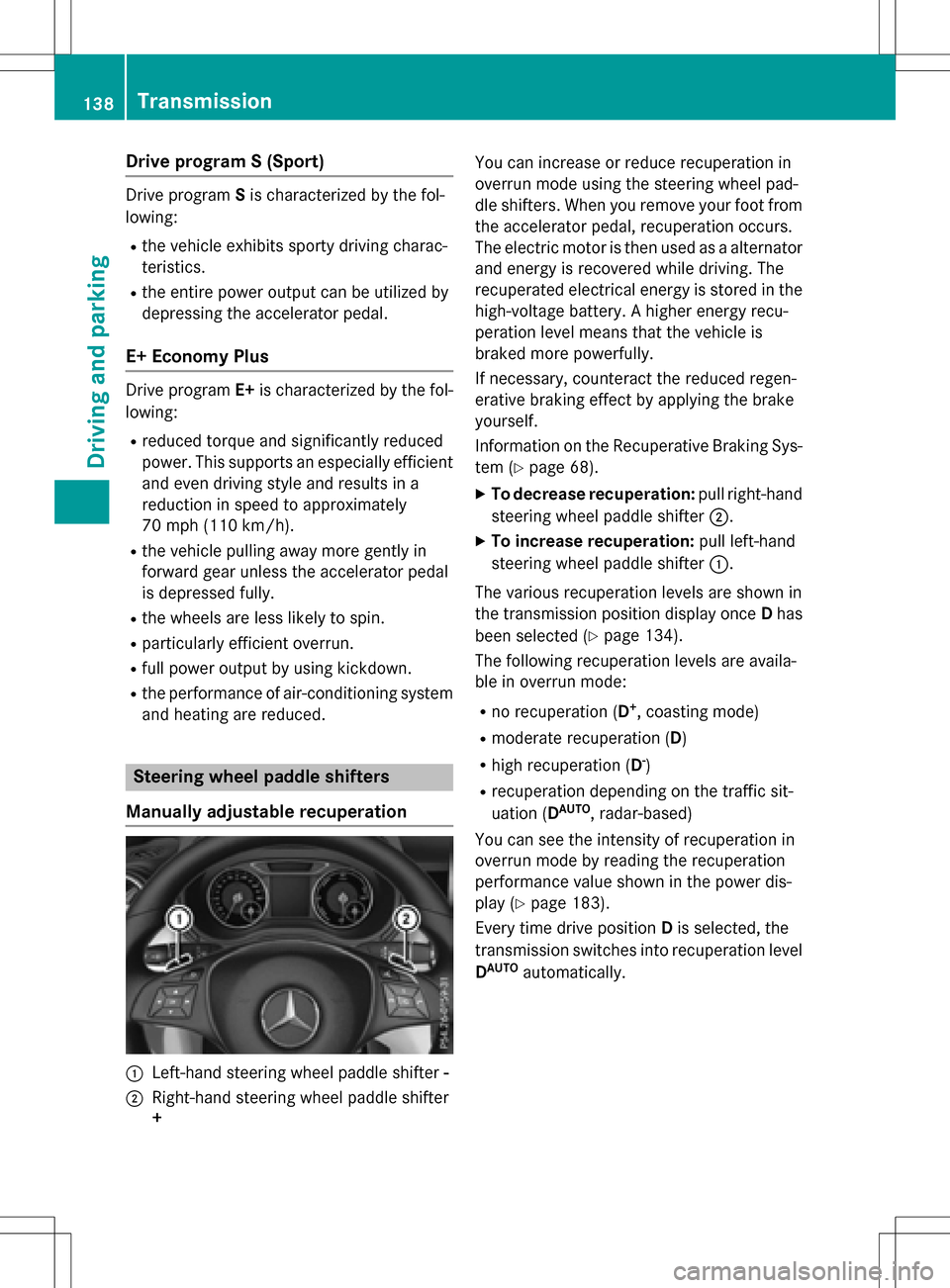
:Left-hand steering wheel paddle shifter -
;Right-hand steering wheel paddle shifter
+ You can increase or reduce recuperation in
overrun mode using the steering wheel pad-
dle shifters. When you remove your foot from
the accelerator pedal, recuperation occurs.
The electric motor is then used as a alternator
and energy is recovered while driving. The
recuperated electrical energy is stored in the
high-voltage battery. A higher energy recu-
peration level means that the vehicle is
braked more powerfully.
If necessary, counteract the reduced regen-
erative braking effect by applying the brake
yourself.
Information on the Recuperative Braking Sys-
tem (
Ypage 68).
XTo decrease recuperation:
pull right-hand
steering wheel paddle shifter ;.
XTo increase recuperation:pull left-hand
steering wheel paddle shifter :.
The various recuperation levels are shown in
the transmission position display once Dhas
been selected (
Ypage 134).
The following recuperation levels are availa-
ble in overrun mode:
Rno recuperation (D+, coasting mode)
Rmoderate recuperation (D )
Rhigh recuperation (D-)
Rrecuperation depending on the traffic sit-
uation (DAUTO, radar-based)
You can see the intensity of recuperation in
overrun mode by reading the recuperation
performance value shown in the power dis-
play (
Ypage 183).
Every time drive position Dis selected, the
transmission switches into recuperation level
D
AUTOautomatically.
138Transmission
Driving and parking
Page 141 of 342

The various different levels are to be used
under the following conditions:
D+Driving without much braking
and without the presence of
obstacles or sharp bends
The vehicle retains the maxi-
mum possible amount of kinetic
energy.
DNormal driving
D-Sporty driving or driving on a
downhill gradient
The brake pedal does not need
to be used as often because the
extent of the deceleration is
greater than inD.
Energy use when decelerating is
considerably higher than when
the vehicle is braked with the
brake pedal.
DAUTO
(radar-
based)
The intensity of recuperation is
automatically adjusted to the
current traffic situation.
Default setting
In levels Dand D-, deceleration can be con-
trolled in an infinitely variable manner using
the accelerator pedal.
The braking performance of the electric
motor using recuperative braking is, in some
operating modes, either reduced or not effec-
tive:
Rwhen the condition of charge of the high-
voltage battery increases
Rif the high-voltage battery is not yet at a
normal operating temperature
Rwhen driving close to the maximum design
speed
Rwhen the vehicle is almost stationary
Rin transmission position N
Rduring and after ESP stability control
If you do not make an additional effort to
apply the brake yourself, the braking effect may not be sufficient. If necessary, counter-
act the reduced regenerative braking effect
by applying the brake yourself.
Radar-based recuperation
The vehicle uses the sensors of COLLISION
PREVENTION ASSIST PLUS during radar-
based recuperation (D
AUTO). The sensors
detect the distance to the vehicle ahead and
its speed. The intensity of recuperation is
then automatically adjusted to the current
traffic situation.
The range can then be increased by storing
energy efficiently. Adjustment is infinitely var-
iable from overrun mode (no recuperation) to
maximum recuperation.
Maintain sufficient distance to the vehicle in
front. Mercedes-Benz recommends that you
activate COLLISION PREVENTION ASSIST
PLUS as a visual and acoustic aid.
Examples of radar-based recuperation:
RApproaching a slower vehicle, a decelerat-
ing vehicle or when following a vehicle
downhill. Your vehicle decelerates slightly
and increases recuperation.
RDriving when no vehicle is detected in front
or when a vehicle is detected in the far dis- tance or an accelerating vehicle is detec-
ted. Your vehicle switches to overrun mode
at higher speeds.
RDriving on a steep downhill slope. Acceler-
ation downhill is reduced and recuperation
is increased. This is comparable with shift-
ing down when driving downhill.
XTo activate radar-based recuperation:
pull steering wheel paddle shifter :or;
towards you and hold for about one second.
XTo deactivate radar-based recupera-
tion: briefly pull steering wheel paddle
shifter :or; towards you.
Transmission139
Driving and parking
Z
Page 142 of 342

If you change between radar-based and man-
ual recuperation, the following levels are acti-
vated depending on the selection via the
steering wheel paddle shifters:
:Steering
wheel paddle
shifter -selects D-(maximum
recuperation)
; Steering
wheel paddle
shifter +selects D+(overrun)
In particular, the function of the radar sensors
can be impaired in the case of:
Rthere is dirt on the sensors or anything else
covering the sensors
Rthere is snow or heavy rain
Rthere is interference by other radar sources
Rthere are strong radar reflections, for
example in parking garages
Ra narrow vehicle traveling in front, e.g. a
motorbike
Ra vehicle traveling in front on a different line
relative to the center of your vehicle
Following damage to the front end of the vehi-
cle, have the radar sensor settings and oper-
ation checked at a qualified specialist work-
shop immediately. This also applies to colli-
sions at slow speeds where there is no visible
damage to the front of the vehicle.
If the radar sensors are not available, the sys-
tem switches automatically to level Dwith
moderate recuperation. Have the radar sen-
sors checked at a qualified specialist work-
shop immediately.
Automatic adjustment of recuperation
on downhill gradients
The vehicle can detect steep downhill gradi-
ents. To reduce acceleration downhill and to
charge the high-voltage battery, recuperation
is increased steplessly. This is comparable to
the engine brake in a combustion engine
when you downshift a gear on a downhill gra-
dient. Automatic adjustment of recuperation on
downhill gradients is available in level
D
AUTO
or on vehicles without steering wheel paddle
shifters in levelD.
Intelligent recuperation
The vehicle uses the map and camera data of
Traffic Sign Assist in addition to the sensors
of COLLISION PREVENTION ASSIST PLUS
during radar-based recuperation (D
AUTO). The
rate of recuperation is then automatically
adjusted to the current traffic situation, tak-
ing the current and future maximum speed
into account.
High-voltage battery
Important safety notes
GDANGER
The vehicle's high-voltage electrical system is under high voltage. If you modify components
in the vehicle's high-voltage electrical system
or touch damaged components, you may be
electrocuted. The components in the vehi-
cle's high-voltage electrical system may be
damaged in an accident, although the damage
is not visible. There is a risk of fatal injury.
Following an accident, do not touch any high-
voltage components and never modify the
vehicle's high-voltage electrical system. Have
the vehicle towed away after an accident and
the vehicle's high-voltage electrical system
checked by a qualified specialist workshop.
GWARNING
In the event of a vehicle fire, the internal pres- sure of the high-voltage battery can exceed a
critical value. In this case flammable gas
escapes through a ventilation valve on the
underbody. The gas can ignite. There is a risk
of injury.
Leave the danger zone immediately. Secure
the danger area at a suitable distance, whilst
observing legal requirements.
140High-voltage battery
Driving and parking