2016 LINCOLN MKZ HYBRID inflation pressure
[x] Cancel search: inflation pressurePage 340 of 543
Improper or inadequate vehicle
maintenance can cause tires to wear
abnormally. Inspect all your tires,
including the spare, frequently, and
replace them if one or more of the
following conditions exist:
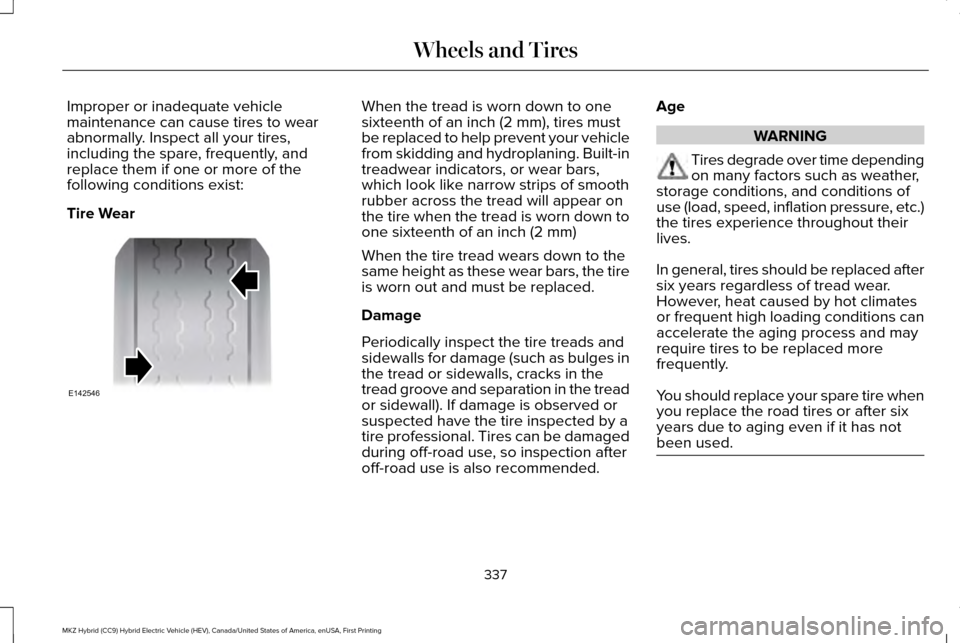
Tire Wear When the tread is worn down to one
sixteenth of an inch (2 mm), tires must
be replaced to help prevent your vehicle
from skidding and hydroplaning. Built-in
treadwear indicators, or wear bars,
which look like narrow strips of smooth
rubber across the tread will appear on
the tire when the tread is worn down to
one sixteenth of an inch (2 mm)
When the tire tread wears down to the
same height as these wear bars, the tire
is worn out and must be replaced.
Damage
Periodically inspect the tire treads and
sidewalls for damage (such as bulges in
the tread or sidewalls, cracks in the
tread groove and separation in the tread
or sidewall). If damage is observed or
suspected have the tire inspected by a
tire professional. Tires can be damaged
during off-road use, so inspection after
off-road use is also recommended.
Age WARNING
Tires degrade over time depending
on many factors such as weather,
storage conditions, and conditions of
use (load, speed, inflation pressure, etc.)
the tires experience throughout their
lives.
In general, tires should be replaced after
six years regardless of tread wear.
However, heat caused by hot climates
or frequent high loading conditions can
accelerate the aging process and may
require tires to be replaced more
frequently.
You should replace your spare tire when
you replace the road tires or after six
years due to aging even if it has not
been used. 337
MKZ Hybrid (CC9) Hybrid Electric Vehicle (HEV), Canada/United States of America, enUSA, First Printing Wheels and TiresE142546
Page 343 of 543
Highway Hazards
No matter how carefully you drive
there
’s always the possibility that you
may eventually have a flat tire on the
highway. Drive slowly to the closest safe
area out of traffic. This may further
damage the flat tire, but your safety is
more important.
If you feel a sudden vibration or ride
disturbance while driving, or you suspect
your tire or vehicle has been damaged,
immediately reduce your speed. Drive
with caution until you can safely pull off
the road. Stop and inspect the tires for
damage. If you cannot detect a cause,
have the vehicle towed to the nearest
repair facility or tire dealer to have the
vehicle inspected. Tire and Wheel Alignment
A bad jolt from hitting a curb or pothole
can cause the front end of your vehicle
to become misaligned or cause damage
to your tires. If your vehicle seems to
pull to one side when you’re driving, the
wheels may be out of alignment. Have
an authorized dealer check the wheel
alignment periodically.
Wheel misalignment in the front or the
rear can cause uneven and rapid
treadwear of your tires and should be
corrected by an authorized dealer.
Front-wheel drive vehicles and those
with an optional independent rear
suspension may require alignment of all
four wheels.
You should balance the tires
periodically. An unbalanced tire and
wheel assembly may result in irregular
tire wear.Tire Rotation
Note:
If your tires show uneven wear
ask an authorized dealer to check for
and correct any wheel misalignment,
tire imbalance or mechanical problem
involved before tire rotation.
Note: Your vehicle may be equipped
with a dissimilar spare wheel and tire
assembly. A dissimilar spare wheel and
tire assembly is defined as a spare
wheel and tire assembly that is different
in brand, size or appearance from the
road tires and wheels. If you have a
dissimilar spare wheel and tire assembly
it is intended for temporary use only and
should not be used in a tire rotation.
Note: After having your tires rotated,
inflation pressure must be checked and
adjusted to the vehicle requirements.
Rotating your tires at the recommended
interval (as indicated in the Scheduled
Maintenance chapter) will help your tires
wear more evenly, providing better tire
performance and longer tire life.
340
MKZ Hybrid (CC9) Hybrid Electric Vehicle (HEV), Canada/United States of America, enUSA, First Printing Wheels and Tires
Page 345 of 543

vehicle with the tires installed, or checking
tire inflation. Do not place tires near heaters
or heating devices used to warm the room
where the tires are stored. Do not apply heat
or blow heated air directly on the tires.
Always inspect the tires after storage periods
and before use.
USING SNOW CHAINS
WARNINGS
If you choose to install snow tires on
your vehicle, they must be the same
size, construction, and load range as the
original tires listed on the tire placard, and
they must be installed on all four wheels.
Mixing tires of different size or construction
on your vehicle can adversely affect your
vehicle's handling and braking, and may lead
to loss of vehicle control. Do not use snow chains or cables on
this vehicle as they may cause damage
to your vehicle which may lead to loss of
vehicle control. Snow chains have not been approved for
use on your vehicle.
The original equipment tires on your vehicle
may have an all-weather tread design to
provide traction, handling, and braking
performance in year-round driving. You may
install snow tires for improved traction when
driving in areas with sustained periods of
snow or icy driving conditions.
TIRE PRESSURE MONITORING
SYSTEM
WARNING
The tire pressure monitoring system is
NOT a substitute for manually checking
tire pressure. The tire pressure should be
checked periodically (at least monthly) using
a tire gauge, see Inflating your tires in this
chapter. Failure to properly maintain your
tire pressure could increase the risk of tire
failure, loss of control, vehicle rollover and
personal injury. Each tire, including the spare (if
provided), should be checked
monthly when cold and inflated to
the inflation pressure recommended by the
vehicle manufacturer on the vehicle placard
or tire inflation pressure label. (If your vehicle
has tires of a different size than the size
indicated on the vehicle placard or tire
inflation pressure label, you should
determine the proper tire inflation pressure
for those tires.)
As an added safety feature, your vehicle has
been equipped with a tire pressure
monitoring system (TPMS) that illuminates a
low tire pressure telltale when one or more
of your tires is significantly under-inflated.
Accordingly, when the low tire pressure
telltale illuminates, you should stop and
check your tires as soon as possible, and
inflate them to the proper pressure. Driving
on a significantly under-inflated tire causes
the tire to overheat and can lead to tire
failure. Under-inflation also reduces fuel
efficiency and tire tread life, and may affect
the vehicle ’s handling and stopping ability.
342
MKZ Hybrid (CC9) Hybrid Electric Vehicle (HEV), Canada/United States of America, enUSA, First Printing Wheels and Tires
Page 346 of 543

Please note that the TPMS is not a substitute
for proper tire maintenance, and it is the
driver’
s responsibility to maintain correct tire
pressure, even if under-inflation has not
reached the level to trigger illumination of
the TPMS low tire pressure telltale.
Your vehicle has also been equipped with a
TPMS malfunction indicator to indicate when
the system is not operating properly. The
malfunction indicator is combined with the
low tire pressure telltale. When the system
detects a malfunction, the telltale will flash
for approximately one minute and then
remain continuously illuminated. This
sequence will continue upon subsequent
vehicle start-ups as long as the malfunction
exists.
When the malfunction indicator is illuminated,
the system may not be able to detect or
signal low tire pressure as intended. TPMS
malfunctions may occur for a variety of
reasons, including the installation of
replacement or alternate tires or wheels on
the vehicle that prevent the TPMS from functioning properly. Always check the TPMS
malfunction telltale after replacing one or
more tires or wheels on your vehicle to
ensure that the replacement or alternate tires
and wheels allow the TPMS to continue to
function properly.
The tire pressure monitoring system
complies with part 15 of the FCC rules and
with RSS-210 of Industry Canada. Operation
is subject to the following two conditions: (1)
This device may not cause harmful
interference, and (2) This device must accept
any interference received, including
interference that may cause undesired
operation.
Changing Tires with a Tire Pressure
Monitoring System Note:
Each road tire is equipped with a tire
pressure sensor located inside the wheel
and tire assembly cavity. The pressure
sensor is attached to the valve stem. The
pressure sensor is covered by the tire and
is not visible unless the tire is removed. Care
must be taken when changing the tire to
avoid damaging the sensor
It is recommended that you always have your
tires serviced by an authorized dealer.
343
MKZ Hybrid (CC9) Hybrid Electric Vehicle (HEV), Canada/United States of America, enUSA, First Printing Wheels and TiresE142549
Page 349 of 543

When Inflating your Tires
When putting air into your tires (such as at a
gas station or in your garage), the tire
pressure monitoring system may not respond
immediately to the air added to your tires.
It may take up to two minutes of driving over
20 mph (32 km/h) for the light to turn off after
you have filled your tires to the
recommended inflation pressure
How Temperature Affects your Tire
Pressure
The tire pressure monitoring system monitors
tire pressure in each pneumatic tire. While
driving in a normal manner, a typical
passenger tire inflation pressure may
increase approximately 2 to 4 psi (14 to 28
kPa) from a cold start situation. If the vehicle
is stationary overnight with the outside
temperature significantly lower than the
daytime temperature, the tire pressure may
decrease approximately 3 psi (21 kPa) for a
drop of 30°F (17°C) in ambient temperature.This lower pressure value may be detected
by the TPMS as being significantly lower than
the recommended inflation pressure and
activate the TPMS warning light for low tire
pressure. If the low tire pressure warning
light is on, visually check each tire to verify
that no tire is flat. (If one or more tires are
flat, repair as necessary.) Check air pressure
in the road tires. If any tire is under-inflated,
carefully drive the vehicle to the nearest
location where air can be added to the tires.
Inflate all the tires to the recommended
inflation pressure.
346
MKZ Hybrid (CC9) Hybrid Electric Vehicle (HEV), Canada/United States of America, enUSA, First Printing Wheels and Tires
Page 540 of 543

Safety Precautions........................................177
Scheduled Maintenance Record..............489
Scheduled Maintenance
.............................479
Seats.................................................................146
Security..............................................................77
Settings...........................................................376 Clock......................................................................376
Display...................................................................377
Settings.................................................................383
Sound....................................................................379
Vehicle..................................................................380
Side Airbags
.....................................................49
Side Curtain Airbags......................................50
Sitting in the Correct Position....................146
Snow Chains See: Using Snow Chains..................................342
Special Notices
.................................................13
New Vehicle Limited Warranty...........................13
Special Instructions...............................................13
Special Operating Conditions Scheduled Maintenance...............................................486
Exceptions............................................................488
Speed Control See: Cruise Control.............................................214
Stability Control
............................................202
Principle of Operation.......................................202 Starting a Gasoline Engine
.........................167
Automatic Shutdown..........................................168
Fast Restart...........................................................168
Guarding Against Exhaust Fumes..................169
Important Ventilating Information...................169
Switching Off the Vehicle When It Is
Moving...............................................................169
Switching Off the Vehicle When It Is Stationary..........................................................169
Starting and Stopping the Engine
.............166
General Information............................................166
Steering ...........................................................
234
Electric Power Steering....................................234
Steering Wheel
................................................80
Storage Compartments...............................165
Sunroof See: Moonroof.....................................................100
Sun Shades
......................................................99
Sun Visors.........................................................99
Illuminated Vanity Mirror.....................................99
Supplementary Restraints System
.............44
Principle of Operation..........................................44
Symbols Glossary
..............................................7
T
Technical Specifications See: Capacities and Specifications...............349 Temporary Mobility Kit.................................314
First Stage: Reinflating the Tire with Sealing
Compound and Air.........................................316
General Information............................................314
Second Stage: Checking Tire Pressure.........
317
Tips for Use of the Kit.........................................315
Type 1......................................................................314
Type 2...................................................................320
What to do after the Tire has been Sealed................................................................318
What to do when a Tire Is Punctured............316
The Better Business Bureau (BBB) Auto Line Program (U.S. Only)
..........................264
Tire Care.........................................................327 Glossary of Tire Terminology..........................329
Information About Uniform Tire Quality
Grading.............................................................327
Information Contained on the Tire Sidewall............................................................330
Temperature A B C............................................328
Traction AA A B C...............................................328
Treadwear............................................................328
Tire Inflation When Punctured See: Temporary Mobility Kit..............................314
537
MKZ Hybrid (CC9) Hybrid Electric Vehicle (HEV), Canada/United States of America, enUSA, First Printing Index