591-1. For safe use
1
For safety and security
LS460/LS460L_GE (OM50G06E)
■If the SRS airbags deploy (inflate)
●Slight abrasions, burns, bruising etc., may be sustained from SRS airbags, due to
the extremely high speed deployment (inflation) by hot gases.
●A loud noise and white powder will be emitted.
●Parts of the airbag module (steering wheel hub, airbag cover and inflator) as well as
the seats, parts of the front and rear pillars, and roof side rails, may be hot for sev-
eral minutes. The airbag itself may also be hot.
●The windshield may crack.
●Vehicles with ERA-GLONASS: If the SRS airbags deploy, the system is designed
to send an emergency call* to the Public Safety Answering Point (PSAP), notifying
them of the vehicle's location (without needing to push the “SOS” button) and an
agent will attempt to speak with the occupants to ascertain the level of emergency
and assistance required. If the occupants are unable to communicate, the agent
automatically treats the call as an emergency and helps to dispatch the necessary
emergency services. ( P. 504)
*: In some cases, the call cannot be made. (P. 506)
■SRS airbag deployment conditions (SRS front airbags and SRS seat cushion air-
bag)
●The SRS front airbags and SRS seat cushion airbag will deploy in the event of an
impact that exceeds the set threshold level (the level of force corresponding to an
approximately 20 - 30 km/h [12 - 18 mph] frontal collision with a fixed wall that
does not move or deform).
However, this threshold velocity will be considerably higher in the following situa-
tions:
• If the vehicle strikes an object, such as a parked vehicle or sign pole, which can
move or deform on impact
• If the vehicle is involved in an underride collision, such as a collision in which the
front of the vehicle “underrides”, or goes under, the bed of a truck
●Depending on the type of collision, it is possible that only the seat belt pretension-
ers will activate.
●Front passenger occupant classification system: The SRS front passenger airbag
will not activate, if there is no passenger sitting in the front passenger seat. How-
ever, the SRS front passenger airbag may deploy, if luggage is put in the seat, or the
seat belt is fastened, even if the seat is unoccupied.
631-1. For safe use
1
For safety and security
LS460/LS460L_GE (OM50G06E)
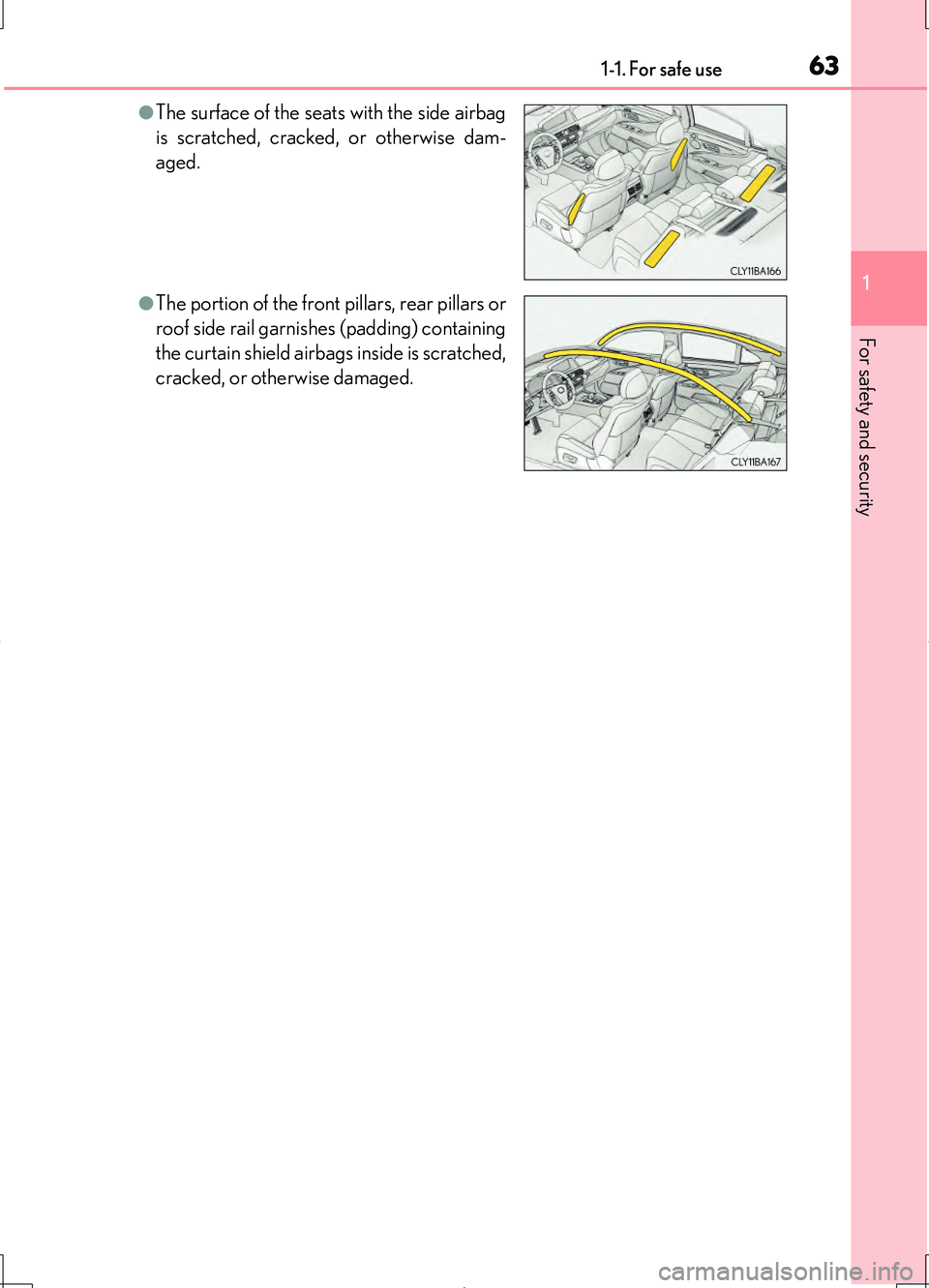
●The surface of the seats with the side airbag
is scratched, cracked, or otherwise dam-
aged.
●The portion of the front pillars, rear pillars or
roof side rail garnishes (padding) containing
the curtain shield airbags inside is scratched,
cracked, or otherwise damaged.
4044-6. Driving tips
LS460/LS460L_GE (OM50G06E)
◆Air conditioning
Use the air conditioning only when necessary. Doing so can help reduce
excessive fuel consumption.
In summer: When the ambient temperature is high, use the recirculated air
mode. Doing so will help to reduce the burden on the air conditioning system
and reduce fuel consumption as well.
In winter: Turn the A/C switch on only when both heating and dehumidifying
are needed, and if only heating is needed, turn the A/C switch off. Turning the
A/C switch on when unnecessary leads to excessive fuel consumption.
◆Performing idling stops
●Avoid unnecessary idling. Stop the engine when parking the vehicle to
reduce excessive fuel consumption, even it is only for a short period of time.
●Except in severe environment, such as when the outside temperature is
extremely low, warming up the engine before driving is unnecessary.
Rather than idling, it is more efficien t to drive the vehicle gently to warm up
each part while avoiding increasing the engine revolutions unnecessarily
and accelerating or decelerating suddenly.
◆Luggage
Carrying heavy luggage will lead to poor fuel economy. Avoid carrying
unnecessary luggage. Installing a large roof rack will also cause poor fuel
economy.
◆Regular maintenance
●Make sure to check the tire inflation pressure frequently. Improper tire
inflation pressure can cause poor fuel economy. Also, as snow tires can
cause large amounts of friction, their us e on dry roads can lead to poor fuel
economy. Use tires that are appropri ate for the season and road condi-
tions.
●Use oil and fluid of the recommended quality, which affect fuel consump-
tion and the life of the vehicle. Also, check oil and fluid periodically.
( P. 520)