Page 518 of 708

5186-2. Maintenance
LS460/LS460L_GE (OM50G06E)
What about do-it-yourself maintenance?
Many of the maintenance items are easy to do yourself if you have a little mechan-
ical ability and a few basic automotive tools. Simple instructions for how to per-
form them are presented in this section.
Note, however, that some maintenance tasks require special tools and skills.
These are best performed by qualified technicians. Even if you are an experi-
enced do-it-yourself mechanic, we recommend that repairs and maintenance be
conducted by your Lexus dealer who will keep a record of maintenance on your
vehicle. This record could be helpful should you ever require Warranty Service.
■Does your vehicle need repairs?
Be on the alert for changes in performance and sounds, and visual tip-offs that indi-
cate service is needed. Some important clues are:
●Engine missing, stumbling or pinging
●Appreciable loss of power
●Strange engine noises
●A fluid leak under the vehicle (However, water dripping from the air conditioning
system after use is normal.)
●Change in exhaust sound (This may indicate a dangerous carbon monoxide leak.
Drive with the windows open and have the exhaust system checked immediately.)
●Flat-looking tires, excessive tire squeal when cornering, uneven tire wear
●Vehicle pulls to one side when driven straight on a level road
●Strange noises related to suspension movement
●Loss of brake effectiveness, spongy feeling brake pedal, pedal almost touches the
floor, vehicle pulls to one side when braking
●Engine coolant temperature continually higher than normal ( P. 125)
If you notice any of these clues, take your vehicle to your Lexus dealer as soon as
possible. Your vehicle may need adjustment or repair.
Do-it-yourself maintenance
Page 522 of 708

5226-2. Maintenance
LS460/LS460L_GE (OM50G06E)
CHASSIS AND BODY
13Brake pedal <>IIIIIIII6
14Brake linings and drumsIIII12
15Brake pads and discsIIIIIIII6
16Brake fluidIIIRIIIRI: 6
R: 24
17Brake pipes and hosesIIII12
18Steering wheel, linkage and
steering gear boxIIII12
19Drive shaft bootsIIII24
20Suspension ball joint and
dust coverIIII12
21Automatic transmission fluidII24
22Transfer oil (AWD models)IRIRI: 12
R: 48
23Front differential oil (AWD
models)IRIRI: 12
R: 48
24Rear differential oilIRIRI: 12
R: 48
25Front and rear suspension
<>IIII12
26Tires and inflation pressureIIIIIIII6
27Lights, horns, wipers and
washersIIIIIIII6
28Air conditioning filter
When a message on the multi-information
display indicates that maintenance is
required, replace the filter.
Refrigerant amount for air condi-
tionerIIII12
Maintenance operations:I =Inspect
R =Replace, change or lubricate
SERVICE
INTERVAL:ODOMETER READING
MONTHS(Odometer
reading or
months,
whichever
comes first.)
x1000 km1020304050607080
x1000 miles612182430364248
Page 529 of 708

5296-2. Maintenance
6
Maintenance and care
LS460/LS460L_GE (OM50G06E)
NOTE:
1. First replace at 160000 km (100000 miles), then replace every 80000 km
(48000 miles).
2. It is possible to replace every 100000 km (60000 miles).
3. Including the filter in fuel tank.
4. Parking brake inspection is not necessary.
CHASSIS AND BODY
17Brake pipes and hosesIIIIII12
18Steering wheel, linkage and steering
gear boxIIIIII12
19Drive shaft bootsIIIIII24
20Suspension ball joint and dust coverIIIIII12
21Automatic transmission fluidII36
22Rear differential oilIRIRIRI: 12
R: 48
23Front and rear suspensionIIIIII12
24Tires and inflation pressureIIIIII12
25Lights, horns, wipers and washersIIIIII12
26Air conditioning filter
When a message on the multi-
information display indicates that
maintenance is required, replace
the filter.
Refrigerant amount for air conditionerIIIIII12
Maintenance operations:I =Inspect
R =Replace, change or lubricate
SERVICE INTERVAL:ODOMETER READING
(Odometer reading or
months, whichever
comes first.)
x1000 km153045607590
MONTHSx1000
miles91827364554
Page 556 of 708
5566-3. Do-it-yourself maintenance
LS460/LS460L_GE (OM50G06E)
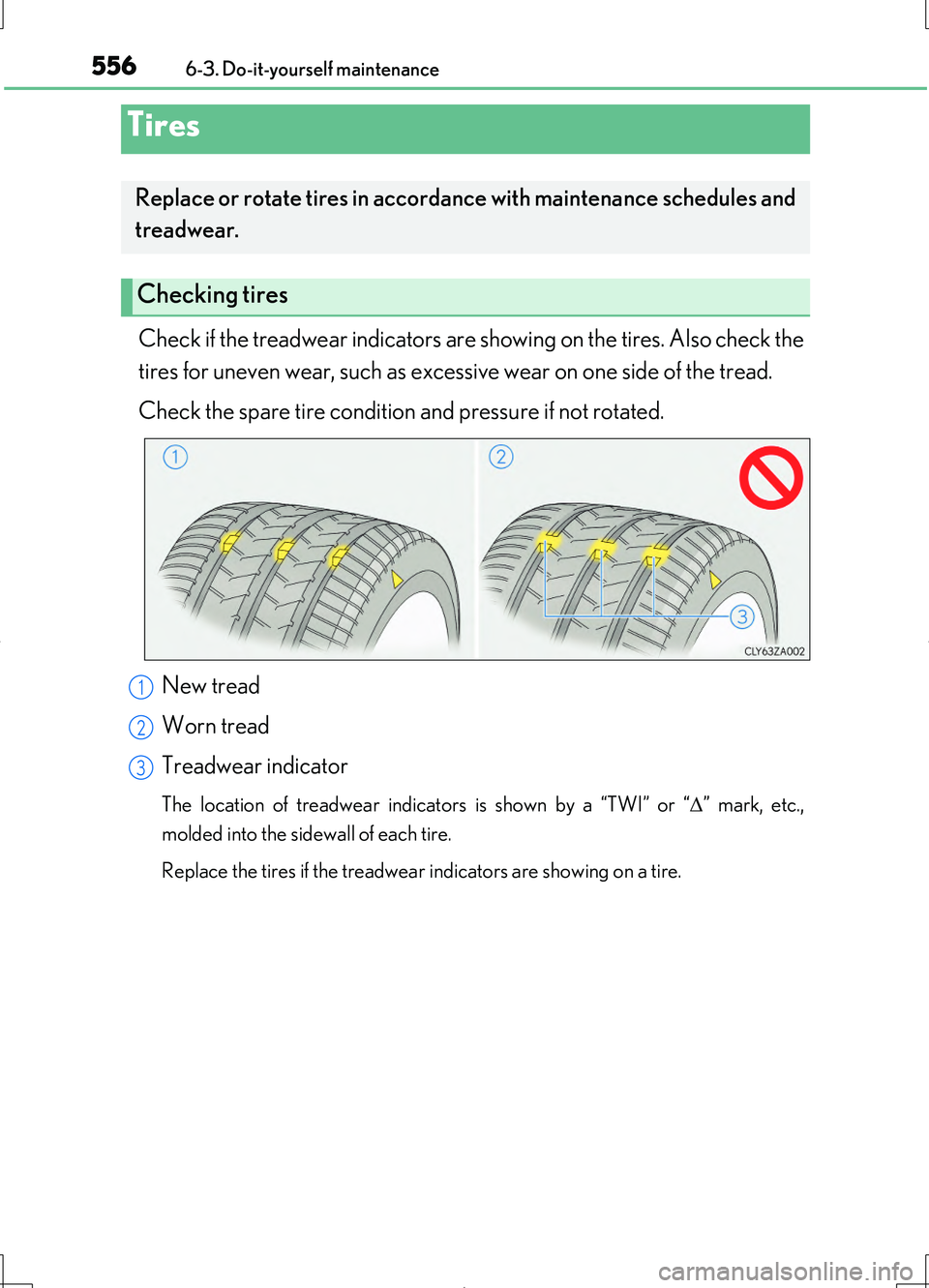
Check if the treadwear indicators are showing on the tires. Also check the
tires for uneven wear, such as excessive wear on one side of the tread.
Check the spare tire condition and pressure if not rotated.
New tread
Worn tread
Treadwear indicator
The location of treadwear indicators is shown by a “TWI” or “ ” mark, etc.,
molded into the sidewall of each tire.
Replace the tires if the treadwear indicators are showing on a tire.
Tires
Replace or rotate tires in accord ance with maintenance schedules and
treadwear.
Checking tires
1
2
3
Page 557 of 708
5576-3. Do-it-yourself maintenance
6
Maintenance and care
LS460/LS460L_GE (OM50G06E)
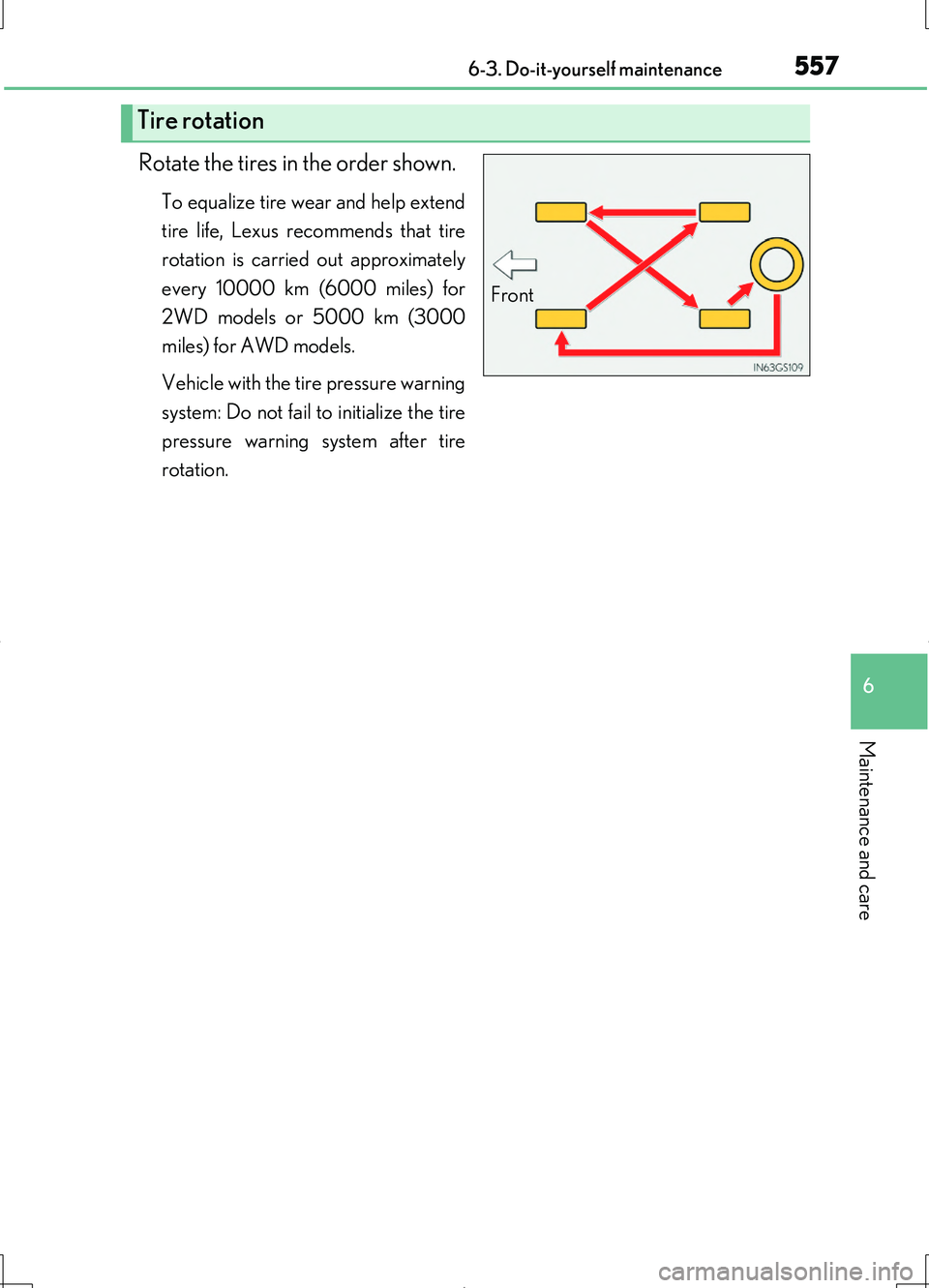
Rotate the tires in the order shown.
To equalize tire wear and help extend
tire life, Lexus recommends that tire
rotation is carried out approximately
every 10000 km (6000 miles) for
2WD models or 5000 km (3000
miles) for AWD models.
Vehicle with the tire pressure warning
system: Do not fail to initialize the tire
pressure warning system after tire
rotation.
Tire rotation
Front
Page 558 of 708

5586-3. Do-it-yourself maintenance
LS460/LS460L_GE (OM50G06E)
Your vehicle is equipped with a tire pressure warning system that uses tire
pressure warning valves and transmitters to detect low tire inflation pres-
sure before serious problems arise.
●If the tire pressure drops below a predetermined level, the driver is
warned by a screen display and a warning light. ( P. 609, 614)
◆Installing tire pressure wa rning valves and transmitters
When replacing tires or wheels, tire pressure warning valves and trans-
mitters must also be installed.
When new tire pressure warning valves and transmitters are installed,
new ID codes must be registered in the tire pressure warning computer
and the tire pressure warning system must be initialized. Have tire pres-
sure warning valve and transmitter ID codes registered by your Lexus
dealer. ( P. 560)
◆Initializing the tire pressure warning system
■The tire pressure warning system must be initialized in the following
circumstances:
●When rotating the tires.
●When the tire inflation pressure is changed such as when changing
traveling speed. ( P. 660, 662)
●When changing the tire size.
When the tire pressure warning system is initialized, the current tire
inflation pressure is set as the benchmark pressure.
Tire pressure warning system (if equipped)
●The tire pressure detected by the tire pressure
warning system can be displayed on the multi-
information display. ( P. 133)
Page 560 of 708

5606-3. Do-it-yourself maintenance
LS460/LS460L_GE (OM50G06E)
◆Registering ID codes
The tire pressure warning valve and transmitter is equipped with a
unique ID code. When replacing a tire pressure warning valve and
transmitter, it is necessary to register the ID code. Have the ID code
registered by your Lexus dealer.
■When to replace your vehicle’s tires
Tires should be replaced if:
●The treadwear indicators are showing on a tire.
●You have tire damage such as cuts, splits, cracks deep enough to expose the fabric,
and bulges indicating internal damage
●A tire goes flat repeatedly or cannot be properly repaired due to the size or loca-
tion of a cut or other damage
If you are not sure, consult with your Lexus dealer.
■Replacing tires and wheels (vehicles with the tire pressure warning system)
If the ID code of the tire pressure warning valve and transmitter is not registered, the
tire pressure warning system will not work properly. After driving for about 10 min-
utes, the tire pressure warning light blinks for 1 minute and stays on to indicate a sys-
tem malfunction.
■Tire life
Any tire over 6 years old must be checked by a qualified technician even if it has sel-
dom or never been used or damage is not obvious.
■Routine tire inflation pressure checks (vehicles with the tire pressure warning sys-
tem)
The tire pressure warning system does not replace routine tire inflation pressure
checks. Make sure to check tire inflation pressure as part of your routine of daily
vehicle checks.
■When rotating the tires (vehicles with the tire pressure warning system)
Make sure that the engine switch is off. If the tires are rotated while the engine switch
is in IGNITION ON mode, the tire position information will not be updated.
If this accidentally occurs, either turn the engine switch to off and then to IGNITION
ON mode, or initialize the system after checking that the tire pressure is properly
adjusted.
Page 561 of 708

5616-3. Do-it-yourself maintenance
6
Maintenance and care
LS460/LS460L_GE (OM50G06E)
■If the tread on snow tires wears down below 4 mm (0.16 in.)
The effectiveness of the tires as snow tires is lost.
■Situations in which the tire pressure warning system may not operate properly
(vehicles with the tire pressure warning system)
●In the following cases, the tire pressure warning system may not operate properly.
• If non-genuine Lexus wheels are used.
• A tire has been replaced with a tire that is not an OE (Original Equipment) tire.
• A tire has been replaced with a tire that is not of the specified size.
• Tire chains etc. are equipped.
• An auxiliary-supported run-flat tire is equipped.
• If a window tint that affects the radio wave signals is installed.
• If there is a lot of snow or ice on the vehicle, particularly around the wheels or
wheel housings.
• If the tire inflation pressure is extr emely higher than the specified level.
• If the spare tire is in a location subject to poor radio wave signal reception.
• If a large metallic object which can interfere with signal reception is put in the
trunk.
• If tires not equipped with tire pressure warning valves and transmitters are used.
• If the ID code on the tire pressure warning valves and transmitters is not regis-
tered in the tire pressure warning computer.
●Performance may be affected in the following situations.
• Near a TV tower, electric power plant, gas station, radio station, large display,
airport or other facility th at generates strong radio waves or electrical noise
• When carrying a portable radio, cellular phone, cordless phone or other wire-
less communication device
If tire position information is not correctly displayed due to the radio wave condi-
tions, the display may be corrected by driving and changing the radio wave condi-
tions.
●When the vehicle is parked, the time taken for the warning to start or go off could
be extended.
●When tire inflation pressure declines rapidly for example when a tire has burst, the
warning may not function.