2016 Lexus GS350 fuel cap
[x] Cancel search: fuel capPage 390 of 624

390
GS350_200t_GS F_OM_OM30E86U_(U)6-2. Maintenance
Emission inspection an
d maintenance (I/M)
programs
The OBD system determines that a problem exists somewhere in the emission
control system. Your vehicle may not pa ss the I/M test and may need to be
repaired. Contact your Lexus dealer to service the vehicle.
●When the battery is disconnected or discharged
Readiness codes that are set during ordinary driving are erased.
Also, depending on your driving habits, the readiness codes may not be com-
pletely set.
●When the fuel tank cap is loose
The malfunction indicator lamp comes on indicating a temporary malfunction
and your vehicle may not pass the I/M test.
The error code in the OBD system will not be cleared unless the vehicle is driven
40 or more times.
Contact your Lexus dealer to prepare the vehicle for re-testing.
Some states have vehicle emission inspection programs which include OBD
(On Board Diagnostics) checks. The OBD system monitors the operation of
the emission control system.
If the malfunction indicator lamp comes on
Your vehicle may not pass the I/M test in the following situations:
When the malfunction indicator lamp s till remains on after several driv-
ing trips
If your vehicle does not pass the I/M test
Page 423 of 624

GS350_200t_GS F_OM_OM30E86U_(U)
4236-3. Do-it-yourself maintenance
6
Maintenance and care
Tire valve
Tire pressure gauge
Remove the tire valve cap.
Press the tip of the tire pressure gauge onto the tire valve.
Read the pressure using the gauge gradations.
If the tire inflation pressure is not at the recommended level, adjust the pres-
sure.
If you add too much air, press the center of the valve to deflate.
After completing the tire inflation pressure measurement and adjustment,
apply soapy water to the valve and check for leakage.
Put the tire valve cap back on.
■Tire inflation pressure check interval
You should check tire inflation pressure ev ery two weeks, or at least once a month.
Do not forget to check the spare.
■Effects of incorrect tire inflation pressure
Driving with incorrect tire inflation pressure may result in the following:
●Reduced fuel economy
●Reduced driving comfort and poor handling
●Reduced tire life due to wear
●Reduced safety
●Damage to the drive train
If a tire needs frequent inflating, ha ve it checked by your Lexus dealer.
Inspection and adjustment procedure
1
2
1
2
3
4
5
6
Page 456 of 624

4567-2. Steps to take in an emergency
GS350_200t_GS F_OM_OM30E86U_(U)
■SRS warning light
This warning light system monitors the airbag sensor assembly, front impact sensors, side
impact sensors (front door), side impact sensors (front), side impact sensors (rear),
driver’s seat position sensor, driver’s seat belt buckle switch, front passenger occupant
classification system, “AIR BAG ON” indica tor light, “AIR BAG OFF” indicator light,
front passenger’s seat belt buckle switch, seat belt pretensioner assemblies, airbags,
interconnecting wiring and power sources. ( P. 4 3 )
■Front passenger detection sensor, seat belt reminder and warning buzzer
If luggage is placed on the front passenger seat, the front passenger detection sensor
may cause the warning light to flash and the wa rning buzzer to sound even if a passenger
is not sitting in the seat.
■If the malfunction indicator lamp comes on while driving
First check the following:
●Is the fuel tank empty?
If it is, fill the fuel tank immediately.
●Is the fuel tank cap loose?
If it is, tighten it securely.
The light will go off after several driving trips.
If the light does not go off even after severa l trips, contact your Lexus dealer as soon as
possible.
■Electric power steering system warning light (warning buzzer)
When the battery charge becomes insufficie nt or the voltage temporarily drops, the
electric power steering system warning light may come on and the warning buzzer may
sound.
■When the tire pressure warning light comes on
Check the tire inflation pressure and adjust to the appropriate level. Initializing the tire
pressure warning system will not turn off the tire pressure warning light.
■The tire pressure warning light may come on due to natural causes
The tire pressure warning light may come on due to natural causes such as natural air
leaks and tire inflation pressure changes caused by temperature. In this case, adjusting
the tire inflation pressure will turn off the warning light (after a few minutes).
■When a tire is replaced with a spare tire
The compact spare tire is not equipped with a tire pressure warning valve and transmit-
ter. If a tire goes flat, the tire pressure warning light will not turn off even though the flat
tire has been replaced with the spare tire.
■Conditions that the tire pressure warning system may not function properly
P. 4 1 8
■If the tire pressure warning light frequently comes on after blinking for 1 minute
If the tire pressure warning light frequently comes on after blinking for 1 minute when the
engine switch is turned to IGNITION ON mo de, have it checked by your Lexus dealer.
Page 538 of 624

538
GS350_200t_GS F_OM_OM30E86U_(U)8-1. Specifications
Maintenance data (fuel, oil level, etc.)
GS350/GS200t
*1: Unladen vehicle
*2: Vehicles with 265/35R19 tires
GS F
*: Unladen vehicle
Dimensions and weight
Overall length190.9 in. (4850 mm)
Overall width72.4 in. (1840 mm)
Overall height*12WD57.3 in. (1455 mm)
AW D57.9 in. (1470 mm)
Wheelbase112.2 in. (2850 mm)
Tr e a d*1
Front62.0 in. (1575 mm)
Rear62.6 in. (1590 mm)
61.4 in. (1560 mm)
*2
Vehicle capacity weight
(Occupants + luggage)825 lb. (370 kg)
Overall length193.5 in. (4915 mm)
Overall width72.6 in. (1845 mm)
Overall height*56.7 in. (1440 mm)
Wheelbase112.2 in. (2850 mm)
Tr e a d*Front61.2 in. (1555 mm)
Rear61.4 in. (1560 mm)
Vehicle capacity weight
(Occupants + luggage)865 lb. (390 kg)
Page 541 of 624

GS350_200t_GS F_OM_OM30E86U_(U)
5418-1. Specifications
8
Vehicle specifications
GS350
GS200t
GS F
Engine
Model3.5 L 6-cylinder (2GR-FKS)
Ty p e6-cylinder V type, 4-cycle, gasoline
Bore and stroke3.70 3.27 in. (94.0 83.0 mm)
Displacement210.9 cu.in. (3456 cm3)
Valve clearanceAutomatic adjustmentDrive belt tension
Model2.0 L 4-cylinder with turbocharger (8AR-FTS)
Ty p e4-cylinder in line, 4-cycle, gasoline
Bore and stroke3.39 3.39 in. (86.0 86.0 mm)
Displacement121.9 cu. in. (1998 cm3)
Valve clearanceAutomatic adjustmentDrive belt tension
Model5.0 L 8-cylinder (2UR-GSE)
Ty p e8-cylinder V type, 4-cycle, gasoline
Bore and stroke3.70 3.52 in. (94.0 89.5 mm)
Displacement303.2 cu. in. (4969 cm3)
Valve clearance
(engine cold)Intake: 0.006 in. (0.15 mm)
Exhaust: 0.009 in. (0.22 mm)
Drive belt tensionAutomatic adjustment
Fuel
Fuel typeUnleaded gasoline only
Octane Rating91 (Research Octane Number 96) or higher
Fuel tank capacity (Reference)17.5 gal. (66.3 L, 14.6 Imp.gal.)
Page 544 of 624

544
GS350_200t_GS F_OM_OM30E86U_(U)8-1. Specifications
GS200t
*: The engine oil capacity is a reference quantity to be used when changing the engine
oil. Warm up the engine and turn off the engine, wait more than 5 minutes, and check
the oil level on the dipstick.
■Engine oil selection
“Toyota Genuine Motor Oil SAE 0W-20 for Direct Injection Turbo Gasoline
Engines” is used in your Lexus vehicle. Use Lexus approved “Toyota Genuine
Motor Oil SAE 0W-20 for Direct In jection Turbo Gasoline Engines” or
equivalent to satisfy the following grade and viscosity.
Oil grade: “Toyota Genuine Motor Oil SAE 0W-20 for Direct Injection Turbo
Gasoline Engines” or ILSAC GF-5 multigrade engine oil
Recommended viscosity: SAE 0W-20
SAE 0W-20 is the best choice for
good fuel economy and good start-
ing in cold weather.
If SAE 0W-20 is not available, SAE
5W-20 oil may be used. However, it
must be replaced with SAE 0W-20
at the next oil change.
Oil capacity
(Drain and refill — reference
*)
With filter
Without filter4.9 qt. (4.6 L, 4.0 Imp.qt.)
4.5 qt. (4.3 L, 3.8 Imp.qt.)
Outside temperature
Page 563 of 624

GS350_200t_GS F_OM_OM30E86U_(U)
5638-1. Specifications
8
Vehicle specifications
■Temperature A, B, C
The temperature grades are A (the highest), B, and C, representing the tire’s
resistance to the generation of heat and its ability to dissipate heat when
tested under controlled conditions on a specified indoor laboratory test
wheel.
Sustained high temperature can cause the material of the tire to degenerate and
reduce tire life, and excessive temperature can lead to sudden tire failure.
Grade C corresponds to a level of perfor mance which all passenger car tires must
meet under the Federal Motor Vehicle Safety Standard No. 109.
Grades B and A represent higher levels of performance on the laboratory test
wheel than the minimum required by law.
Warning: The temperature grades of a tire assume that it is properly inflated and
not overloaded.
Excessive speed, underinflation, or excessiv e loading, either separately or in com-
bination, can cause heat buildup and possible tire failure.
Glossary of tire terminology
Tire related termMeaning
Cold tire inflation pressure
Tire pressure when the vehicle has been parked for
three hours or more, or has not been driven more than 1
mile or 1.5 km un der that condition
Maximum inflation pres-
sureThe maximum cold inflated pressure to which a tire may
be inflated, shown on the sidewall of the tire
Recommended inflation
pressureCold tire inflation pressure recommended by a manu-
facturer
Accessory weight
The combined weight (in excess of those standard items
which may be replaced) of automatic transmission,
power steering, power brakes, power windows, power
seats, radio and heater, to the extent that these items are
available as factory-installed equipment (whether
installed or not)
Curb weight
The weight of a motor vehicle with standard equipment,
including the maximum capacity of fuel, oil and coolant,
and if so equipped, air co nditioning and additional
weight optional engine
Maximum loaded vehicle
weight
The sum of:
(a) Curb weight
(b) Accessory weight
(c) Vehicle capacity weight
(d) Production options weight
Normal occupant weight150 lb. (68 kg) times the numb er of occupants specified
in the second column of Table 1
* that follows
Page 609 of 624
609Alphabetical index
GS350_200t_GS F_OM_OM30E86U_(U)
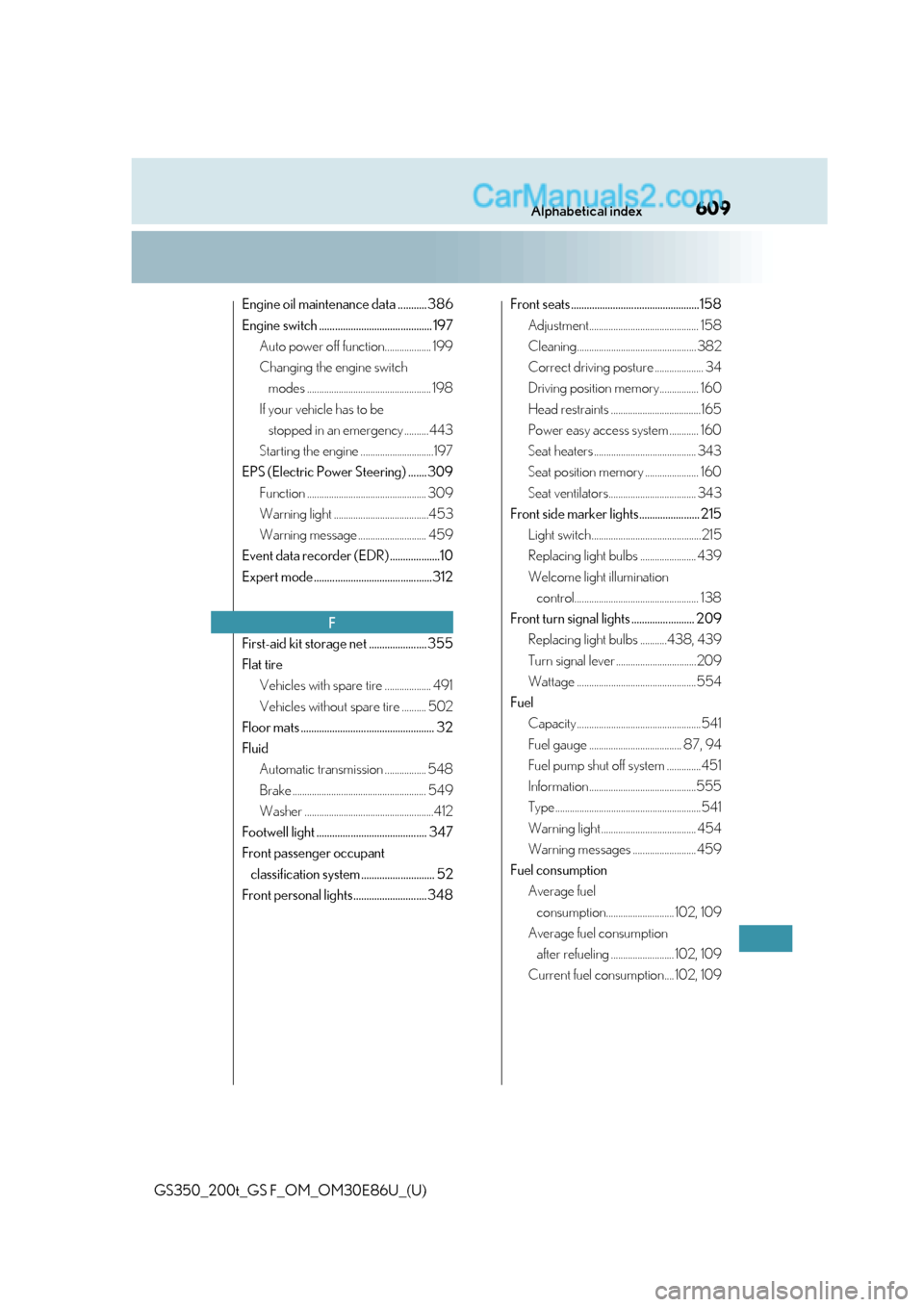
Engine oil maintenance data ........... 386
Engine switch ........................................... 197Auto power off function................... 199
Changing the engine switch modes ................................................... 198
If your vehicle has to be stopped in an emergency ..........443
Starting the engine ..............................197
EPS (Electric Power Steering) ....... 309 Function ................................................. 309
Warning light .......................................453
Warning message ............................ 459
Event data recorder (EDR) ...................10
Expert mode .............................................312
First-aid kit storage net ...................... 355
Flat tire Vehicles with spare tire ................... 491
Vehicles without spare tire .......... 502
Floor mats ................................................... 32
Fluid Automatic transmission ................. 548
Brake ....................................................... 549
Washer .....................................................412
Footwell light .......................................... 347
Front passenger occupant classification system ............................ 52
Front personal lights............................ 348 Front seats .................................................158
Adjustment............................................. 158
Cleaning................................................. 382
Correct driving posture .................... 34
Driving position memory................ 160
Head restraints .....................................165
Power easy access system ............ 160
Seat heaters .......................................... 343
Seat position memory ...................... 160
Seat ventilators.................................... 343
Front side marker lights....................... 215 Light switch............................................. 215
Replacing light bulbs ....................... 439
Welcome light illumination control................................................... 138
Front turn signal lights ........................ 209 Replacing light bulbs ...........438, 439
Turn signal lever ................................. 209
Wattage .................................................554
Fuel Capacity ...................................................541
Fuel gauge ...................................... 87, 94
Fuel pump shut off system ..............451
Information............................................555
Type............................................................541
Warning light ....................................... 454
Warning messages .......................... 459
Fuel consumption Average fuel consumption............................ 102, 109
Average fuel consumption after refueling .......................... 102, 109
Current fuel consumption.... 102, 109
F