Page 26 of 501
Safety features of your vehicle
10
3
✽
✽
NOTICE
If you recline the seatback towards
the front with the headrest and seat
cushion raised, the headrest may
come in contact with the sunvisor or
other parts of the vehicle.
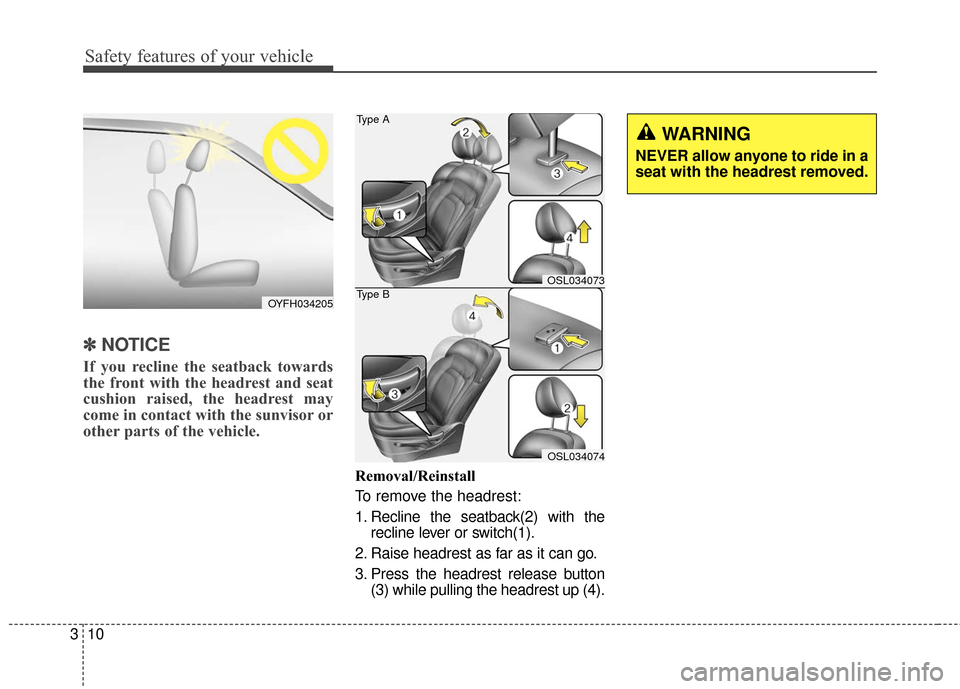
Removal/Reinstall
To remove the headrest:
1. Recline the seatback(2) with the
recline lever or switch(1).
2. Raise headrest as far as it can go.
3. Press the headrest release button (3) while pulling the headrest up (4).
WARNING
NEVER allow anyone to ride in a
seat with the headrest removed.
OSL034073
OSL034074
Type A
Type BOYFH034205
Page 27 of 501
311
Safety features of your vehicle
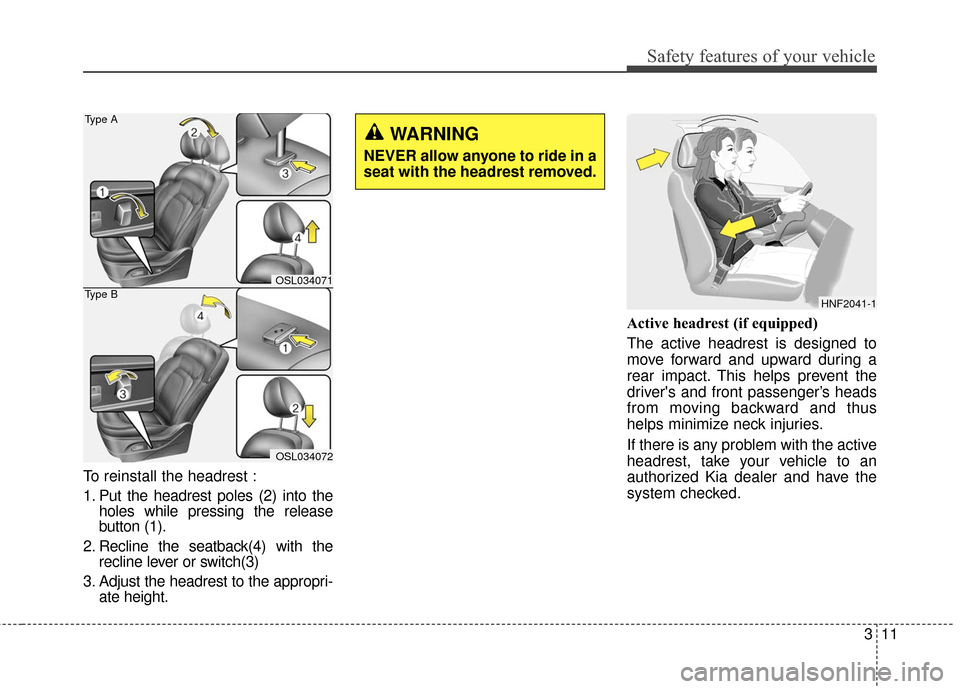
To reinstall the headrest :
1. Put the headrest poles (2) into theholes while pressing the release
button (1).
2. Recline the seatback(4) with the recline lever or switch(3)
3. Adjust the headrest to the appropri- ate height. Active headrest (if equipped)
The active headrest is designed to
move forward and upward during a
rear impact. This helps prevent the
driver's and front passenger’s heads
from moving backward and thus
helps minimize neck injuries.
If there is any problem with the active
headrest, take your vehicle to an
authorized Kia dealer and have the
system checked.
OSL034071
OSL034072
Type A
Type B
WARNING
NEVER allow anyone to ride in a
seat with the headrest removed.
HNF2041-1
Page 30 of 501
Safety features of your vehicle
14
3
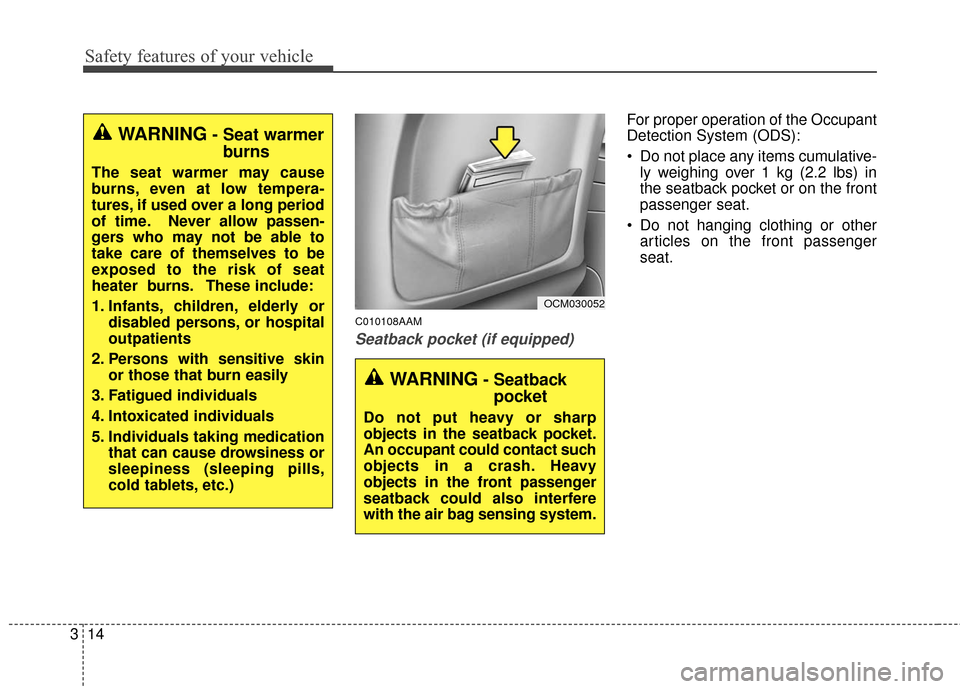
C010108AAM
Seatback pocket (if equipped)
For proper operation of the Occupant
Detection System (ODS):
Do not place any items cumulative-
ly weighing over 1 kg (2.2 lbs) in
the seatback pocket or on the front
passenger seat.
Do not hanging clothing or other articles on the front passenger
seat.
OCM030052
WARNING- Seat warmerburns
The seat warmer may cause
burns, even at low tempera-
tures, if used over a long period
of time. Never allow passen-
gers who may not be able to
take care of themselves to be
exposed to the risk of seat
heater burns. These include:
1. Infants, children, elderly or
disabled persons, or hospital
outpatients
2. Persons with sensitive skin or those that burn easily
3. Fatigued individuals
4. Intoxicated individuals
5. Individuals taking medication that can cause drowsiness or
sleepiness (sleeping pills,
cold tablets, etc.)
WARNING- Seatbackpocket
Do not put heavy or sharp
objects in the seatback pocket.
An occupant could contact such
objects in a crash. Heavy
objects in the front passenger
seatback could also interfere
with the air bag sensing system.
Page 31 of 501
315
Safety features of your vehicle
Rear seat adjustment
Seatback angle
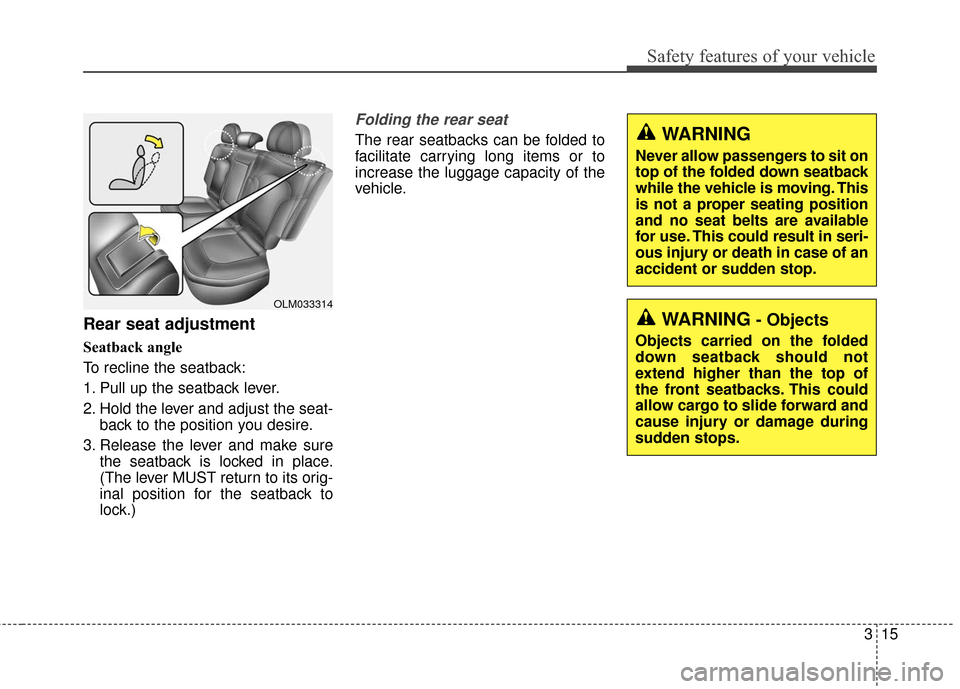
To recline the seatback:
1. Pull up the seatback lever.
2. Hold the lever and adjust the seat-back to the position you desire.
3. Release the lever and make sure the seatback is locked in place.
(The lever MUST return to its orig-
inal position for the seatback to
lock.)
Folding the rear seat
The rear seatbacks can be folded to
facilitate carrying long items or to
increase the luggage capacity of the
vehicle.
OLM033314
WARNING
Never allow passengers to sit on
top of the folded down seatback
while the vehicle is moving. This
is not a proper seating position
and no seat belts are available
for use. This could result in seri-
ous injury or death in case of an
accident or sudden stop.
WARNING- Objects
Objects carried on the folded
down seatback should not
extend higher than the top of
the front seatbacks. This could
allow cargo to slide forward and
cause injury or damage during
sudden stops.
Page 33 of 501
317
Safety features of your vehicle
When returning the rear seatbacks to
the upright position, remember to
return the rear shoulder belts to their
proper position. Routing the seat belt
webbing through the rear seat belt
guides will help keep the belts from
being trapped behind or under the
seats.
CAUTION - Damaging
rear seat belt buckles
When you fold the rear seat-
back, insert the buckle in thepocket between the rear seat-back and cushion. Doing so canprevent the buckle from beingdamaged by the rear seatback.
WARNING- Rear seat- back
When returning the rear seat-
back from a folded to an upright
position, hold the seatback and
return it slowly. Ensure that the
seatback is completely locked
into its upright position by
pushing on the top of the seat-
back. In an accident or sudden
stop, the unlocked seatback
could allow cargo to move for-
ward with great force and enter
the passenger compartment.
WARNING- Cargo
Do not place heavy objects in
the rear seats, since they can-
not be properly secured and
may hit vehicle occupants in a
frontal collision.
Page 37 of 501
321
Safety features of your vehicle
WARNING- Seat heaterburns
Passengers should use extreme
caution when using seat
heaters due to the possibility of
excess heating or burns. The
seat heater may cause burns
even at low temperatures, espe-
cially if used for long periods of
time. In particular, the driver
must exercise extreme care for
the following types of passen-
gers:
1. Infants, children, elderly or
handicapped persons, or
hospital outpatients
2. Persons with sensitive skin or those that burn easily
3. Fatigued individuals
4. Intoxicated individuals
5. Individuals taking medication that can cause drowsiness or
sleepiness (sleeping pills,
cold tablets, etc.)
Page 38 of 501
Safety features of your vehicle
22
3
SEAT BELTS
C020100AHM
Seat belt restraint system
For maximum restraint system pro-
tection, the seat belts must always
be used whenever the vehicle is
moving. A properly positioned
shoulder belt should be positioned
midway over your shoulder across
your collarbone.
Never allow children to ride in the front passenger seat. See child
restraint system section for further
discussion.
WARNING- Shoulder belt
Never wear the shoulder beltunder your arm or behind
your back. An improperly
positioned shoulder belt can-
not protect the occupant in a
crash.
Always wear both the shoul- der portion and lap portion of
the lap/shoulder belt.
WARNING- Damagedseat belt
Replace the entire seat belt
assembly if any part of the web-
bing or hardware is damaged as
you can no longer be sure that a
damaged seat belt will provide
protection in a crash.
WARNING- Twisted seatbelt
Make sure your seat belt is not
twisted when worn. A twisted
seat belt may not properly pro-
tect you in an accident and
could even cut into your body.
Page 39 of 501
323
Safety features of your vehicle
Seat belts are designed to bear upon
the bony structure of the body, and
should be worn low across the front
of the pelvis, chest and shoulders, as
applicable; wearing the lap section of
the belt across the abdominal area
must be avoided.
Seat belts should be adjusted as
firmly as possible, consistent with
comfort, to provide the protection for
which they have been designed.
A slack belt will greatly reduce the
protection afforded to the wearer.
Care should be taken to avoid con-
tamination of the webbing with pol-
ishes, oils and chemicals, and partic-
ularly battery acid. Cleaning may
safely be carried out using mild soap
and water. The belt should be
replaced if webbing becomes frayed,
contaminated or damaged. No modifications or additions
should be made by the user which
will either prevent the seat belt
adjusting devices from operating to
remove slack, or prevent the seat
belt assembly from being adjusted
to remove slack.
When you fasten the seat belt, be careful not to latch the seat belt in
buckles of other seat. It's very dan-
gerous and you may not be pro-
tected by the seat belt properly.
Do not unfasten the seat belt and do not fasten and unfasten the seat
belt repeatedly while driving. This
could result in loss of control, and
an accident causing death, serious
injury, or property damage.
WARNING- Seat belt buckle
Do not allow foreign material
(gum, crumbs, coins, etc.) to
obstruct the seat belt buckle.
This may prevent the seat belt
from fastening securely.