2016 KIA Sedona Recommended lubricants and capacities
[x] Cancel search: Recommended lubricants and capacitiesPage 556 of 644

Maintenance
28
7
Automatic transaxle fluid
Automatic transaxle fluid does not
need to be checked under normal
usage conditions.
But in severe conditions, the fluid
should be changed at an authorized
Kia dealer in accordance to the
scheduled maintenance at the begin-
ning of this chapter.
✽ ✽
NOTICE
Automatic transaxle fluid color is
basically red.
As the vehicle is driven, the auto-
matic transaxle fluid will begin to
look darker.
This a normal condition and you
should not judge the need to replace
the fluid based upon the changed
color.
The use of a non-specified fluid
could result in transaxle malfunction
and failure.
Use only specified automatic
transaxle fluid. (Refer to
“Recommended lubricants and
capacities” in chapter 8.)
Brake hoses and lines
Visually check for proper installation,
chafing, cracks, deterioration and
any leakage. Replace any deteriorat-
ed or damaged parts immediately.
Brake fluid
Check brake fluid level in the brake
fluid reservoir. The level should be
between “MIN” and “MAX” marks on
the side of the reservoir. Use only
hydraulic brake fluid conforming to
DOT 3 or DOT 4 specification.
Parking brake
Inspect the parking brake system
including the parking brake pedal or
lever and cables.
Brake discs, pads, calipers
and rotors
Check the pads for excessive wear,
discs for run out and wear, and
calipers for fluid leakage.
Suspension mounting bolts
Check the suspension connections
for looseness or damage. Retighten
to the specified torque.
Steering gear box, linkage &
boots/lower arm ball joint
With the vehicle stopped and engine
off, check for excessive free-play in
the steering wheel.
Check the linkage for bends or dam-
age. Check the dust boots and ball
joints for deterioration, cracks, or
damage. Replace any damaged
parts.
Page 558 of 644

Maintenance
30
7
ENGINE OIL
Checking the engine oil level
1. Be sure the vehicle is on level
ground.
2. Start the engine and allow it to reach normal operating tempera-
ture.
3. Turn the engine off and wait for a few minutes (about 5 minutes) for
the oil to return to the oil pan.
4. Pull the dipstick out, wipe it clean, and re-insert it fully. 5. Pull the dipstick out again and
check the level. The level should
be between F and L.
If it is near or at L, add enough oil to
bring the level to F.Do not overfill.
Use a funnel to help prevent oil
from being spilled on engine com-
ponents.
Use only the specified engine oil. (Refer to “Recommended lubricantsand capacities” in chapter 8.)
WARNING - Radiator
hose
Be very careful not to touch the
radiator hose when checking or
adding the engine oil as it may
be hot enough to burn you.
CAUTION - Replacing
engine oil
Do not overfill the engine oil. It
may damage the engine.
Do not spill engine oil, when adding or changing engineoil. If you drop the engine oilon the engine room, wipe it offimmediately.
OYP074062N
OYP074045N
Page 563 of 644

735
Maintenance
BRAKE FLUID
Checking the brake fluid level
Check the fluid level in the reservoir
periodically. The fluid level should be
between MAX (Maximum) and MIN
(Minimum) marks on the side of the
reservoir.
Before removing the reservoir cap
and adding brake fluid, clean the
area around the reservoir cap thor-
oughly to prevent brake fluid contam-
ination.If the level is low, add fluid to the
MAX (Maximum) level. The level will
fall with accumulated mileage. This is
a normal condition associated with
the wear of brake linings. If the fluid
level is excessively low, have the
brake system checked by an author-
ized Kia dealer.
Use only the specified brake fluid.
(Refer to “Recommended lubricantsor capacities” in chapter 8.)
Never mix different types of fluid.
In the event the brake system
requires frequent additions of fluid,
the vehicle should be inspected by
an authorized Kia dealer.
When changing and adding brake
fluid, handle it carefully. Do not let it
come in contact with your eyes. If
brake fluid should come in contact
with your eyes, immediately flush
them with a large quantity of fresh
tap water. Have your eyes examined
by a doctor as soon as possible.
Brake fluid, which has been exposed
to open air for an extended time
should never be used as its quality
cannot be guaranteed. It should be
disposed of properly.
OYP074048K
CAUTION - Proper fluid
Only use brake fluid in brakesystem. Small amounts ofimproper fluids (such as engineoil) can cause damage to thebrake system.
CAUTION - Brake fluid
Do not allow brake fluid to con-tact the vehicle's body paint, aspaint damage will result.
Page 564 of 644

Maintenance
36
7
POWER STEERING FLUID (IF EQUIPPED)
Checking the power steering
fluid level
With the vehicle on level ground,
check the fluid level in the power
steering reservoir periodically. The
fluid should be between MAX and
MIN marks on the side of the reser-
voir at the normal temperature.
Before adding power steering fluid,
thoroughly clean the area around the
reservoir cap to prevent power steer-
ing fluid contamination.
If the level is low, add fluid to the
MAX level. In the event the power steering sys-
tem requires frequent addition of
fluid, the vehicle should be inspected
by an authorized Kia dealer.
To avoid damage to the power
steering pump, do not operate the
vehicle for prolonged periods with
a low power steering fluid level.
Never start the engine when the reservoir tank is empty.
When adding fluid, be careful that dirt does not get into the tank.
Too little fluid can result in increased steering effort and/or
noise from the power steering sys-
tem.
The use of the non-specified fluid could reduce the effectiveness of
the power steering system and
cause damage to it.
Use only the specified power steer-ing fluid. (Refer to "Recommendedlubricants or capacities" in chapter8.)
Checking the power steering
hose
Check the connections for oil leaks,
damage and twists in the power
steering hose before driving.
OYP074063N
Page 626 of 644

Specifications & Consumer information
Dimensions . . . . . . . . . . . . . . . . . . . . . . . . . . . . . . . . 8-2
Engine . . . . . . . . . . . . . . . . . . . . . . . . . . . . . . . . . . . . \
8-2
Bulb wattage . . . . . . . . . . . . . . . . . . . . . . . . . . . . . . . 8-3
Tires and wheels . . . . . . . . . . . . . . . . . . . . . . . . . . . . 8-4
Gross vehicle weight. . . . . . . . . . . . . . . . . . . . . . . . . 8-5
Luggage volume . . . . . . . . . . . . . . . . . . . . . . . . . . . . 8-5
Air conditioning system . . . . . . . . . . . . . . . . . . . . . . 8-5
Recommended lubricants and capacities . . . . . . . 8-6
• Recommended sae viscosity number . . . . . . . . . . . . . . 8-7
Vehicle identification number (VIN) . . . . . . . . . . . 8-8
Vehicle certification label. . . . . . . . . . . . . . . . . . . . . 8-8
Tire specification and pressure label . . . . . . . . . . . 8-9
Engine number . . . . . . . . . . . . . . . . . . . . . . . . . . . . . 8-9
8
Page 631 of 644

68
Specifications & Consumer information
RECOMMENDED LUBRICANTS AND CAPACITIES
To help achieve proper engine and powertrain performance and durability, use only lubricants of the proper quality.
The correct lubricants also help promote engine efficiency that results in improved fuel economy.
These lubricants and fluids are recommended for use in your vehicle.
*
1Refer to the recommended SAE viscosity numbers on the next page.
*2Engine oils labeled Energy Conserving Oil are now available. Along with other additional benefits, they contribute
to fuel economy by reducing the amount of fuel necessary to overcome engine friction. Often, these improvements
are difficult to measure in everyday driving, but in a year’s time, they can offer significant cost and energy savings.
Lubricant Volume Classification
Engine oil *
1*2
(drain and refill)
Recommends
(or equivalent) Lambda 3.3
GDI Engine 5.7L (6.02 US qt.) ACEA A5 or above
* If the ACEA A5 engine oil is not available in
your country, you are able to use API service SL, IL SAC GF-3, ACEA A3.
Automatic transaxle fluid Lambda 3.3
GDI Engine 7.8L (8.24 US qt.) ATF SP-IV or equivalent
Coolant Lambda 3.3
GDI Engine 11.5L (12.15 US qt.) Mixture of antifreeze and water
(Ethylene glycol base coolant for aluminum radiator)
Power steering fluid (if equipped) 1.0~1.5L
(1.06~1.59 US qt.) PSF-4
Brake fluid 0.58~0.62L
(0.61~0.66 US qt.) SAE J1703, FMVSS 116 DOT-3 or DOT-4
Fuel 80L (84.54 US qt.) Refer to “Fuel requirements” in chapter 1
Page 641 of 644
I7
Index
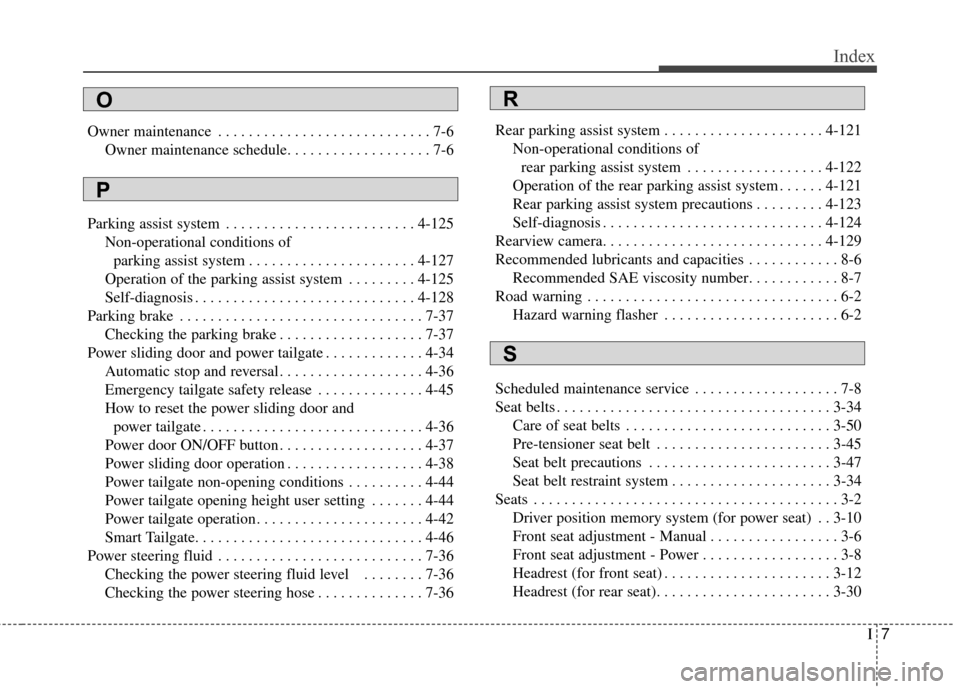
Owner maintenance . . . . . . . . . . . . . . . . . . . . . . . . . . . . 7-6Owner maintenance schedule. . . . . . . . . . . . . . . . . . . 7-6
Parking assist system . . . . . . . . . . . . . . . . . . . . . . . . . 4-125 Non-operational conditions of parking assist system . . . . . . . . . . . . . . . . . . . . . . 4-127
Operation of the parking assist system . . . . . . . . . 4-125
Self-diagnosis . . . . . . . . . . . . . . . . . . . . . . . . . . . . . 4-128
Parking brake . . . . . . . . . . . . . . . . . . . . . . . . . . . . . . . . 7-37 Checking the parking brake . . . . . . . . . . . . . . . . . . . 7-37
Power sliding door and power tailgate . . . . . . . . . . . . . 4-34 Automatic stop and reversal . . . . . . . . . . . . . . . . . . . 4-36
Emergency tailgate safety release . . . . . . . . . . . . . . 4-45
How to reset the power sliding door and power tailgate . . . . . . . . . . . . . . . . . . . . . . . . . . . . . 4-36
Power door ON/OFF button . . . . . . . . . . . . . . . . . . . 4-37
Power sliding door operation . . . . . . . . . . . . . . . . . . 4-38
Power tailgate non-opening conditions . . . . . . . . . . 4-44
Power tailgate opening height user setting . . . . . . . 4-44
Power tailgate operation . . . . . . . . . . . . . . . . . . . . . . 4-42
Smart Tailgate. . . . . . . . . . . . . . . . . . . . . . . . . . . . . . 4-46
Power steering fluid . . . . . . . . . . . . . . . . . . . . . . . . . . . 7-36 Checking the power steering fluid level . . . . . . . . 7-36
Checking the power steering hose . . . . . . . . . . . . . . 7-36 Rear parking assist system . . . . . . . . . . . . . . . . . . . . . 4-121
Non-operational conditions of rear parking assist system . . . . . . . . . . . . . . . . . . 4-122
Operation of the rear parking assist system . . . . . . 4-121
Rear parking assist system precautions . . . . . . . . . 4-123
Self-diagnosis . . . . . . . . . . . . . . . . . . . . . . . . . . . . . 4-124
Rearview camera. . . . . . . . . . . . . . . . . . . . . . . . . . . . . 4-129
Recommended lubricants and capacities . . . . . . . . . . . . 8-6 Recommended SAE viscosity number. . . . . . . . . . . . 8-7
Road warning . . . . . . . . . . . . . . . . . . . . . . . . . . . . . . . . . 6-2 Hazard warning flasher . . . . . . . . . . . . . . . . . . . . . . . 6-2
Scheduled maintenance service . . . . . . . . . . . . . . . . . . . 7-8
Seat belts . . . . . . . . . . . . . . . . . . . . . . . . . . . . . . . . . . . . \
3-34 Care of seat belts . . . . . . . . . . . . . . . . . . . . . . . . . . . 3-50
Pre-tensioner seat belt . . . . . . . . . . . . . . . . . . . . . . . 3-45
Seat belt precautions . . . . . . . . . . . . . . . . . . . . . . . . 3-47
Seat belt restraint system . . . . . . . . . . . . . . . . . . . . . 3-34
Seats . . . . . . . . . . . . . . . . . . . . . . . . . . . . . . . . . . . . \
. . . . 3-2 Driver position memory system (for power seat) . . 3-10
Front seat adjustment - Manual . . . . . . . . . . . . . . . . . 3-6
Front seat adjustment - Power . . . . . . . . . . . . . . . . . . 3-8
Headrest (for front seat) . . . . . . . . . . . . . . . . . . . . . . 3-12
Headrest (for rear seat). . . . . . . . . . . . . . . . . . . . . . . 3-30
O
P
R
S