Page 575 of 644
747
Maintenance
✽
✽NOTICE
If you connect unauthorized elec-
tronic devices to the battery, the bat-
tery may be discharged. Never use
unauthorized devices.
Battery recharging
Your vehicle has a maintenance-free,
calcium-based battery.
If the battery becomes discharged
in a short time (because, for exam-
ple, the headlights or interior lights
were left on while the vehicle was
not in use), recharge it by slow
charging (trickle) for 10 hours.
If the battery gradually discharges because of high electric load while
the vehicle is being used, recharge
it at 20-30A for two hours. When recharging the battery,
observe the following precautions:
The battery must be removed from
the vehicle and placed in an area
with good ventilation.
Do not allow cigarettes, sparks, or flame near the battery.
Watch the battery during charging, and stop or reduce the charging
rate if the battery cells begin
gassing (boiling) violently or if the
temperature of the electrolyte of
any cell exceeds 49°C (120°F).
Wear eye protection when check- ing the battery during charging.
Disconnect the battery charger in the following order.
1. Turn off the battery charger main switch.
2. Unhook the negative clamp from the negative battery terminal.
3. Unhook the positive clamp from the positive battery terminal.WARNING- Risk of elec-
trocution
Never touch the electrical igni-
tion system while the vehicle is
running. This system works
with high voltage which can
"zap" you.
Page 592 of 644

Maintenance
64
7
FUSES
A vehicle’s electrical system is pro-
tected from electrical overload dam-
age by fuses.
This vehicle has 2 (or 3) fuse panels,
one located in the driver’s side panel
bolster, the other in the engine com-
partment near the battery.
If any of your vehicle’s lights, acces-
sories, or controls do not work, check
the appropriate circuit fuse. If a fuse
has blown, the element inside the
fuse will melt.
If the electrical system does not
work, first check the driver’s side
fuse panel.
Always replace a blown fuse with
one of the same rating.
If the replacement fuse blows, this
indicates an electrical problem. Avoid
using the system involved and imme-
diately consult an authorized Kia
dealer.
Three kinds of fuses are used: blade
type for lower amperage rating, car-tridge type, and multi fuse for higheramperage ratings.OYP074073N
Normal
Normal
■
Blade type
■ Cartridge type
■ Multi fuse Blown
Blown
Normal Blown
WARNING- Fuse replace- ment
Never replace a fuse with any- thing but another fuse of the
same rating.
A higher capacity fuse could cause damage and possibly a
fire.
Never install a wire or alu- minum foil instead of the
proper fuse - even as a tem-
porary repair. It may cause
extensive wiring damage and
a possible fire.
Do not arbitrarily modify or add-on electric wiring of the
vehicle.
Page 602 of 644

Maintenance
74
7
LIGHT BULBS
Use only the bulbs of the specified
wattage.
✽
✽ NOTICE
• If the light bulb or lamp connector
is removed from an operating
lamp activated by electricity, the
fuse box’s electronic device may
scan it as a malfunction.
Therefore, a lamp malfunction
history may be recorded in
Diagnostic Trouble Code (DTC) in
the fuse box.
• It is normal for an operating lamp may blink temporarily. Since this
occurrence is due stabilization
function of the vehicle’s electronic
control device, if the lamp lights
up normally after temporary
blinking, there is no problem in
the vehicle.
However, if the lamp continues to
blink several times or turn off
completely, there may be an error
in the vehicle’s electronic control
device. So please have the vehicle
checked by an authorized Kia
dealer immediately.
If you don’t have necessary tools, the
correct bulbs and the expertise, con-
sult an authorized Kia dealer. In
many cases, it is difficult to replace
vehicle light bulbs because other
parts of the vehicle must be removed
before you can get to the bulb. This is
especially true if you have to remove
the headlight assembly to get to the
bulb(s).
Removing/installing the headlight
assembly can result in damage to
the vehicle.
WARNING - Working on
the lights
Prior to working on the light,
firmly apply the parking brake,
ensure that the ignition switch
is turned to the LOCK position
and turn off the lights to avoid
sudden movement of the vehi-
cle and burning your fingers or
receiving an electric shock.
CAUTION -Light replace-
ment
Be sure to replace the burned-
out bulb with one of the samewattage rating. Otherwise, itmay cause damage to the fuseor electric wiring system.
Page 603 of 644
775
Maintenance
Front light bulb replacement
(1) Headlight (High)
(2) Headlight (Low)
(3) Turn signal light / Position light(if equipped)
(4) Side marker light
(5) Front fog light (if equipped)
(6) Position light (if equipped) (1) Headlight (High)
(2) Headlight (Low)
(3) Turn signal light
(4) Side marker light
(5) Front fog light (if equipped)
(6) Position light
Headlight bulb
OXM079200N
WARNING- Halogen
bulbs
Handle halogen bulbs with care.
Halogen bulbs contain pressur-
ized gas that will produce flying
pieces of glass if broken.
OYP074016K
■ Type A
OYP074016N
■Type B
Page 604 of 644
Maintenance
76
7
Always handle them carefully, and
avoid scratches and abrasions. If
the bulbs are lit, avoid contact with
liquids. Never touch the glass with
bare hands. Residual oil may
cause the bulb to overheat and
burst when lit. A bulb should be
operated only when installed in a
headlight.
If a bulb becomes damaged or cracked, replace it immediately
and carefully dispose of it.
Wear eye protection when chang- ing a bulb. Allow the bulb to cool
down before handling it.Headlamp (bulb type) -high/low
WARNING - HID
Headlamp low beam
(if equipped)
Do not attempt to replace or
inspect the low beam (XENON
bulb) due to electric shock dan-
ger. If the light bulb does not
operate, have your vehicle
checked by an authorized Kia
dealer.
OYP074068N
OYP074069N
OYP074055NHigh lampLow lamp
Page 612 of 644
Maintenance
84
7
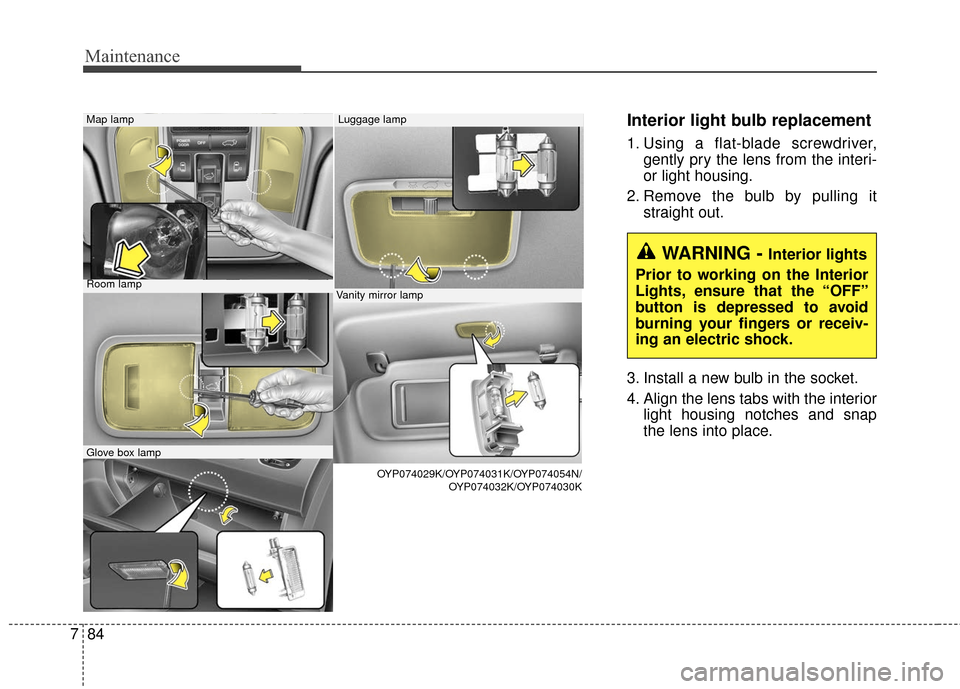
Interior light bulb replacement
1. Using a flat-blade screwdriver,
gently pry the lens from the interi-
or light housing.
2. Remove the bulb by pulling it straight out.
3. Install a new bulb in the socket.
4. Align the lens tabs with the interior light housing notches and snap
the lens into place.
Room lamp
Map lamp
Glove box lamp
Luggage lamp
Vanity mirror lamp
OYP074029K/OYP074031K/OYP074054N/ OYP074032K/OYP074030K
WARNING - Interior lights
Prior to working on the Interior
Lights, ensure that the “OFF”
button is depressed to avoid
burning your fingers or receiv-
ing an electric shock.
Page 613 of 644
785
Maintenance
APPEARANCE CARE
Exterior care
Exterior general caution
It is very important to follow the label
directions when using any chemical
cleaner or polish. Read all warning
and caution statements that appear
on the label.
Finish maintenance
Washing
To help protect your vehicle’s finish
from rust and deterioration, wash it
thoroughly and frequently at least
once a month with lukewarm or cold
water.
If you use your vehicle for off-road
driving, you should wash it after each
off-road trip. Pay special attention to
the removal of any accumulation of
salt, dirt, mud, and other foreign mate-
rials. Make sure the drain holes in the
lower edges of the doors and rocker
panels are kept clear and clean.
Insects, tar, tree sap, bird droppings,
industrial pollution and similar
deposits can damage your vehicle’s
finish if not removed immediately.
Even prompt washing with plain water
may not completely remove all these
deposits. A mild soap, safe for use on
painted surfaces, may be used.
After washing, rinse the vehicle thor-
oughly with lukewarm or cold water.
Do not allow soap to dry on the finish.After washing the vehicle, test the
brakes while driving slowly to see if
they have been affected by water. If
braking performance is impaired, dry
the brakes by applying them lightly
while maintaining a slow forward
speed.
Page 636 of 644

Index
2I
Active ECO system. . . . . . . . . . . . . . . . . . . . . . . . . . . . 5-53Active ECO operation . . . . . . . . . . . . . . . . . . . . . . . 5-53
Limitation of Active ECO operation . . . . . . . . . . . . 5-53
When Active ECO is activated . . . . . . . . . . . . . . . . . 5-53
Air bag - advanced supplemental restraint system . . . . . 3-5 Air bag warning label. . . . . . . . . . . . . . . . . . . . . . . . 3-86
Air bag warning light . . . . . . . . . . . . . . . . . . . . . . . . 3-62
Curtain air bag . . . . . . . . . . . . . . . . . . . . . . . . . . . . . 3-78
Do not install a child restraint on the front passenger’s seat . . . . . . . . . . . . . . . . . . . . . . . 3-62
Driver's and passenger's front air bag . . . . . . . . . . . 3-73
How does the air bag system operate. . . . . . . . . . . . 3-60
Occupant Detection System (ODS) . . . . . . . . . . . . . 3-66
Side air bag. . . . . . . . . . . . . . . . . . . . . . . . . . . . . . . . 3-76
SRS Care . . . . . . . . . . . . . . . . . . . . . . . . . . . . . . . . . 3-85
SRS components and functions . . . . . . . . . . . . . . . . 3-63
Air cleaner . . . . . . . . . . . . . . . . . . . . . . . . . . . . . . . . . . 7-38\
Filter replacement. . . . . . . . . . . . . . . . . . . . . . . . . . . 7-38
Air conditioning system . . . . . . . . . . . . . . . . . . . . . . . . . 8-5
Appearance care . . . . . . . . . . . . . . . . . . . . . . . . . . . . . . 7-85 Exterior care . . . . . . . . . . . . . . . . . . . . . . . . . . . . . . . 7-85
Interior care . . . . . . . . . . . . . . . . . . . . . . . . . . . . . . . 7-91 Audio system . . . . . . . . . . . . . . . . . . . . . . . . . . . . . . . 4-201
Antenna . . . . . . . . . . . . . . . . . . . . . . . . . . . . . . . . . 4-201
Aux, USB port . . . . . . . . . . . . . . . . . . . . . . . . . . . . 4-203
CD player . . . . . . . . . . . . . . . . . . . . . . . . . . . . 4-215, 264
How vehicle audio works . . . . . . . . . . . . . . . . . . . . 4-204
Steering wheel remote controller . . . . . . . . . . . . . . 4-201
Automatic climate control system . . . . . . . . . . . . . . . 4-162 Automatic heating and air conditioning. . . . . . . . . 4-163
Checking the amount of air conditioner refrigerant and compressor lubricant . . . . . . . . . . . . . . . . . . . . . . 4-179
Climate control air filter. . . . . . . . . . . . . . . . . . . . . 4-178
From the front seat . . . . . . . . . . . . . . . . . . . . . . . . . 4-173
From the rear seat. . . . . . . . . . . . . . . . . . . . . . . . . . 4-173
Manual heating and air conditioning . . . . . . . . . . . 4-164
Outside thermometer . . . . . . . . . . . . . . . . . . . . . . . 4-168
Rear climate control . . . . . . . . . . . . . . . . . . . . . . . . 4-173
System operation . . . . . . . . . . . . . . . . . . . . . . . . . . 4-176
Automatic transaxle . . . . . . . . . . . . . . . . . . . . . . . . . . . 5-13 Automatic transaxle operation . . . . . . . . . . . . . . . . . 5-13
Good driving practices . . . . . . . . . . . . . . . . . . . . . . . 5-18
A