Page 441 of 513
741
Maintenance
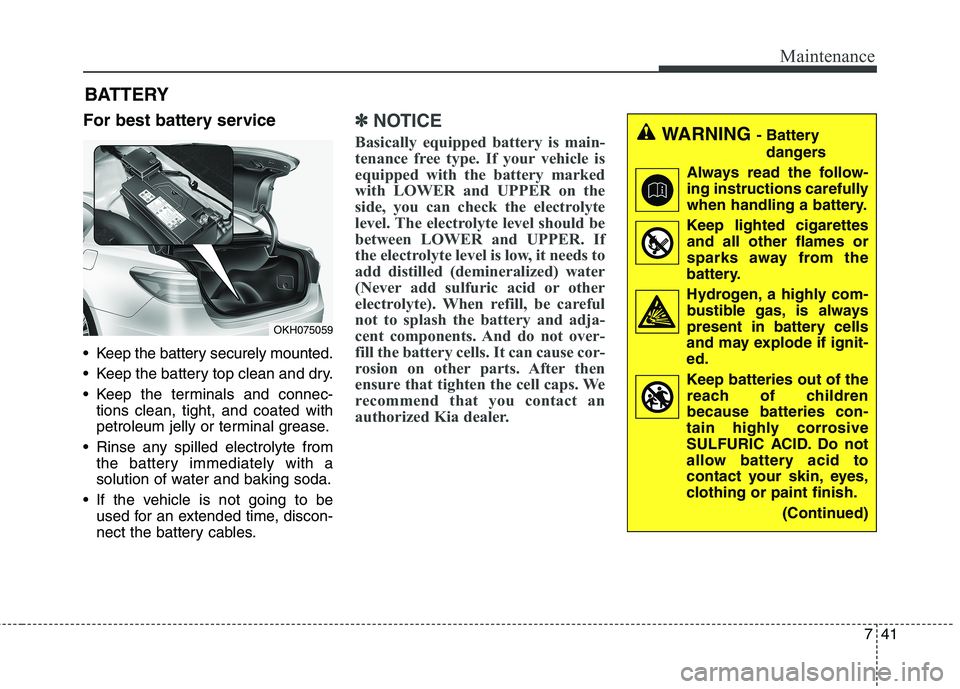
For best battery service
Keep the battery securely mounted.
Keep the battery top clean and dry.
Keep the terminals and connec-tions clean, tight, and coated with
petroleum jelly or terminal grease.
Rinse any spilled electrolyte from the battery immediately with a
solution of water and baking soda.
If the vehicle is not going to be used for an extended time, discon-
nect the battery cables.✽✽ NOTICE
Basically equipped battery is main-
tenance free type. If your vehicle is
equipped with the battery marked
with LOWER and UPPER on the
side, you can check the electrolyte
level. The electrolyte level should be
between LOWER and UPPER. If
the electrolyte level is low, it needs to
add distilled (demineralized) water
(Never add sulfuric acid or other
electrolyte). When refill, be careful
not to splash the battery and adja-
cent components. And do not over-
fill the battery cells. It can cause cor-
rosion on other parts. After then
ensure that tighten the cell caps. We
recommend that you contact an
authorized Kia dealer.
BATTERY
WARNING - Battery
dangers
Always read the follow-
ing instructions carefully
when handling a battery.
Keep lighted cigarettes and all other flames or
sparks away from the
battery.
Hydrogen, a highly com- bustible gas, is always
present in battery cells
and may explode if ignit-ed.
Keep batteries out of the reach of children because batteries con-
tain highly corrosive
SULFURIC ACID. Do not
allow battery acid to
contact your skin, eyes,
clothing or paint finish.
(Continued)
OKH075059
Page 442 of 513

Maintenance
42
7
CAUTION
When you don’t use the vehi-
cle for a long time in the lowtemperature area, separate the battery and keep it indoors.
Always charge the battery fully to prevent battery case dam-age in low temperature area.
If you connect unauthorized electronic devices to the bat-tery, the battery may be dis- charged. Never use unautho-rized devices.
Make sure the battery cap is closed. If the battery cap is notclosed securely, it can mal- function because the electriccomponents are exposed tomoisture.
WARNING
We recommend that the system
be serviced by an authorized
Kia dealer.
(Continued)
When lifting a plastic-cased battery, excessive pressure
on the case may cause battery
acid to leak, resulting in per-
sonal injury. Lift with a battery
carrier or with your hands on
opposite corners.
Never attempt to recharge the battery when the battery
cables are connected.
The electrical ignition system works with high voltage. Never
touch these components withthe engine running or the
Engine Start/Stop turned on.
Failure to follow the abovewarnings can result in serious
bodily injury or death.(Continued)
If any electrolyte getsinto your eyes, flush
your eyes with clean
water for at least 15 min-
utes and get immediatemedical attention.
If electrolyte gets on your
skin, thoroughly wash
the contacted area. If you
feel a pain or a burning
sensation, get medical
attention immediately.
Wear eye protection when charging or work-
ing near a battery.
Always provide ventila-
tion when working in an
enclosed space.
An inappropriately dis- posed battery can be
harmful to the environ-ment and human health.
Dispose the battery
according to your local
law(s) or regulation.
(Continued)
Pb
Page 443 of 513

743
Maintenance
Battery capacity label
(see the example) ❈The actual battery label in the vehicle may
differ from the illustration.
1. CMF60L-BCI : The Kia model
name of battery
2. 12V : The nominal voltage
3. 60Ah (20HR) : The nominal capaci-
ty (in Ampere hours)
4. 92RC : The nominal reserve
capacity (in min.)
5. 550CCA : The cold-test current in amperes by SAE
6. 440A : The cold-test current in
amperes by EN Battery recharging
Your vehicle has a maintenance-free,
calcium-based battery.
If the battery becomes discharged
in a short time (because, for exam-
ple, the headlights or interior lights
were left on while the vehicle was
not in use), recharge it by slow
charging (trickle) for 10 hours.
If the battery gradually discharges because of high electric load while
the vehicle is being used, recharge
it at 20-30A for two hours.(Continued)
Watch the battery during charging, and stop or reduce
the charging rate if the batterycells begin gassing (boiling)
violently or if the temperature
of the electrolyte of any cell
exceeds 49°C (120°F).
Wear eye protection when checking the battery during
charging.
Disconnect the battery charg- er in the following order.
1. Turn off the battery charger main switch.
2. Unhook the negative clamp from the negative battery ter-minal.
3. Unhook the positive clamp from the positive battery ter-minal.
WARNING - Recharging
battery
When recharging the battery,
observe the following precau-tions:
The battery must be removed from the vehicle and placed in an area with good ventilation.
Do not allow cigarettes, sparks, or flame near the battery.
(Continued)
OJD072039
Example
Page 444 of 513
Maintenance
44
7
Reset items Items should be reset after the bat-
tery has been discharged or the bat-
tery has been disconnected.
Auto up/down window
(See section 4)
Sunroof (See section 4)
Driver position memory system (See section 4)
Trip computer (See section 4)
Climate control system (See section 4)
Clock (See section 4)
Audio (See section 4)WARNING
Before performing mainte- nance or recharging the bat-
tery, turn off all accessories
and stop the engine.
The negative battery cable must be removed first and
installed last when the batteryis disconnected.
We recommend that the sys- tem be serviced by an author-
ized Kia dealer.
CAUTION
Keep the battery away from
water or any liquid.
We recommend that you use parts for replacement from anauthorized Kia dealer.
Page 456 of 513

Maintenance
56
7
FUSES
A vehicle’s electrical system is pro-
tected from electrical overload dam-
age by fuses.
This vehicle has 2 fuse panels, one
located in the driver’s side panel bol-
ster, another is in the engine com-
partment.
If any of your vehicle’s lights, acces-
sories, or controls do not work, check
the appropriate circuit fuse. If a fuse
has blown, the element inside thefuse will be melted.
If the electrical system does not
work, first check the driver’s sidefuse panel.
Before replacing a blown fuse, dis-
connect the negative battery cable.
Always replace a blown fuse with
one of the same rating.
If the replacement fuse blows, this
indicates an electrical problem. Avoid
using the system involved and we
recommend that you consult an
authorized Kia dealer.
Three kinds of fuses are used: blade
type for lower amperage rating, car-
tridge type, and fusible link for higher
amperage ratings. ✽
✽
NOTICE
The actual fuse/relay panel label
may differ from equipped items.
WARNING - Fuse replace-
ment
Never replace a fuse with any- thing but another fuse of the same rating.
A higher capacity fuse could cause damage and possibly a
fire.
Never install a wire or aluminum foil instead of the proper fuse
even as a temporary repair. It
may cause extensive wiring
damage and a possible fire.
Do not arbitrarily modify or add- on electric wiring of the vehicle.
CAUTION
Do not use a screwdriver or any
other metal object to removefuses because it may cause ashort circuit and damage the system.
OKH073054
Normal
Normal
■
Blade type
■ Cartridge type
■ Multi fuse type
■ Fusible link Blown
Blown
Normal Blown
Normal Blown
Page 460 of 513
Maintenance
60
7
Main fuse
If the main fuse is blown, it must be
removed as follows:
1. Turn off the engine.
2. Disconnect the negative battery
cable.
3. Remove the nuts shown in the pic- ture above.
4. Replace the fuse with a new one of the same rating.
5. Reinstall in the reverse order of removal.
Multi fuse
If the multi fuse is blown, it must be
removed as follows:
1. Disassemble the negative cable ofbattery.
2. Remove the nuts shown in the pic- ture above.
3. Replace the fuse with a new one of the same rating.
4. Reinstall in the reverse order of removal.
✽✽ NOTICE
If the multi fuse is blown, we recom-
mend that you consult an authorized
Kia dealer.
OKH072024OBH078025
CAUTION
Visually inspect the battery cap for secure closing. If the batterycap is not securely latched, the electrical system may be dam-aged to due influx of moistureinto the system.
Page 468 of 513
Maintenance
68
7
Fuse NameSymbolFuse rastingCircuit Protected
Stop Lamp15AStop Signal Electronic Module
Brake SW10AStop Lamp Switch, Smart Key Control Module
AAF10ANot Used
Injector 11
INJECTOR15AIDB (Injector Drive Box)
SMK (IGN1)SMART KEY
(IGN1)40AE/R Fuse & Relay Box LH (RLY.5)
ESC 140AESC Control Module
ALT200AE/R Fuse & Relay Box LH (Fuse : F9, F15, F16, F18, F19), Alternator
Cooling70AE/R Fuse & Relay Box LH (RLY.6)
SMK (IGN2)SMART KEY(IGN2)30AE/R Fuse & Relay Box LH (RLY.3)
ESC 240AESC Control Module
Diagnosis25AMultipurpose Check Connector
H/Lamp Washer25AE/R Fuse & Relay Box LH (RLY.7)
Battery 340ASmart Junction Box (Fuse : F5, F6, F8, F9, F10)
SMK (ACC)SMART KEY (ACC)40AE/R Fuse & Relay Box LH (RLY.9)
TCU 110AECM, Transmission Range Switch, Transmission Park Postilion Sensor & Switch
ESC 310ASteering Angle Sensor, ESC Control Module
B/UP Lamp 110AE/R Fuse & Relay Box LH (RLY.4)
Page 472 of 513
Maintenance
72
7
FuseFuse NameSymbolFuse rastingCircuit Protected
METAL
CORE
BLOCK
(PCB #2)
A/C 210AA/C Control Module
Cruise10ASmart Cruise Control Radar
TCU 215ATCM
ECU 210AECM
Blower40AMetal Core Block(PCB) (Blower Relay)
Start 130AE/R Fuse Relay Box LH (RLY.2)
MULTI FUSE
Seat Belt LH40ADriver Seat Belt Pretensioner
Seat Belt RH40APassenger Seat Belt Pretensioner
Battery 260ASmart Junction Box (Fuse : F13~20, F23, F24, F27, F28, IPS5~8, Arisu-LT2)
Battery 160ASmart Junction Box (Fuse : F38, IPS1, 3, Arisu-LT1, Leak Current Autocut Device)
EHPS 280AEHPS Module
FUSEBattery 460AMetal Core Block (PCB #1) (Fuse : F2, F4, F6, F10, F11, F12)
Battery 560AMetal Core Block (PCB #2) (Fuse : F7, F11)


