2016 KIA QUORIS seats
[x] Cancel search: seatsPage 67 of 513

Safety features of your vehicle
50
3
There are even circumstances
under which contact with the
steering wheel air bag can cause
fatal injuries, especially if the
occupant is positioned exces-
sively close to the steering wheel.Noise and smoke
When the air bags inflate, they make
a loud noise and they leave smoke
and powder in the air inside of the
vehicle. This is normal and is a result
of the ignition of the air bag inflator.
After the air bag inflates, you may
feel substantial discomfort in breath-
ing due to the contact of your chestwith both the seat belt and the air
bag, as well as from breathing the
smoke and powder. Open your
doors and/or windows as soon as
possible after impact in order to
reduce discomfort and prevent
prolonged exposure to the smoke
and powder.
Though the smoke and powder are
non-toxic, they may cause irritation
to the skin (eyes, nose and throat,
etc). If this is the case, wash and
rinse with cold water immediatelyand consult a doctor if the symptom
persists.WARNING
To avoid severe personal injury or death caused by
deploying air bags in a colli-
sion, the driver should sit as
far back from the steering
wheel air bag as possible (at
least 250 mm (10 inches)
away). The front passengers
should always move their
seats as far back as possible
and sit back in their seat.
Air bags inflate instantly in the event of collision, and passen-
gers may be injured by the air
bag expansion force if they are
not in a proper position.
Air bag inflation may cause injuries including facial or
bodily abrasions, injuries
from broken glasses or burns.
Page 69 of 513

Safety features of your vehicle
52
3
Air bag warning light
The purpose of the air bag warning
light in your instrument panel is to
alert you of a potential problem with
your air bag - Supplemental
Restraint System (SRS).
When the Engine Start/Stop button
is turned ON, the warning light
should illuminate for approximately 6
seconds, then go off. Have the system checked if:
The light does not turn on briefly
when you turn the engine start/stop
button to the ON position.
The light stays on after illuminating for approximately 6 seconds.
The light comes on while the vehi- cle is in motion.
The light blinks when the engine start/stop button is in ON position.
W7-147
WARNING
NEVER use a rearward facing child restraint on a seat pro-
tected by an ACTIVE AIR BAG
in front of it, DEATH or SERI-
OUS INJURY to the CHILD can
occur.
Never put a child restraint in the front passenger’s seat. If
the front passenger air bag
inflates, it can cause serious
or fatal injuries.
When children are seated in the rear outboard seats of a
vehicle equipped with side
and/or curtain air bags, be sure
to install the child restraint sys-
tem as far away from the door
side as possible, and securely
lock the child restraint system
in position. Inflation of side
and/or curtain air bags could
cause serious injury or death
to an infant or child.
Page 75 of 513

Safety features of your vehicle
58
3
(Continued)
Front air bags are not intended
to deploy in side-impact, rear-
impact or rollover crashes. In
addition, front air bags will not
deploy in frontal crashes below
the deployment threshold.
A child restraint system must never be placed in the front
seat. The infant or child could
be severely injured or killed
by an air bag deployment incase of an accident.
Children age 12 and under must always be properlyrestrained in the rear seat.
Never allow children to ride in
the front passenger seat. If a
child over 12 must be seated
in the front seat, he or she
must be properly belted and
the seat should be moved as
far back as possible.
(Continued)(Continued)
Do not tamper with or discon-nect SRS wiring or other com- ponents of the SRS system.
Doing so could result in injury,
due to accidental deployment
of the air bags or by rendering
the SRS inoperative.
If the SRS air bag warning light remains illuminated
while the vehicle is being driv-
en, we recommend that the
system be inspected by an
authorized Kia dealer.
Air bags can only be used once – we recommend that
the system be replaced by an
authorized Kia dealer.
The SRS is designed to deploy the front air bags only when an
impact is sufficiently severe.
Additionally, the air bags will
only deploy once. Seat belts
must be worn at all times.
(Continued)(Continued)
Front and side air bags caninjure occupants improperly
positioned in the front seats.
Move your seat as far back as practical from the front air
bags, while still maintaining
control of the vehicle.
You and your passengers should never sit or lean unnec-
essarily close to the air bags.
Improperly positioned drivers
and passengers can be severe-
ly injured by inflating air bags.
Never lean agai nst the door or
center console – always sit in an upright position.
No objects should be placed over or near the air bag mod- ules on the steering wheel,
instrument panel or the front
passenger's panel above the
glove box, because any suchobject could cause harm if the
vehicle is in a crash severe
enough to cause the air bags
to deploy.
(Continued)
Page 77 of 513

Safety features of your vehicle
60
3
Your vehicle is equipped with a side air bag in each front and outboard rear
seat. The purpose of the air bag is to
provide the vehicle's driver and/or thefront and outboard rear passengerswith additional protection than that
offered by the seat belt alone.
The side air bags are designed to
deploy during certain side-impact
collisions, depending on the crash
severity, angle, speed and point ofimpact.
The side air bags are not designed to deploy in all side impact.
WARNING
The side air bag is supple- mental to the driver’s and the
passengers seat belt systems
and is not a substitute for
them. Therefore your seat
belts must be worn at all times
while the vehicle is in motion.
The air bags deploy only in
certain side impact conditions
severe enough to cause sig-
nificant injury to the vehicleoccupants.
For best protection from the side air bag system and to
avoid being injured by the
deploying side air bag, both
front and all rear (if equipped)seat occupants should sit inan upright position with the
seat belt properly fastened.The driver's hands should beplaced on the steering wheelat the 9:00 and 3:00 positions.
The passenger’ arms andhands should be placed ontheir laps.
(Continued)WARNING
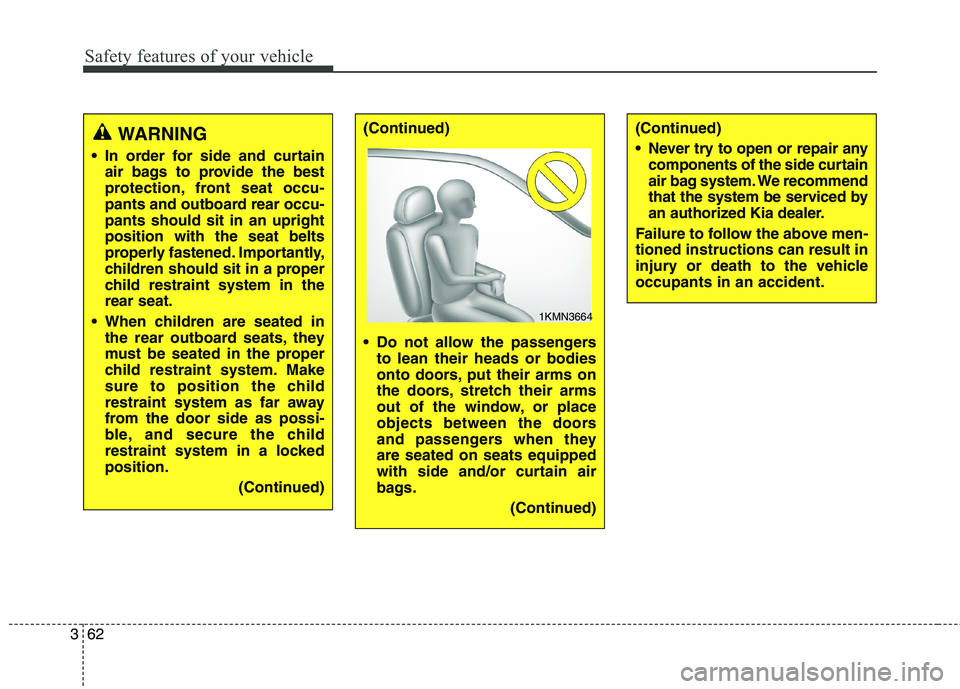
Do not allow the passengers to lean their heads or bodies onto
doors, put their arms on the
doors, stretch their arms out of
the window, or place objects
between the doors and passen-
gers when they are seated onseats equipped with side and/or
curtain air bags.
Page 79 of 513
Safety features of your vehicle
62
3
WARNING
In order for side and curtain air bags to provide the best
protection, front seat occu-
pants and outboard rear occu-pants should sit in an uprightposition with the seat belts
properly fastened. Importantly,
children should sit in a proper
child restraint system in therear seat.
When children are seated in the rear outboard seats, they
must be seated in the proper
child restraint system. Make
sure to position the child
restraint system as far away
from the door side as possi-
ble, and secure the child
restraint system in a lockedposition.
(Continued)(Continued)
Do not allow the passengersto lean their heads or bodies
onto doors, put their arms on
the doors, stretch their arms
out of the window, or place
objects between the doors
and passengers when theyare seated on seats equipped
with side and/or curtain air
bags.
(Continued)(Continued)
Never try to open or repair anycomponents of the side curtain
air bag system. We recommend
that the system be serviced by
an authorized Kia dealer.
Failure to follow the above men-tioned instructions can result in
injury or death to the vehicleoccupants in an accident.
1KMN3664
Page 86 of 513

369
Safety features of your vehicle
Additional safety precautions
All occupants should sit upright,fully back in their seats with their
seat belts on and their feet on the
floor.
Passengers should not move
out of or change seats while the
vehicle is moving. A passenger
who is not wearing a seat belt dur-
ing a crash or emergency stop can
be thrown against the inside of the
vehicle, against other occupants,
or out of the vehicle.
Each seat belt is designed torestrain one occupant. If more
than one person uses the same
seat belt, they could be seriouslyinjured or killed in a collision.
Do not use any accessories onseat belts. Devices claiming to
improve occupant comfort or repo-sition the seat belt can reduce the
protection provided by the seat belt
and increase the chance of serious
injury in a crash.
Passengers should not place
hard or sharp objects between
themselves and the air bags.
Carrying hard or sharp objects on
your lap or in your mouth can result
in injuries if an air bag inflates.
Keep occupants away from the
air bag covers. All occupants
should sit upright, fully back in theirseats with their seat belts on and
their feet on the floor. If occupants
are too close to the air bag covers,
they could be injured if the air bags
inflate.
Do not attach or place objects
on or near the air bag covers.
Any object attached to or placed
on the front or side air bag covers
could interfere with the proper
operation of the air bags.
Do not modify the front seats.Modification of the front seats
could interfere with the operation of
the supplemental restraint systemsensing components or side air
bags.
Do not place items under the
front seats. Placing items under
the front seats could interfere with
the operation of the supplemental
restraint system sensing compo-
nents and wiring harnesses.
Never hold an infant or child on
your lap. The infant or child could
be seriously injured or killed in the
event of a crash. All infants and
children should be properly
restrained in appropriate child
safety seats or seat belts in therear seat.
Page 249 of 513

Features of your vehicle
162
4
Seat warmer (if equipped) During mild weather or under condi-
tions where the operation of the seat
warmer is not needed, keep the
switches in the "OFF" position.
Each time you press the switch,
the temperature setting of the seat
will change as follows :
When pressing the switch for more than 1.5 seconds with the seat
warmer operating, the seat warmer
will turn OFF.
The seat warmer defaults to the OFF position whenever the engine
start/stop button is turned on.
OKH032034/OKH032042
■Rear seat (if equipped) (Type A)
■Rear seat (if equipped) (Type B)
OKH032075L/OKH032013
■Front seat (Type A)
■Front seat (Type B)
The seat warmer is provided to warm the seats during cold weather. With
the engine start/stop button in the ON position, push the switch to warm theseat.
OFF HIGH( ) MIDDLE( ) LOW( )
Page 250 of 513

4163
Features of your vehicle
You can activate or deactivate therear seat warmer button by using the
REAR LOCK button on the rear arm-
rest or “System Settings” in
AVN(Audio, Video, and Navigation).
Detailed information for “System
Settings” is described in a separate-
ly supplied manual. If the REAR
LOCK button activated (LED “ON”),
you can not activate the rear seat
warmer button.
After deactivating (LED “OFF”) the
REAR LOCK button, you can acti-
vate the rear seat warmer button.
If the REAR LOCK button has acti-
vated through AVN, you can deac-
tivate the REAR LOCK button only
Through AVN.
✽✽ NOTICE
With the seat warmer switch in ON
position, the heating system in the
seat turns off or on automatically
depending on the seat temperature.
CAUTION - Seat damage
When cleaning the seats, do
not use an organic solventsuch as paint thinner, ben- zene, alcohol and gasoline.Doing so may damage the sur-face of the heater or seats.
To prevent overheating the seat warmer, do not place any-thing on the seats that insu-lates against heat, such asblankets, cushions or seat covers on the seats while theseat warmer is in operation.
Do not place heavy or sharp objects on the seat. Thosethings may damage the seat warmer system.
Be careful not to spill liquid such as water or beverages onthe seat. If you spill some liquid,wipe the seat with a dry towel. Before using the seat warmer,dry the seat completely.
Do not change the seat cover. It may damage the seat warmeror airventilation system.
WARNING - Seat warmer
burns
Passengers should use extreme caution when using seat warm-
ers due to the possibility of
excess heating or burns. The
occupants must be able to feelif the seat is becoming toowarm and to turn the seat
warmer off. The seat warmer
may cause burns even at low
temperatures, especially if used
for long periods of time.
In particular, the driver must
exercise extreme care for the
following types of passengers:
1. Infants, children, elderly or disabled persons, or hospital outpatients
2. Persons with sensitive skin or those that burn easily
3. Fatigued individuals
4. Intoxicated individuals
5. Individuals taking medication that can cause drowsiness or sleepiness (sleeping pills,
cold tablets, etc.)