Page 295 of 488
513
Driving your vehicle
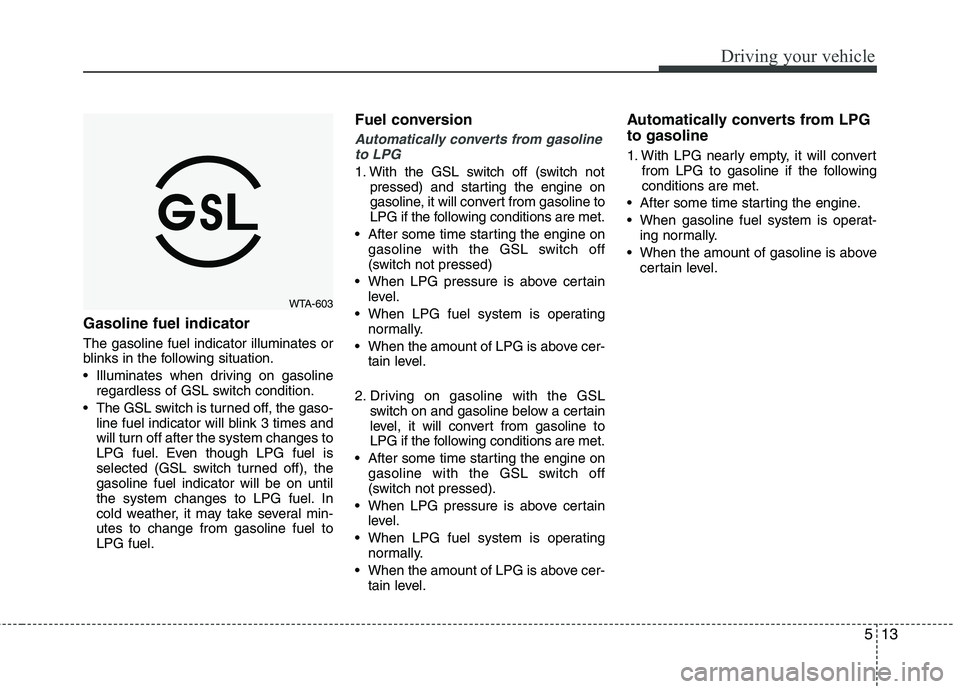
Gasoline fuel indicator The gasoline fuel indicator illuminates or
blinks in the following situation.
Illuminates when driving on gasolineregardless of GSL switch condition.
The GSL switch is turned off, the gaso- line fuel indicator will blink 3 times and
will turn off after the system changes to
LPG fuel. Even though LPG fuel is
selected (GSL switch turned off), thegasoline fuel indicator will be on until
the system changes to LPG fuel. In
cold weather, it may take several min-utes to change from gasoline fuel toLPG fuel. Fuel conversion
Automatically converts from gasoline
to LPG
1. With the GSL switch off (switch not pressed) and starting the engine on
gasoline, it will convert from gasoline to
LPG if the following conditions are met.
After some time starting the engine on gasoline with the GSL switch off
(switch not pressed)
When LPG pressure is above certain level.
When LPG fuel system is operating normally.
When the amount of LPG is above cer- tain level.
2. Driving on gasoline with the GSL switch on and gasoline below a certain
level, it will convert from gasoline to
LPG if the following conditions are met.
After some time starting the engine on gasoline with the GSL switch off
(switch not pressed).
When LPG pressure is above certain level.
When LPG fuel system is operating normally.
When the amount of LPG is above cer- tain level. Automatically converts from LPG to gasoline
1. With LPG nearly empty, it will convert
from LPG to gasoline if the following conditions are met.
After some time starting the engine.
When gasoline fuel system is operat- ing normally.
When the amount of gasoline is above certain level.
WTA-603
Page 296 of 488
Driving your vehicle
14
5
Manually converts from gasoline to LPG
1. When the GSL switch is turned off
(switch not pressed), while driving with
the GSL switch on (switch pressed), it
will convert to from gasoline to LPG if
the following conditions are met.
After some time starting the engine on gasoline.
When LPG pressure is above certain level.
When LPG fuel system is operating normally.
When the amount of LPG is above cer- tain level. Manually converts from LPG to gasoline
1. When GSL switch is turned on (switch
pressed) while driving on LPG with the
GSL switch off (switch not pressed), it
will convert from LPG to gasoline if the
following conditions are met.
After some time starting the engine.
When gasoline fuel system is operat- ing normally.
When the amount of gasoline is above certain level.
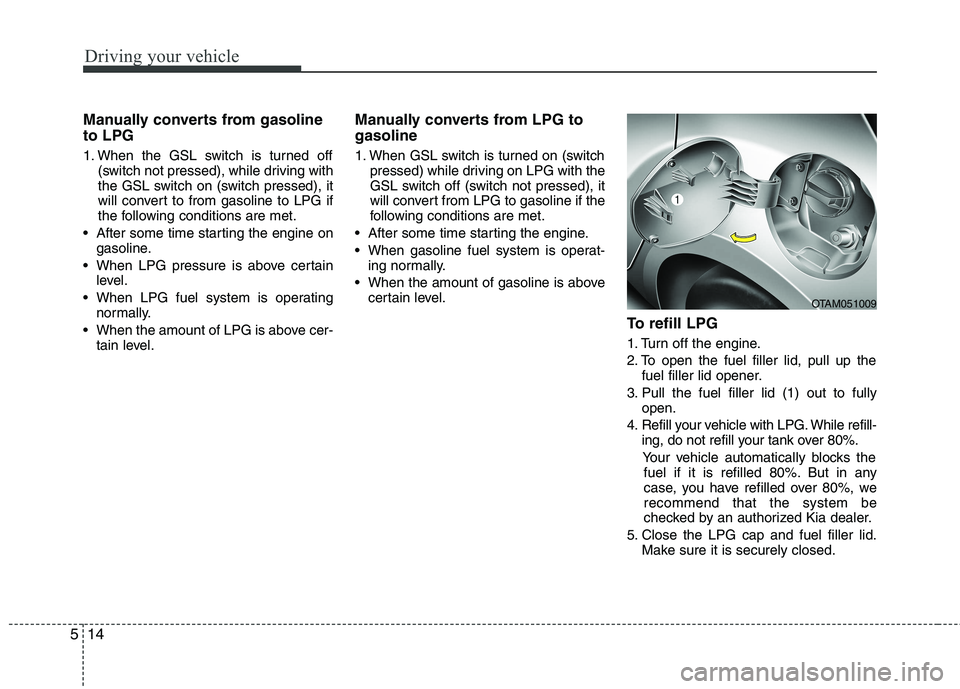
To refill LPG
1. Turn off the engine.
2. To open the fuel filler lid, pull up thefuel filler lid opener.
3. Pull the fuel filler lid (1) out to fully open.
4. Refill your vehicle with LPG. While refill- ing, do not refill your tank over 80%.
Your vehicle automatically blocks the fuel if it is refilled 80%. But in any
case, you have refilled over 80%, werecommend that the system be
checked by an authorized Kia dealer.
5. Close the LPG cap and fuel filler lid. Make sure it is securely closed.
OTAM051009
Page 300 of 488

Driving your vehicle
18
5
Manual transaxle operation
The manual transaxle has 5 forward
gears.
This shift pattern is imprinted on the shift
knob. The transaxle is fully synchronized
in all forward gears so shifting to either a
higher or a lower gear is easily accom-plished.
Depress the clutch pedal down fully while
shifting, then release it slowly.
If your vehicle is equipped with an igni-
tion lock switch, the engine will not start
when starting the engine without
depressing the clutch pedal. (if equipped)
The shift lever must be returned to the
neutral position before shifting into R
(Reverse).
Make sure the vehicle is completely
stopped before shifting into R (Reverse).
Never operate the engine with thetachometer (rpm) in the red zone. During cold weather, shifting may be difficult until the transaxle lubricant is
warmed up. This is normal and not
harmful to the transaxle.
If you've come to a complete stop and it's hard to shift into 1st or R(Reverse),
leave the shift lever at N(Neutral) posi-
tion and release the clutch. Press the
clutch pedal back down, and then shift
into 1st or R(Reverse) gear position.
MANUAL TRANSAXLE (IF EQUIPPED)
OTA050010
CAUTION
When downshifting from fifth gear
to fourth gear, caution should betaken not to inadvertently pressthe shift lever sideways in such a
manner that the second gear isengaged. Such a drastic down-shift may cause the engine speed to increase to the point that the
tachometer will enter the red-zone. Such over-revving of theengine and transaxle may possi-bly cause engine damage.
Do not downshift more than 2 gears or downshift the gear whenthe engine is running at highspeed (5,000 RPM or higher). Sucha downshifting may damage the
engine, clutch and the transaxle.
CAUTION
To avoid premature clutch wear and damage, do not drive withyour foot resting on the clutch
pedal. Also, don’t use the clutchto hold the vehicle stopped on an uphill grade, while waiting for atraffic light, etc.
To prevent possible damage to the clutch system, do not start withthe 2nd (second) gear engagedexcept when you start on a slip- pery road.
Do not use the shift lever as a handrest during driving, as thiscan result in premature wear ofthe transaxle shift forks.
Page 301 of 488
519
Driving your vehicle
Using the clutch
The clutch should be pressed all the way
to the floor before shifting, then released
slowly. The clutch pedal should always be
fully released while driving. Do not rest
your foot on the clutch pedal while driv-
ing. This can cause unnecessary wear.
Do not partially engage the clutch to hold
the vehicle on an incline. This causes
unnecessary wear. Use the foot brake or
parking brake to hold the vehicle on an
incline. Do not operate the clutch pedal
rapidly and repeatedly.
Downshifting
When you must slow down in heavy traf-
fic or while driving up steep hills, down-
shift before the engine starts to labor.
Downshifting reduces the chance of
stalling and gives better acceleration
when you again need to increase your
speed. When the vehicle is traveling
down steep hills, downshifting helps
maintain safe speed and prolongs brake
life.WARNING
Before leaving the driver’s seat, always set the parking brake fully
and shut the engine off. Thenmake sure the transaxle is shifted
into 1st gear when the vehicle is
parked on a level or uphill grade,
and shifted into R (Reverse) on a
downhill grade. Unexpected and
sudden vehicle movement canoccur if these precautions are not
followed in the order identified.
Do not use the engine brake (shifting from a high gear to
lower gear) rapidly on slippery
roads. The vehicle may slip caus-ing an accident.
If your vehicle has a manual transaxle not equipped with an
ignition lock switch, it may moveand cause a serious accident
when starting the engine without
depressing the clutch pedal whilethe parking brake is released and
the shift lever not in the N(Neutral) position.
CAUTION
When operating the clutch pedal,
press the clutch pedal down fully. If
you don’t press the clutch pedalfully, the clutch may be damaged ornoise may occur.
Page 316 of 488

Driving your vehicle
34
5
ESC operation
ESC ON condition
ON, ESC and ESC OFF indi-
cator lights illuminate for
approximately 3 seconds,
then ESC is turned on.
after turning the ignition ON
to turn ESC off. (ESC OFF
indicator will illuminate). To
turn the ESC on, press the
ESC OFF button (ESC OFFindicator light will go off).
you may hear a slight ticking
sound. This is the ESC per-
forming an automatic system
self-check and does not indi-
cate a problem. When operating
When the ESC is in operation,
the ESC indicator light blinks.
Control is operating properly,
you can feel a slight pulsation
in the vehicle. This is only the
effect of brake control and
indicates nothing unusual.
or driving on a slippery road,
the engine rpm (revolution per
minute) may not be increased
even if you press the acceler-
ator pedal deeply. This is to
maintain the stability and trac-
tion of the vehicle and does
not indicate a problem.
ESC operation off
ESC OFF state
press the ESC OFF button (ESC OFF indicator light illu-minates).
to LOCK position when ESC
is off, ESC remains off. Upon
restarting the engine, the
ESC will automatically turnon again.
-
Page 321 of 488

539
Driving your vehicle
Your vehicle may be equipped with the ISG system, which reduces fuel con-
sumption by automatically shutting down
the engine, when the vehicle is at a
standstill. (For example : red light, stop
sign and traffic jam)
The engine starts automatically as soon
as the starting conditions are met.
The ISG system is ON whenever the
engine is running.
✽✽NOTICE
When the engine automatically starts by
the ISG system, some warning lights
(ABS, ESC, ESC OFF, EPS or Parking
brake warning light) may turn on for a
few seconds.
This happens because of low battery
voltage. It does not mean the system has
malfunctioned.
Auto stop
To stop the engine in idle stop mode
1. Decrease the vehicle speed to less than 5 km/h (3 mph).
2. Shift into N (Neutral) position.
3. Release the clutch pedal.
The engine will stop and the green AUTO
STOP( ) indicator on the instrument
cluster will illuminate. Also, a message "Auto Stop" will appear
on the LCD display.✽✽
NOTICE
You must reach a speed of at least 10
km/h (6 mph) since last idle stop.
ISG (IDLE STOP AND GO) SYSTEM (IF EQUIPPED)
OTA055100KOTA045473L
Page 327 of 488

545
Driving your vehicle
✽✽NOTICE
During normal cruise control opera- tion, when the SET switch is activated
or reactivated after applying the
brakes, the cruise control will ener-
gize after approximately 3 seconds.
This delay is normal.
To activate cruise control, depress the
brake pedal at least once after turning
the ignition switch to the ON position
or starting the engine. This is to check
if the brake switch which is important
part to cancel cruise control is in nor-
mal condition.
Cruise control switch
: Turns cruise control system on oroff. (ON CANCEL OFF)
: Changes mode between cruise con- trol system and speed limit control system.
RES+: Resumes or increases cruisecontrol speed.
SET-: Sets or decreases cruise control speed. To set cruise control speed:
1. Press the button on the steering
wheel, to turn the system on. The indicator light will illuminate
2. Accelerate to the desired speed, which must be more than approximately 30km/h (20 mph).
✽✽ NOTICE - Manual transaxle
For manual transaxle vehicles, you
should depress the brake pedal at least
once to set the cruise control after start-
ing the engine.
OTA055102OTA055039L
Page 345 of 488
6
Road warning / 6-2
In case of an emergency while driving / 6-3
If the engine will not start / 6-4
Emergency starting / 6-5
If the engine overheats / 6-8
If you have a flat tire / 6-9
If you have a flat tire (with Tire Mobility Kit) / 6-19
Tire pressure monitoring system (TPMS) / 6-25
Towing / 6-30
Emergency commodity / 6-34
What to do in an emergency