2016 KIA PICANTO cooling
[x] Cancel search: coolingPage 382 of 488
Maintenance
4
7
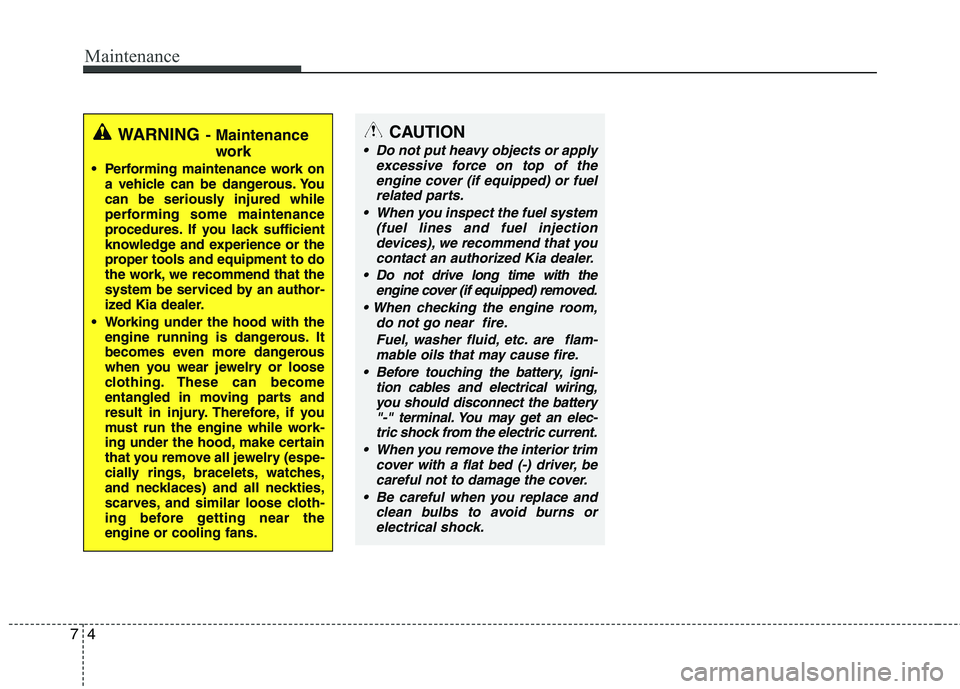
CAUTION
Do not put heavy objects or apply
excessive force on top of the
engine cover (if equipped) or fuelrelated parts.
When you inspect the fuel system (fuel lines and fuel injection
devices), we recommend that you contact an authorized Kia dealer.
Do not drive long time with the engine cover (if equipped) removed.
do not go near fire.
Fuel, washer fluid, etc. are flam-mable oils that may cause fire.
Before touching the battery, igni- tion cables and electrical wiring,you should disconnect the battery
"-" terminal. You may get an elec-tric shock from the electric current.
When you remove the interior trim cover with a flat bed (-) driver, becareful not to damage the cover.
Be careful when you replace and clean bulbs to avoid burns orelectrical shock.WARNING - Maintenance
work
Performing maintenance work on a vehicle can be dangerous. You
can be seriously injured while
performing some maintenance
procedures. If you lack sufficient
knowledge and experience or the
proper tools and equipment to do
the work, we recommend that the
system be serviced by an author-
ized Kia dealer.
Working under the hood with the engine running is dangerous. It
becomes even more dangerous
when you wear jewelry or loose
clothing. These can become
entangled in moving parts and
result in injury. Therefore, if you
must run the engine while work-
ing under the hood, make certain
that you remove all jewelry (espe-
cially rings, bracelets, watches,
and necklaces) and all neckties,
scarves, and similar loose cloth-
ing before getting near theengine or cooling fans.
Page 390 of 488

Maintenance
12
7
NORMAL MAINTENANCE SCHEDULE (CONT.)
60,000 km (40,000 miles) or 48months
❑ Inspect air cleaner filter - Except China, India, Middle East
❑ Inspect air conditioner refrigerant/compressor (if equipped)
❑ Inspect battery condition
❑ Inspect brake lines, hoses and connections
❑ Inspect brake fluid (Except Europe)
❑ Replace brake fluid (For Europe)
❑ Inspect disc brakes and pads
❑ Inspect drive belt * 1
❑
Inspect drive shafts and boots
❑ Inspect exhaust system
❑ Inspect front suspension ball joints
❑ Inspect fuel filter (For Europe) * 6
❑
Inspect fuel lines, hoses and connections
❑ Inspect parking brake
❑ Inspect steering gear rack, linkage and boots
❑ Inspect tire (pressure & tread wear)
❑ Inspect automatic transaxle fluid (if equipped)
❑ Inspect manual transaxle fluid (if equipped)
❑ Inspect vapor hose and fuel filler cap
(Continued)
(Continued)
❑ Inspect valve clearance * 5
(For Gasoline Engine)
(Every 95,000 km (60,000 miles) or 48 months * 4
)
❑ Replace air cleaner filter - For China, India, Middle East
❑ Replace climate control air filter (if equipped)
❑ Replace engine oil and filter - Except Middle East, Brazil * 2
❑
Replace spark plugs - For Leaded Gasoline Engine
❑ Replace engine oil and filter - For Middle East, Brazil * 2
(Every 10,000 km (6,500 miles) or 12months * 3
)
❑ Replace fuel filter (Except Europe)
❑ Inspect cooling system
(At first, 60,000 km (40,000 miles) or 48months
after that, every 30,000 km (20,000 miles) or 24months)
❑ Add fuel additives * 8
(Every 15,000 km or 12months - For Europe, every 5,000 km or 6months - Except Europe)
❈ Inspect : Inspect and if necessary, adjust, correct, clean or
replace.
Page 392 of 488
Maintenance
14
7
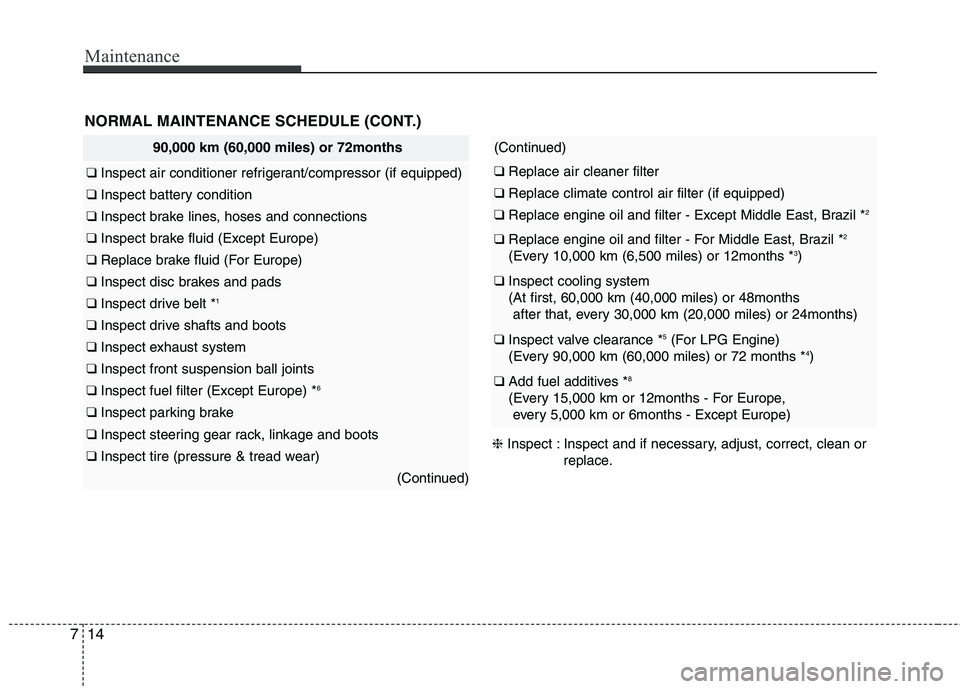
NORMAL MAINTENANCE SCHEDULE (CONT.)
90,000 km (60,000 miles) or 72months
❑ Inspect air conditioner refrigerant/compressor (if equipped)
❑ Inspect battery condition
❑ Inspect brake lines, hoses and connections
❑ Inspect brake fluid (Except Europe)
❑ Replace brake fluid (For Europe)
❑ Inspect disc brakes and pads
❑ Inspect drive belt * 1
❑
Inspect drive shafts and boots
❑ Inspect exhaust system
❑ Inspect front suspension ball joints
❑ Inspect fuel filter (Except Europe) * 6
❑
Inspect parking brake
❑ Inspect steering gear rack, linkage and boots
❑ Inspect tire (pressure & tread wear)
(Continued)
(Continued)
❑ Replace air cleaner filter
❑ Replace climate control air filter (if equipped)
❑ Replace engine oil and filter - Except Middle East, Brazil * 2
❑
Replace engine oil and filter - For Middle East, Brazil * 2
(Every 10,000 km (6,500 miles) or 12months * 3
)
❑ Inspect cooling system
(At first, 60,000 km (40,000 miles) or 48months
after that, every 30,000 km (20,000 miles) or 24months)
❑ Inspect valve clearance * 5
(For LPG Engine)
(Every 90,000 km (60,000 miles) or 72 months * 4
)
❑ Add fuel additives * 8
(Every 15,000 km or 12months - For Europe, every 5,000 km or 6months - Except Europe)
❈ Inspect : Inspect and if necessary, adjust, correct, clean or
replace.
Page 394 of 488

Maintenance
16
7
NORMAL MAINTENANCE SCHEDULE (CONT.)
120,000 km (80,000 miles) or 96months
❑ Inspect air cleaner filter - Except China, India, Middle East
❑ Inspect air conditioner refrigerant/compressor (if equipped)
❑ Inspect battery condition
❑ Inspect brake lines, hoses and connections
❑ Inspect brake fluid (Except Europe)
❑ Replace brake fluid (For Europe)
❑ Inspect disc brakes and pads
❑ Inspect drive belt * 1
❑
Inspect drive shafts and boots
❑ Inspect exhaust system
❑ Inspect front suspension ball joints
❑ Inspect fuel filter (For Europe) * 6
❑
Inspect fuel lines, hoses and connections
❑ Inspect parking brake
❑ Inspect steering gear rack, linkage and boots
❑ Inspect tire (pressure & tread wear)
❑ Inspect automatic transaxle fluid (if equipped)
❑ Inspect manual transaxle fluid (if equipped)
❑ Inspect vapor hose and fuel filler cap
(Continued)
(Continued)
❑ Inspect valve clearance * 5
(For Gasoline Engine)
(Every 95,000 km (60,000 miles) or 48 months * 4
)
❑ Replace air cleaner filter - For China, India, Middle East
❑ Replace climate control air filter (if equipped)
❑ Replace engine oil and filter - Except Middle East, Brazil * 2
❑
Replace engine oil and filter - For Middle East, Brazil * 2
(Every 10,000 km (6,500 miles) or 12months * 3
)
❑ Replace fuel filter (Except Europe)
❑ Replace spark plugs - For Leaded Gasoline Engine
❑ Replace spark plugs
- For Unleaded Gasoline Engine or LPG Engine
(Every 160,000 km (100,000 miles) or 120 months)
❑ Replace coolant * 7
(At first, 210,000 km (120,000 miles) or 120months
after that, every 30,000 km (20,000 miles) or 24months * 4
)
❑ Inspect cooling system
(At first, 60,000 km (40,000 miles) or 48months
after that, every 30,000 km (20,000 miles) or 24months)
❑ Add fuel additives * 8
(Every 15,000 km or 12months - For Europe, every 5,000 km or 6months - Except Europe)
❈ Inspect : Inspect and if necessary, adjust, correct, clean or
replace.
Page 400 of 488

Maintenance
22
7
Spark plugs
Make sure to install new spark plugs of
the correct heat range.
Valve clearance
Inspect excessive valve noise and/or
engine vibration and adjust if necessary.
We recommend that the system be serv-
iced by an authorized Kia dealer. Cooling system
Check cooling system components, such
as radiator, coolant reservoir, hoses and
connections for leakage and damage.
Replace any damaged parts. Coolant The coolant should be changed at the
intervals specified in the maintenance
schedule.
Manual transaxle fluid (if equipped)
Inspect the manual transaxle fluid
according to the maintenance schedule.
Automatic transaxle fluid (if equipped)
The fluid level should be in the "HOT"
range of the dipstick, after the engine
and transaxle are at normal operating
temperature. Check the automatic
transaxle fluid level with the engine run-
ning and the transaxle in neutral, with the
parking brake properly applied.
Brake hoses and lines
Visually check for proper installation,
chafing, cracks, deterioration and any
leakage. Replace any deteriorated or
damaged parts immediately. Brake fluid
Check brake fluid level in the brake fluid
reservoir. The level should be between
“MIN” and “MAX” marks on the side of
the reservoir. Use only hydraulic brake
fluid conforming to DOT 3 or DOT 4specification.
Parking brake
Inspect the parking brake system includ-
ing the parking brake lever and cables.
WARNING
Do not disconnect and inspect spark plugs when the engine is hot.
You may burn yourself.
Page 404 of 488
Maintenance
26
7
ENGINE COOLANT
The high-pressure cooling system has a
reservoir filled with year-round antifreeze
coolant. The reservoir is filled at the fac-
tory.
Check the antifreeze protection and
coolant level at least once a year, at thebeginning of the winter season, and
before traveling to a colder climate. Checking the coolant level
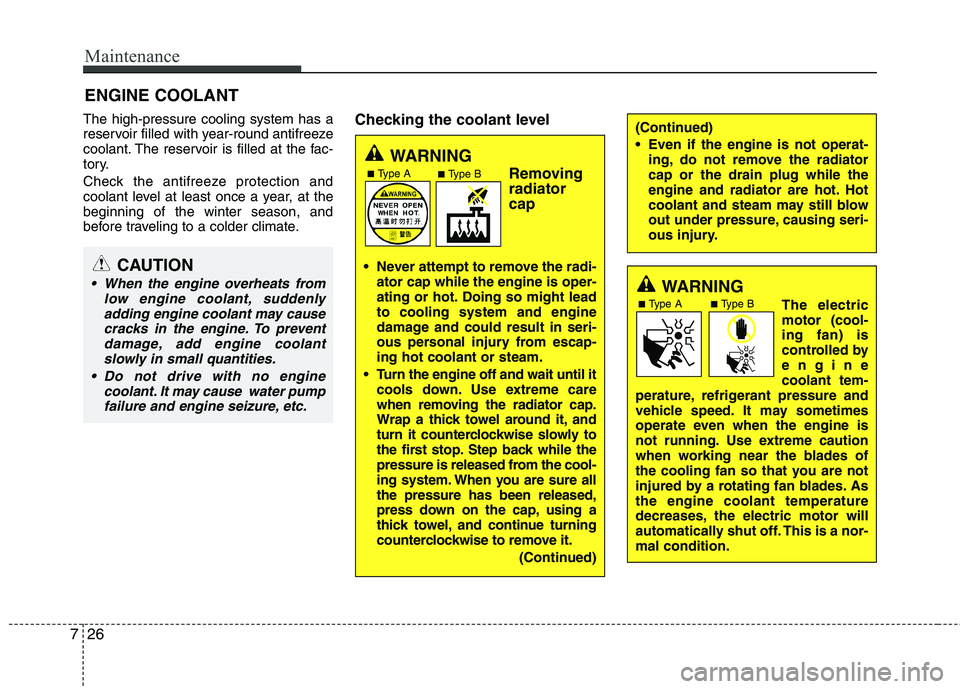
WARNING
Removingradiator cap
Never attempt to remove the radi- ator cap while the engine is oper-
ating or hot. Doing so might leadto cooling system and engine
damage and could result in seri-
ous personal injury from escap-ing hot coolant or steam.
Turn the engine off and wait until it cools down. Use extreme care
when removing the radiator cap.
Wrap a thick towel around it, and
turn it counterclockwise slowly to
the first stop. Step back while the
pressure is released from the cool-
ing system. When you are sure allthe pressure has been released,
press down on the cap, using a
thick towel, and continue turning
counterclockwise to remove it.
(Continued)
(Continued)
Even if the engine is not operat-ing, do not remove the radiator cap or the drain plug while the
engine and radiator are hot. Hot
coolant and steam may still blow
out under pressure, causing seri-
ous injury.
WARNING
The electric motor (cool-ing fan) is
controlled byenginecoolant tem-
perature, refrigerant pressure and
vehicle speed. It may sometimes
operate even when the engine is
not running. Use extreme caution
when working near the blades of
the cooling fan so that you are not
injured by a rotating fan blades. Asthe engine coolant temperature
decreases, the electric motor will
automatically shut off. This is a nor-mal condition.
CAUTION
When the engine overheats from
low engine coolant, suddenly
adding engine coolant may causecracks in the engine. To preventdamage, add engine coolant slowly in small quantities.
Do not drive with no engine coolant. It may cause water pumpfailure and engine seizure, etc.
■ Type B■Type A
■ Type B■Type A
Page 405 of 488
727
Maintenance
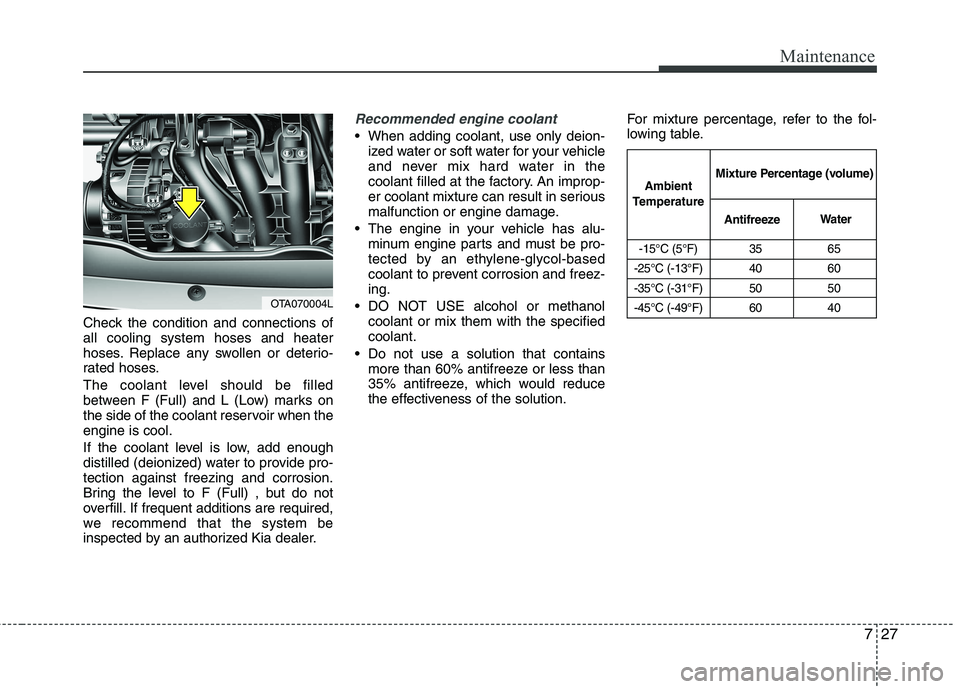
Check the condition and connections of all cooling system hoses and heater
hoses. Replace any swollen or deterio-
rated hoses.
The coolant level should be filled
between F (Full) and L (Low) marks on
the side of the coolant reservoir when theengine is cool.
If the coolant level is low, add enough
distilled (deionized) water to provide pro-tection against freezing and corrosion.
Bring the level to F (Full) , but do not
overfill. If frequent additions are required,
we recommend that the system be
inspected by an authorized Kia dealer.
Recommended engine coolant
When adding coolant, use only deion- ized water or soft water for your vehicle
and never mix hard water in the
coolant filled at the factory. An improp-
er coolant mixture can result in serious
malfunction or engine damage.
The engine in your vehicle has alu- minum engine parts and must be pro-
tected by an ethylene-glycol-based
coolant to prevent corrosion and freez-ing.
DO NOT USE alcohol or methanol coolant or mix them with the specifiedcoolant.
Do not use a solution that contains more than 60% antifreeze or less than
35% antifreeze, which would reduce
the effectiveness of the solution. For mixture percentage, refer to the fol-
lowing table.
-15°C (5°F) 35 65
-25°C (-13°F) 40 60
-35°C (-31°F) 50 50
-45°C (-49°F) 60 40
Ambient
Temperature Mixture Percentage (volume)
Antifreeze Water
OTA070004L
Page 443 of 488

765
Maintenance
SymbolFuse ratingProtected Component
MULTI FUSE80AEPS Control Module
125AAlternator, PCB Fuse & Relay Box
FUSE
50AI/P Junction Box (Power Connector Fuse : F1 10A / F2 20A,
Fuse : F24 10A / F25 10A / F26 10A / F27 15A, Tail Lamp Relay)
40AProjection Type : E/R Sub Fuse Box (Fuse : F1 10A / F2 20A / F4 15A / F5 10A / F7 10A )
50AI/P Junction Box (Fuse : F8 20A / F9 25A / F10 15A / F16 15A / F17 25A / F18 15A / F19 10A
/ F35 10A, Power Window Relay)
40AE/R Junction Box (Fuse : F11 15A), Ignition Switch, PDM Relay Box (ESCL Relay)
40AABS Control Relay, ESC Control Relay
30AABS Control Relay, ESC Control Relay
40ARear Defogger Relay
40APCB Fuse & Relay Box (Start Relay), Ignition Switch, PDM Relay Box (ESCL Relay)
30APCB Fuse & Relay Box (Engine Control Relay, Fuse : F23 10A)
40APCB Fuse & Relay Box (Blower Relay)
40APCB Fuse & Relay Box (Cooling Fan Relay)
FUSE
(General head light type)10AInstrument Cluster, Head Lamp RH, PCB Fuse & Relay Box (Head Lamp (HI) Relay)
2FUEL PUMP
(FFV)
VACCUM PUMP (EU K3 AT)
15APCB Fuse & Relay Box (Fuel Pump #2 Relay)
Engine compartment main fuse panel