Page 432 of 466

Specifications & Consumer information
Dimensions . . . . . . . . . . . . . . . . . . . . . . . . . . . . . . . . 8-2
Engine . . . . . . . . . . . . . . . . . . . . . . . . . . . . . . . . . . . . \
8-2
Gross vehicle weight. . . . . . . . . . . . . . . . . . . . . . . . . 8-2
Luggage volume . . . . . . . . . . . . . . . . . . . . . . . . . . . . 8-3
Battery . . . . . . . . . . . . . . . . . . . . . . . . . . . . . . . . . . . . \
8-3
Air conditioning system . . . . . . . . . . . . . . . . . . . . . . 8-3
Bulb wattage . . . . . . . . . . . . . . . . . . . . . . . . . . . . . . . 8-4
Tires and wheels . . . . . . . . . . . . . . . . . . . . . . . . . . . . 8-5
Recommended lubricants and capacities . . . . . . . 8-6
• Recommended SAE viscosity number. . . . . . . . . . . . . 8-7
Vehicle identification number (VIN) . . . . . . . . . . . 8-8
Vehicle certification label. . . . . . . . . . . . . . . . . . . . . 8-8
Tire specification and pressure label . . . . . . . . . . . 8-9
Engine number . . . . . . . . . . . . . . . . . . . . . . . . . . . . . 8-9
8
Page 433 of 466
28
Specifications & Consumer information
DIMENSIONS
ItemGasoline 2.4L
Displacement [cc(cu.in)] 2,359 cc (143.96 cu.in)
Bore x Stroke [mm(in)] 88 x 97 mm (3.46 x 3.82 in)
Firing order 1
→ 3 → 4 → 2
No. of cylinders 4, In-line
Itemmm (in.)
Overall length 4,845 (190.7)
Overall width 1,830 (72.0)
Overall height 1,450 (57.1)
Front tread 1,601 (63.0)*
1/1,595 (62.8)*2
Rear tread1,601 (63.0)*1/1,595 (62.8)*2
Wheelbase 2,795 (110.0)
*1: with R16 tire
*2: with R17 tire
ENGINE
GROSS VEHICLE WEIGHT
ITEM Gasoline 2.4L
Gross vehicle weight A/T 2,080 kg (4,586 lbs)
Page 437 of 466
68
Specifications & Consumer information
RECOMMENDED LUBRICANTS AND CAPACITIES
To help achieve proper engine and powertrain performance and durability, use only lubricants of the proper quality.
The correct lubricants also help promote engine efficiency that results in improved fuel economy.
These lubricants and fluids are recommended for use in your vehicle.
*1Refer to the recommended SAE viscosity numbers on the next page.
*2Engine oils labeled Energy Conserving Oil are now available. Along with other additional benefits, they contribute
to fuel economy by reducing the amount of fuel necessary to overcome engine friction. Often, these improvements
are difficult to measure in everyday driving, but in a year’s time, they can offer significant cost and energy savings.
*
3If the API service SM engine oil is not available in your country, you are able to use API service SL.
LubricantVolumeClassification
Engine oil *1 *2 (drain and refill)
Recommended (or equivalent)
4.8 l(5.07 US qt.)API Service SM*3,
ILSAC GF-4 or above
Automatic transaxle fluid6.0 l(6.34 US qt.)ATF SP-IV
Coolant 6.6~6.9 l
(6.97~7.29 US qt.)Mixture of antifreeze and water
(Ethylene glycol base coolant for aluminum radiator)
Inverter coolant2.26 l(2.39 US qt.)Mixture of antifreeze and water
(Ethylene glycol base coolant for aluminum radiator)
Brake fluid0.7~0.8 l
(0.7~0.8 US qt.)FMVSS116 DOT-3 or DOT-4
Fuel65 l(17.2 US gal.)Refer to "Fuel requirements" in chapter 1.
Page 438 of 466

Recommended SAE viscosity
numberEngine oil viscosity (thickness) has
an effect on fuel economy and cold
weather operating (engine start and
engine oil flowability). Lower viscosi-
ty engine oils can provide better fuel
economy and cold weather perform-
ance, however, higher viscosity
engine oils are required for satisfac-
tory lubrication in hot weather.Using oils of any viscosity other than
those recommended could result in
engine damage.
When choosing an oil, consider the
range of temperature your vehicle
will be operated in before the next oil
change. Proceed to select the rec-
ommended oil viscosity from the
chart.
CAUTION
Always be sure to clean the area
around any filler plug, drainplug, or dipstick before check-ing or draining any lubricant.This is especially important industy or sandy areas and whenthe vehicle is used on unpavedroads. Cleaning the plug anddipstick areas will prevent dirtand grit from entering theengine and other mechanismsthat could be damaged.
Temperature Range for SAE Viscosity Numbers
Temperature
Engine Oil°C
(°F)-30 -20 -10 0 10 20 30 40 50 -10 0 20 40 60 80 100 120
5W-20, 5W-30
20W-50
10W-30
15W-40
87
Specifications & Consumer information
For better fuel economy, it is recommended to use the engine oil of a
viscosity grade SAE 5W-20 (API SM / ILSAC GF-4). However, if the
engine oil is not available in your country, select the proper engine oil
using the engine oil viscosity chart.
Page 440 of 466
89
Specifications & Consumer information
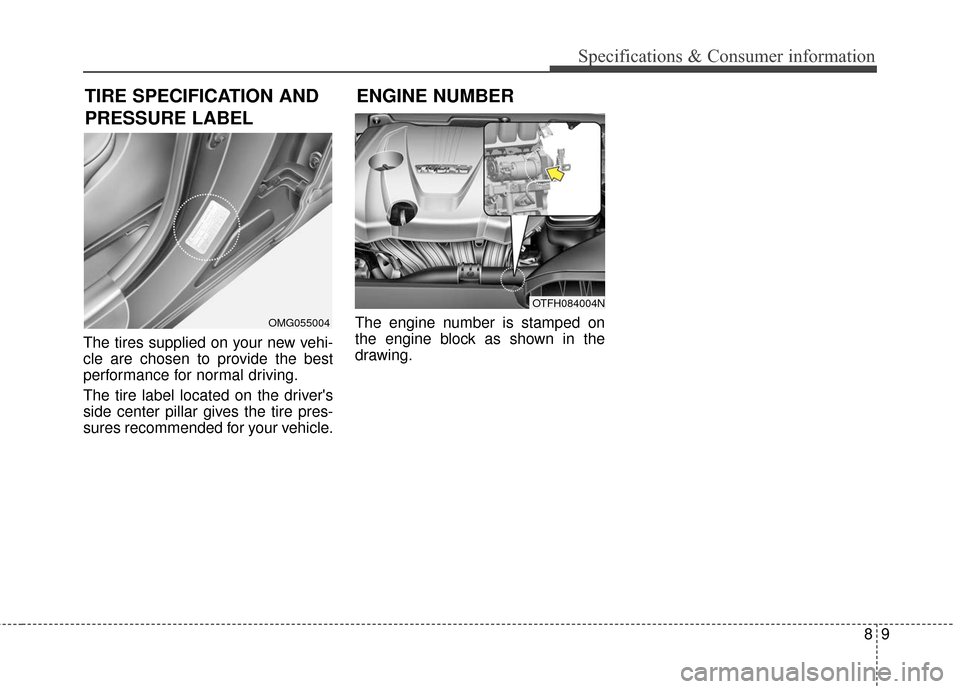
The tires supplied on your new vehi-
cle are chosen to provide the best
performance for normal driving.
The tire label located on the driver's
side center pillar gives the tire pres-
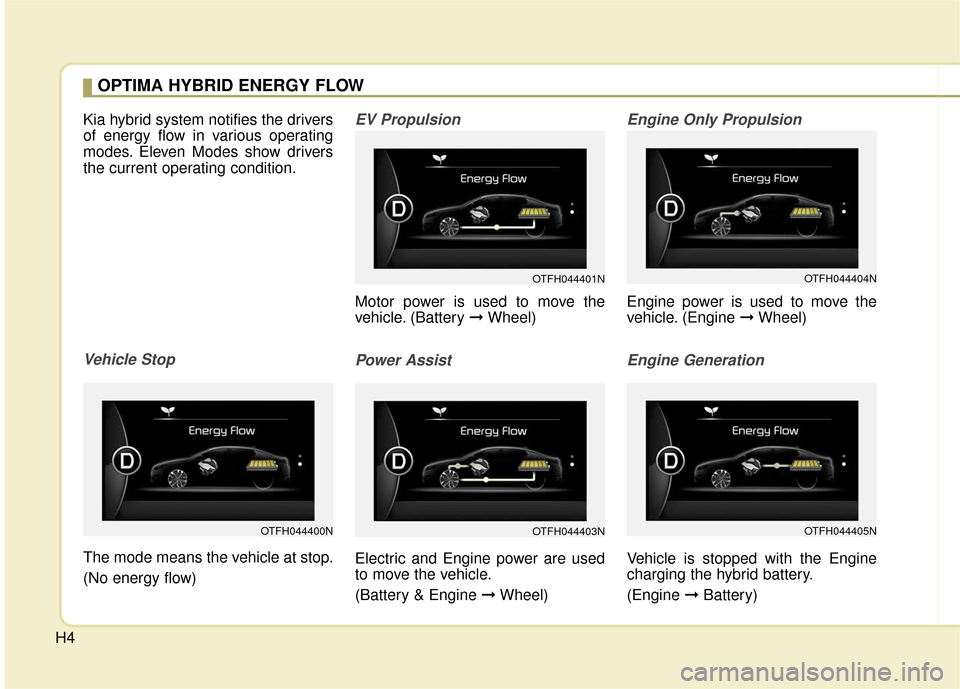
sures recommended for your vehicle.The engine number is stamped on
the engine block as shown in the
drawing.
TIRE SPECIFICATION AND
PRESSURE LABEL
OMG055004
ENGINE NUMBER
OTFH084004N
Page 442 of 466
H2
Kia Hybrid-Electric Vehicle (HEV)
uses a gasoline engine and an
electric motor for power. The elec-
tric motor is powered by a 270V
high voltage HEV battery.
The HEV computer decides when
to use the engine and when to use
electric motor, according to driv-
ing conditions. At times, both are
used simultaneously.
By turning off the engine under
certain conditions and using the
electric motor alone, the HEV sys-
tem saves fuel.
When the HEV battery reaches a
low state of charge, the engine will
cycle on and off to recharge the
battery. Charging also occurs
when decelerating by using
regenerative braking.Hybrid System Display
Many of the displays provide infor-
mation about the hybrid system,
such as the ECO Level and ECO
Score.
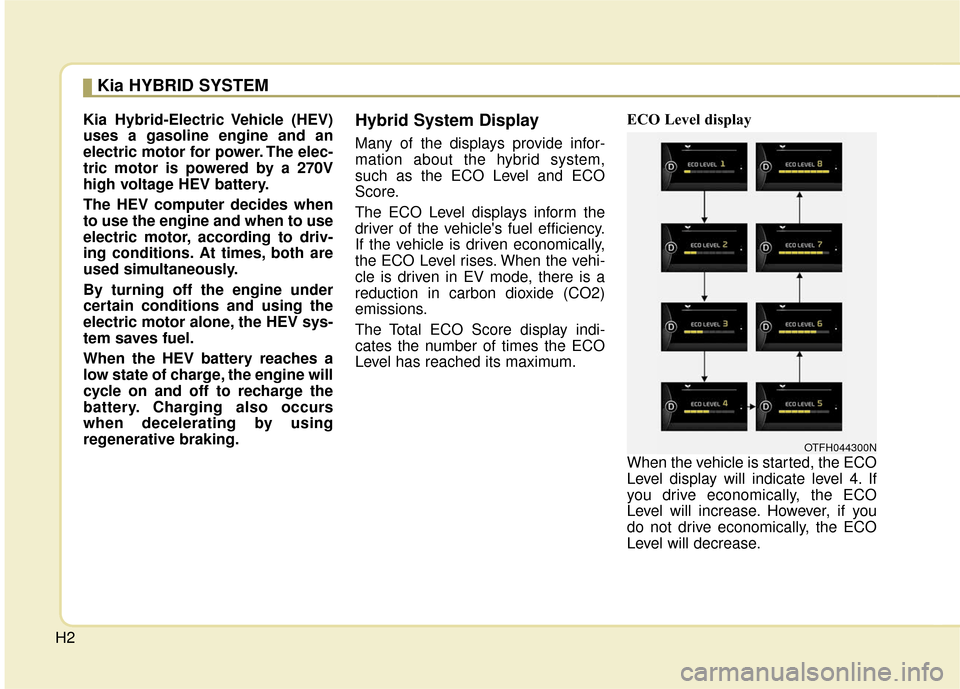
The ECO Level displays inform the
driver of the vehicle's fuel efficiency.
If the vehicle is driven economically,
the ECO Level rises. When the vehi-
cle is driven in EV mode, there is a
reduction in carbon dioxide (CO2)
emissions.
The Total ECO Score display indi-
cates the number of times the ECO
Level has reached its maximum.ECO Level display
When the vehicle is started, the ECO
Level display will indicate level 4. If
you drive economically, the ECO
Level will increase. However, if you
do not drive economically, the ECO
Level will decrease.
Kia HYBRID SYSTEM
OTFH044300N
Page 443 of 466
H3
State of charge
The state of charge (SOC) gauge
indicates the hybrid battery's charge
level. If the SOC is near Low (L)
level, the vehicle automatically oper-
ates the engine to charge the battery.
The gauge will rarely approach the
High (H) level. This is normal and is
not an indication of a malfunction.
However, if the service indicator and
MIL(Malfunction indicator lamp) turn
on when the State of Charge(SOC)
is near L, have your vehicle checked
by an authorized Kia dealer immedi-
ately.
OTFH044057
CAUTION- Extendedcranking
Do not crank the engine for aprolonged period of time with-out the engine starting. Thiscould result in damage to theHEV battery and becomingtotally discharged.
Page 444 of 466
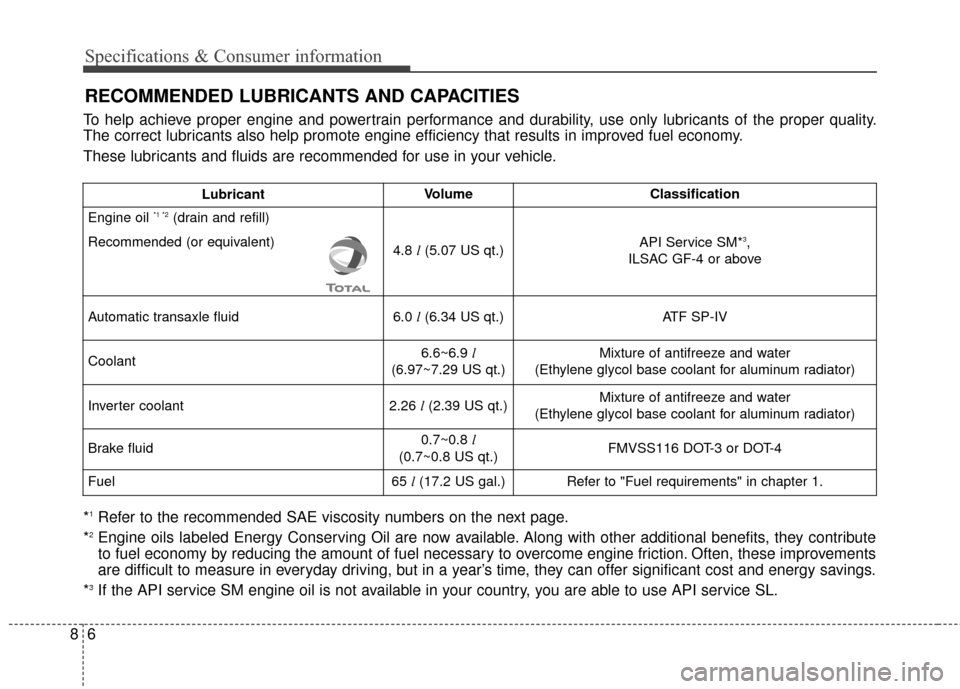
H4Kia hybrid system notifies the drivers
of energy flow in various operating
modes. Eleven Modes show drivers
the current operating condition.
Vehicle Stop
The mode means the vehicle at stop.
(No energy flow)
EV Propulsion
Motor power is used to move the
vehicle. (Battery
➞Wheel)
Power Assist
Electric and Engine power are used
to move the vehicle.
(Battery & Engine ➞ Wheel)
Engine Only Propulsion
Engine power is used to move the
vehicle. (Engine ➞Wheel)
Engine Generation
Vehicle is stopped with the Engine
charging the hybrid battery.
(Engine ➞Battery)
OPTIMA HYBRID ENERGY FLOW
OTFH044400NOTFH044403N
OTFH044404NOTFH044401N
OTFH044405N
![KIA Optima Hybrid 2016 4.G Owners Manual 28
Specifications & Consumer information
DIMENSIONS
ItemGasoline 2.4L
Displacement [cc(cu.in)] 2,359 cc (143.96 cu.in)
Bore x Stroke [mm(in)] 88 x 97 mm (3.46 x 3.82 in)
Firing order 1
→ 3 → 4 â](/manual-img/2/2974/w960_2974-432.png "KIA Optima Hybrid 2016 4.G Owners Manual 28
Specifications & Consumer information
DIMENSIONS
ItemGasoline 2.4L
Displacement [cc(cu.in)] 2,359 cc (143.96 cu.in)
Bore x Stroke [mm(in)] 88 x 97 mm (3.46 x 3.82 in)
Firing order 1
→ 3 → 4 â")