Page 374 of 688
LaneSense Warning Message
The LaneSense system will indicate the current lane drift
condition through the Electronic Vehicle Information
Center (EVIC) or Driver Information Display (DID).
3.5 EVIC Screen — If Equipped
When the LaneSense system is ON, the lane lines are gray
when both of the lane boundaries have not been detected
and the LaneSense indicator is solid white.
System ON (Gray Lines/White Indicator)
372 STARTING AND OPERATING
Page 375 of 688
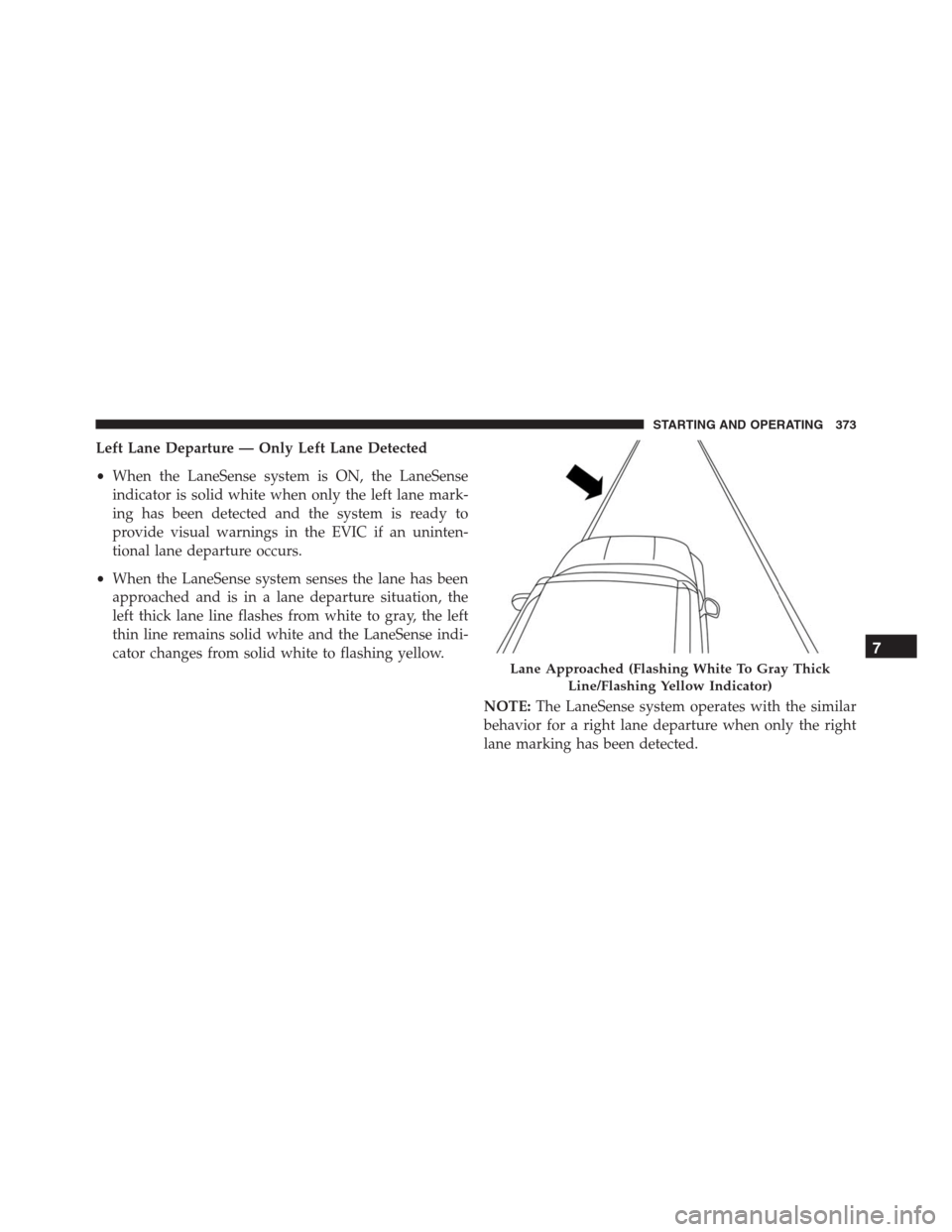
Left Lane Departure — Only Left Lane Detected
•When the LaneSense system is ON, the LaneSense
indicator is solid white when only the left lane mark-
ing has been detected and the system is ready to
provide visual warnings in the EVIC if an uninten-
tional lane departure occurs.
•When the LaneSense system senses the lane has been
approached and is in a lane departure situation, the
left thick lane line flashes from white to gray, the left
thin line remains solid white and the LaneSense indi-
cator changes from solid white to flashing yellow.
NOTE:The LaneSense system operates with the similar
behavior for a right lane departure when only the right
lane marking has been detected.
Lane Approached (Flashing White To Gray Thick
Line/Flashing Yellow Indicator)
7
STARTING AND OPERATING 373
Page 376 of 688
Left Lane Departure — Both Lanes Detected
•When the LaneSense system is ON, the lane lines turn
from gray to white to indicate that both of the lane
markings have been detected. The LaneSense indicator
is solid green when both lane markings have been
detected and the system is “armed” to provide visual
warnings in the EVIC and a torque warning in the
steering wheel if an unintentional lane departure oc-
curs.
•When the LaneSense system senses a lane drift situa-
tion, the left thick lane line and the left thin line turn
solid white. The LaneSense indicator changes from
solid green to solid yellow. At this time torque is
applied to the steering wheel in the opposite direction
of the lane boundary.
Lanes Sensed (White Lines/Green Indicator)
374 STARTING AND OPERATING
Page 385 of 688

If an obstacle is detected in the left and/or right rear
region, the display will show a single flashing arc in the
left and/or right rear region and will produce a fast
sound tone. As the vehicle moves closer to the obstacle,
the display will show the single arc moving closer to the
vehicle and the tone will change from fast to continuous.
In general, the car is closest to the obstacle when the
display shows only a flashing arc and the chime becomes
continuous.
The color on the display depends on the distance and
location of the obstacle.
Enabling And Disabling Rear ParkSense
Rear ParkSense can be enabled and disabled with the
Rear ParkSense switch.
When the Rear ParkSense switch is pressed to
disable the system, the instrument cluster will
display the “PARKSENSE DISABLED” messagefor approximately five seconds. Refer to “Electronic Vehicle
Information Center (EVIC)” or “Driver Information Dis-
play (DID)” in “Getting To Know Your Instrument Panel”
for further information. When the shift lever is moved to
REVERSE and the system is disabled, the EVIC/DID will
display the “PARKSENSE DISABLED” message for as long
as the vehicle is in REVERSE.
The Rear ParkSense switch LED will be ON when Rear
ParkSense is disabled or requires service. The Rear
ParkSense switch LED will be OFF when the system is
enabled. If the Rear ParkSense switch is pushed, and
requires service, the Rear ParkSense switch LED will
blink momentarily, and then the LED will be ON.
Rear ParkSense will remember the previous state when
the vehicle is switch off.
7
STARTING AND OPERATING 383
Page 386 of 688

CAUTION!
After turning off the ignition, the Rear ParkSense
remains in this setting until the next key cycle, even
in the case of changing the setting of starting MAR/
RUN to STOP/OFF and then again in MAR/RUN.
Service The Rear ParkSense System
During vehicle start up, when the Rear ParkSense System
has detected a faulted condition, the instrument cluster
will actuate a single chime, once per ignition cycle, and it
will display the “PARKSENSE UNAVAILABLE WIPE
REAR SENSORS” or the “PARKSENSE UNAVAILABLE
SERVICE REQUIRED” message. Refer to “Electronic
Vehicle Information Center (EVIC) or Driver Information
Display (DID)” for further information. When the shiftlever is moved to REVERSE and the system has detected
a faulted condition, the EVIC/DID will display the
�PARKSENSE UNAVAILABLE WIPE REAR SENSORS�
or�PARKSENSE UNAVAILABLE SERVICE REQUIRED�
message for as long as the vehicle is in REVERSE. Under
this condition, Rear ParkSense will not operate.
If “PARKSENSE UNAVAILABLE WIPE REAR SEN-
SORS” appears in the Electronic Vehicle Information
Center (EVIC) or Driver Information Display (DID) make
sure the outer surface and the underside of the rear
fascia/bumper is clean and clear of snow, ice, mud, dirt
or other obstructions and then cycle the ignition. If the
message continues to appear, see an authorized dealer.
If “PARKSENSE UNAVAILABLE SERVICE REQUIRED”
appears in the EVIC/DID, see an authorized dealer.
384 STARTING AND OPERATING
Page 395 of 688

value as shown in the�Inflate to XX�message. Once the
system receives the updated tire pressures, the system
will automatically update and the “Tire Pressure Moni-
toring Telltale Light” will turn off.
NOTE:When filling warm tires, the tire pressure may
need to be increased up to an additional 4 psi (30 kPa)
above the recommended cold placard pressure in order
to turn the Tire Pressure Monitoring Telltale Light off.
The vehicle may need to be driven for up to 20 minutes
above 15 mph (24 km/h) in order for the TPMS to receive
this information.
Service TPMS Warning
When a system fault is detected, the “Tire Pressure
Monitoring Telltale Light” will flash on and off for 75
seconds and then remain on solid. The system fault will
also sound a chime. If the ignition is cycled, this sequence
will repeat, providing the system fault still exists. The“Tire Pressure Monitoring Telltale Light” will turn off
when the fault condition no longer exists. A system fault
can occur due to any of the following:
1. Jamming due to electronic devices or driving next to
facilities emitting the same radio frequencies as the
TPMS sensors.
2. Installing some form of aftermarket window tinting
that affects radio wave signals.
3. Lots of snow or ice around the wheels or wheel
housings.
4. Using tire chains on the vehicle.
5. Using wheels/tires not equipped with TPMS sensors.
7
STARTING AND OPERATING 393
Page 397 of 688
Premium System — If Equipped
The Tire Pressure Monitor System (TPMS) uses wireless
technology with wheel rim mounted electronic sensors to
monitor tire pressure levels. Sensors, mounted to each
wheel as part of the valve stem, transmit tire pressure
readings to the receiver module.
NOTE:It is particularly important for you to check the
tire pressure in all of the tires on your vehicle monthly
and to maintain the proper pressure.The TPMS consists of the following components:
•Receiver Module
•Four Tire Pressure Monitoring Sensors
•Various Tire Pressure Monitoring System messages,
which display in the Electronic Vehicle Information
Center (EVIC) or Driver Information Display (DID).
•Tire Pressure Monitoring Telltale Light
7
STARTING AND OPERATING 395
Page 398 of 688
Tire Pressure Monitoring Low Pressure Warnings
The “Tire Pressure Monitoring Telltale Light” will
illuminate in the instrument cluster and a chime
will sound when tire pressure is low in one or
more of the four active road tires. In addition, the
Electronic Vehicle Information Center (EVIC)/Driver in-
formation Display (DID) will display a�Tire Low�mes-
sage for a minimum of five seconds, an�Inflate to XX�
message and a graphic showing the pressure values of
each tire with the low tire pressure values in a different
color.
Should this occur, you should stop as soon as possible
and inflate the tires with low pressure (those in a
different color in the EVIC/DID graphic) to the vehicle’s
recommended cold placard pressure value as shown in
the�Inflate to XX�message. Once the system receives the
updated tire pressures, the system will automatically
Tire Pressure Monitoring Low Pressure Warning
396 STARTING AND OPERATING