Page 430 of 688

Towing Tips
Before setting out on a trip, practice turning, stopping,
and backing the trailer in an area located away from
heavy traffic.
Automatic Transmission — If Equipped
The DRIVE range can be selected when towing. The
transmission controls include a drive strategy to avoid
frequent shifting when towing. However, if frequent
shifting does occur while in DRIVE, you can use the
AutoStick shift control to manually select a lower gear.
NOTE:Using a lower gear while operating the vehicle
under heavy loading conditions will improve perfor-
mance and extend transmission life by reducing exces-
sive shifting and heat build up. This action will also
provide better engine braking.
AutoStick
•When using the AutoStick shift control, select the
highest gear that allows for adequate performance and
avoids frequent downshifts. For example, choose “5” if
the desired speed can be maintained. Choose “4” or
“3” if needed to maintain the desired speed.
•To prevent excess heat generation, avoid continuous
driving at high RPM. Reduce vehicle speed as neces-
sary to avoid extended driving at high RPM. Return to
a higher gear or vehicle speed when grade and road
conditions allow.
428 STARTING AND OPERATING
Page 432 of 688
RECREATIONAL TOWING
Towing This Vehicle Behind Another Vehicle
FRONT WHEEL DRIVE (FWD)FOUR-WHEEL
DRIVE (4WD)
TOWING
CONDITIONWHEELS OFF THE
GROUNDAUTOMATIC
TRANSMISSIONMANUAL
TRANSMISSIONMANUAL/
AUTOMATIC
TRANSMISSION
Flat Tow NONE NOT ALLOWED NOT ALLOWED NOT ALLOWED
Dolly Tow REAR NOT ALLOWED NOT ALLOWED NOT ALLOWED
FRONT OK OK NOT ALLOWED
On Trailer ALL BEST METHOD BEST METHOD OK
NOTE:
•When recreational towing your vehicle, always follow
applicable state and provincial laws. Contact state and
provincial Highway Safety offices for additional de-
tails.•You must ensure that the Auto Park Brake feature is
disabled before towing this vehicle, to avoid inadver-
tent Electric Park Brake engagement. The Auto Park
Brake feature is enabled or disabled via the customer
programmable features in the Uconnect Settings.
430 STARTING AND OPERATING
Page 433 of 688

Recreational Towing
Models With Front-Wheel Drive (FWD)
Recreational towing is allowed ONLY if the front wheels
are OFF the ground. This may be accomplished using a
tow dolly (front wheels off the ground) or vehicle trailer
(all four wheels off the ground). If using a tow dolly,
follow this procedure:
•Properly secure the dolly to the tow vehicle, following
the dolly manufacturer’s instructions.
•Drive the front wheels onto the tow dolly.
•Apply the Electronic Parking Brake (EPB). Place the
transmission in PARK. Turn the engine OFF.
•Properly secure the front wheels to the dolly, following
the dolly manufacturer’s instructions.
•Turn the ignition to the MAR/RUN position, but do
not start the engine.•Press and hold the brake pedal.
•Release the Electric Park Brake (EPB).
•Turn the ignition OFF, remove the key, and release the
brake pedal.
CAUTION!
•DO NOT flat tow this vehicle. Damage to the
drivetrain will result. If this vehicle requires tow-
ing, make sure the drive wheels are OFF the
ground.
•Ensure that the Electric Park Brake is released, and
remains released, while being towed.
•Towing this vehicle in violation of the above re-
quirements can cause severe transmission damage.
Damage from improper towing is not covered un-
der the New Vehicle Limited Warranty.
7
STARTING AND OPERATING 431
Page 434 of 688
Models With Four-Wheel Drive (4WD)
Recreational towing (with all four wheels on the ground,
or using a towing dolly) is NOT ALLOWED. This vehicle
may be towed on a flatbed or vehicle trailer provided all
four wheels are OFF the ground.
CAUTION!
Towing this vehicle with ANY of its wheels on the
ground can cause severe transmission and/or power
transfer unit damage. Damage from improper towing
is not covered under the New Vehicle Limited War-
ranty.
432 STARTING AND OPERATING
Page 482 of 688
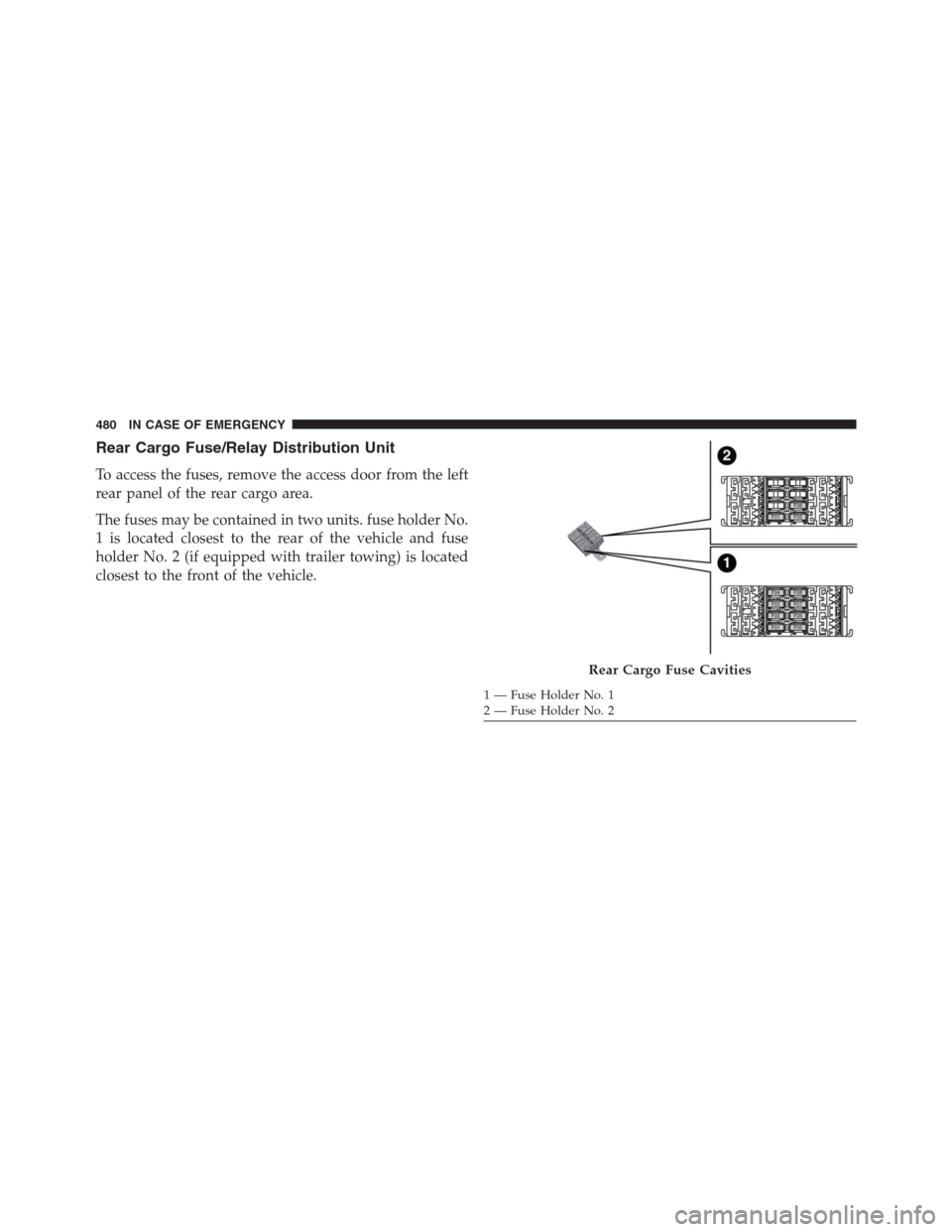
Rear Cargo Fuse/Relay Distribution Unit
To access the fuses, remove the access door from the left
rear panel of the rear cargo area.
The fuses may be contained in two units. fuse holder No.
1 is located closest to the rear of the vehicle and fuse
holder No. 2 (if equipped with trailer towing) is located
closest to the front of the vehicle.
Rear Cargo Fuse Cavities
1 — Fuse Holder No. 1
2 — Fuse Holder No. 2 480 IN CASE OF EMERGENCY
Page 484 of 688
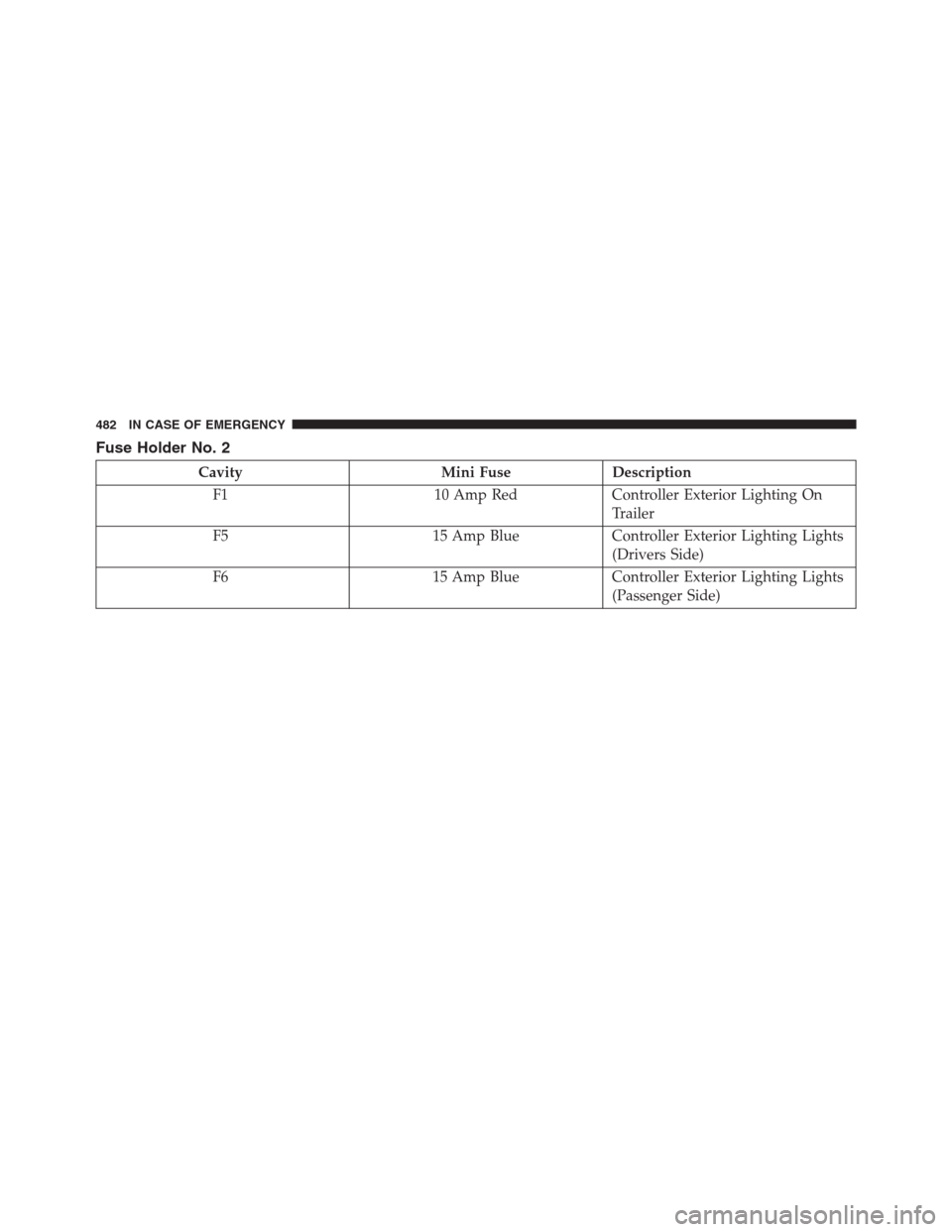
Fuse Holder No. 2
Cavity Mini Fuse Description
F1 10 Amp Red Controller Exterior Lighting On
Trailer
F5 15 Amp Blue Controller Exterior Lighting Lights
(Drivers Side)
F6 15 Amp Blue Controller Exterior Lighting Lights
(Passenger Side)
482 IN CASE OF EMERGENCY
Page 526 of 688

WARNING!
You can be badly injured working on or around a
motor vehicle. Only do service work for which you
have the knowledge and the proper equipment. If you
have any doubt about your ability to perform a service
job, take your vehicle to a competent mechanic.
MAINTENANCE SCHEDULE
Your vehicle is equipped with an automatic oil change
indicator system. The oil change indicator system will
remind you that it is time to take your vehicle in for
scheduled maintenance.
Based on engine operation conditions, the oil change indi-
cator message will illuminate in the instrument cluster. This
means that service is required for your vehicle. Operating
conditions such as frequent short-trips, trailer tow and
extremely hot or cold ambient temperatures will influencewhen the “Change Oil” or “Oil Change Required” message
is displayed. Severe Operating Conditions can cause the
change oil message to illuminate as early as 3,500 miles
(5,600 km) since last reset. Have your vehicle serviced as
soon as possible, within the next 500 miles (805 km).
Your authorized dealer will reset the oil change indicator
message after completing the scheduled oil change. If a
scheduled oil change is performed by someone other
than your authorized dealer, the message can be reset by
referring to the steps described under “Electronic Vehicle
Information Center (EVIC)/Driver Information Display
(DID)” in “Getting To Know Your Instrument Panel” for
further information.
NOTE:Under no circumstances should oil change inter-
vals exceed 10,000 miles (16,000 km), one year or 350
hours of engine run time, whichever comes first. The 350
hours of engine run or idle time is generally only a
concern for fleet customers.
524 MAINTAINING AND CARING FOR YOUR VEHICLE
Page 532 of 688
Mileage or time passed
(whichever comes first)
10,000
20,000
30,000
40,000
50,000
60,000
70,000
80,000
90,000
100,000
110,000
120,000
130,000
140,000
150,000
Years123456789101112131415
Or Kilometers
16,000
32,000
48,000
64,000
80,000
96,000
112,000
128,000
144,000
160,000
176,000
192,000
208,000
224,000
240,000
Replace brake fluid every two years.•••••••
Replace cabin filter.○•○•○•○•○•○•○•○
Change the manual transmission fluid if
using your vehicle for any of the following:
trailer towing, heavy loading, taxi, police,
delivery service (commercial service), off-
road, desert operation or more than 50%
of your driving is at sustained speeds dur-
ing hot weather, above 90°F (32°C).••
Flush and replace the engine coolant at
10 years or 150,000 miles (240,000 km)
whichever comes first.••
530 MAINTAINING AND CARING FOR YOUR VEHICLE