Page 154 of 688

Closing
Hold up the hood with one hand and with the other hand
remove the support rod from its seat and reinsert it into
the locking tab.
Lower the hood to approximately 6 inches (15 cm) from
the engine compartment and drop it. Make sure that the
hood is completely closed.
CAUTION!
To prevent possible damage, do not slam the hood to
close it. Lower the hood until it is open approxi-
mately 6 inches (15 cm), and then drop it. This should
secure both latches. Never drive your vehicle unless
the hood is fully closed, with both latches engaged.
WARNING!
Be sure the hood is fully latched before driving your
vehicle. If the hood is not fully latched, it could open
when the vehicle is in motion and block your vision.
Failure to follow this warning could result in serious
injury or death.
LIFTGATE
Opening
To unlock the liftgate, use the Remote Keyless Entry
(RKE) transmitter or activate the power door lock
switches located on the driver door handle.
To open the liftgate, squeeze the electronic liftgate release
and pull the liftgate open with one fluid motion.
152 GETTING TO KNOW YOUR VEHICLE
Page 159 of 688
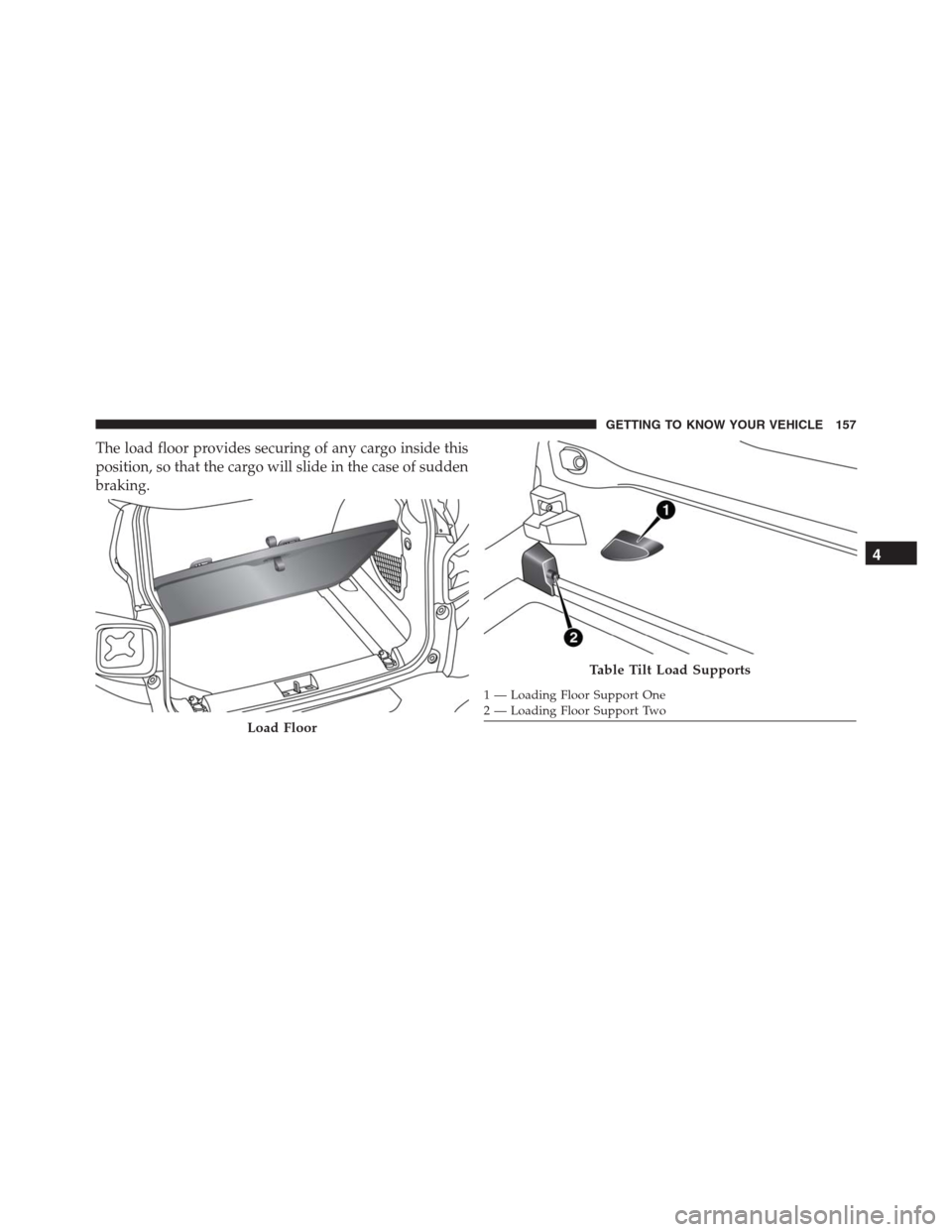
The load floor provides securing of any cargo inside this
position, so that the cargo will slide in the case of sudden
braking.
Load Floor
Table Tilt Load Supports
1 — Loading Floor Support One
2 — Loading Floor Support Two
4
GETTING TO KNOW YOUR VEHICLE 157
Page 162 of 688
Anchoring Of The Load
The cargo tie-downs, located on the cargo area floor,
should be used to safely secure loads when the vehicle is
moving.The side panels maybe equipped with three grocery
hooks (one on the left side and two on the right side) for
securing loads that are not excessively heavy.
Tie-Downs
Grocery Hook
160 GETTING TO KNOW YOUR VEHICLE
Page 176 of 688

ROOF LUGGAGE RACK — IF EQUIPPED
Your vehicle may be equipped with a Roof Luggage Rack
for transporting accessories.
Crossbars should always be used whenever cargo is
placed on the Roof Luggage Rack. Check the straps
frequently to be sure that the load remains securely
attached.
NOTE:Crossbars can be purchased at a authorized
dealer through Mopar parts. External racks do not in-
crease the total load carrying capacity of the vehicle. Be
sure that the total occupant and luggage load inside the
vehicle, plus the load on the Roof Luggage Rack, do not
exceed the maximum vehicle load capacity.
The load carried on the roof, when equipped with a
luggage rack, must not exceed 150 lbs (68 kg), and it
should be uniformly distributed over the cargo area.Do not use the retractable roof when using the crossbars.CAUTION!
•To avoid damage to the Roof Luggage Rack and
vehicle, do not exceed the maximum roof rack load
capacity. Always distribute heavy loads as evenly
as possible and secure the load appropriately.
•Long loads, which extend over the windshield,
such as wood panels or surfboards, should be
secured to both the front and rear of the vehicle.
•Place a blanket or other protection between the
surface of the roof and the load.
•Travel at reduced speeds and turn corners carefully
when carrying large or heavy loads on the roof
rack. Wind forces, due to natural causes or nearby
truck traffic, can add sudden upward loads. This is
especially true on large flat loads and may result in
damage to the cargo or your vehicle.
174 GETTING TO KNOW YOUR VEHICLE
Page 177 of 688
WARNING!
Roof rack cargo must be securely tied down before
driving your vehicle. Improperly secured loads may
fall off the vehicle, particularly at high speeds, re-
sulting in personal injury or property damage. Fol-
low the Roof Luggage Rack warnings and cautions
when carrying cargo on your roof rack.
4
GETTING TO KNOW YOUR VEHICLE 175
Page 179 of 688
GETTING TO KNOW YOUR INSTRUMENT CLUSTER
CONTENTS
�INSTRUMENT CLUSTER.................179
▫Instrument Cluster With Multi-Functional
Display (EVIC).......................179
▫Instrument Cluster With Reconfigurable
Multi-Functional Display (DID)............180
▫Speedometer (EVIC)....................181
▫Speedometer (DID)....................182
▫Odometer...........................183
▫Tachometer..........................183
▫Fuel Gauge..........................183▫Engine Coolant Temperature Gauge.........184
�WARNING AND INDICATOR LIGHTS.......185
▫Red Telltale Indicator Lights..............186
▫Yellow Telltale Indicator Lights............198
▫Green Telltale Indicator Lights............211
▫Blue Telltale Indicator Light..............213
▫White Telltale Indicator Light.............214
�ONBOARD DIAGNOSTIC SYSTEM (OBD II) . . .215
▫Onboard Diagnostic System (OBD II)
Cybersecurity........................215
5
Page 192 of 688
Vehicle Security Warning Light — If Equipped
Red Telltale
LightWhat It Means
Vehicle Security Warning Light
This light will flash at a fast rate for approximately 15 seconds when the vehicle security
alarm is arming, and then will flash slowly until the vehicle is disarmed.
Oil Pressure Warning Light
Red Telltale
LightWhat It Means
Oil Pressure Warning Light
This light indicates low engine oil pressure. If the light turns on while driving, stop the ve-
hicle and shut off the engine as soon as possible. A chime will sound when this light turns
on.
Do not operate the vehicle until the cause is corrected. This light does not indicate how
much oil is in the engine. The engine oil level must be checked under the hood.
190 GETTING TO KNOW YOUR INSTRUMENT CLUSTER
Page 210 of 688
Vehicle Security Indicator Light
Yellow Telltale
LightWhat It Means
Vehicle Security Indicator Light
This indicator will illuminate when the Vehicle Theft Alarm system has detected an attempt
was made to break into the vehicle.
Exterior Bulb Failure Indicator Light
Yellow Telltale
LightWhat It Means
Exterior Bulb Failure Indicator Light
This light will illuminate when there is a malfunction in one of the exterior bulbs.
208 GETTING TO KNOW YOUR INSTRUMENT CLUSTER