Page 242 of 587
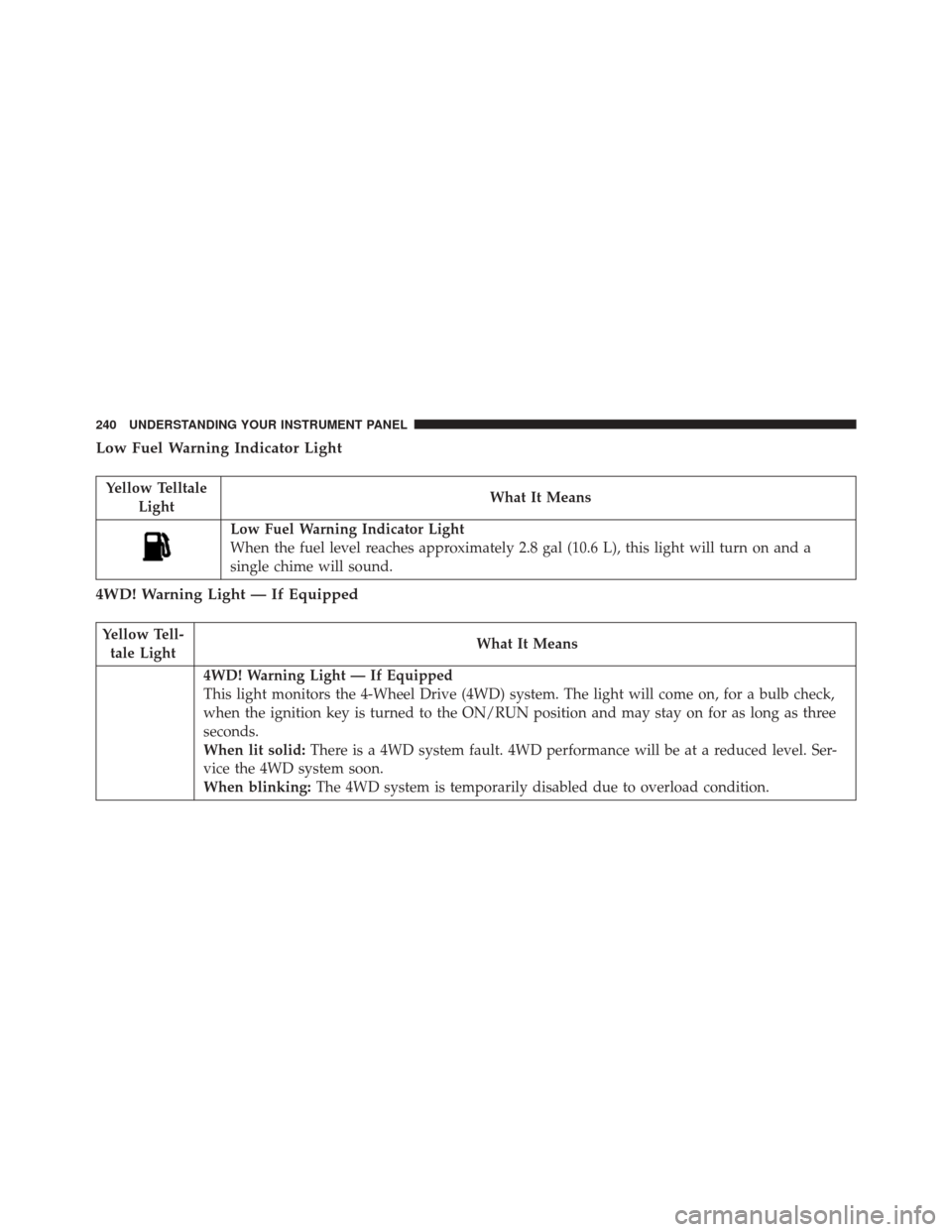
Low Fuel Warning Indicator Light
Yellow TelltaleLight What It Means
Low Fuel Warning Indicator Light
When the fuel level reaches approximately 2.8 gal (10.6 L), this light will turn on and a
single chime will sound.
4WD! Warning Light — If Equipped
Yellow Tell-
tale Light What It Means
4WD! Warning Light — If Equipped
This light monitors the 4-Wheel Drive (4WD) system. The light will come on, for a bulb check,
when the ignition key is turned to the ON/RUN position and may stay on for as long as three
seconds.
When lit solid:
There is a 4WD system fault. 4WD performance will be at a reduced level. Ser-
vice the 4WD system soon.
When blinking: The 4WD system is temporarily disabled due to overload condition.
240 UNDERSTANDING YOUR INSTRUMENT PANEL
Page 244 of 587
Transmission Temperature Indicator Light
Red TelltaleLight What It Means
Transmission Temperature Indicator Light
This light indicates that the transmission fluid temperature is running hot. This may occur with
severe usage, such as trailer towing. If this light turns on, safely pull over and stop them ve-
hicle. Then, shift the transmission into NEUTRAL and run the engine at idle or faster until the
light turns off.
CAUTION!
Continuous driving with the Transmission Tempera-
ture Warning Light illuminated will eventually cause
severe transmission damage or transmission failure.
WARNING!
If you continue operating the vehicle when the
Transmission Temperature Warning Light is illumi-
nated you could cause the fluid to boil over, come in
contact with hot engine or exhaust components and
cause a fire.
242 UNDERSTANDING YOUR INSTRUMENT PANEL
Page 250 of 587
ELECTRONIC VEHICLE INFORMATION CENTER
(EVIC) — IF EQUIPPED
The Electronic Vehicle Information Center (EVIC) fea-
tures a driver-interactive display that is located in the
instrument cluster.The EVIC consists of the following:
•
System Status
• Units
• Vehicle Information Warning Message Displays
• Personal Settings (Customer-Programmable Features)
• Compass Heading
• Outside Temperature Display
• Trip Computer Functions
• Uconnect Phone Displays (if equipped)
• Audio Mode Display
• Tire Pressure Monitor (TPM)
Electronic Vehicle Information Center (EVIC)
248 UNDERSTANDING YOUR INSTRUMENT PANEL
Page 252 of 587
DOWN ButtonPush and release the DOWN button to scroll
downward through the submenus.
When the appropriate conditions exist, the EVIC displays
the following messages:
• Turn Signal On (with a continuous warning chime
after 1 mile (1.6 km) of distance travelled)
• Left Front Turn Signal Lamp Out (with a single chime)
• Left Rear Turn Signal Lamp Out (with a single chime)
• Right Front Turn Signal Lamp Out (with a single
chime)
• Right Rear Turn Signal Lamp Out (with a single chime)
• RKE Battery Low (with a single chime) •
Personal Settings Not Avail. — Vehicle is not in PARK
(automatic transmission), or vehicle is in motion
(manual transmission).
• Door Ajar (with vehicle graphic showing which door is
open. A single chime sounds if the vehicle is in
motion).
• Doors Ajar (with vehicle graphic showing which doors
are open. A single chime sounds if the vehicle is in
motion).
• Gate (with vehicle graphic showing the Liftgate open
and a single chime)
• Headlamps or Park Lamps On
• Remote Start Aborted — Door Ajar
• Remote Start Aborted — Hood Ajar
• Remote Start Aborted — L/Gate Ajar
250 UNDERSTANDING YOUR INSTRUMENT PANEL
Page 313 of 587

To exit List mode without selecting a track, push the
samePRESET button again to go back to Play mode.
LIST button: The LISTbutton will display the top level
menu of the iPod or external USB device.
• Turn the TUNEcontrol knob to list the top-menu item
to be selected and push the TUNEcontrol knob. This
will display the next sub-menu list item on the audio
device, then follow the same steps to go to the desired
track in that list. Not all iPod or external USB device
sub-menu levels are available on this system.
MUSIC TYPE button: TheMUSIC TYPE button is
another shortcut button to the genre listing on your audio
device.CAUTION!
• Leaving the iPod or external USB device (or any
supported device) anywhere in the vehicle in ex-
treme heat or cold can alter the operation or dam-
age the device. Follow the device manufacturer ’s
guidelines.
• Placing items on the iPod or external USB device,
or connections to the iPod or external USB device
in the vehicle, can cause damage to the device
and/or to the connectors.
WARNING!
Do not plug in or remove the iPod or external USB
device while driving. Failure to follow this warning
could result in an accident.
4
UNDERSTANDING YOUR INSTRUMENT PANEL 311
Page 334 of 587

�AUTOSTICK ......................... .355
▫ AutoStick (Six-Speed Automatic
Transmission) ....................... .355
▫ AutoStick (CVT) — If Equipped ...........357
� FOUR-WHEEL DRIVE OPERATION — IF
EQUIPPED .......................... .359
� ON-ROAD DRIVING TIPS ................359
� OFF-ROAD DRIVING TIPS ...............360
▫ When To Use Low (L Off-Road) With The 4WD
Lock Lever Engaged — If Equipped ........361
▫ Driving In Snow, Mud And Sand ..........361
▫ Hill Climbing ....................... .363
▫ Driving Through Water .................365
▫ After Driving Off-Road .................367 �
POWER STEERING .....................368
▫ Power Steering Fluid Check ..............369
� PARKING BRAKE ..................... .370
� BRAKE SYSTEM ...................... .373
� ELECTRONIC BRAKE CONTROL SYSTEM . . . .374
▫ Electronic Brake Force Distribution (EBD) . . . .374
▫ Brake System Warning Light ..............374
▫ Anti-Lock Brake System (ABS) ............374
▫ Anti-Lock Brake Warning Light ............376
▫ Brake Assist System (BAS) ...............377
▫ Hill Start Assist (HSA) .................377
▫ Traction Control System (TCS) ............380
▫ Electronic Stability Control (ESC) ..........381
332 STARTING AND OPERATING
Page 336 of 587

�FUEL REQUIREMENTS ..................424
▫ 2.0L And 2.4L Engine ...................424
▫ Reformulated Gasoline .................424
▫ Gasoline/Oxygenate Blends ..............425
▫ E-85 Usage In Non-Flex Fuel Vehicles .......425
▫ MMT In Gasoline .....................426
▫ Materials Added To Fuel ................426
▫ Fuel System Cautions ...................427
▫ Carbon Monoxide Warnings .............428
� ADDING FUEL ....................... .428
▫ Fuel Filler Cap (Gas Cap) ...............428
▫ Loose Fuel Filler Cap Message ............430
� VEHICLE LOADING ....................431 ▫
Vehicle Certification Label ...............431
� TRAILER TOWING .....................433
▫ Common Towing Definitions .............433
▫ Trailer Hitch Classification ...............436
▫ Trailer Towing Weights (Maximum Trailer Weight
Ratings) ........................... .437
▫ Trailer And Tongue Weight ..............438
▫ Towing Requirements ..................439
▫ Towing Tips ........................ .445
� RECREATIONAL TOWING (BEHIND
MOTORHOME, ETC.) ...................447
▫ Towing This Vehicle Behind Another Vehicle . .447
334 STARTING AND OPERATING
Page 337 of 587

STARTING PROCEDURES
Before starting your vehicle, adjust your seat, adjust both
inside and outside mirrors, and fasten your seat belts.
WARNING!
•Before exiting a vehicle, always shift the transmis-
sion into PARK, apply the parking brake and
remove the Key Fob from the ignition. When
leaving the vehicle, always lock your vehicle.
• Never leave children alone in a vehicle, or with
access to an unlocked vehicle.
• Allowing children to be in a vehicle unattended is
dangerous for a number of reasons. A child or
others could be seriously or fatally injured. Chil-
dren should be warned not to touch the parking
brake, brake pedal or the gear selector.
(Continued)
WARNING! (Continued)
•Do not leave the Key Fob in or near the vehicle, or
in a location accessible to children. A child could
operate power windows, other controls, or move
the vehicle.
Manual Transmission — If Equipped
Before starting the engine fully apply the parking brake,
press the clutch pedal to the floor, and place the shift
lever in NEUTRAL.
NOTE:
• The engine will not start unless the clutch pedal is
pressed to the floor.
•
If the key will not turn and the steering wheel is locked,
rotate the wheel in either direction to relieve pressure on
the locking mechanism and then turn the key.
5
STARTING AND OPERATING 335