Page 213 of 723
Using ACC On Hills
When driving on hills, ACC may not detect a vehicle in
your lane. Depending on the speed, vehicle load, traffic
conditions, and the steepness of the hills, ACC perfor-
mance may be limited.
Lane Changing
ACC may not detect a vehicle until it is completely in the
lane in which you are traveling. In the illustration shown,
ACC has not yet detected the vehicle changing lanes and
it may not detect the vehicle until it’s too late for the ACC
system to take action. ACC may not detect a vehicle until
it is completely in the lane. There may not be sufficient
distance to the lane-changing vehicle. Always be atten-
tive and ready to apply the brakes if necessary.
ACC Hill Example
3
UNDERSTANDING THE FEATURES OF YOUR VEHICLE 211
Page 214 of 723
Narrow Vehicles
Some narrow vehicles traveling near the outer edges of
the lane or edging into the lane are not detected until they
have moved fully into the lane. There may not be
sufficient distance to the vehicle ahead.
Stationary Objects And Vehicles
ACC does not react to stationary objects and stationary
vehicles. For example, ACC will not react in situations
where the vehicle you are following exits your lane and
the vehicle ahead is stopped in your lane. Always be
attentive and ready to apply the brakes if necessary.
Lane Changing ExampleNarrow Vehicle Example
212 UNDERSTANDING THE FEATURES OF YOUR VEHICLE
Page 220 of 723
NOTE:FCW monitors the information from the forward
looking sensors as well as the Electronic Brake Controller
(EBC), to calculate the probability of a forward collision.
When the system determines that a forward collision is
probable, the driver will be provided with audible and
visual warnings and may provide a brake jerk warning. If
the driver does not take action based upon these progres-
sive warnings, then the system will provide a limited
level of active braking to help slow the vehicle and
mitigate the potential forward collision. If the driver
reacts to the warnings by braking and the system deter-
mines that the driver intends to avoid the collision by
braking but has not applied sufficient brake force, the
system will compensate and provide additional brake
force as required.
If a Forward Collision Warning with Mitigation event
begins at a speed below 26 mph (42 km/h), the system
may provide the maximum or partial braking to mitigate
the potential forward collision. If the Forward Collision Warning with Mitigation event stops the vehicle com-
pletely, the system will hold the vehicle at a standstill for
two seconds and then release the brakes.
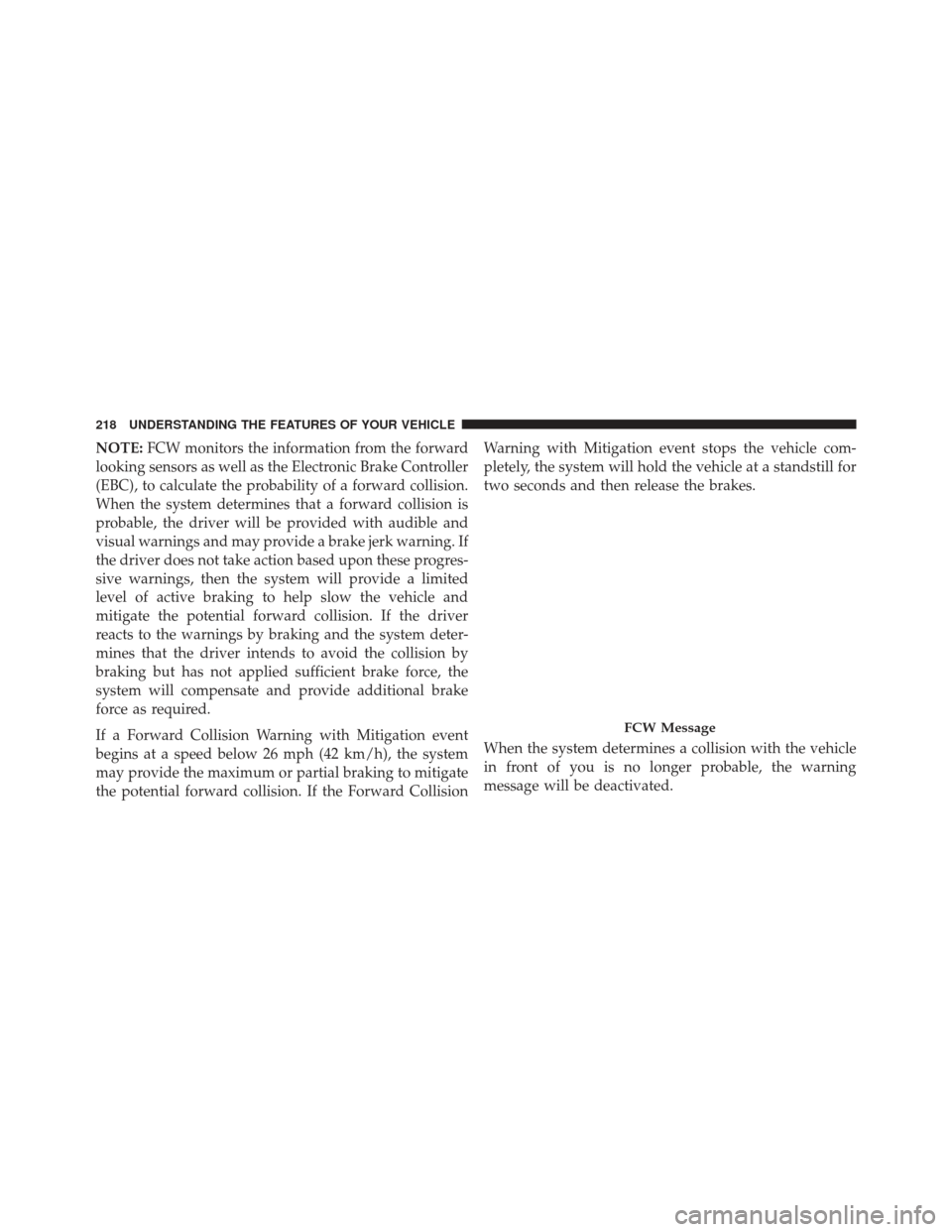
When the system determines a collision with the vehicle
in front of you is no longer probable, the warning
message will be deactivated.
FCW Message
218 UNDERSTANDING THE FEATURES OF YOUR VEHICLE
Page 224 of 723
PARKSENSE REAR PARK ASSIST — IF
EQUIPPED
The ParkSense Rear Park Assist system provides visual
and audible indications of the distance between the rear
fascia and a detected obstacle when backing up, e.g.
during a parking maneuver. If your vehicle is equipped
with an Automatic Transmission, the vehicle brakes may
be automatically applied and released when performing
a reverse parking maneuver if the system detects a
possible collision with an obstacle.
NOTE:
•The driver can override the automatic braking func-
tion by pressing the gas pedal, turning ParkSense off
via ParkSense switch, or changing the gear while the
automatic brakes are being applied.
• Automatic brakes will not be available if ESC is not
available. •
Automatic brakes will not be available if there is a
faulted condition detected with the ParkSense Park
Assist system or the Braking System Module.
• The automatic braking function may only be applied if
the vehicle deceleration is not enough to avoid collid-
ing with a detected obstacle.
• The automatic braking function may not be applied
fast enough for obstacles that move toward the rear of
the vehicle from the left and/or right sides.
• The automatic braking function can be enabled/
disabled from the Customer-Programmable Features
section of the Uconnect System.
• ParkSense will retain its last known configuration state
for the automatic braking function through ignition
cycles.
222 UNDERSTANDING THE FEATURES OF YOUR VEHICLE
Page 235 of 723
PARKSENSE FRONT AND REAR PARK ASSIST —
IF EQUIPPED
The ParkSense Park Assist system provides visual and
audible indications of the distance between the rear
and/or front fascia and a detected obstacle when backing
up or moving forward, e.g. during a parking maneuver.
If your vehicle is equipped with an Automatic Transmis-
sion, the vehicle brakes may be automatically applied
and released when performing a reverse parking maneu-
ver if the system detects a possible collision with an
obstacle.
NOTE:
•The driver can override the automatic braking func-
tion by pressing the gas pedal, turning ParkSense off
via ParkSense switch, or changing the gear while the
automatic brakes are being applied. •
Automatic brakes will not be available if ESC is not
available.
• Automatic brakes will not be available if there is a
faulted condition detected with the ParkSense Park
Assist system or the Braking System Module.
• The automatic braking function may only be applied if
the vehicle deceleration is not enough to avoid collid-
ing with a detected obstacle.
• The automatic braking function will not be available if
vehicle is in 4LO transfer case mode.
• The automatic braking function may not be applied
fast enough for obstacles that move toward the rear of
the vehicle from the left and/or right sides.
• The automatic braking function can be enabled/
disabled from the Customer-Programmable Features
section of the Uconnect System.
3
UNDERSTANDING THE FEATURES OF YOUR VEHICLE 233
Page 313 of 723
Anti-Lock Brake (ABS) Indicator Light
Yellow TelltaleLight What It Means
Anti-Lock Brake (ABS) Indicator Light
This light monitors the Anti-Lock Brake System (ABS). The light will turn on when the igni-
tion is placed in the ON/RUN position and may stay on for as long as four seconds.
If the ABS light remains on or turns on while driving, then the Anti-Lock portion of the
brake system is not functioning and service is required. However, the conventional brake
system will continue to operate normally if the brake warning light is not on.
If the ABS light is on, the brake system should be serviced as soon as possible to restore the
benefits of Anti-Lock Brakes. If the ABS light does not turn on when the ignition is placed in
the ON/RUN position, have the light inspected by an authorized dealer.
4
UNDERSTANDING YOUR INSTRUMENT PANEL 311
Page 337 of 723

1/4 Mile (400 Meters) Time
When selected, this screen displays the time it takes the
vehicle to travel 1/4 mile within 25 seconds and the
vehicle’s speed when it reaches 1/4 mile (400 meters).
•The feature will “ready” when the vehicle is at 0 MPH
(0 km/h). The word “READY” will flash when condi-
tions are met for the event to begin.
• Dashes will display if the vehicle fails to reach 1/4
mile (400 meters) in less then 25 seconds.
• To clear the vehicle’s best 1/4 mile (400 meters) run,
push and hold the OKbutton for two seconds.
60 Foot (18 Meters) Time
When selected, this screen displays the time it takes the
vehicle to travel 60 ft (18 meters) as measured from the
Initial acceleration, the charge a vehicle makes off the
starting line and through those sixty-foot timers. NOTE:
This number is most associated with chassis
efficiency, or “hook”.
Braking Distance
When selected, this screen displays the vehicle’s braking
distance, and the speed at which the brake pedal was
pushed.
• This feature will only function when applying the
brakes at speeds above 30 MPH (48 km/h).
• Engaging the parking brake will disable this feature.
• The word “READY” will display when conditions are
met for the event to begin.
• The distance and speed measurements display while
the event is taking place.
• The distance measurement will be aborted if the brake
pedal is released before the vehicle comes to a com-
plete stop.
4
UNDERSTANDING YOUR INSTRUMENT PANEL 335
Page 465 of 723
STARTING PROCEDURES
Before starting your vehicle, adjust your seat, adjust the
inside and outside mirrors, fasten your seat belt, and if
present, instruct all other occupants to buckle their seat
belts.
WARNING!
•Before exiting a vehicle, always shift the automatic
transmission into PARK and apply the parking
brake. Always make sure the keyless ignition node
is in the “OFF” mode, remove the Key Fob from the
vehicle and lock the vehicle.
• Never leave children alone in a vehicle, or with
access to an unlocked vehicle. Leaving children in
a vehicle unattended is dangerous for a number of
reasons. A child or others could be seriously or
fatally injured. Children should be warned not to
(Continued)
WARNING! (Continued)
touch the parking brake, brake pedal or the gear
selector.
• Do not leave the key fob in or near the vehicle, or
in a location accessible to children, and do not
leave the ignition of a vehicle equipped with
Keyless Enter-N-Go in the ACC or ON/RUN mode.
A child could operate power windows, other con-
trols, or move the vehicle.
• Do not leave children or animals inside parked
vehicles in hot weather. Interior heat build-up may
cause serious injury or death.
Automatic Transmission
The gear selector must be in the NEUTRAL or PARK
position before you can start the engine. Apply the brakes
before shifting into any driving gear.
5
STARTING AND OPERATING 463