Page 67 of 117
Avoid Using Contaminated Fuel
Fuel that is contaminated by water or dirt can cause
severe damage to the engine fuel system. Proper main-
tenance of the engine fuel filter and fuel tank is essential.
Refer to “Maintenance Procedures” in “Maintaining Your
Vehicle” for further information.
Bulk Fuel Storage — Diesel Fuel
If you store quantities of fuel, good maintenance of the
stored fuel is also essential. Fuel contaminated with
water will promote the growth of “microbes.” These
microbes form “slime” that will clog the fuel filtration
system and lines. Drain condensation from the supply
tank and change the line filter on a regular basis.
NOTE:When a diesel engine is allowed to run out of
fuel, air is pulled into the fuel system. If the vehicle will not start, refer to “Maintenance
Procedures/Priming If The Engine Has Run Out Of Fuel”
in “Maintaining Your Vehicle” for further information.
WARNING!
Do not open the high pressure fuel system with the
engine running. Engine operation causes high fuel
pressure. High pressure fuel spray can cause serious
injury or death.
Diesel Exhaust Fluid Storage
Diesel Exhaust Fluid (DEF) is considered a very stable
product with a long shelf life. If DEF is kept in tempera-
tures between 10° and 90°F (-12° and 32°C), it will last a
minimum of one year.
4
STARTING AND OPERATING 65
Page 70 of 117
CAUTION!
•To avoid DEF spillage, and possible damage to the
DEF tank from overfilling, do not “top off” the DEF
tank after filling.
• DO NOT OVERFILL. DEF will freeze below 12ºF
(-11ºC). The DEF system is designed to work in
temperatures below the DEF freezing point, how-
ever, if the tank is overfilled and freezes, the
system could be damaged.
• When DEF is spilled, clean the area immediately
with water and use an absorbent material to soak
up the spills on the ground.
• Do not attempt to start your engine if DEF is
accidentally added to the diesel fuel tank as it can
result in severe damage to your engine, including
but not limited to failure of the fuel pump and
injectors.
(Continued)
CAUTION! (Continued)
•Never add anything other than DEF to the tank –
especially any form of hydrocarbon such as diesel
fuel, fuel system additives, gasoline, or any other
petroleum-based product. Even a very small
amount of these (less than 100 parts per million or
less than 1 oz. per 78 gallons) will contaminate the
entire DEF system and will require replacement.
If owners use a container, funnel or nozzle when
refilling the tank, it should either be new or one
that is has only been used for adding DEF. MOPAR
provides an attachable nozzle with its DEF for this
purpose.
3. Stop filling the DEF tank immediately when any of the following happen: DEF stops flowing from the fill
bottle into the DEF fill inlet, DEF splashes out the fill
inlet, or a DEF pump nozzle automatically shuts off.
4. Reinstall cap onto DEF fill inlet.
68 STARTING AND OPERATING
Page 71 of 117
MAINTAINING YOUR VEHICLE
CONTENTS
�ENGINE COMPARTMENT — 3.0L DIESEL .....70
� MAINTENANCE PROCEDURES ............71
▫ Engine Oil ...........................72
▫ Engine Air Cleaner Filter ................74
▫ Draining Fuel/Water Separator Filter ........78
▫
Underbody Mounted Fuel Filter Replacement. . .80
▫
Priming If The Engine Has Run Out Of Fuel....81
▫ Intervention Regeneration Strategy —
Message Process Flow ..................83 ▫
Maintenance-Free Batteries ...............83
▫ Cooling System .......................84
▫ Charge Air Cooler — Inter-Cooler ..........90
▫ Brake System .........................90
� FLUID CAPACITIES .....................92
�
FLUIDS, LUBRICANTS AND GENUINE PARTS . . .93
▫ Engine .............................93
▫ Chassis .............................95
5
Page 72 of 117
ENGINE COMPARTMENT — 3.0L DIESEL
1 — Remote Jump Start Positive Terminal6 — Engine Oil Fill
2 — Engine Oil Dipstick 7 — Brake Fluid Reservoir
3 — Power Distribution Center (Fuses) 8 — Air Cleaner Filter
4 — Coolant Pressure Cap (Reservoir) 9 — Washer Fluid Reservoir
5 — Remote Jump Start Negative Terminal 70 MAINTAINING YOUR VEHICLE
Page 73 of 117
MAINTENANCE PROCEDURES
The pages that follow contain therequiredmaintenance
services determined by the engineers who designed your
vehicle.
Besides those maintenance items specified in the fixed
maintenance schedule, there are other components which
may require servicing or replacement in the future.
CAUTION!
• Failure to properly maintain your vehicle or per-
form repairs and service when necessary could
result in more costly repairs, damage to other
components or negatively impact vehicle perfor-
mance. Immediately have potential malfunctions
examined by an authorized dealership or qualified
repair center.
(Continued)
CAUTION! (Continued)
•Your vehicle has been built with improved fluids
that protect the performance and durability of your
vehicle and also allow extended maintenance inter-
vals. Do not use chemical flushes in these compo-
nents as the chemicals can damage your engine,
transmission, power steering or air conditioning.
Such damage is not covered by the New Vehicle
Limited Warranty. If a flush is needed because of
component malfunction, use only the specified
fluid for the flushing procedure.
5
MAINTAINING YOUR VEHICLE 71
Page 74 of 117
Engine Oil
Engine Oil Selection
For best performance and maximum protection under all
types of operating conditions, the manufacturer recom-
mends engine oils that meet the requirements of FCA
Material Standard MS-11106, and that are approved to
ACEA C3.
Checking Oil Level
To assure proper lubrication of your vehicle’s engine, the
engine oil must be maintained at the correct level. Check
the oil level at regular intervals. The best time to check
the oil level is before starting the engine after it has been
parked overnight. When checking oil after operating the
engine, first ensure the engine is at full operating tem-
perature, then wait for five minutes after engine shut-
down to check the oil.
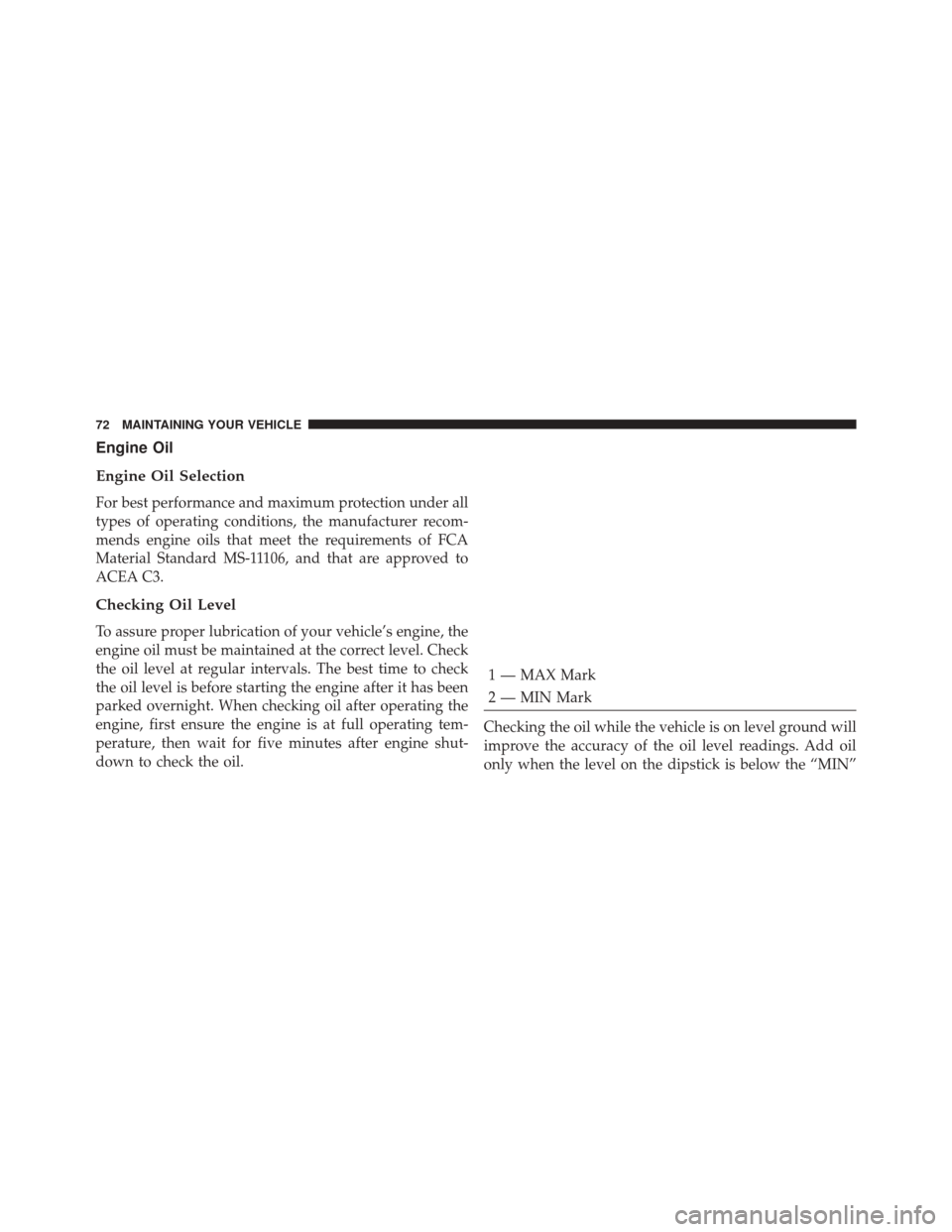
1 — MAX Mark
2 — MIN Mark
Checking the oil while the vehicle is on level ground will
improve the accuracy of the oil level readings. Add oil
only when the level on the dipstick is below the “MIN”
72 MAINTAINING YOUR VEHICLE
Page 75 of 117
mark. The total capacity from the MIN mark to the MAX
mark is 1.7 qts (1.6L).
CAUTION!
Overfilling or underfilling the crankcase will cause
oil aeration or loss of oil pressure. This could damage
your engine.
NOTE: It is possible for your oil level to be slightly
higher than a previous check. This would be due to diesel
fuel that may temporarily be in the crankcase due to
operation of the diesel particulate filter regeneration
strategy. This fuel will evaporate out under normal
operation.
Never operate the engine with oil level below the “MIN”
mark or above the upper “MAX” mark.
Change Engine Oil
Refer to the “Maintenance Schedule” for the proper
maintenance intervals.
Engine Oil Viscosity (SAE Grade)
CAUTION!
Your vehicle is equipped with an advanced technol-
ogy Diesel Engine and an emission device designed
to limit Diesel Particulate Emissions from being
released into the atmosphere. The durability of your
engine and life expectancy of this diesel particulate
filter emission device is highly dependent on the use
of the correct engine oil.
Only use ACEA C3 SAE 5W-30 Synthetic Low Ash engine
oil meeting FCA Material Standard MS-11106 or Pennzoil
Ultra Euro L full synthetic 5W-30 motor oil, which is5
MAINTAINING YOUR VEHICLE 73
Page 76 of 117
recommended for all operating temperatures. This en-
gine oil improves low temperature starting and vehicle
fuel economy.
Materials Added To Engine Oil
The manufacturer strongly recommends against the ad-
dition of any additives (other than leak detection dyes) to
the engine oil. Engine oil is an engineered product and
its performance may be impaired by supplemental addi-
tives.
Engine Oil Filter
Refer to “Fluids, Lubricants, And Genuine Parts” in
“Maintaining Your Vehicle” for further information. The
engine oil filter should be changed at every engine oil
change.
Disposing Of Used Engine Oil And Oil Filters
Care should be taken in disposing of used engine oil and
oil filters from your vehicle. Used oil and oil filters,
indiscriminately discarded, can present a problem to the
environment. Contact your authorized dealer, service
station or governmental agency for advice on how and
where used oil and oil filters can be safely discarded in
your area.
Engine Air Cleaner Filter
Refer to the “Maintenance Schedule” for the proper
maintenance intervals.
CAUTION!
All air entering the engine intake must be filtered.
The abrasive particles in unfiltered air will cause
rapid wear to engine components.
74 MAINTAINING YOUR VEHICLE