Page 523 of 770

braking conditions. The system automatically prevents
wheel lock, and enhances vehicle control during braking.
The ABS performs a self-check cycle to ensure that the
ABS is working properly each time the vehicle is started
and driven. During this self-check you may hear a slight
clicking sound as well as some related motor noises.
ABS is activated during braking when the system detects
one or more wheels begins to lock. Road conditions such as
ice, snow, gravel, bumps, railroad tracks, loose debris, or
panic stops may increase the likelihood of ABS activation(s).
You also may experience the following when ABS activates:
•The ABS motor noise (it may continue to run for a
short time after the stop).
• The clicking sound of solenoid valves.
• Brake pedal pulsations.
• A slight drop of the brake pedal at the end of the stop. These are all normal characteristics of ABS.
WARNING!
•
The ABS contains sophisticated electronic equip-
ment that may be susceptible to interference
caused by improperly installed or high output
radio transmitting equipment. This interference
can cause possible loss of anti-lock braking capa-
bility. Installation of such equipment should be
performed by qualified professionals.
• Pumping of the Anti-Lock Brakes will diminish
their effectiveness and may lead to a collision.
Pumping makes the stopping distance longer. Just
press firmly on your brake pedal when you need to
slow down or stop.
• The ABS cannot prevent the natural laws of phys-
ics from acting on the vehicle, nor can it increase
(Continued)
5
STARTING AND OPERATING 521
Page 576 of 770

display a�SERVICE TPM SYSTEM� message for a mini-
mum of five seconds and then display dashes (- -) in
place of the pressure value to indicate which sensor is not
being received.
If the ignition key is cycled, this sequence will repeat,
providing the system fault still exists. If the system fault no longer exists, the “Tire Pressure Monitoring Telltale
Light” will no longer flash, and the “SERVICE TPM
SYSTEM” message will no longer display, and a pressure
value will display in place of the dashes. A system fault
can occur due to any of the following:
1. Jamming due to electronic devices or driving next to
facilities emitting the same radio frequencies as the
TPMS sensors.
2. Installing some form of aftermarket window tinting that affects radio wave signals.
3. Lots of snow or ice around the wheels or wheel housings.
4. Using tire chains on the vehicle.
5. Using wheels/tires not equipped with TPMS sensors.
Tire Pressure Monitoring Service Warning
574 STARTING AND OPERATING
Page 619 of 770

HAZARD WARNING FLASHERS
The Hazard Warning flasher switch is located in the
switch bank below the radio screen.Push the switch to turn on the Hazard Warning
flasher. When the switch is activated, all direc-
tional turn signals will flash on and off to warn oncoming
traffic of an emergency. Push the switch a second time to
turn off the Hazard Warning flashers.
This is an emergency warning system and it should not
be used when the vehicle is in motion. Use it when your
vehicle is disabled and it is creating a safety hazard for
other motorists.
When you must leave the vehicle to seek assistance, the
Hazard Warning flashers will continue to operate even
though the ignition is placed in the OFF position.
NOTE: With extended use the Hazard Warning flashers
may wear down your battery.
IF YOUR ENGINE OVERHEATS
In any of the following situations, you can reduce the
potential for overheating your engine by taking the
appropriate action.
• On the highways — slow down.
• In city traffic — while stopped, put transmission in
NEUTRAL, but do not increase engine idle speed.
CAUTION!
Driving with a hot cooling system could damage
your vehicle. If the temperature gauge reads “H,”
pull over and stop the vehicle. Idle the vehicle with
the air conditioner turned off until the pointer drops
back into the normal range. If the pointer remains on
the “H” and you hear continuous chimes, turn the
engine off immediately and call for service.
6
WHAT TO DO IN EMERGENCIES 617
Page 648 of 770

WARNING!
•Take care to avoid the radiator cooling fan when-
ever the hood is raised. It can start anytime the
ignition switch is ON. You can be injured by
moving fan blades.
• Remove any metal jewelry such as rings, watch
bands and bracelets that could make an inadvertent
electrical contact. You could be seriously injured.
• Batteries contain sulfuric acid that can burn your
skin or eyes and generate hydrogen gas which is
flammable and explosive. Keep open flames or
sparks away from the battery.
1. Set the parking brake, shift the automatic transmission into PARK and turn the ignition to LOCK.
2. Turn off the heater, radio, and all unnecessary electri- cal accessories. 3. If using another vehicle to jump-start the battery, park
the vehicle within the jumper cables reach, set the
parking brake and make sure the ignition is OFF.
WARNING!
Do not allow vehicles to touch each other as this
could establish a ground connection and personal
injury could result.
Jump Starting Procedure
WARNING!
Failure to follow this jump-starting procedure could
result in personal injury or property damage due to
battery explosion.
646 WHAT TO DO IN EMERGENCIES
Page 707 of 770

Glass Surfaces
All glass surfaces should be cleaned on a regular basis
with MOPAR Glass Cleaner, or any commercial
household-type glass cleaner. Never use an abrasive type
cleaner. Use caution when cleaning the inside rear win-
dow equipped with electric defrosters or windows
equipped with radio antennas. Do not use scrapers or
other sharp instrument that may scratch the elements.
When cleaning the rear view mirror, spray cleaner on the
towel or cloth that you are using. Do not spray cleaner
directly on the mirror.
Cleaning Plastic Instrument Cluster Lenses
The lenses in front of the instruments in this vehicle are
molded in clear plastic. When cleaning the lenses, care
must be taken to avoid scratching the plastic.1. Clean with a wet soft cloth. A mild soap solution may
be used, but do not use high alcohol content or
abrasive cleaners. If soap is used, wipe clean with a
clean damp cloth.
2. Dry with a soft cloth.
Seat Belt Maintenance
Do not bleach, dye or clean the belts with chemical
solvents or abrasive cleaners. This will weaken the fabric.
Sun damage can also weaken the fabric.
If the belts need cleaning, use a mild soap solution or
lukewarm water. Do not remove the belts from the
vehicle to wash them. Dry with a soft cloth.
Replace the belts if they appear frayed or worn or if the
buckles do not work properly.
7
MAINTAINING YOUR VEHICLE 705
Page 716 of 770
Cavity Blade Fuse Cartridge FuseDescription
F79 10 Amp Red –Integrated Center Stack (ICS) / HVAC / Aux Switch Bank
Module (ASBM) / Instrument Panel Cluster (IPC)
F80 20 Amp Yellow –Radio / CD - If Equipped
F81 – – Not Used
F82 – – Not Used
F83 –20 Amp Blue Engine Controller Module (Gas)
F84 –30 Amp Pink Electric Park Brake (EPB) - Left
F85 – – Not Used
F86 20 Amp Yellow –Horns - If Equipped With Stop/Start Engine Option
F87A 20 Amp Yellow –HID Headlamp Left - If Equipped with Stop/Start Engine
Option
F88 15 Amp Blue –Collision Mitigation Module (CMM) / Electrochromatic
Mirror / Smart Camera Module - If Equipped
F89 10 Amp Red –Headlamp Leveling - If Equipped
F90 – – Not Used
714 MAINTAINING YOUR VEHICLE
Page 759 of 770
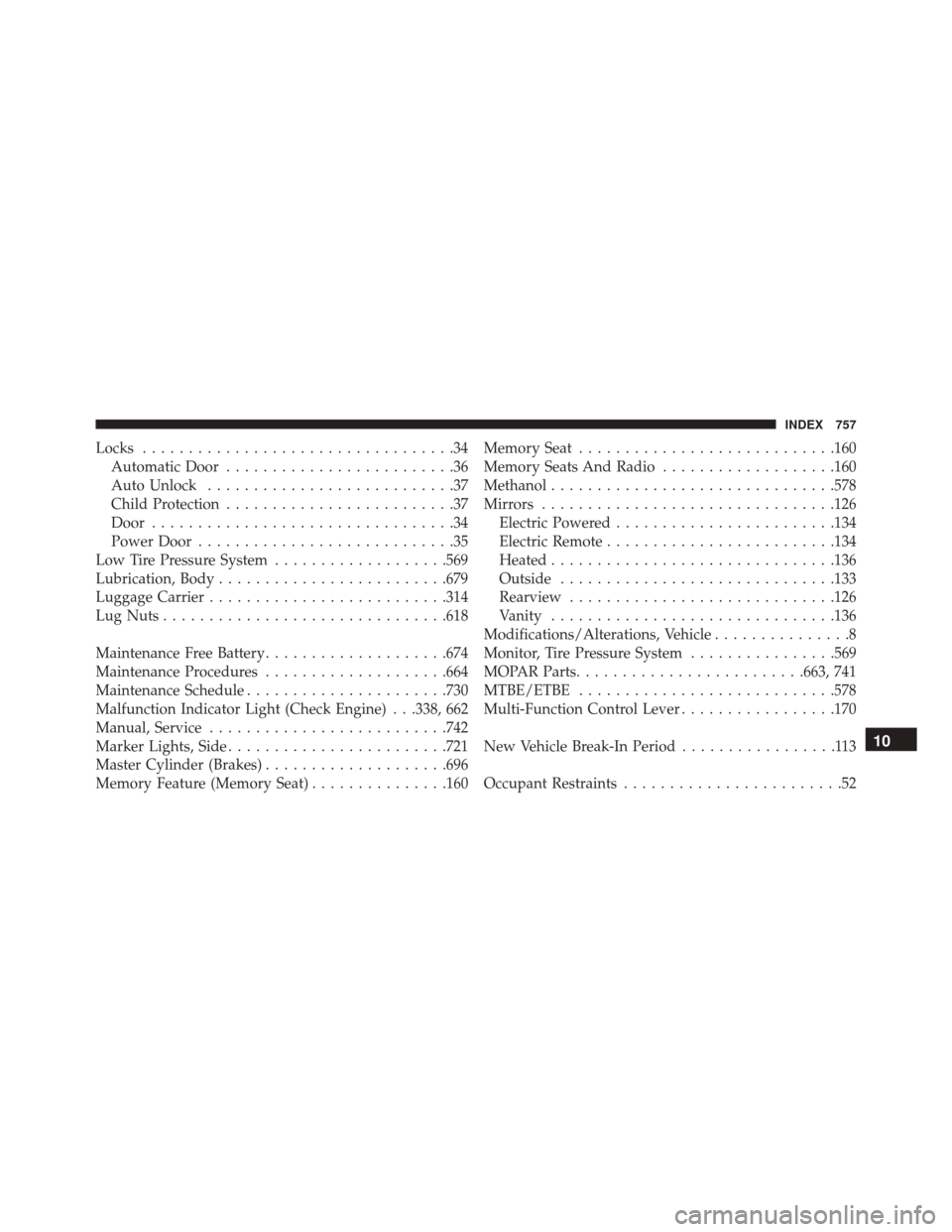
Locks..................................34
Automatic Door .........................36
Auto Unlock ...........................37
Child Protection .........................37
Door .................................34
Power Door ............................35
Low Tire Pressure System ...................569
Lubrication, Body ........................ .679
Luggage Carrier ......................... .314
Lug Nuts .............................. .618
Maintenance Free Battery ....................674
Maintenance Procedures ....................664
Maintenance Schedule ..................... .730
Malfunction Indicator Light (Check Engine) . . .338, 662
Manual, Service ......................... .742
Marker Lights, Side ....................... .721
Master Cylinder (Brakes) ....................696
Memory Feature (Memory Seat) ...............160Memory Seat
........................... .160
Memory Seats And Radio ...................160
Methanol .............................. .578
Mirrors ............................... .126
Electric Powered ....................... .134
Electric Remote ........................ .134
Heated .............................. .136
Outside ............................. .133
Rearview ............................ .126
Vanity .............................. .136
Modifications/Alterations, Vehicle ...............8
Monitor, Tire Pressure System ................569
MOPAR Parts ........................ .663, 741
MTBE/ETBE ........................... .578
Multi-Function Control Lever .................170
New Vehicle Break-In Period .................113
Occupant Restraints ........................52
10
INDEX 757
Page 761 of 770

Lift Gate..............................50
Mirrors ............................. .134
Outlet (Auxiliary Electrical Outlet) ...........296
Sunroof ............................. .291
Windows ..............................45
Pregnant Women And Seat Belts ...............63
Preparation For Jacking .....................634
Pretensioners Seat Belts ..............................63
Programming Transmitters (Remote Keyless Entry) . .23
Radial Ply Tires ......................... .555
Radiator Cap (Coolant Pressure Cap) ...........694
Radio Frequency General Information ............17, 19, 29, 34, 44
Radio Operation ......................... .419
Radio Remote Controls .....................416
Radio (Sound Systems) .....................415
Rain Sensitive Wiper System .................179Rear Camera
........................... .280
Rear Cross Path ......................... .143
Rear ParkSense System ..................229, 239
Rear Seat, Folding ........................ .157
Rear Window Defroster .....................313
Rear Window Features .....................312
Rear Wiper/Washer ....................... .312
Recorder, Event Data .......................90
Recreational Towing ...................... .604
Shifting Into Power Transfer Unit Neutral (N) . . .609
Shifting Into Transfer Case Neutral (N) ........609
Shifting Out Of Power Transfer Unit
Neutral (N) .......................... .612
Shifting Out Of Transfer Case Neutral (N) ......612
Reformulated Gasoline .....................577
Refrigerant ............................. .676
Release, Hood ........................... .164
Reminder, Lights On ...................... .169
Reminder, Seat Belt .........................54
10
INDEX 759
