2016 HYUNDAI VELOSTER TURBO intr
[x] Cancel search: intrPage 4 of 406
F4FOREWORD
Thank you for choosing Hyundai. We are pleased to welcome you to the growing number of discriminating people who drive
Hyundais. The advanced engineering and high-quality construction of each Hyundai we build is something of which we're very
proud.
Your Owner's Manual will introduce you to the features and operation of your new Hyundai. It is suggested that you read it care-
fully because the information it contains can contribute greatly to the satisfaction you receive from your new car.
Hyundai Auto Canada Corp. also recommends that all service and maintenance on your car be performed by an authorized
Hyundai dealer. Hyundai dealers are prepared to provide high-quality service, maintenance and any other assistance that may be
required.
HYUNDAI AUTO CANADA
Note: Because future owners will also need the information included in this manual, if you sell this Hyundai, please leave the man-
ual in the vehicle for their use. Thank you.
This Owner's manual copyright 2015, Hyundai Auto Canada Corp. All rights reserved. No part of this publication may be repro-
duced, stored in any retrieval system or transmitted in any form or by any means without prior written permission of Hyundai Auto
Canada Corp.
All trademarks and tradenames owned in Canada by Hyundai Auto Canada Corp.
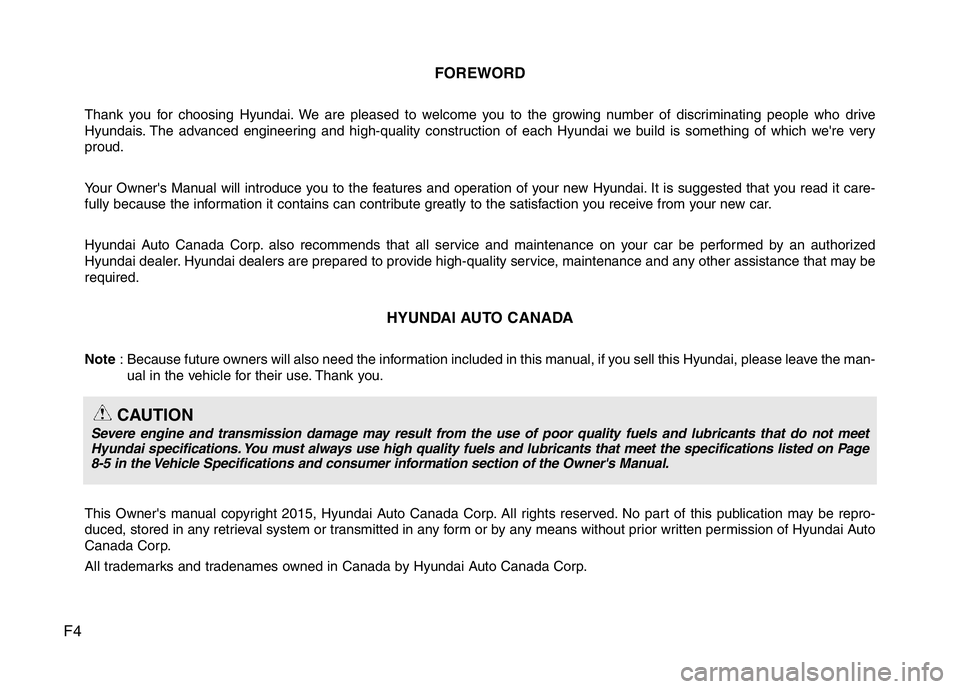
CAUTION
Severe engine and transmission damage may result from the use of poor quality fuels and lubricants that do not meet
Hyundai specifications. You must always use high quality fuels and lubricants that meet the specifications listed on Page
8-5 in the Vehicle Specifications and consumer information section of the Owner's Manual.
Page 6 of 406
1
2
3
4
5
6
7
8
I
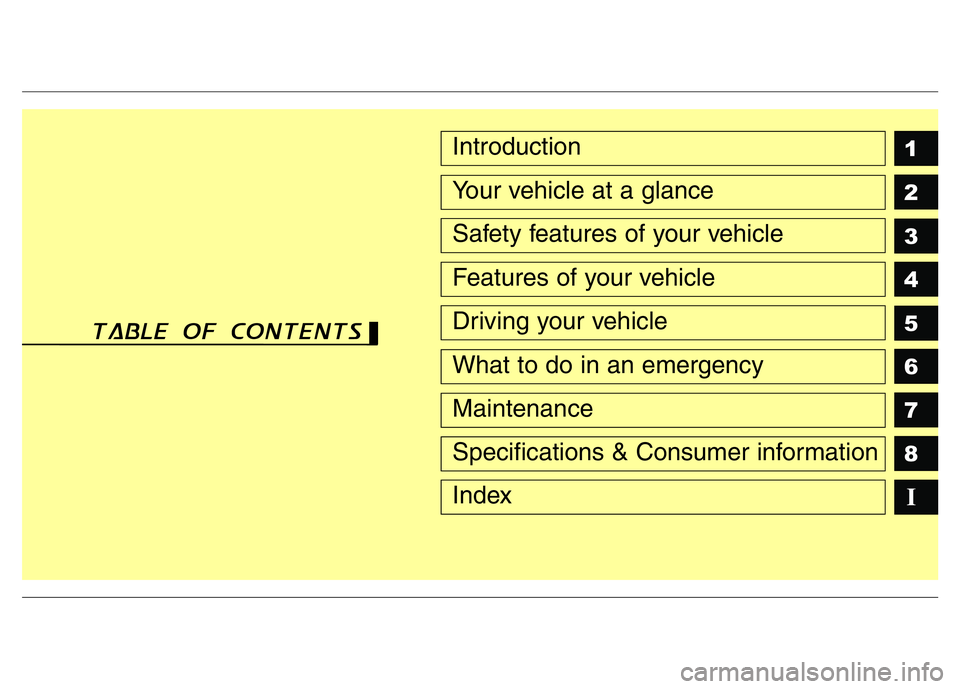
Introduction
Your vehicle at a glance
Safety features of your vehicle
Features of your vehicle
Driving your vehicle
What to do in an emergency
Maintenance
Specifications & Consumer information
Index
table of contents
Page 7 of 406
1
How to use this manual / 1-2
Fuel requirements / 1-3
Vehicle break-in process / 1-5
Vehicle Data Collection and Event Data
Recorders / 1-6
Introduction
Page 8 of 406
Introduction
2 1
We want to help you get the greatest
possible driving experience from your
vehicle. Your Owner’s Manual can assist
you in many ways. We strongly recom-
mend that you read the entire manual. In
order to minimize the chance of death or
injury, you must read the WARNING and
CAUTION sections in the manual.
Illustrations complement the text in this
manual to best explain how to use your
vehicle. By reading your manual, you will
learn about features, important safety
information, and driving tips under vari-
ous road conditions.
The general layout of the manual is pro-
vided in the Table of Contents. A good
place to start is the index; it has an alpha-
betical listing of all information in your
manual.
Sections: This manual has eight sections
plus an index. Each section begins with a
brief list of contents so you can tell at a
glance if that section has the information
you want.
You will find various WARNINGS, CAU-
TIONS, and NOTICES in this manual.
These WARNINGS were prepared to
enhance your personal safety. You should
carefully read and follow ALL procedures
and recommendations provided in these
WARNINGS, CAUTIONS and NOTICES.
✽NOTICE
A NOTICE indicates interesting or help-
ful information is being provided.
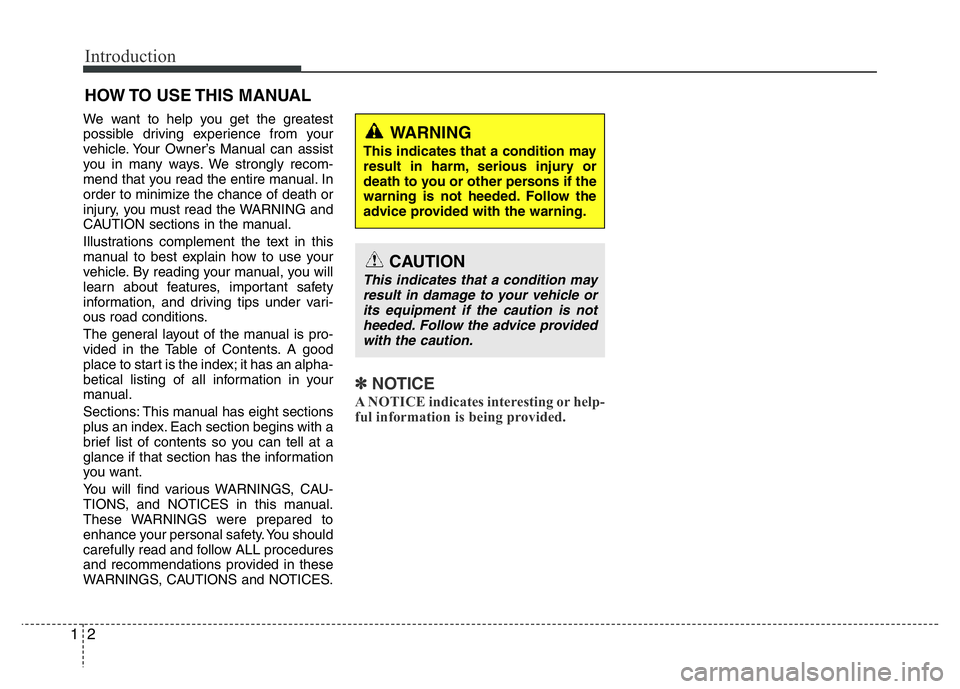
HOW TO USE THIS MANUAL
WARNING
This indicates that a condition may
result in harm, serious injury or
death to you or other persons if the
warning is not heeded. Follow the
advice provided with the warning.
CAUTION
This indicates that a condition may
result in damage to your vehicle or
its equipment if the caution is not
heeded. Follow the advice provided
with the caution.
Page 9 of 406

13
Introduction
Your new vehicle is designed to obtain
maximum performance with UNLEADED
FUEL, as well as minimize exhaust emis-
sions and spark plug fouling.
Your new vehicle is designed to use only
unleaded fuel having a pump octane
number ((R+M)/2) of 87 (Research
Octane Number 91) or higher. (Do not
use methanol blended fuels.)Gasoline containing alcohol and
methanol
Gasohol, a mixture of gasoline and
ethanol (also known as grain alcohol),
and gasoline or gasohol containing
methanol (also known as wood alcohol)
are being marketed along with or instead
of leaded or unleaded gasoline.
Do not use gasohol containing more than
10% ethanol, and do not use gasoline or
gasohol containing any methanol. Either
of these fuels may cause drivability prob-
lems and damage to the fuel system,
engine control system and emission con-
trol system.
Discontinue using gasohol of any kind if
drivability problems occur.
Vehicle damage or drivability problems
may not be covered by the manufactur-
er’s warranty if they result from the use
of:
1. Gasohol containing more than 10%
ethanol.
2. Gasoline or gasohol containing
methanol.
3. Leaded fuel or leaded gasohol."E85" fuel is an alternative fuel com-
prised of 85 percent ethanol and 15 per-
cent gasoline, and is manufactured
exclusively for use in Flexible Fuel
Vehicles. “E85” is not compatible with
your vehicle. Use of “E85” may result in
poor engine performance and damage to
your vehicle's engine and fuel system.
HYUNDAI recommends that customers
do not use fuel with an ethanol content
exceeding 10 percent.
FUEL REQUIREMENTS
CAUTION
Never add any fuel system cleaning
agents to the fuel tank other than
what has been specified. (Consult
an authorized HYUNDAI dealer for
details.)
WARNING
• Do not "top off" after the nozzle
automatically shuts off when
refueling.
• Tighten the cap until it clicks one
time, otherwise the fuel cap open
warning light will illuminate.
• Always check that the fuel cap is
installed securely to prevent fuel
spillage in the event of an acci-
dent.
CAUTION
Never use gasohol which contains
methanol. Discontinue use of any
gasohol product which impairs dri-
vability.
CAUTION
Your New Vehicle Limited Warranty
does not cover damage to the fuel
system or any performance prob-
lems caused by the use of “E85” fuel.
Page 10 of 406
Introduction
4 1
Other fuels
Using fuels such as;
- Silicone (Si) contained fuel,
- Ferrocene (Fe) contained fuel, and
- Other metallic additives contained
fuels,
may cause vehicle and engine damage
or cause plugging, misfiring, poor accel-
eration, engine stalling, catalyst melting,
abnormal corrosion, life cycle reduction,
etc.
Also, the Malfunction Indicator Lamp
(MIL) may illuminate.
✽NOTICE
Damage to the fuel system or perform-
ance problem caused by the use of these
fuels may not be covered by your New
Vehicle Limited Warrenty.
Gasoline containing MMT
Some gasoline contains harmful man-
ganese-based fuel additives such as
MMT (Methylcyclopentadienyl
Manganese Tricarbonyl).
HYUNDAI does not recommend the use
of gasoline containing MMT.
This type of fuel can reduce vehicle per-
formance and affect your emission con-
trol system.
The malfunction indicator lamp on the
cluster may come on.
Use of MTBE
HYUNDAI recommends avoiding fuels
containing MTBE (Methyl Tertiary Butyl
Ether) over 15.0% vol. (Oxygen Content
2.7% weight) in your vehicle.
Fuel containing MTBE over 15.0% vol.
(Oxygen Content 2.7% weight) may
reduce vehicle performance and produce
vapor lock or hard starting.
CAUTION
Your New Vehicle Limited Warranty
may not cover damage to the fuel
system and any performance prob-
lems that are caused by the use of
fuels containing methanol or fuels
containing MTBE (Methyl Tertiary
Butyl Ether) over 15.0% vol.
(Oxygen Content 2.7% weight.)
Page 11 of 406
15
Introduction
Do not use methanol
Fuels containing methanol (wood alco-
hol) should not be used in your vehicle.
This type of fuel can reduce vehicle per-
formance and damage components of
the fuel system, engine control system
and emission control system.
Fuel Additives
HYUNDAI recommends that you use
good quality gasolines treated with deter-
gent additives such as TOP TIER
Detergent Gasoline, which help prevent
deposit formation in the engine. These
gasolines will help the engine run clean-
er and enhance performance of the
Emission Control System. For more infor-
mation on TOP TIER Detergent
Gasoline, please go to the website
(www.toptiergas.com)
For customers who do not use TOP Tier
Detergent Gasoline regularly, and have
problems starting or the engine does not
run smoothly, additives that you can buy
separately may be added to the gasoline.
If TOP TIER Detergent Gasoline is not
available, one bottle of additive added to
the fuel tank at every 12,000 km (7,500
mile) or every engine oil change is rec-
ommended. Additives are available from
your authorized HYUNDAI dealer along
with information on how to use them. Do
not mix other additives.
Operation in foreign countries
If you are going to drive your vehicle in
another country, be sure to:
• Observe all regulations regarding reg-
istration and insurance.
• Determine that acceptable fuel is avail-
able.No special break-in period is needed. By
following a few simple precautions for the
first 1,000 km (600 miles) you may add to
the performance, economy and life of
your vehicle.
• Do not race the engine.
• While driving, keep your engine speed
(rpm, or revolutions per minute)
between 2,000 rpm and 4,000 rpm.
• Do not maintain a single speed for long
periods of time, either fast or slow.
Varying engine speed is needed to
properly break-in the engine.
• Avoid hard stops, except in emergen-
cies, to allow the brakes to seat prop-
erly.
VEHICLE BREAK-IN PROCESS
Page 12 of 406
Introduction
6 1
VEHICLE DATA COLLECTION AND EVENT DATA RECORDERS
This vehicle is equipped with an event
data recorder (EDR). The main pur-
pose of an EDR is to record, in certain
crash or near crash-like situations,
such as an air bag deployment or hit-
ting a road obstacle, data that will
assist in understanding how a vehi-
cle's systems performed. The EDR is
designed to record data related to
vehicle dynamics and safety systems
for a short period of time, typically 30
seconds or less. The EDR in this vehi-
cle is designed to record such data
as:
• How various systems in your vehi-
cle were operating;
• Whether or not the driver and pas-
senger safety belts were buckled/
fastened;
• How far (if at all) the driver was
depressing the accelerator and/or
brake pedal; and,
• How fast the vehicle was traveling.These data can help provide a better
understanding of the circumstances
in which crashes and injuries occur.
NOTE: EDR data are recorded by your
vehicle only if a non-trivial crash situ-
ation occurs; no data are recorded by
the EDR under normal driving condi-
tions and no personal data (e.g.,
name, gender, age, and crash loca-
tion) are recorded. However, other
parties, such as law enforcement,
could combine the EDR data with the
type of personally identifying data
routinely acquired during a crash
investigation.To read data recorded by an EDR, spe-
cial equipment is required, and
access to the vehicle or the EDR is
needed. In addition to the vehicle
manufacturer, other parties, such as
law enforcement, that have the special
equipment, can read the information if
they have access to the vehicle or the
EDR.