2016 Hyundai Santa Fe height
[x] Cancel search: heightPage 557 of 759

Driving your vehicle
32
5
If at all possible, cease driving the
vehicle immediately. If that is not pos-
sible, use extreme caution while
operating the vehicle and only con-
tinue to drive the vehicle until you
can reach a safe location or repair
shop.Anti-lock brake system (ABS)
WARNING
ABS (or ESC) will not prevent
accidents due to improper or
dangerous driving maneuvers.
Even though vehicle control is
improved during emergency
braking, always maintain a safe
distance between you and
objects ahead. Vehicle speeds
should always be reduced dur-
ing extreme road conditions.
The braking distance for vehi-
cles equipped with an anti-lock
braking system or (Electronic
Stability Control System) may be
longer than for those without it
in the following road conditions.
During these conditions the
vehicle should be driven at
reduced speeds:
(Continued)
(Continued)
Rough, gravel or snow-cov-ered roads.
With tire chains installed.
On roads where the road sur- face is pitted or has different
surface height.
The safety features of an ABS
(or ESC) equipped vehicle
should not be tested by high
speed driving or cornering.
This could endanger the safe-
ty of yourself or others.
Page 580 of 759

555
Driving your vehicle
Non-operating conditions
Driver's Attention
The driver must be extra cautious in
the following situations in which the
system may not assist the driver and
may not function properly.
- Curved roads, tollgates, etc.
- The area around the sensor is cov-ered by rain, snow, mud, etc
- The rear bumper near the sensor is covered or hidden with foreign mat-
ter such as a sticker, bumper guard,
bicycle stand etc.
- The rear bumper is damaged or the sensor is out of place.
- The height of the vehicle is changed or altered such as when
the cargo area is loaded with heavy
objects, or has abnormal tire pres-
sure etc.
- Due to bad weather such as heavy rain or snow.
- A fixed object is near such as a guardrail, tunnel etc.
- A large amount of metal sub- stances are near the vehicles such
as a construction area. - A big vehicle is near such as a bus
or truck.
- A motorcycle or bicycle is near.
- A flatbed trailer is near.
- If the vehicle has been started at the same time as the vehicle next to
it and the vehicle has started to
move.
- When the other vehicle passes by very fast.
- When changing lanes.
- When going down or up a steep road where the height of the lane is
different.
- When the other vehicle drives at the rear very nearby or drives very
close.
- When the temperature of the rear bumper is high.
- When a trailer or carrier is installed.
- When driving through a narrow road with many trees or bushes.
Outside rearview mirror may not
alert the driver when:
- The outside rearview mirror hous- ing is very muddy or dirty.
- The driver or passenger window is very muddy or dirty.
- The driver or passenger window is tinted with a very dark tint.
This device complies with Part
15 of the FCC rules.
Operation is subject to the following
two conditions:
1. This device may not cause harm- ful interference, and
2. This device must accept any inter- ference received, including inter-
ference that may cause undesired
operation.
Page 695 of 759
753
Maintenance
Compact spare tire replacement (if equipped)
A compact spare tire has a shorter
tread life than a regular size tire.
Replace it when you can see the
tread wear indicator bars on the tire.
The replacement compact spare tire
should be the same size and design
tire as the one provided with your
new vehicle and should be mounted
on the same compact spare tire
wheel. The compact spare tire is not
designed to be mounted on a regular
size wheel, and the compact spare
tire wheel is not designed for mount-
ing a regular size tire.
Wheel replacement
When replacing the metal wheels for
any reason, make sure the new
wheels are equivalent to the original
factory units in diameter, rim width
and offset.
Tire traction
Tire traction can be reduced if you
drive on worn tires, tires that are
improperly inflated or on slippery
road surfaces. Tires should be
replaced when tread wear indicators
appear. To reduce the possibility of
losing control, slow down whenever
there is rain, snow or ice on the road.
WARNING
A wheel that is not the correct
size may adversely affect wheel
and bearing life, braking and
stopping abilities, handling
characteristics, ground clear-
ance, body-to-tire clearance,
snow chain clearance,
speedometer and odometer cal-
ibration, headlight aim and
bumper height.
Page 696 of 759
Maintenance
54
7
Tire maintenance
In addition to proper inflation, correct
wheel alignment helps to decrease
tire wear. If you find a tire is worn
unevenly, have your dealer check the
wheel alignment.
When you have new tires installed,
make sure they are balanced. This
will increase vehicle ride comfort and
tire life. Additionally, a tire should
always be rebalanced if it is removed
from the wheel.
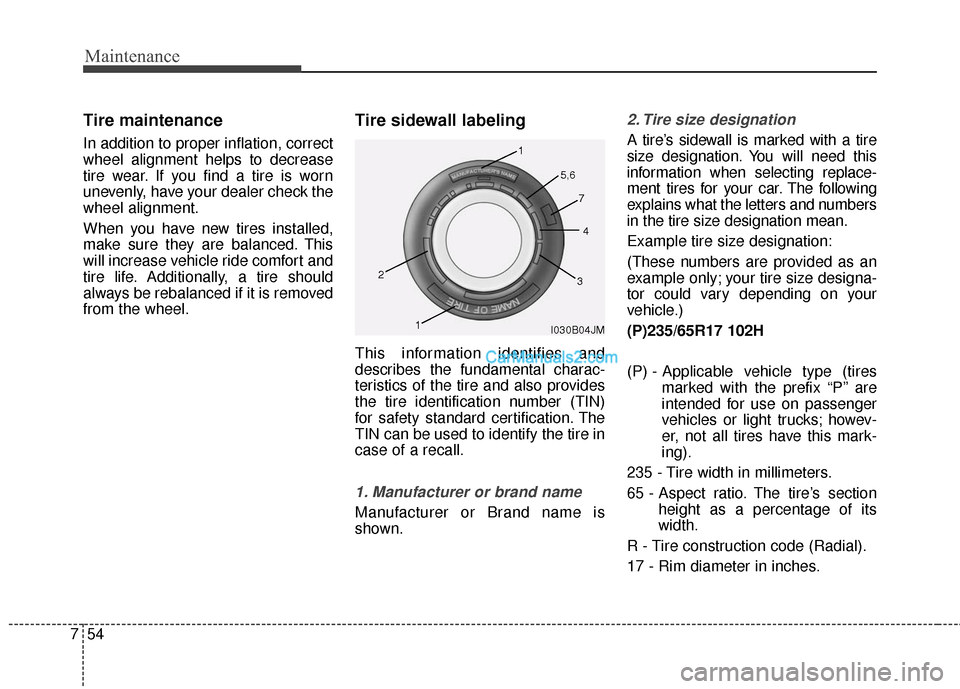
Tire sidewall labeling
This information identifies and
describes the fundamental charac-
teristics of the tire and also provides
the tire identification number (TIN)
for safety standard certification. The
TIN can be used to identify the tire in
case of a recall.
1. Manufacturer or brand name
Manufacturer or Brand name is
shown.
2. Tire size designation
A tire’s sidewall is marked with a tire
size designation. You will need this
information when selecting replace-
ment tires for your car. The following
explains what the letters and numbers
in the tire size designation mean.
Example tire size designation:
(These numbers are provided as an
example only; your tire size designa-
tor could vary depending on your
vehicle.)
(P)235/65R17 102H
(P) - Applicable vehicle type (tires
marked with the prefix “P’’ are
intended for use on passenger
vehicles or light trucks; howev-
er, not all tires have this mark-
ing).
235 - Tire width in millimeters.
65 - Aspect ratio. The tire’s section height as a percentage of its
width.
R - Tire construction code (Radial).
17 - Rim diameter in inches.
I030B04JM
1
1
2
34
5,6
7
Page 700 of 759
Maintenance
58
7
Tire terminology and definitions
Air Pressure: The amount of air
inside the tire pressing outward on
the tire. Air pressure is expressed in
pounds per square inch (psi) or kilo-
pascal (kPa).
Accessory Weight: This means the
combined weight of optional acces-
sories. Some examples of optional
accessories are, automatic transaxle
power seats, and air conditioning.
Aspect Ratio: The relationship of a
tire's height to its width.
Belt: A rubber coated layer of cords
that is located between the plies and
the tread. Cords may be made from
steel or other reinforcing materials.
Bead: The tire bead contains steel
wires wrapped by steel cords that
hold the tire onto the rim.
Bias Ply Tire: A pneumatic tire in
which the plies are laid at alternate
angles less than 90 degrees to the
centerline of the tread.
Cold Tire Pressure: The amount of
air pressure in a tire, measured in
pounds per square inch (psi) or kilo-
pascals (kPa) before a tire has built
up heat from driving. Curb Weight:
This means the weight
of a motor vehicle with standard and
optional equipment including the
maximum capacity of fuel, oil and
coolant, but without passengers and
cargo.
DOT Markings: A code molded into
the sidewall of a tire signifying that
the tire is in compliance with the U.S.
Department of Transportation motor
vehicle safety standards. The DOT
code includes the Tire Identification
Number (TIN), an alphanumeric des-
ignator which can also identify the
tire manufacturer, production plant,
brand and date of production.
GVWR: Gross Vehicle Weight Rating
GAWR FRT: Gross Axle Weight
Rating for the Front Axle.
GAWR RR: Gross Axle Weight
Rating for the Rear axle.
Intended Outboard Sidewall: The
side of an asymmetrical tire, that
must always face outward when
mounted on a vehicle.
Kilopascal (kPa): The metric unit for
air pressure. Light truck(LT) tire:
A tire designat-
ed by its manufacturer as primarily
intended for use on lightweight trucks
or multipurpose passenger vehicles.
Load ratings: The maximum load
that a tire is rated to carry for a given
inflation pressure.
Load Index: An assigned number
ranging from 1 to 279 that corre-
sponds to the load carrying capacity
of a tire.
Maximum Inflation Pressure: The
maximum air pressure to which a
cold tire may be inflated. The maxi-
mum air pressure is molded onto the
sidewall.
Maximum Load Rating: The load
rating for a tire at the maximum per-
missible inflation pressure for that
tire.
Maximum Loaded Vehicle Weight:
The sum of curb weight; accessory
weight; vehicle capacity weight; and
production options weight.
Normal Occupant Weight: The
number of occupants a vehicle is
designed to seat multiplied by 150
pounds (68 kg).
Page 739 of 759
Specifications, Consumer information and Reporting safety defects
28
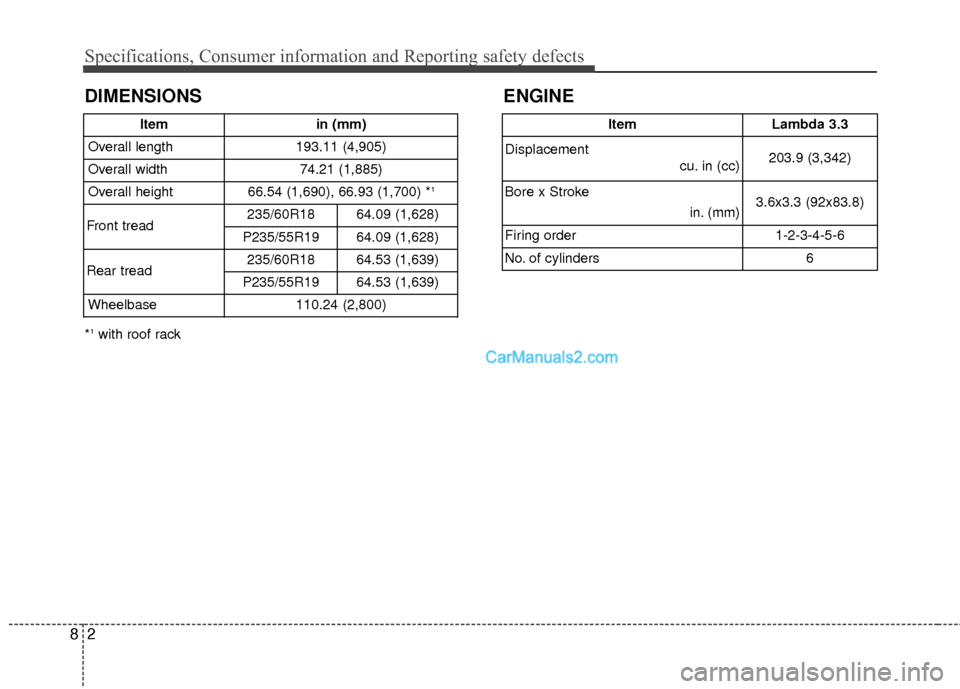
DIMENSIONS
*1with roof rackItem in (mm)
Overall length 193.11 (4,905)
Overall width 74.21 (1,885)
Overall height 66.54 (1,690), 66.93 (1,700) *
1
Front tread 235/60R18 64.09 (1,628)P235/55R1964.09 (1,628)
Rear tread235/60R1864.53 (1,639)
P235/55R19 64.53 (1,639)
Wheelbase 110.24 (2,800)
ItemLambda 3.3
Displacement cu. in (cc)
203.9 (3,342)
Bore x Stroke in. (mm)
3.6x3.3 (92x83.8)
Firing order
1-2-3-4-5-6
No. of cylinders
6
ENGINE
Page 753 of 759
I5
Index
Jack and tools ............................................................6-20
Jack label ...................................................................6-29
Removing and storing the spare tire .........................6-21
Floor mat anchor(s) ....................................................4-155
Fluid Brakes fluid ...............................................................7-35
Washer fluid ..............................................................7-37
Folding Key ....................................................................4-4
Folding the rear seat .....................................................3-21
Front fog light .............................................................4-116
Front seat adjustment - Manual ......................................3-5
Front seat adjustment - power ........................................3-6
Fuel Economy ...............................................................4-91
Fuel filler lid .................................................................4-43 Emergency fuel filer door release .............................4-46
Fuel Gauge....................................................................4-74\
Fuel requirements ...........................................................1-3
Fuse switch ...................................................................7-64
Fuse/relay panel description .........................................7-66
Fuses ........................................................................\
.....7-62 Engine compartment panel fuse ......................7-64, 7-70
Fuse switch ................................................................7-64
Fuse/relay panel description......................................7-66
Instrument panel fuse ................................................7-63
Main fuse...................................................................7-65
Multi fuse ..................................................................7-65 Gauges ........................................................................\
..4-73
Glove box ...................................................................4-147\
Glove box lamp ..........................................................4-122
Good braking practices .................................................5-43
Good driving practices .................................................5-19
Gross vehicle weight ......................................................8-5
Hazard warning flasher...............................................4-110
Hazardous driving conditions .......................................5-59
Headlamp delay ..........................................................4-111
Headlamp welcome ....................................................4-123
Headlight bulb replacement..........................................7-74
Headlight position.......................................................4-113
Headrest(3rd row) .........................................................3-18
Headrest(front)..............................................................3-10
Headrest(rear) ...............................................................3-17
Heated steering wheel...................................................4-55
Height adjustment (Front) ............................................3-30
High beam operation ..................................................4-114
Highway driving ...........................................................5-63
Hill-start assist control (HAC) .....................................5-42
Hood ........................................................................\
.....4-41
Horn ........................................................................\
......4-55
How to use this manual ..................................................1-2G
H
Page 757 of 759

I9
Index
Seat belts .......................................................................3\
-27Care of seat belts .......................................................3-39
Height adjustment (Front) .........................................3-30
Pre-tensioner seat belt ...............................................3-33
Seat belt precautions .................................................3-36
Seat belt warning.......................................................3-28
Seat warmer (Rear seat) ...............................................3-19
Seat warmer(front)........................................................3-13
Seatback pocket ............................................................3-15
Seats ........................................................................\
........3-2 Armrest (Rear seat) ...................................................3-19
Driver position memory system ..................................3-8
Folding the rear seat ..................................................3-21
Front seat adjustment - Manual ..................................3-5
Front seat adjustment - power .....................................3-6
Headrest(3rd row) .....................................................3-18
Headrest(front) ..........................................................3-10
Headrest(rear) ............................................................3-17
Rear seat adjustment .................................................3-15
Seat warmer (Rear seat) ............................................3-19
Seat warmer(front) ....................................................3-13
Seatback pocket.........................................................3-15
Service Mode ................................................................4-78
Shift-lock override ........................................................5-18
Side curtain .................................................................4-159
Side impact air bag .......................................................3-67
Smart key ......................................................................4-\
10
Smooth cornering .........................................................5-61 Snow tires .....................................................................5-6\
5
Spare tire
Changing tires ...........................................................6-23
Removing and storing the spare tire .........................6-21
Special driving conditions ............................................5-59 Driving at night .........................................................5-61
Driving in flooded areas............................................5-63
Driving in the rain .....................................................5-62
Driving off-road ........................................................5-63
Hazardous driving conditions ...................................5-59
Highway driving........................................................5-63
Reducing the risk of a rollover .................................5-59
Rocking the vehicle...................................................5-60
Smooth cornering ......................................................5-61
Speedometer .................................................................4-73
Sports mode ..................................................................5-17
SRS components and functions ....................................3-50
Starting difficulties, see engine will not start .................6-4
Steering wheel ..............................................................4-53 Driver selectable steering mode ................................4-56
Electric power steering (EPS) ...................................4-53
Heated steering wheel ...............................................4-55
Horn........................................................................\
...4-55
Power steering ...........................................................4-53
Tilt & telescopic steering ..........................................4-54