Page 687 of 699
Diesel Particulate Filter
(if equipped)
The Diesel Particulate Filter (DPF)
system removes the soot emitted
from the vehicle.
Unlike a disposable air filter, the DPF
system automatically burns (oxi-
dizes) and removes the accumulated
soot according to the driving condi-
tion. In other words, the active burn-
ing by engine control system and
high exhaust gas temperature
caused by normal/high driving condi-
tion burns and removes the accumu-
lated soot.
However, if the vehicle continues to
be driven at low speed for long time,
the accumulated soot may not be
automatically removed because of
low exhaust gas temperature. In this
particular case, the amount of soot is
out of detection limit, the soot oxida-
tion process by engine control sys-
tem may not happen and the mal-
function indicator light may blink.When the malfunction indicator light
blinks, it may stop blinking by driving
the vehicle at more than 60km/h (37
mph) or at more than second gear
with 1500 ~ 2000 engine rpm for a
certain time (for about 25 minutes).
If the malfunction indicator light con-
tinues to be blinked in spite of the
procedure, please visit a HYUNDAI
authorised repairer and then check
the DPF system.
If you continue to drive with the mal-
function indicator light blinking for a
long time, the DPF system can be
damaged and fuel consumption can
be worsen.
CAUTION - Diesel Fuel
(if equipped with DPF)
It is recommended to use the
regulated automotive diesel fuel
for diesel vehicle equipped with
the DPF system.
If you use diesel fuel including
high sulfur (more than 50 ppm
sulfur) and unspecified addi-
tives, it can cause the DPF sys-
tem to be damaged and white
smoke can be emitted.
790
Maintenance
Page 689 of 699
Specifications & Consumer information
2 8
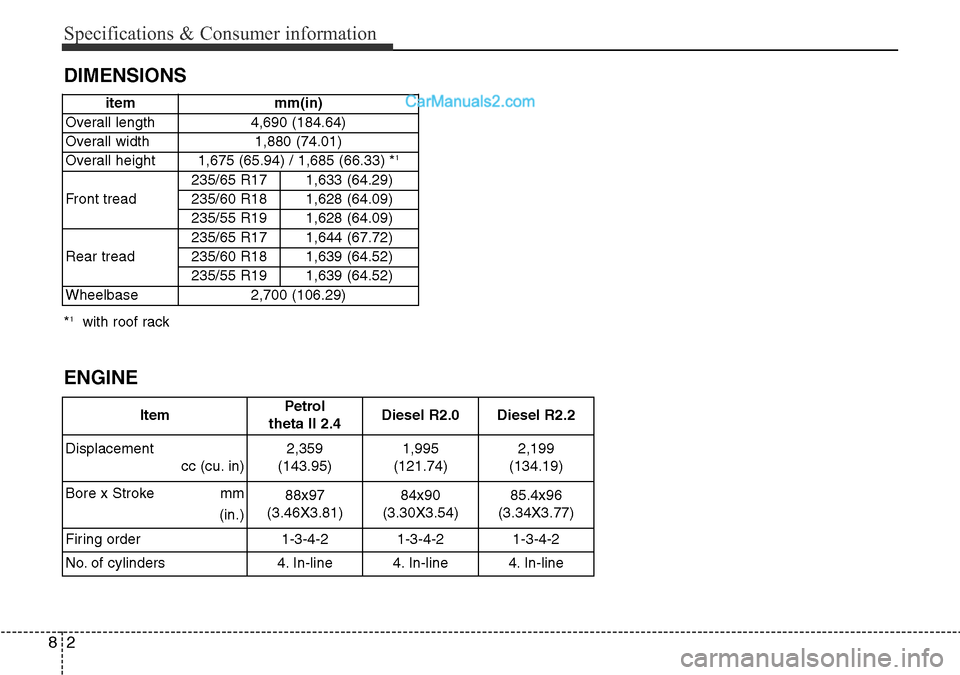
DIMENSIONS
*1with roof rack
ENGINE
ItemPetrol
theta II 2.4Diesel R2.0Diesel R2.2
Displacement
cc (cu. in)
2,359
(143.95)1,995
(121.74)2,199
(134.19)
Bore x Stroke mm
(in.)
88x97
(3.46X3.81)84x90
(3.30X3.54)85.4x96
(3.34X3.77)
Firing order
1-3-4-21-3-4-21-3-4-2
No. of cylinders
4. In-line4. In-line4. In-line
item mm(in)
Overall length 4,690 (184.64)
Overall width 1,880 (74.01)
Overall height 1,675 (65.94) / 1,685 (66.33) *
1
Front tread235/65 R17 1,633 (64.29)
235/60 R18 1,628 (64.09)
235/55 R19 1,628 (64.09)
Rear tread235/65 R17 1,644 (67.72)
235/60 R18 1,639 (64.52)
235/55 R19 1,639 (64.52)
Wheelbase 2,700 (106.29)
Page 694 of 699
87
Specifications & Consumer information
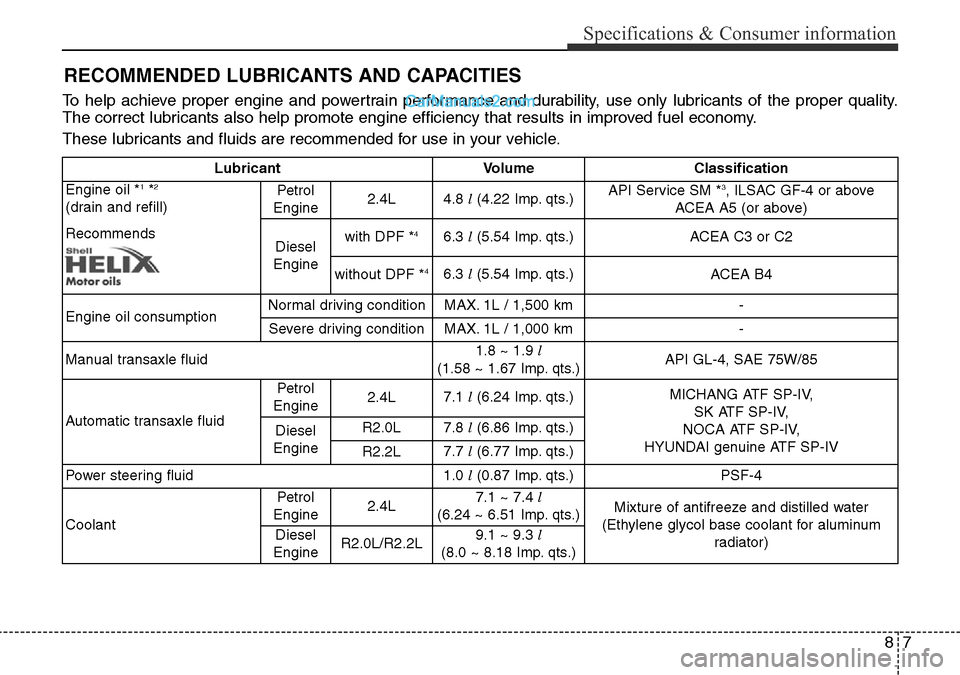
RECOMMENDED LUBRICANTS AND CAPACITIES
To help achieve proper engine and powertrain performance and durability, use only lubricants of the proper quality.
The correct lubricants also help promote engine efficiency that results in improved fuel economy.
These lubricants and fluids are recommended for use in your vehicle.
Lubricant Volume Classification
Engine oil *
1*2
(drain and refill)
RecommendsPetrol
Engine2.4L4.8 l(4.22 Imp. qts.)API Service SM *
3, ILSAC GF-4 or above
ACEA A5 (or above)
Diesel
Enginewith DPF *
46.3 l(5.54 Imp. qts.)
ACEA C3 or C2
without DPF *
46.3 l(5.54 Imp. qts.)
ACEA B4
Engine oil consumption Normal driving condition MAX. 1L / 1,500 km -
Severe driving condition MAX. 1L / 1,000 km -
Manual transaxle fluid 1.8 ~ 1.9 l
(1.58 ~ 1.67 Imp. qts.)API GL-4, SAE 75W/85
Automatic transaxle fluid Petrol
Engine2.4L7.1 l(6.24 Imp. qts.)MICHANG ATF SP-IV,
SK ATF SP-IV,
NOCA ATF SP-IV,
HYUNDAI genuine ATF SP-IV
Diesel
EngineR2.0L7.8 l(6.86 Imp. qts.)
R2.2L7.7 l(6.77 Imp. qts.)
Power steering fluid 1.0 l(0.87 Imp. qts.)PSF-4
Coolant
Petrol
Engine2.4L7.1 ~ 7.4 l
(6.24 ~ 6.51 Imp. qts.)Mixture of antifreeze and distilled water
(Ethylene glycol base coolant for aluminum
radiator)
Diesel
EngineR2.0L/R2.2L9.1 ~ 9.3 l
(8.0 ~ 8.18 Imp. qts.)
Page 695 of 699
Specifications & Consumer information
8 8
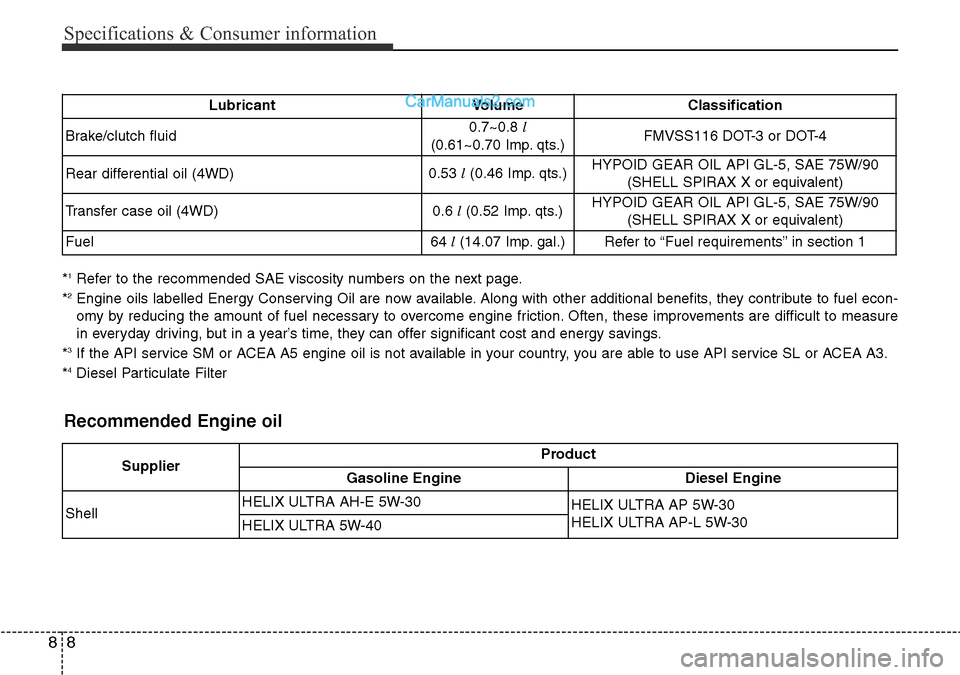
*1Refer to the recommended SAE viscosity numbers on the next page.
*2Engine oils labelled Energy Conserving Oil are now available. Along with other additional benefits, they contribute to fuel econ-
omy by reducing the amount of fuel necessary to overcome engine friction. Often, these improvements are difficult to measure
in everyday driving, but in a year’s time, they can offer significant cost and energy savings.
*
3If the API service SM or ACEA A5 engine oil is not available in your country, you are able to use API service SL or ACEA A3.
*4Diesel Particulate FilterLubricant Volume Classification
Brake/clutch fluid0.7~0.8 l
(0.61~0.70 Imp. qts.)FMVSS116 DOT-3 or DOT-4
Rear differential oil (4WD)0.53 l(0.46 Imp. qts.)HYPOID GEAR OIL API GL-5, SAE 75W/90
(SHELL SPIRAX X or equivalent)
Transfer case oil (4WD) 0.6 l(0.52 Imp. qts.)HYPOID GEAR OIL API GL-5, SAE 75W/90
(SHELL SPIRAX X or equivalent)
Fuel64 l(14.07 Imp. gal.)
Refer to “Fuel requirements” in section 1
Recommended Engine oil
SupplierProduct
Gasoline Engine Diesel Engine
ShellHELIX ULTRA AH-E 5W-30
HELIX ULTRA AP 5W-30
HELIX ULTRA AP-L 5W-30
HELIX ULTRA 5W-40
Page 696 of 699
89
Specifications & Consumer information
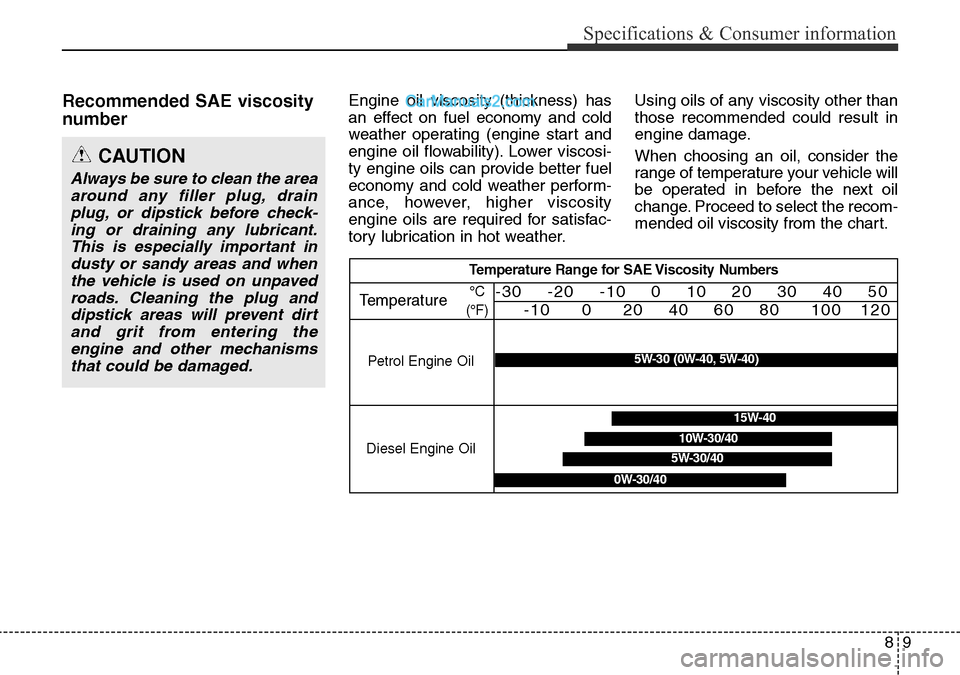
Recommended SAE viscosity
number Engine oil viscosity (thickness) has
an effect on fuel economy and cold
weather operating (engine start and
engine oil flowability). Lower viscosi-
ty engine oils can provide better fuel
economy and cold weather perform-
ance, however, higher viscosity
engine oils are required for satisfac-
tory lubrication in hot weather.Using oils of any viscosity other than
those recommended could result in
engine damage.
When choosing an oil, consider the
range of temperature your vehicle will
be operated in before the next oil
change. Proceed to select the recom-
mended oil viscosity from the chart.
CAUTION
Always be sure to clean the area
around any filler plug, drain
plug, or dipstick before check-
ing or draining any lubricant.
This is especially important in
dusty or sandy areas and when
the vehicle is used on unpaved
roads. Cleaning the plug and
dipstick areas will prevent dirt
and grit from entering the
engine and other mechanisms
that could be damaged.
Temperature Range for SAE Viscosity Numbers
Temperature
Petrol Engine Oil°C
(°F)
-30 -20 -10 0 10 20 30 40 50
-10 0 20 40 60 80 100 120
Diesel Engine Oil5W-30/40
15W-40
10W-30/40
0W-30/40
5W-30 (0W-40, 5W-40)
Page 697 of 699
Specifications & Consumer information
10 8
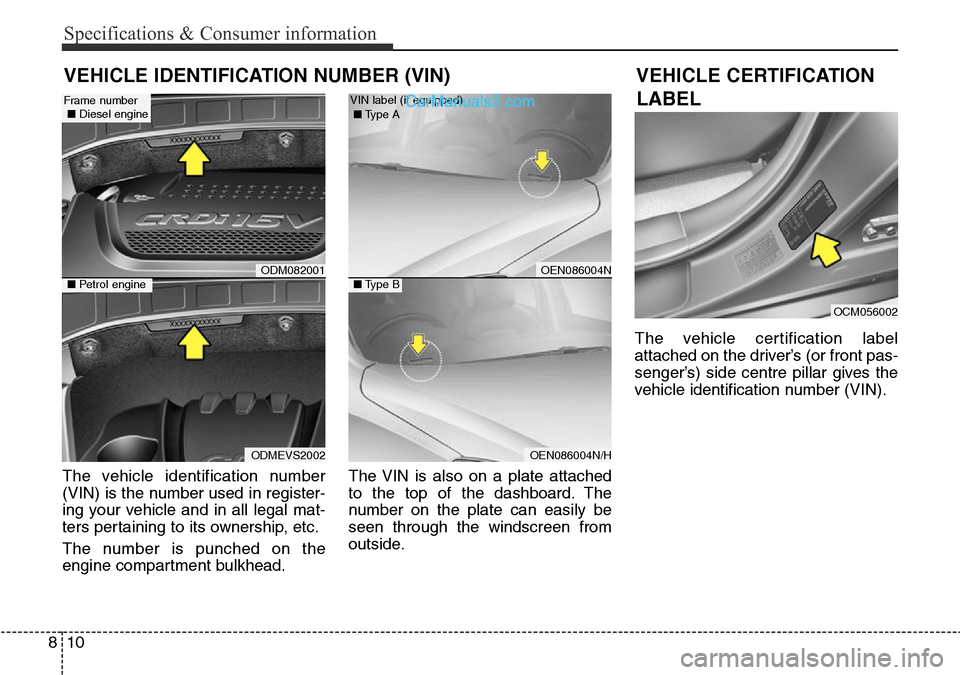
The vehicle identification number
(VIN) is the number used in register-
ing your vehicle and in all legal mat-
ters pertaining to its ownership, etc.
The number is punched on the
engine compartment bulkhead.The VIN is also on a plate attached
to the top of the dashboard. The
number on the plate can easily be
seen through the windscreen from
outside.The vehicle certification label
attached on the driver’s (or front pas-
senger’s) side centre pillar gives the
vehicle identification number (VIN).
VEHICLE IDENTIFICATION NUMBER (VIN) VEHICLE CERTIFICATION
LABEL
OCM056002
ODM082001
ODMEVS2002
Frame number
■ Diesel engine
■ Petrol engineOEN086004N
OEN086004N/H VIN label (if equipped)
■Type B
■Type A
Page 698 of 699
811
Specifications & Consumer information
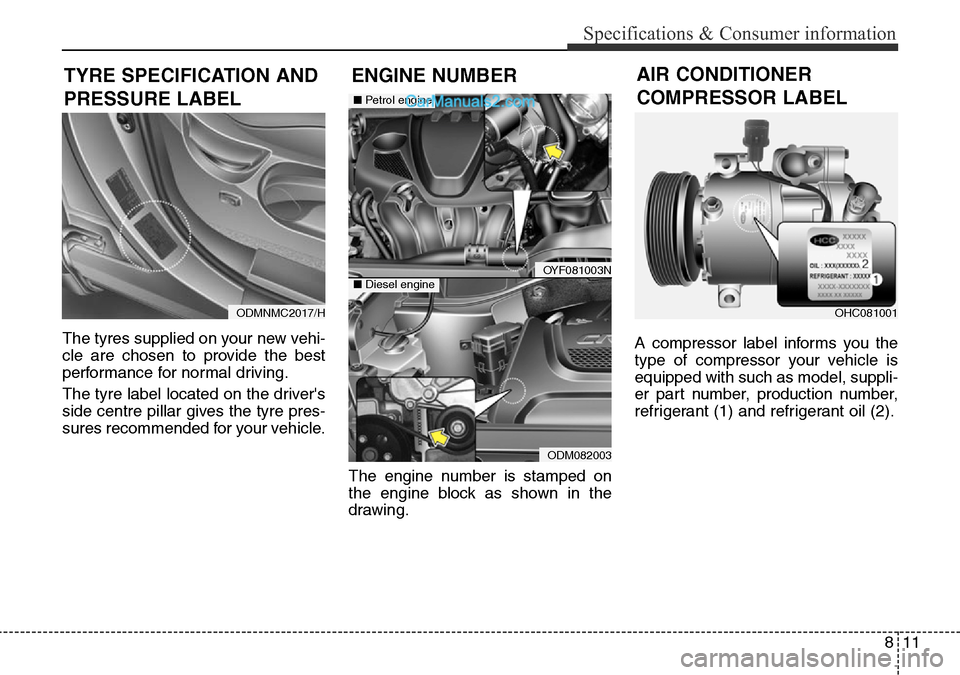
The tyres supplied on your new vehi-
cle are chosen to provide the best
performance for normal driving.
The tyre label located on the driver's
side centre pillar gives the tyre pres-
sures recommended for your vehicle.
The engine number is stamped on
the engine block as shown in the
drawing.A compressor label informs you the
type of compressor your vehicle is
equipped with such as model, suppli-
er part number, production number,
refrigerant (1) and refrigerant oil (2).
TYRE SPECIFICATION AND
PRESSURE LABELENGINE NUMBER
ODMNMC2017/H
OYF081003N
ODM082003
■ Diesel engine
■ Petrol engine
OHC081001
AIR CONDITIONER
COMPRESSOR LABEL