2016 Hyundai H-1 (Grand Starex) fuel consumption
[x] Cancel search: fuel consumptionPage 104 of 332

Features of your vehicle
36 4
Push the TRIP button for less than 1 sec-
ond to select distance to empty, average
speed or tripmeter function as follows :
Distance to empty (km or miles)
This mode indicates the estimated dis-
tance to empty based on the current fuel
in the fuel tank and the amount of fuel
delivered to the engine. When the
remaining distance is below 50 km (30
miles), “---” will be displayed and the dis-
tance to empty indicator will blink.
The meter’s working range is from 50 to
999 km (30 to 999 miles).✽NOTICE
• If the vehicle is not on level ground or
the battery power has been interrupt-
ed, the “Distance to empty” function
may not operate correctly.
The trip computer may not register
additional fuel if less than 6 litres (1.6
gallons) of fuel are added to the vehi-
cle.
• The fuel consumption and distance to
empty values may vary significantly
based on driving conditions, driving
habits, and condition of the vehicle.
• The distance to empty value is an esti-
mate of the available driving distance.
This value may differ from the actual
driving distance available.
OTQ047052 Odometer
Average speed
Tripmeter
Distance to empty
Page 110 of 332
Features of your vehicle
42 4
Generally, your vehicle will continue to be
drivable, but have the system checked by
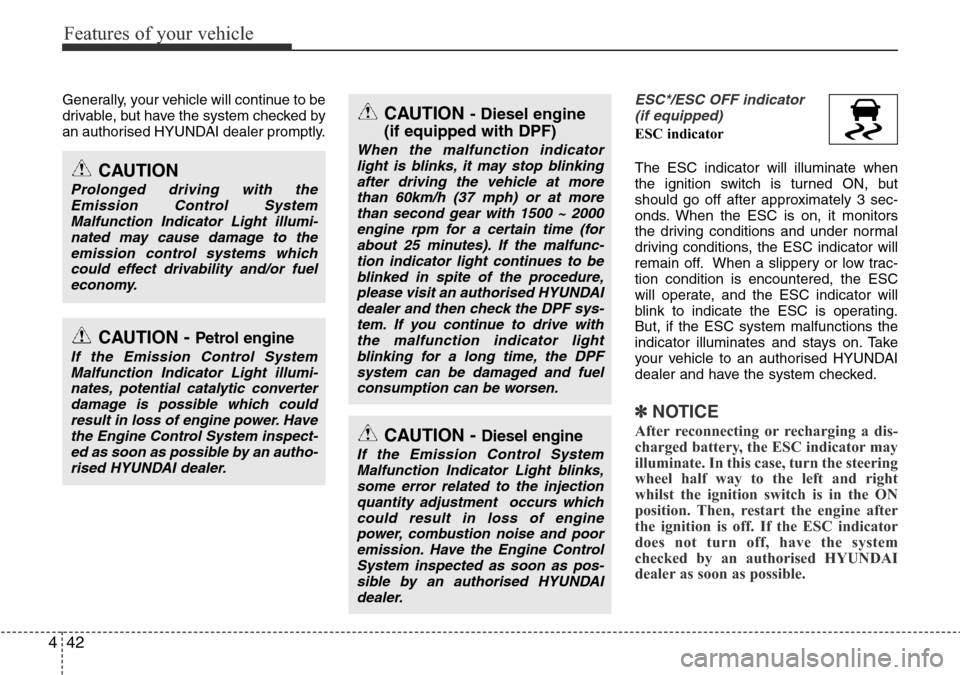
an authorised HYUNDAI dealer promptly.ESC*/ESC OFF indicator
(if equipped)
ESC indicator
The ESC indicator will illuminate when
the ignition switch is turned ON, but
should go off after approximately 3 sec-
onds. When the ESC is on, it monitors
the driving conditions and under normal
driving conditions, the ESC indicator will
remain off. When a slippery or low trac-
tion condition is encountered, the ESC
will operate, and the ESC indicator will
blink to indicate the ESC is operating.
But, if the ESC system malfunctions the
indicator illuminates and stays on. Take
your vehicle to an authorised HYUNDAI
dealer and have the system checked.
✽NOTICE
After reconnecting or recharging a dis-
charged battery, the ESC indicator may
illuminate. In this case, turn the steering
wheel half way to the left and right
whilst the ignition switch is in the ON
position. Then, restart the engine after
the ignition is off. If the ESC indicator
does not turn off, have the system
checked by an authorised HYUNDAI
dealer as soon as possible.CAUTION - Diesel engine
If the Emission Control System
Malfunction Indicator Light blinks,
some error related to the injection
quantity adjustment occurs which
could result in loss of engine
power, combustion noise and poor
emission. Have the Engine Control
System inspected as soon as pos-
sible by an authorised HYUNDAI
dealer.
CAUTION- Diesel engine
(if equipped with DPF)
When the malfunction indicator
light is blinks, it may stop blinking
after driving the vehicle at more
than 60km/h (37 mph) or at more
than second gear with 1500 ~ 2000
engine rpm for a certain time (for
about 25 minutes). If the malfunc-
tion indicator light continues to be
blinked in spite of the procedure,
please visit an authorised HYUNDAI
dealer and then check the DPF sys-
tem. If you continue to drive with
the malfunction indicator light
blinking for a long time, the DPF
system can be damaged and fuel
consumption can be worsen.
CAUTION
Prolonged driving with the
Emission Control System
Malfunction Indicator Light illumi-
nated may cause damage to the
emission control systems which
could effect drivability and/or fuel
economy.
CAUTION - Petrol engine
If the Emission Control System
Malfunction Indicator Light illumi-
nates, potential catalytic converter
damage is possible which could
result in loss of engine power. Have
the Engine Control System inspect-
ed as soon as possible by an autho-
rised HYUNDAI dealer.
Page 135 of 332

467
Features of your vehicle
• When using the air conditioning sys-
tem, you may notice clear water drip-
ping (or even puddling) on the ground
under the passenger side of the vehi-
cle. This is a normal system operation
characteristic.
• Operating the air conditioning system
in the recirculated air position provides
maximum cooling, however, continual
operation in this mode may cause the
air inside the vehicle to become stale.
• During cooling operation, you may
occasionally notice a misty air flow
because of rapid cooling and humid air
intake. This is a normal system opera-
tion characteristics.D230504ATQ-EA
Fuel-fired Heater (if equipped)
The low fuel consumption fuel-fired
heater supplies additional heat to the
interior compartment to assist with cabin
heating during engine warm-up.
The following 3 conditions should be met
at the same time for automatic operation
of the fuel-fired heater.
• Engine running.
• Ambient temperature is lower than 5°C.
• Coolant temperature is lower than
68°C.
A cleaning process of the fuel-fired
heater will be performed automatically
when the heater is not operated due to
increase of coolant temperature and igni-
tion off.
During cleaning process, supplied fuel in
the heater will be burnt completely and
any smoke will be expelled. It is a neces-
sary process for next operation and dura-
bility of the heater and takes about 1~3
minutes.
✽NOTICE
• The following symptoms will occur
and it is normal.
- A white smoke may come out from
the fuel-fired heater exhaust pipe
during operation of the heater.
However, when an excessive black
smoke is discharged, the fuel-fired
heater should be inspected.
- A “buk-buk” noise from the heater is
a noise to form flame for combus-
tion.
- When the heater is operated at full
load, a “Wooing” noise occurs.
- When shutting off the engine during
heater operation, a “Wing” noise
occurs to perform the cleaning
process.
• When refuelling, stop operation of the
fuel-fired heater by shutting off the
engine.
Page 214 of 332

529
Driving your vehicle
E100000AFD-EA
Your vehicle's fuel economy depends
mainly on your style of driving, where you
drive and when you drive.
Each of these factors affects how many
kilometers (miles) you can get from a litre
(gallon) of fuel. To operate your vehicle
as economically as possible, use the fol-
lowing driving suggestions to help save
money in both fuel and repairs:
• Drive smoothly. Accelerate at a moder-
ate rate. Don't make “kangaroo” starts
or full-throttle shifts and maintain a
steady cruising speed. Don't race
between stoplights. Try to adjust your
speed to that of the other traffic so you
don't have to change speeds unneces-
sarily. Avoid heavy traffic whenever
possible. Always maintain a safe dis-
tance from other vehicles so you can
avoid unnecessary braking. This also
reduces brake wear.
• Drive at a moderate speed. The faster
you drive, the more fuel your car uses.
Driving at a moderate speed, especial-
ly on the highway, is one of the most
effective ways to reduce fuel consump-
tion.• Don't "ride" the brake or clutch pedal.
This can increase fuel consumption
and also increase wear on these com-
ponents. In addition, driving with your
foot resting on the brake pedal may
cause the brakes to overheat, which
reduces their effectiveness and may
lead to more serious consequences.
• Take care of your tyres. Keep them
inflated to the recommended pressure.
Incorrect inflation, either too much or
too little, results in unnecessary tyre
wear. Check the tyre pressures at least
once a month.
• Be sure that the wheels are aligned
correctly. Improper alignment can
result from hitting kerbs or driving too
fast over irregular surfaces. Poor align-
ment causes faster tyre wear and may
also result in other problems as well as
greater fuel consumption.
• Keep your car in good condition. For
better fuel economy and reduced
maintenance costs, maintain your car
in accordance with the maintenance
schedule in Section 7. If you drive your
car in severe conditions, more frequent
maintenance is required (see Section
7 for details).• Keep your car clean. For maximum
service, your vehicle should be kept
clean and free of corrosive materials. It
is especially important that mud, dirt,
ice, etc. not be allowed to accumulate
on the underside of the car. This extra
weight can result in increased fuel con-
sumption and also contribute to corro-
sion.
• Travel lightly. Don't carry unnecessary
weight in your car. Weight reduces fuel
economy.
• Don't let the engine idle longer than
necessary. If you are waiting (and not
in traffic), turn off your engine and
restart only when you're ready to go.
• Remember, your vehicle does not
require extended warm-up. After the
engine has started, allow the engine to
run for 10 to 20 seconds prior to plac-
ing the vehicle in gear. In very cold
weather, however, give your engine a
slightly longer warm-up period.
• Don't “labour” or “over-rev” the engine.
Labouring is driving too slowly in too
high a gear resulting in the engine
bucking. If this happens, shift to a lower
gear. Over-revving is racing the engine
beyond its safe limit. This can be avoid-
ed by shifting at the recommended
speeds.
ECONOMICAL OPERATION
Page 330 of 332
Specifications
4 9
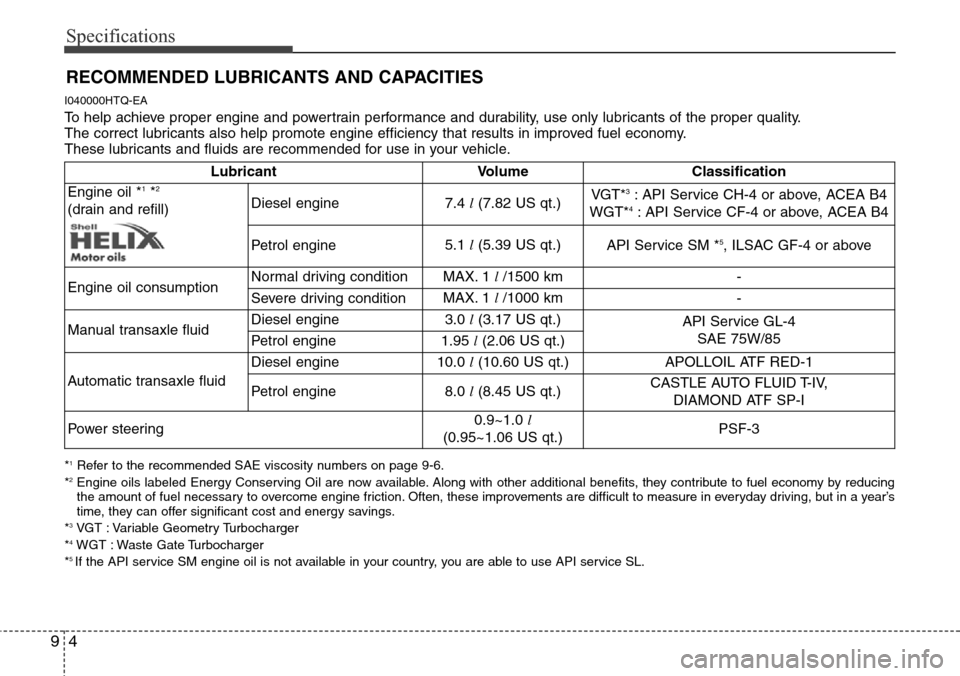
RECOMMENDED LUBRICANTS AND CAPACITIES
I040000HTQ-EA
To help achieve proper engine and powertrain performance and durability, use only lubricants of the proper quality.
The correct lubricants also help promote engine efficiency that results in improved fuel economy.
These lubricants and fluids are recommended for use in your vehicle.
*1Refer to the recommended SAE viscosity numbers on page 9-6.
*2Engine oils labeled Energy Conserving Oil are now available. Along with other additional benefits, they contribute to fuel economy by reducing
the amount of fuel necessary to overcome engine friction. Often, these improvements are difficult to measure in everyday driving, but in a year’s
time, they can offer significant cost and energy savings.
*
3VGT : Variable Geometry Turbocharger
*4WGT : Waste Gate Turbocharger
*5 If the API service SM engine oil is not available in your country, you are able to use API service SL.
Lubricant Volume Classification
Engine oil *1*2
(drain and refill)Diesel engine7.4 l(7.82 US qt.)VGT*
3: API Service CH-4 or above, ACEA B4
WGT*4: API Service CF-4 or above, ACEA B4
Petrol engine5.1 l(5.39 US qt.)
API Service SM *
5, ILSAC GF-4 or above
Engine oil consumptionNormal driving conditionMAX. 1 l/1500 km
-
Severe driving conditionMAX. 1 l/1000 km
-
Manual transaxle fluidDiesel engine3.0 l(3.17 US qt.)
API Service GL-4
SAE 75W/85
Petrol engine1.95 l(2.06 US qt.)
Automatic transaxle fluidDiesel engine10.0 l(10.60 US qt.)
APOLLOIL ATF RED-1
Petrol engine8.0 l(8.45 US qt.)CASTLE AUTO FLUID T-IV,
DIAMOND ATF SP-I
Power steering0.9~1.0 l
(0.95~1.06 US qt.)PSF-3