2016 Hyundai Genesis battery
[x] Cancel search: batteryPage 407 of 502
7
Maintenance
7
Maintenance
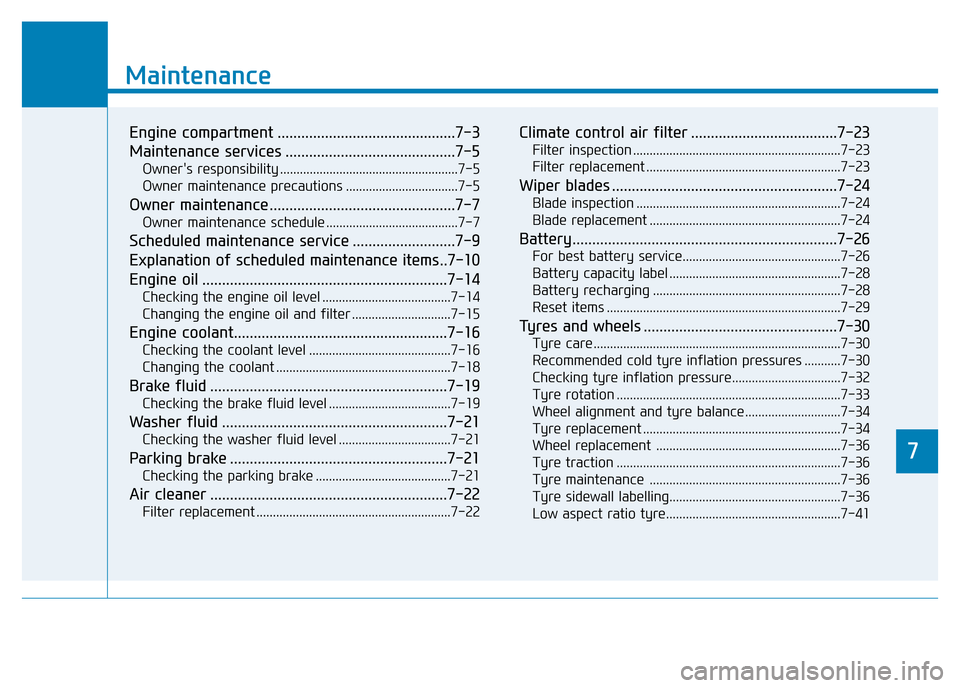
Engine compartment .............................................7-3
Maintenance services ...........................................7-5
Owner's responsibility ......................................................7-5
Owner maintenance precautions ..................................7-5
Owner maintenance ...............................................7-7
Owner maintenance schedule ........................................7-7
Scheduled maintenance service ..........................7-9
Explanation of scheduled maintenance items..7-10
Engine oil ..............................................................7-14
Checking the engine oil level .......................................7-14
Changing the engine oil and filter ..............................7-15
Engine coolant......................................................7-16
Checking the coolant level ...........................................7-16
Changing the coolant .....................................................7-18
Brake fluid ............................................................7-19
Checking the brake fluid level .....................................7-19
Washer fluid .........................................................7-21
Checking the washer fluid level ..................................7-21
Parking brake .......................................................7-21
Checking the parking brake .........................................7-21
Air cleaner ............................................................7-22
Filter replacement ...........................................................7-22
Climate control air filter .....................................7-23
Filter inspection ...............................................................7-23
Filter replacement ...........................................................7-23
Wiper blades .........................................................7-24
Blade inspection ..............................................................7-24
Blade replacement ..........................................................7-24
Battery...................................................................7-26
For best battery service................................................7-26
Battery capacity label ....................................................7-28
Battery recharging .........................................................7-28
Reset items .......................................................................7-29
Tyres and wheels .................................................7-30
Tyre care ...........................................................................7-30
Recommended cold tyre inflation pressures ...........7-30
Checking tyre inflation pressure.................................7-32
Tyre rotation ....................................................................7-33
Wheel alignment and tyre balance.............................7-34
Tyre replacement ............................................................7-34
Wheel replacement ........................................................7-36
Tyre traction ....................................................................7-36
Tyre maintenance ..........................................................7-36
Tyre sidewall labelling....................................................7-36
Low aspect ratio tyre.....................................................7-41
7
Page 412 of 502

7-6
Maintenance
Maintenance work
•Performing maintenance work
on a vehicle can be danger-
ous. You can be seriously
injured whilst performing
some maintenance proce-
dures. If you lack sufficient
knowledge and experience or
the proper tools and equip-
ment to do the work, we rec-
ommend that the system be
serviced by a HYUNDAI autho-
rised repairer.
•Working under the bonnet
with the engine running is
dangerous. It becomes even
more dangerous when you
wear jewellery or loose cloth-
ing.
(Continued)
WARNING (Continued)
These can become entangled
in moving parts and result in
injury. Therefore, if you must
run the engine whilst working
under the bonnet, make cer-
tain that you remove all jew-
ellery (especially rings,
bracelets, watches, and neck-
laces) and all neckties,
scarves, and similar loose
clothing before getting near
the engine or cooling fans.
•Do not put heavy objects or
apply excessive force on top of
the engine cover (if equipped)
or fuel related parts.
•When you inspect the fuel
system (fuel lines and fuel
injection devices), we recom-
mend that you contact a
HYUNDAI authorised repairer.
(Continued)
CAUTION
(Continued)
•Do not drive long time with
the engine cover (if equipped)
removed.
•When checking the engine
room, do not go near fire. Fuel,
washer fluid, etc. are flamma-
ble oils that may cause fire.
•Before touching the battery,
ignition cables and electrical
wiring, you should disconnect
the battery "-" terminal. You
may get an electric shock
from the electric current.
•When you remove the interior
trim cover with a flat head (-)
driver, be careful not to dam-
age the cover.
•Be careful when you replace
and clean bulbs to avoid
burns or electrical shock.
Page 414 of 502
7-8
Maintenance
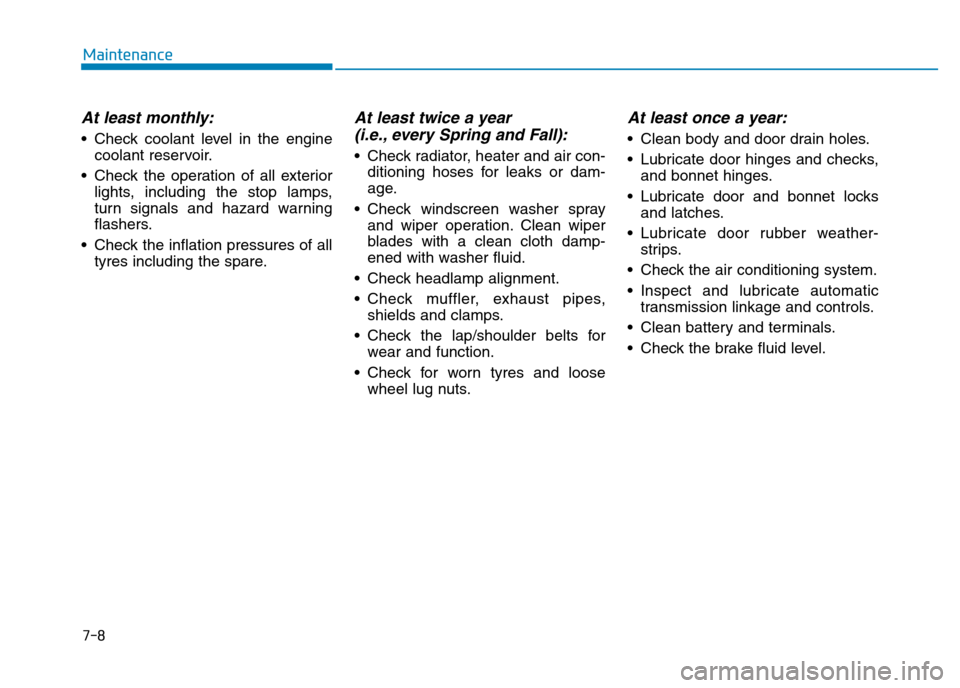
At least monthly:
• Check coolant level in the engine
coolant reservoir.
• Check the operation of all exterior
lights, including the stop lamps,
turn signals and hazard warning
flashers.
• Check the inflation pressures of all
tyres including the spare.
At least twice a year
(i.e., every Spring and Fall):
• Check radiator, heater and air con-
ditioning hoses for leaks or dam-
age.
• Check windscreen washer spray
and wiper operation. Clean wiper
blades with a clean cloth damp-
ened with washer fluid.
• Check headlamp alignment.
• Check muffler, exhaust pipes,
shields and clamps.
• Check the lap/shoulder belts for
wear and function.
• Check for worn tyres and loose
wheel lug nuts.
At least once a year:
• Clean body and door drain holes.
• Lubricate door hinges and checks,
and bonnet hinges.
• Lubricate door and bonnet locks
and latches.
• Lubricate door rubber weather-
strips.
• Check the air conditioning system.
• Inspect and lubricate automatic
transmission linkage and controls.
• Clean battery and terminals.
• Check the brake fluid level.
Page 423 of 502

7-17
7
Maintenance
Check the condition and connections
of all cooling system hoses and
heater hoses. Replace any swollen
or deteriorated hoses.
The coolant level should be filled
between F (MAX) and L (MIN) marks
on the side of the coolant reservoir
when the engine is cool.
If the coolant level is low, add enough
distilled (deionised) or soft water.
Bring the level to F (MAX), but do not
overfill.
If frequent additions are required, we
recommend that the system be
inspected by a HYUNDAI authorised
repairer.
Recommended engine coolant
• When adding coolant, use only
deionised water or soft water for
your vehicle and never mix hard
water in the coolant filled at the fac-
tory. An improper coolant mixture
can result in serious malfunction or
engine damage.
• The engine in your vehicle has alu-
minum engine parts and must be
protected by an ethylene-glycol-
based coolant to prevent corrosion
and freezing.
• DO NOT USE alcohol or methanol
coolant or mix them with the spec-
ified coolant.
• Do not use a solution that contains
more than 60% antifreeze or less
than 35% antifreeze, which would
reduce the effectiveness of the
solution.
ODH073004
The electric motor
(cooling fan) is con-
trolled by engine
coolant temperature,
refrigerant pressure
and vehicle speed. It may some-
times operate even when the
engine is not running. Use
extreme caution when working
near the blades of the cooling
fan so that you are not injured
by a rotating fan blade. As the
engine coolant temperature
decreases, the electric motor
will automatically shut off. This
is a normal condition.
The electric motor (cooling fan)
may operate until you discon-
nect the negative battery cable.
WARNING
Page 432 of 502

7-26
Maintenance
BATTERY
For best battery service
The battery is in the boot.
When replacing the battery, discon-
nect the negative (-) cable (1) and
remove the positive (+) battery fuse
box (2).• Keep the battery securely mounted.
• Keep the battery top clean and dry.
• Keep the terminals and connec-
tions clean, tight, and coated with
petroleum jelly or terminal grease.
• Rinse any spilled electrolyte from
the battery immediately with a
solution of water and baking soda.
• If the vehicle is not going to be
used for an extended time, discon-
nect the battery cables.
✽NOTICE
Basically equipped battery is main-
tenance free type. If your vehicle is
equipped with the battery marked
with LOWER and UPPER on the
side, you can check the electrolyte
level. The electrolyte level should be
between LOWER and UPPER. If
the electrolyte level is low, it needs to
add distilled (demineralised) water
(Never add sulfuric acid or other
electrolyte). When refill, be careful
not to splash the battery and adja-
cent components. And do not over-
fill the battery cells. It can cause cor-
rosion on other parts. After then
ensure that tighten the cell caps. We
recommend that you contact a
HYUNDAI authorised repairer.
ODH073029
ODH073030
Page 433 of 502

7-27
7
Maintenance
(Continued)
If any electrolyte gets
into your eyes, flush
your eyes with clean
water for at least 15 min-
utes and get immediate
medical attention. If elec-
trolyte gets on your skin,
thoroughly wash the
contacted area. If you
feel a pain or a burning
sensation, get medical
attention immediately.
Wear eye protection
when charging or work-
ing near a battery.
Always provide ventila-
tion when working in an
enclosed space.
An inappropriately dis-
posed battery can be
harmful to the environ-
ment and human health.
Dispose the battery
according to your local
law(s) or regulation.
(Continued)(Continued)
•When lifting a plastic-cased
battery, excessive pressure
on the case may cause battery
acid to leak, resulting in per-
sonal injury. Lift with a battery
carrier or with your hands on
opposite corners.
•Never attempt to recharge the
battery when the battery
cables are connected.
•The electrical ignition system
works with high voltage.
Never touch these compo-
nents with the engine running
or the Engine Start/Stop but-
ton pressed.
Failure to follow the above
warnings can result in serious
bodily injury or death.
If you connect unauthorised
electronic devices to the battery,
the battery may be discharged.
Never use unauthorised devices.
CAUTION
Battery dangers
Always read the follow-
ing instructions carefully
when handling a battery.
Keep lighted cigarettes
and all other flames or
sparks away from the
battery.
Hydrogen, a highly com-
bustible gas, is always
present in battery cells
and may explode if ignit-
ed.
Keep batteries out of the
reach of children because
batteries contain highly
corrosive
SULFURIC ACID.
Do not allow battery acid
to contact your skin, eyes,
clothing or paint finish.
(Continued)
WARNING
Page 434 of 502
7-28
Maintenance
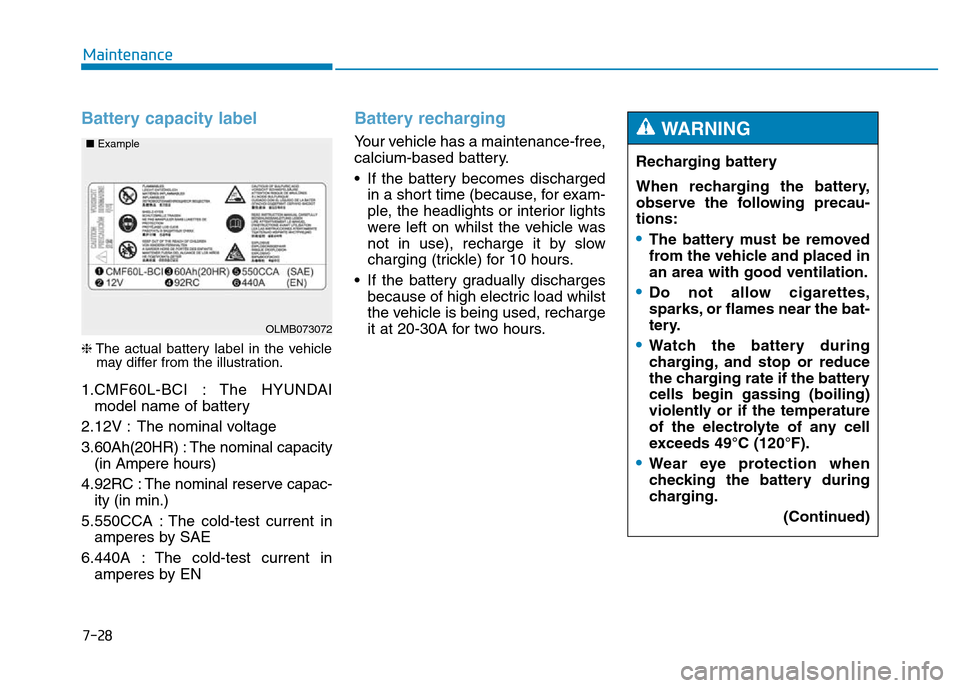
Battery capacity label
❈The actual battery label in the vehicle
may differ from the illustration.
1.CMF60L-BCI : The HYUNDAI
model name of battery
2.12V : The nominal voltage
3.60Ah(20HR) : The nominal capacity
(in Ampere hours)
4.92RC : The nominal reserve capac-
ity (in min.)
5.550CCA : The cold-test current in
amperes by SAE
6.440A : The cold-test current in
amperes by EN
Battery recharging
Your vehicle has a maintenance-free,
calcium-based battery.
• If the battery becomes discharged
in a short time (because, for exam-
ple, the headlights or interior lights
were left on whilst the vehicle was
not in use), recharge it by slow
charging (trickle) for 10 hours.
• If the battery gradually discharges
because of high electric load whilst
the vehicle is being used, recharge
it at 20-30A for two hours.
OLMB073072 ■Example
Recharging battery
When recharging the battery,
observe the following precau-
tions:
•The battery must be removed
from the vehicle and placed in
an area with good ventilation.
•Do not allow cigarettes,
sparks, or flames near the bat-
tery.
•Watch the battery during
charging, and stop or reduce
the charging rate if the battery
cells begin gassing (boiling)
violently or if the temperature
of the electrolyte of any cell
exceeds 49°C (120°F).
•Wear eye protection when
checking the battery during
charging.
(Continued)
WARNING
Page 435 of 502
7-29
7
Maintenance
Reset items
Items should be reset after the bat-
tery has been discharged or the bat-
tery has been disconnected.
• Auto up/down window
(See chapter 3)
• Sunroof (See chapter 3)
• Trip computer (See chapter 3)
• Climate control system
(See chapter 3) (Continued)•Disconnect the battery charg-
er in the following order.
1. Turn off the battery charger
main switch.
2. Unhook the negative clamp
from the negative battery
terminal.
3. Unhook the positive clamp
from the positive battery
terminal.
•Before performing mainte-
nance or recharging the bat-
tery, turn off all accessories
and stop the engine.
•The negative battery cable
must be removed first and
installed last when the battery
is disconnected.