2016 FORD TRANSIT jump cable
[x] Cancel search: jump cablePage 122 of 411

5. Replace the fuel tank filler cap and
close the fuel tank filler door.
6. Clean the plastic funnel and place it back in your vehicle or properly dispose
of it.
Note: Extra funnels can be purchased from
an authorized dealer if you choose to
dispose of the funnel.
CATALYTIC CONVERTER WARNING
Do not park or idle your vehicle over
dry leaves, dry grass or other
combustible materials. The exhaust
will radiate a considerable amount of heat
during use, and after you have switched
the engine off. This is a potential fire
hazard. Driving with a Catalytic Converter
WARNINGS
Avoid running out of fuel.
Do not crank the engine for long
periods.
Do not run the engine when a spark
plug lead is disconnected.
Do not push-start or tow-start your
vehicle. Use booster cables. See
Jump Starting the Vehicle (page
182). Do not switch the ignition off when
driving. SELECTIVE CATALYTIC
REDUCTION SYSTEM
WARNINGS
You must refill the diesel exhaust
fluid tank when it is low. If it is not
refilled, vehicle speed will be limited
to
50 mph (80 km/h). Drive with caution
and refill the fluid tank as soon as possible. If the diesel exhaust fluid becomes
contaminated your vehicle will be
limited to idle speed operation.
Replace the fluid immediately. Tampering with or disabling the
selective catalytic reduction system
will result in severe vehicle
performance limitation. Vehicle speed will
be limited to
5 mph (8 km/h). Your vehicle has a selective catalytic
reduction system to help reduce exhaust
emission levels by injecting diesel exhaust
fluid into the exhaust system.
Diesel Exhaust Fluid Level
For the system to operate correctly, you
must maintain the diesel exhaust fluid
level.
A warning lamp will illuminate
when the diesel exhaust fluid
level is low and needs to be
refilled. See
Warning Lamps and
Indicators (page 78).
The warning lamp will illuminate
approximately
500 mi (800 km) before
the diesel exhaust fluid tank is empty. Refill
the tank as soon as possible.
Note: If the warning lamp illuminates when
your vehicle is moving, and the diesel
exhaust fluid is at a sufficient level, this
indicates a system malfunction. Have your
vehicle checked by an authorized dealer as
soon as possible.
119
Transit (TTH) Canada/United States of America, enUSA, First Printing Fuel and RefuelingE163176
Page 186 of 411

WARNINGS
Use only an adequate-sized cable
with insulated clamps.
Preparing Your Vehicle
Note:
Do not attempt to push-start your
automatic transmission vehicle. Automatic
transmissions do not have push-start
capability. Attempting to push-start a
vehicle with an automatic transmission may
cause transmission damage.
Note: Use only a 12-volt supply to start your
vehicle.
Note: Do not disconnect the battery of the
disabled vehicle as this could damage the
vehicle's electrical system.
Park the booster vehicle close to the hood
of the disabled vehicle, making sure the
two vehicles do not touch, and switch off
all accessories.
Your vehicle has a positive (+) access
terminal and a negative (-) grounding
connection point that you can access
under the hood, even though the actual
battery is under the driver seat. You can
jump your vehicle using these points.
The positive (+) access terminal is next to
the fuse box, under a red cap. To access
the positive (+) terminal, lift the red cap
up. The negative (-) terminal is a post, located
on the driver side, near the hood hinge. It
is a grounding connection point, so you will
need to remove the rubber covering first.
Connecting the Jumper Cables
WARNING
Do not attach the cables to fuel lines,
engine rocker covers, the intake
manifold or electrical components
as grounding points. Stay clear of moving
parts. To avoid reverse polarity
connections, make sure that you correctly
identify the positive (+) and negative (-)
terminals on both the disabled and booster
vehicles before connecting the cables. 183
Transit (TTH) Canada/United States of America, enUSA, First Printing Roadside EmergenciesE145290 E183998
Page 187 of 411
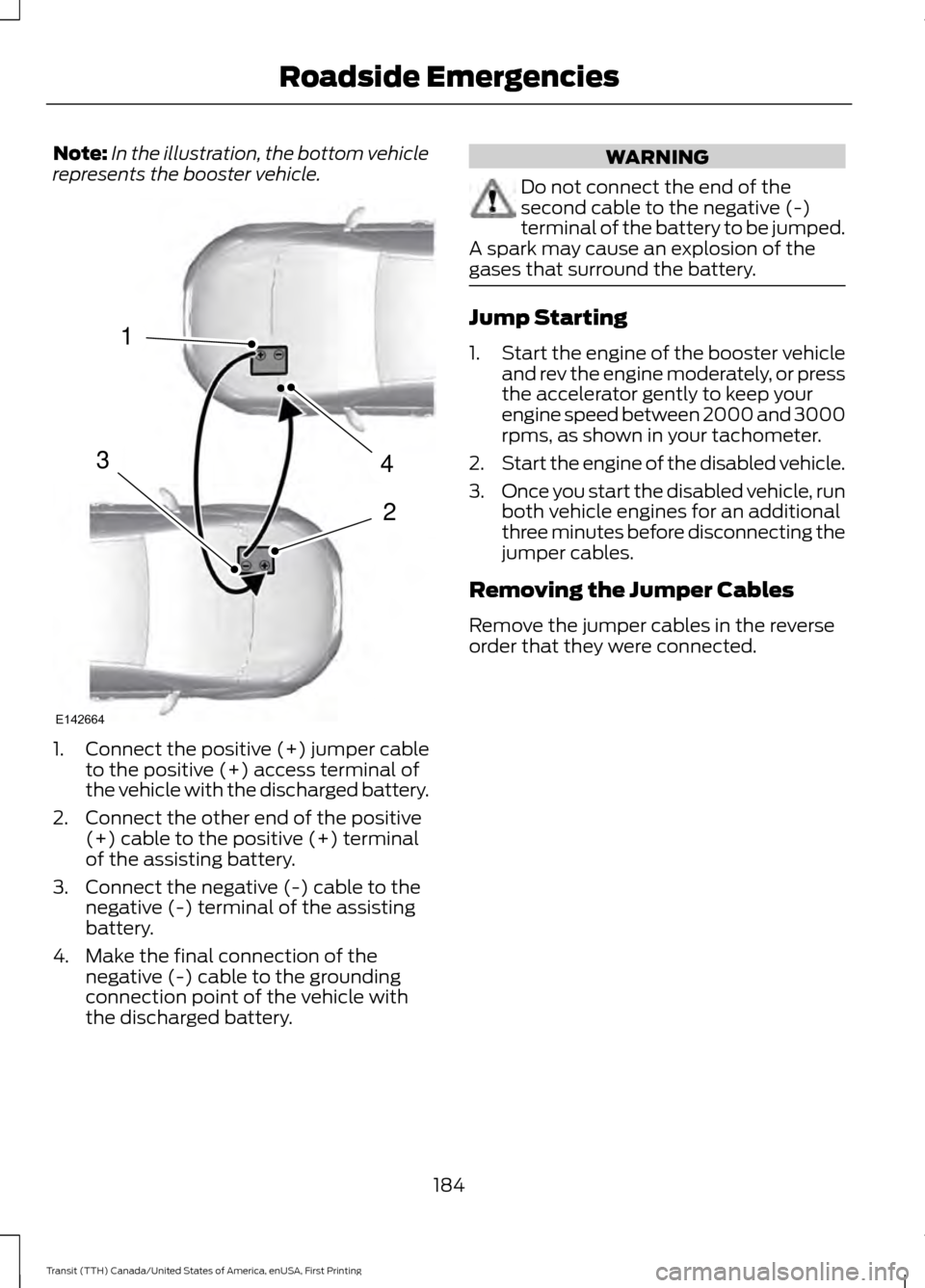
Note:
In the illustration, the bottom vehicle
represents the booster vehicle. 1.
Connect the positive (+) jumper cable
to the positive (+) access terminal of
the vehicle with the discharged battery.
2. Connect the other end of the positive (+) cable to the positive (+) terminal
of the assisting battery.
3. Connect the negative (-) cable to the negative (-) terminal of the assisting
battery.
4. Make the final connection of the negative (-) cable to the grounding
connection point of the vehicle with
the discharged battery. WARNING
Do not connect the end of the
second cable to the negative (-)
terminal of the battery to be jumped.
A spark may cause an explosion of the
gases that surround the battery. Jump Starting
1.
Start the engine of the booster vehicle
and rev the engine moderately, or press
the accelerator gently to keep your
engine speed between 2000 and 3000
rpms, as shown in your tachometer.
2. Start the engine of the disabled vehicle.
3. Once you start the disabled vehicle, run
both vehicle engines for an additional
three minutes before disconnecting the
jumper cables.
Removing the Jumper Cables
Remove the jumper cables in the reverse
order that they were connected.
184
Transit (TTH) Canada/United States of America, enUSA, First Printing Roadside Emergencies4
2
1
3
E142664
Page 188 of 411

1. Remove the jumper cable from the
grounding connection point of the
vehicle with the discharged battery.
2. Remove the jumper cable on the negative (-) terminal of the booster
vehicle's battery.
3. Remove the jumper cable from the positive (+) terminal of the booster
vehicle's battery.
4. Remove the jumper cable from the positive (+) access terminal of the
vehicle with the discharged battery.
After you start the disabled vehicle and
remove the jumper cables, allow your
vehicle to idle for several minutes so the
battery can recharge. POST-CRASH ALERT SYSTEM
The system flashes the direction indicators
and sounds the horn (intermittently) in the
event of a serious impact that deploys an
airbag (front, side, side curtain or Safety
Canopy) or the safety belt pretensioners.
The horn and indicators will turn off when:
•
You press the hazard control button.
• You press the panic button on the
remote entry transmitter (if equipped).
• Your vehicle runs out of power.
185
Transit (TTH) Canada/United States of America, enUSA, First Printing Roadside Emergencies4
1
3
2
E142665
Page 224 of 411

CHANGING THE 12V BATTERY
Removing the Battery
WARNINGS
You must replace your vehicle
battery with one of exactly the same
specification.
Make sure the battery box is correctly
sealed.
Your vehicle battery is heavy; take
care when lifting and removing.
Note:
If you have power seats and the
battery has no charge, jump-start your
vehicle to move the seat. See Jump
Starting the Vehicle (page 182).
Note: Where applicable you must
reprogram the audio system using the
keycode.
The battery is located inside your vehicle
under the driver seat. 1.
Fully raise the driver seat and slide the
seat fully forward. Remove the cover
trim by pulling up the tabs with your
fingers. 2.
Unhook the cover flap and tuck it under
the seat valance. 3. Remove the seat track end caps on
both sides.
4. Remove the seat adjustment end stop
bolts at the front of the seat on both
sides.
221
Transit (TTH) Canada/United States of America, enUSA, First Printing MaintenanceE152526
1 2
E152529 E146781
3
4
Page 406 of 411

Hints on Controlling the Interior
Climate...........................................................94
Cooling the Interior Quickly.............................. 94
General Hints......................................................... 94
Heating the Interior Quickly............................. 94
Maximum Cooling Performance in Instrument Panel or Instrument Panel
and Footwell Positions................................. 95
Recommended Settings for Cooling ...........94
Recommended Settings for Heating............94
Side Window Defogging in Cold Weather.............................................................. 95
Vehicle Stationary for Extended Periods During Extreme High Ambient
Temperatures................................................... 94
Hints on Driving With Anti-Lock Brakes............................................................140
Hood Lock See: Opening and Closing the Hood..........207
I
Ignition Switch..............................................108
In California (U.S. Only)..............................187
Information Display Control.......................65
Information Displays
.....................................82
General Information............................................ 82
Information Messages
..................................87
Installing Child Restraints............................16
Child Seats............................................................... 16
Using Lap and Shoulder Belts.......................... 17
Using Lower Anchors and Tethers for Children (LATCH)............................................. 19
Using Tether Straps.............................................. 21
Instrument Cluster
.........................................76
Instrument Lighting Dimmer.......................71
Interior Lamps
..................................................72
Courtesy Lamp...................................................... 72
Reading Lamps...................................................... 72
Interior Mirror
....................................................74
Auto-Dimming Mirror.......................................... 75
Introduction.........................................................7 J
Jump Starting the Vehicle
.........................182
Connecting the Jumper Cables..................... 183
Jump Starting...................................................... 184
Preparing Your Vehicle..................................... 183
Removing the Jumper Cables........................ 184
K
Keys and Remote Controls.........................47 Principle of Operation......................................... 47
L
Lane Keeping System.................................154 Lane Keeping Alert............................................. 154
Lighting Control
..............................................69
Headlamp Flasher............................................... 70
High Beams............................................................ 69
Lighting Control Positions................................ 69
Parking Lamps....................................................... 70
Lighting..............................................................69 General Information........................................... 69
Load Carrying
.................................................158
Load Limit.......................................................158
Special Loading Instructions for Owners of
Pick-up Trucks and Utility-type
Vehicles............................................................. 165
Vehicle Loading - with and without a Trailer................................................................. 158
Load Retaining Fixtures.............................158 Securing Cargo.................................................... 158
403
Transit (TTH) Canada/United States of America, enUSA, First Printing Index