2016 FORD SUPER DUTY coolant temperature
[x] Cancel search: coolant temperaturePage 242 of 510
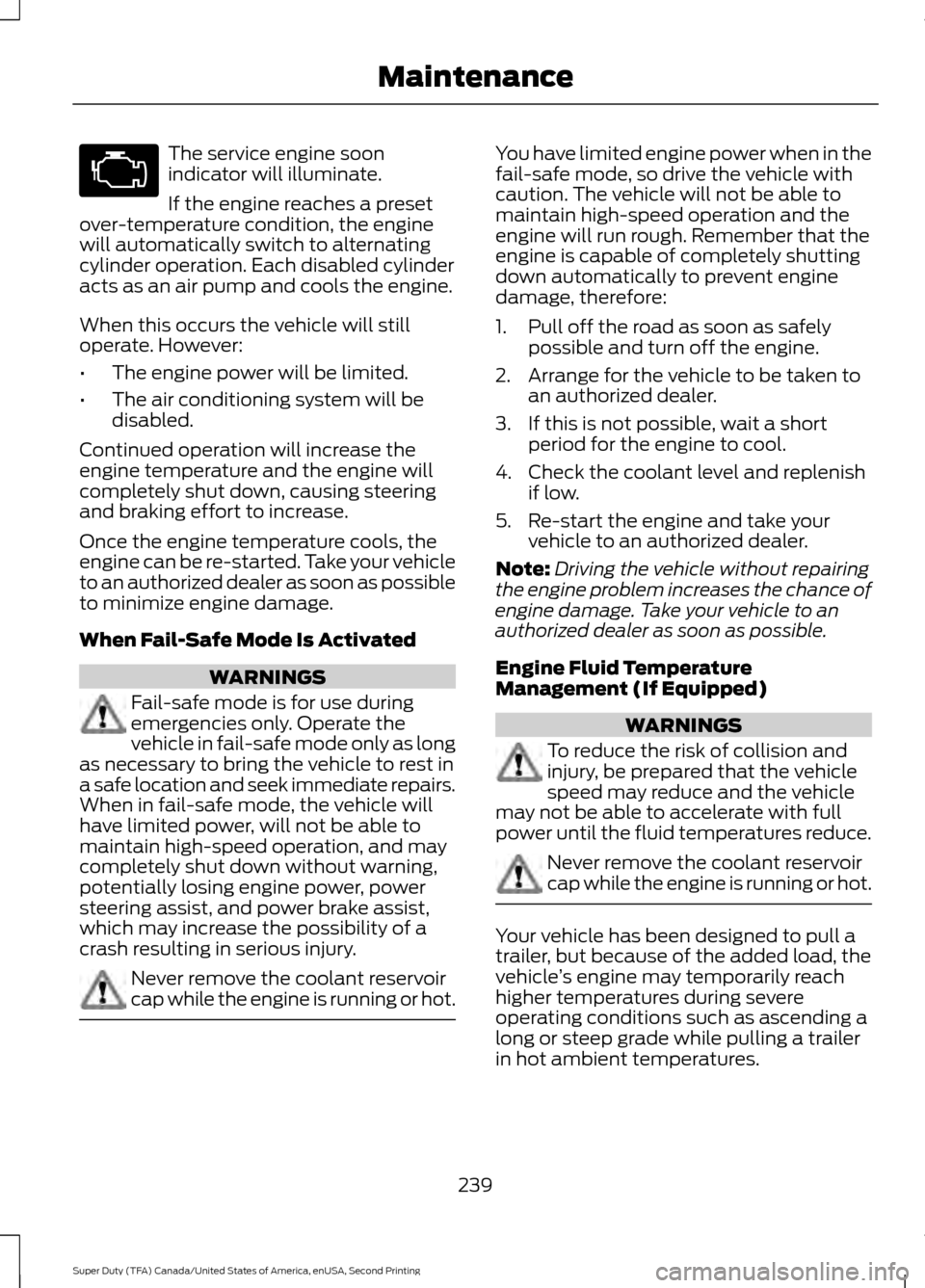
The service engine soon
indicator will illuminate.
If the engine reaches a preset
over-temperature condition, the engine
will automatically switch to alternating
cylinder operation. Each disabled cylinder
acts as an air pump and cools the engine.
When this occurs the vehicle will still
operate. However:
• The engine power will be limited.
• The air conditioning system will be
disabled.
Continued operation will increase the
engine temperature and the engine will
completely shut down, causing steering
and braking effort to increase.
Once the engine temperature cools, the
engine can be re-started. Take your vehicle
to an authorized dealer as soon as possible
to minimize engine damage.
When Fail-Safe Mode Is Activated WARNINGS
Fail-safe mode is for use during
emergencies only. Operate the
vehicle in fail-safe mode only as long
as necessary to bring the vehicle to rest in
a safe location and seek immediate repairs.
When in fail-safe mode, the vehicle will
have limited power, will not be able to
maintain high-speed operation, and may
completely shut down without warning,
potentially losing engine power, power
steering assist, and power brake assist,
which may increase the possibility of a
crash resulting in serious injury. Never remove the coolant reservoir
cap while the engine is running or hot. You have limited engine power when in the
fail-safe mode, so drive the vehicle with
caution. The vehicle will not be able to
maintain high-speed operation and the
engine will run rough. Remember that the
engine is capable of completely shutting
down automatically to prevent engine
damage, therefore:
1. Pull off the road as soon as safely
possible and turn off the engine.
2. Arrange for the vehicle to be taken to an authorized dealer.
3. If this is not possible, wait a short period for the engine to cool.
4. Check the coolant level and replenish if low.
5. Re-start the engine and take your vehicle to an authorized dealer.
Note: Driving the vehicle without repairing
the engine problem increases the chance of
engine damage. Take your vehicle to an
authorized dealer as soon as possible.
Engine Fluid Temperature
Management (If Equipped) WARNINGS
To reduce the risk of collision and
injury, be prepared that the vehicle
speed may reduce and the vehicle
may not be able to accelerate with full
power until the fluid temperatures reduce. Never remove the coolant reservoir
cap while the engine is running or hot.
Your vehicle has been designed to pull a
trailer, but because of the added load, the
vehicle
’s engine may temporarily reach
higher temperatures during severe
operating conditions such as ascending a
long or steep grade while pulling a trailer
in hot ambient temperatures.
239
Super Duty (TFA) Canada/United States of America, enUSA, Second Printing Maintenance
Page 243 of 510
At this time, you may notice your engine
coolant temperature gauge needle move
toward the H and the POWER REDUCED
TO LOWER TEMP message may appear
in the information display.
You may notice a reduction in the vehicle
’s
speed caused by reduced engine power.
In order to manage the engine fluid
temperatures, your vehicle may enter this
mode if certain high-temperature and
high-load conditions take place. The
amount of speed reduction will depend on
the vehicle loading, towing, grade, ambient
temperature, and other factors. If this
occurs, there is no need to pull off the road.
The vehicle can continue to be driven while
this message is active.
The air conditioning may turn on and off
during severe operating conditions to
protect the engine from overheating. When
the engine coolant temperature decreases
to a more normal operating temperature,
the air conditioning will turn on once again.
If the engine coolant temperature gauge
moves fully into the red (hot) area, or if the
coolant temperature warning or service
engine soon messages appear in your
information display:
1. Stop your vehicle as soon as safely possible and shift the transmission into
park (P).
2. Leave the engine running until the coolant temperature gauge needle
moves away from the H range. After
several minutes, if this does not
happen, follow the remaining steps.
3. Switch the engine off and wait for it to
cool before checking the coolant level.
4. If the coolant level is normal, you may restart your engine and continue on. 5. If the coolant is low, add coolant,
restart the engine and take your vehicle
to an authorized dealer. See Adding
engine coolant in this chapter for more
information. Refer to fail-safe cooling
for additional information.
AUTOMATIC TRANSMISSION
FLUID CHECK
Have an authorized dealer check and
change the transmission fluid and filter at
the correct service interval. See
Scheduled Maintenance (page 456).
Do not use supplemental transmission
fluid additives, treatments or cleaning
agents. The use of these materials may
affect transmission operation and result
in damage to internal transmission
components.
Checking Automatic Transmission
Fluid
For scheduled intervals of the fluid checks
and changes, See
Scheduled
Maintenance (page 456). Your
transmission does not consume fluid.
However, the fluid level should be checked
if the transmission is not working properly,
i.e., if the transmission slips or shifts slowly
or if you notice some sign of fluid leakage.
Automatic transmission fluid expands
when warmed. To obtain an accurate fluid
check, drive the vehicle until it is at normal
operating temperature (approximately
19 mi (30 km)
). Verify that the
transmission fluid temperature gauge,
located on the instrument cluster, is within
normal range.
1. Drive the vehicle
19 mi (30 km)until it
reaches normal operating temperature.
2. Park the vehicle on a level surface and
engage the parking brake.
240
Super Duty (TFA) Canada/United States of America, enUSA, Second Printing Maintenance
Page 265 of 510
•
Clean the wheels weekly using
Motorcraft Wheel and Tire Cleaner.
Apply using manufacturer's
instructions.
• Use a sponge to remove heavy
deposits of dirt and brake dust
accumulation.
• Rinse thoroughly with a strong stream
of water when you have completed the
cleaning process.
• To remove tar and grease, use
Motorcraft Bug and Tar Remover.
VEHICLE STORAGE
If you plan on storing your vehicle for 30
days or more, read the following
maintenance recommendations to make
sure your vehicle stays in good operating
condition.
We engineer and test all motor vehicles
and their components for reliable, regular
driving. Under various conditions,
long-term storage may lead to degraded
engine performance or failure unless you
use specific precautions to preserve engine
components.
General
• Store all vehicles in a dry, ventilated
place.
• Protect from sunlight, if possible.
• If vehicles are stored outside, they
require regular maintenance to protect
against rust and damage.
Body
• Wash your vehicle thoroughly to
remove dirt, grease, oil, tar or mud from
exterior surfaces, rear-wheel housing
and the underside of front fenders.
• Periodically wash your vehicle if it is
stored in exposed locations. •
Touch-up exposed or primed metal to
prevent rust.
• Cover chrome and stainless steel parts
with a thick coat of auto wax to prevent
discoloration. Re-wax as necessary
when you wash your vehicle.
• Lubricate all hood, door and luggage
compartment hinges and latches with
a light grade oil.
• Cover interior trim to prevent fading.
• Keep all rubber parts free from oil and
solvents.
Engine
• Change the engine oil and filter prior to
storage because used engine oil
contains contaminates which may
cause engine damage.
• Start the engine every 15 days for a
minimum of 15 minutes. Run at fast idle
with the climate controls set to defrost
until the engine reaches normal
operating temperature.
• With your foot on the brake, shift
through all the gears while the engine
is running.
• We recommend that you change the
engine oil before you use your vehicle
again.
Fuel system
• Fill the fuel tank with high-quality fuel
until the first automatic shutoff of the
fuel pump nozzle.
Cooling system
• Protect against freezing temperatures.
• When removing your vehicle from
storage, check coolant fluid level.
Confirm that there are no cooling
system leaks and that fluid is at the
recommended level.
262
Super Duty (TFA) Canada/United States of America, enUSA, Second Printing Vehicle Care
Page 503 of 510

F
Fastening the Seatbelts..............................29
Fastening the Cinch Tongue............................ 30
Safety Belt Extension Assembly...................... 31
Safety Belt Locking Modes............................... 30
Using Safety Belts During Pregnancy...........30
Using the Safety Belt with Cinch Tongue (Front Center and Rear Center Seats
Only).................................................................... 29
Floor Mats.......................................................207
Fog Lamps - Front See: Front Fog Lamps......................................... 72
Foot Pedals See: Adjusting the Pedals................................. 68
Ford Credit
..........................................................11
(U.S. Only)................................................................. 11
Four-Wheel Drive
.........................................156
Front Fog Lamps.............................................72
Front Seat Armrest.......................................125
Fuel and Refueling.......................................142
Fuel Consumption
........................................145
Calculating Fuel Economy.............................. 146
Filling the Tank..................................................... 145
Fuel Filter........................................................244
Fuel Quality.....................................................143 Choosing the Right Fuel................................... 143
Choosing the Right Fuel With a Flex Fuel Vehicle (If Equipped)................................... 143
Diesel Engine........................................................ 143
Octane Recommendations............................ 143
Fuel Shutoff
....................................................212
Fuses.................................................................223
Fuse Specification Chart...........................223 Passenger Compartment Fuse
Panel
.................................................................. 228
Power Distribution Box.................................... 223
G
Garage Door Opener See: Universal Garage Door Opener............127 Gauges................................................................81
Engine Coolant Temperature Gauge............82
Engine Oil Pressure Gauge............................... 82
Fuel Gauge.............................................................. 82
Information Display............................................. 83
Transmission Fluid Temperature Gauge................................................................... 82
General Information on Radio Frequencies...................................................46
General Maintenance Information.......456 Multi-point Inspection..................................... 458
Owner Checks and Services.......................... 457
Protecting Your Investment.......................... 456
Why Maintain Your Vehicle?......................... 456
Why Maintain Your Vehicle at Your Dealership?..................................................... 456
Getting Assistance Outside the U.S. and Canada..........................................................219
Getting the Services You Need................216 Away From Home............................................... 216
Global Opening
...............................................76
Opening the Windows........................................ 76
H
Handbrake See: Parking Brake............................................. 168
Hazard Warning Flashers
...........................212
HDC See: Using Hill Descent Control..................... 175
Headlamp Adjusting See: Adjusting the Headlamps..................... 247
Headlamp Removal See: Removing a Headlamp.......................... 249
Head Restraints
..............................................115
Adjusting the Head Restraint.......................... 116
Heated Seats
..................................................122
Rear Heated Seats ............................................. 122
Heated Steering Wheel................................67
Heated Windows and Mirrors...................114 Heated Exterior Mirror........................................ 114
Heated Rear Window......................................... 114
Heating See: Climate Control......................................... 109
Hill Start Assist.............................................168 Switching the System On and Off...............169
Using Hill Start Assist....................................... 168
500
Super Duty (TFA) Canada/United States of America, enUSA, Second Printing Index
Page 509 of 510
Using Stability Control................................172
AdvanceTrac® with Roll Stability Control ™
(RSC®)............................................................... 172
Using SYNC™ With Your Media Player.............................................................357
Accessing Your Play Menu............................. 362
Connecting Your Digital Media Player to the USB Port........................................................... 357
Media Menu Features...................................... 360
Media Voice Commands................................ 359
System Settings................................................. 364
What's Playing?................................................. 358
Using SYNC™ With Your Phone............334 Accessing Features Through the Phone
Menu.................................................................. 338
Accessing Your Phone Settings.................... 343
Making a Call....................................................... 337
Pairing a Cell Phone for the First Time................................................................... 334
Pairing Subsequent Cell Phones.................335
Phone Options during an Active Call..........337
Phone Voice Commands................................ 335
Receiving Calls.................................................... 337
System Settings................................................. 344
Text Messaging.................................................... 341
Using Traction Control................................170 System Indicator Lights and
Messages............................................................ 171
Using Voice Recognition............................331 Initiating a Voice Session................................. 331
System Interaction and Feedback..............332
Utilizing the Mediation/Arbitration Program (Canada Only).........................219
V
Vehicle Care...................................................256 General Information......................................... 256
Vehicle Certification Label
......................306
Vehicle Identification Number...............305 Vehicle Storage
.............................................262
Battery................................................................... 263
Body........................................................................\
262
Brakes.................................................................... 263
Cooling system................................................... 262
Engine.................................................................... 262
Fuel system.......................................................... 262
General.................................................................. 262
Miscellaneous..................................................... 263
Removing Vehicle From Storage.................263
Tires........................................................................\
263
Ventilation See: Climate Control......................................... 109
VIN See: Vehicle Identification Number............305
Voice Control...................................................66
W
Warning Lamps and Indicators.................83 4X2........................................................................\
.... 86
4X4 HIGH................................................................ 86
4X4 LOW................................................................. 86
Anti-Lock Braking System................................ 83
Battery...................................................................... 83
Brake System......................................................... 83
Check Fuel Cap..................................................... 84
Cruise Control........................................................ 84
Diesel Warning Lights........................................ 86
Direction Indicator............................................... 84
Door Ajar................................................................. 84
Electronic Locking Differential........................ 84
Engine Coolant Temperature.......................... 84
Engine Oil................................................................ 84
Fasten Safety Belt............................................... 84
Front Airbag........................................................... 84
High Beam.............................................................. 84
Hill Descent............................................................ 84
Low Fuel Level....................................................... 85
Low Tire Pressure Warning............................... 85
Powertrain Malfunction/Reduced Power/Electronic Throttle Control...........85
Service Engine Soon........................................... 85
Stability Control................................................... 85
Stability Control Off............................................ 86
Transmission Tow/Haul.................................... 86
Washer Fluid Check....................................244
506
Super Duty (TFA) Canada/United States of America, enUSA, Second Printing Index