2016 FORD EXPEDITION EL coolant temperature
[x] Cancel search: coolant temperaturePage 251 of 421
3. Refill with engine coolant as soon aspossible.
Water alone, without engine coolant, cancause engine damage from corrosion,overheating or freezing.
Do not use the following as a coolantsubstitute:
•Alcohol.
•Methanol.
•Brine.
•Any engine coolant mixed with alcoholor methanol antifreeze or coolant.
Alcohol and other liquids can cause enginedamage from overheating or freezing.
Do not add extra inhibitors or additives tothe coolant. These can be harmful andcompromise the corrosion protection ofthe engine coolant.
When adding coolant:
1. Unscrew the cap slowly. Any pressurewill escape as you unscrew the cap.
2.Add prediluted engine coolant meetingthe correct specification. SeeCapacities and Specifications (page303).
3. Check the coolant level in the coolantreservoir the next few times you driveyour vehicle.
4. If necessary, add enough predilutedengine coolant to bring the coolantlevel to the proper level.
Recycled Engine Coolant
We do not recommend the use of recycledengine coolant as an approved recyclingprocess is not yet available.
Used engine coolant should be disposedof in an appropriate manner. Follow yourcommunity’s regulations and standardsfor recycling and disposing of automotivefluids.
Severe Climates
If you drive in extremely cold climates:
•It may be necessary to have anauthorized dealer increase the coolantconcentration above 50%.
•A coolant concentration of 60%provides improved freeze pointprotection. Engine coolantconcentrations above 60% decreasethe overheat protection characteristicsof the engine coolant and may causeengine damage.
If you drive in extremely hot climates:
•It may be necessary to have anauthorized dealer decrease the coolantconcentration to 40%.
•A coolant concentration of 40%provides improved overheat protection.Engine coolant concentrations below40% decrease the freeze and corrosionprotection characteristics of the enginecoolant and may cause enginedamage.
Vehicles driven year-round in non-extremeclimates should use prediluted enginecoolant for optimum cooling system andengine protection.
What You Should Know About Fail-Safe Cooling
If you deplete the engine coolant supply,fail-safe cooling allows you to temporarilydrive your vehicle before you incurincremental component damage. Thefail-safe distance depends on ambienttemperatures, vehicle load and terrain.
How Fail-Safe Cooling Works
If the engine begins to overheat, the enginecoolant temperature gauge will move tothe red (hot) area and:
the coolant temperature warninglight will illuminate
248
Expedition (TB7) Canada/United States of America, enUSA, First Printing
Maintenance
Page 252 of 421
the service engine soon indicatorwill illuminate.
If the engine reaches a presetover-temperature condition, the engineautomatically switches to alternatingcylinder operation. Each disabled cylinderacts as an air pump and cools the engine.
When this occurs, your vehicle will stilloperate. However:
•The engine power will be limited.
•This will disable the air conditioningsystem.
Continued operation increases the enginetemperature, causing the engine tocompletely shut down. Your steering andbraking effort increases in this situation.
When the engine temperature cools, youcan re-start your engine. Take your vehicleto an authorized dealer as soon as possibleto minimize engine damage.
When Fail-Safe Mode Is Activated
WARNINGS
Fail-safe mode is for use duringemergencies only. Operate yourvehicle in fail-safe mode only as longas necessary to bring your vehicle to restin a safe location and seek immediaterepairs. When in fail-safe mode, yourvehicle will have limited power, will not beable to maintain high-speed operation, andmay completely shut down withoutwarning, potentially losing engine power,power steering assist, and power brakeassist, which may increase the possibilityof a crash resulting in serious injury.
Never remove the coolant reservoircap while the engine is running or hot.
You have limited engine power when in thefail-safe mode, so drive your vehicle withcaution. Your vehicle will not maintainhigh-speed operation and the engine willoperate poorly.
Remember that the engine is capable ofautomatically shutting down to preventengine damage. In this situation:
1. Pull off the road as soon as safelypossible and switch off the engine.
2. Tow your vehicle to an authorizeddealer.
3. If this is not possible, wait a shortperiod for the engine to cool.
4.Check the coolant level and add if low.
5. Re-start the engine and drive yourvehicle to an authorized dealer.
Note:Driving your vehicle without repairincreases the chance of engine damage.Contact an authorized dealer as soon aspossible.
Engine Fluid TemperatureManagement (If Equipped)
WARNINGS
To reduce the risk of crash and injury,be prepared that the vehicle speedmay reduce and the vehicle may notbe able to accelerate with full power untilthe fluid temperatures reduce.
Never remove the coolant reservoircap while the engine is running or hot.
Your vehicle can pull a trailer, but becauseof the added load, your vehicle’s enginemay temporarily reach highertemperatures during severe operatingconditions such as ascending a long orsteep grade while pulling a trailer in hightemperatures.
249
Expedition (TB7) Canada/United States of America, enUSA, First Printing
Maintenance
Page 253 of 421
At this time, you may notice your enginecoolant temperature gauge needle movetoward the H and the POWER REDUCEDTO LOWER TEMP message may appearin the information display.
You may notice a reduction in vehiclespeed caused by reduced engine power.In order to manage the engine fluidtemperatures, your vehicle may enter thismode if certain high-temperature andhigh-load conditions take place. Theamount of speed reduction depends onmany factors such as vehicle loading,towing, grade and ambient temperature.If this occurs, there is no need to pull offthe road. You can continue to drive yourvehicle while this message is active.
The air conditioning may also cycle on andoff during severe operating conditions toprotect overheating of the engine. Whenthe engine coolant temperature decreasesto a normal operating temperature, the airconditioning will turn on once again.
If the engine coolant temperature gaugemoves fully into the red (hot) area, or if thecoolant temperature warning or serviceengine soon messages appear in yourinformation display:
1. Pull off the road as soon as safelypossible and shift the transmission intoP.
2. Leave the engine running until thecoolant temperature gauge needlemoves away from the red (hot) area.After several minutes, if thetemperature does not drop, follow theremaining steps.
3.Switch the engine off and wait for it tocool before checking the coolant level.
4. If the coolant level is normal, restartyour engine and continue.
5. If the coolant is low, add coolant, andrestart the engine. See Adding EngineCoolant or How Fail-Safe CoolingWorks in this chapter for moreinformation.
AUTOMATIC TRANSMISSION
FLUID CHECK
If required, have an authorized dealer checkand change the transmission fluid at thecorrect service interval. See ScheduledMaintenance (page 372).
The automatic transmission does not havea transmission fluid dipstick.
Refer to your scheduled maintenanceinformation for scheduled intervals for fluidchecks and changes. Your transmissiondoes not consume fluid. However, if thetransmission slips, shifts slowly or if younotice a sign of leaking fluid, contact anauthorized dealer.
Do not use supplemental transmissionfluid additives, treatments or cleaningagents. The use of these materials mayaffect transmission operation and resultin damage to internal transmissioncomponents.
250
Expedition (TB7) Canada/United States of America, enUSA, First Printing
Maintenance
Page 273 of 421
•Touch-up exposed or primed metal toprevent rust.
•Cover chrome and stainless steel partswith a thick coat of auto wax to preventdiscoloration. Re-wax as necessarywhen you wash your vehicle.
•Lubricate all hood, door and luggagecompartment hinges and latches witha light grade oil.
•Cover interior trim to prevent fading.
•Keep all rubber parts free from oil andsolvents.
Engine
•Change the engine oil and filter prior tostorage because used engine oilcontains contaminates which maycause engine damage.
•Start the engine every 15 days for aminimum of 15 minutes. Run at fast idlewith the climate controls set to defrostuntil the engine reaches normaloperating temperature.
•With your foot on the brake, shiftthrough all the gears while the engineis running.
•We recommend that you change theengine oil before you use your vehicleagain.
Fuel system
•Fill the fuel tank with high-quality fueluntil the first automatic shutoff of thefuel pump nozzle.
Cooling system
•Protect against freezing temperatures.
•When removing your vehicle fromstorage, check coolant fluid level.Confirm that there are no coolingsystem leaks and that fluid is at therecommended level.
Battery
•Check and recharge as necessary. Keepconnections clean.
•If storing your vehicle for more than 30days without recharging the battery,we recommend that you disconnectthe battery cables to maintain batterycharge for quick starting.
Note:It is necessary to reset memoryfeatures if battery cables are disconnected.
Brakes
•Make sure the brakes and parking brakerelease fully.
Tires
•Maintain recommended air pressure.
Miscellaneous
•Make sure all linkages, cables, leversand pins under your vehicle are coveredwith grease to prevent rust.
•Move vehicles at least 25 ft (7.5 m)every 15 days to lubricate working partsand prevent corrosion.
Removing Vehicle From Storage
When your vehicle is ready to come out ofstorage, do the following:
•Wash your vehicle to remove any dirtor grease film build-up on windowsurfaces.
•Check windshield wipers for anydeterioration.
•Check under the hood for any foreignmaterial that may have collectedduring storage such as mice or squirrelnests.
•Check the exhaust for any foreignmaterial that may have collectedduring storage.
270
Expedition (TB7) Canada/United States of America, enUSA, First Printing
Vehicle Care
Page 419 of 421
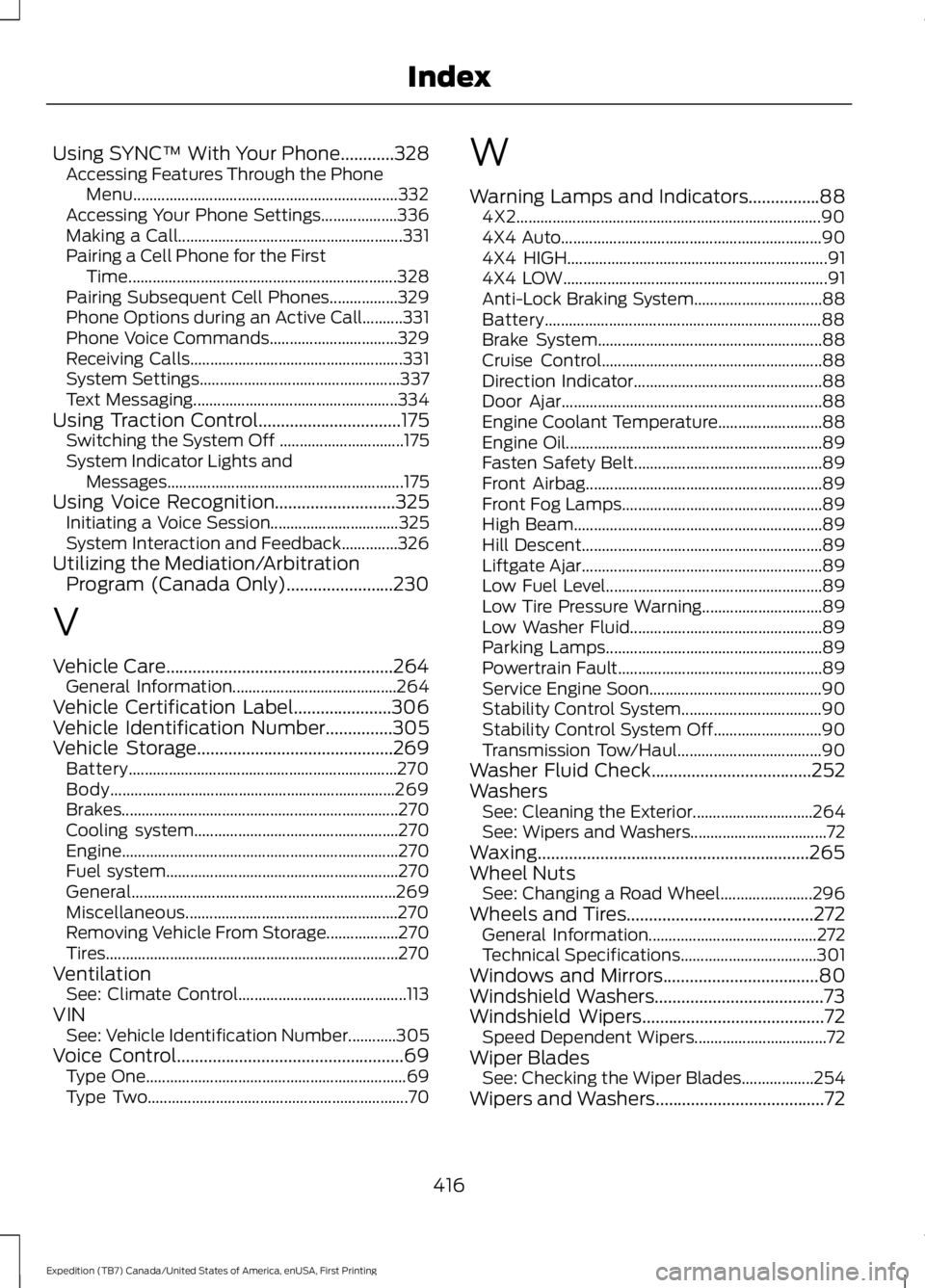
Using SYNC™ With Your Phone............328Accessing Features Through the PhoneMenu..................................................................332Accessing Your Phone Settings...................336Making a Call........................................................331Pairing a Cell Phone for the FirstTime...................................................................328Pairing Subsequent Cell Phones.................329Phone Options during an Active Call..........331Phone Voice Commands................................329Receiving Calls.....................................................331System Settings..................................................337Text Messaging...................................................334Using Traction Control................................175Switching the System Off ...............................175System Indicator Lights andMessages...........................................................175Using Voice Recognition...........................325Initiating a Voice Session................................325System Interaction and Feedback..............326Utilizing the Mediation/ArbitrationProgram (Canada Only)........................230
V
Vehicle Care...................................................264General Information.........................................264Vehicle Certification Label......................306Vehicle Identification Number...............305Vehicle Storage............................................269Battery...................................................................270Body.......................................................................269Brakes.....................................................................270Cooling system...................................................270Engine.....................................................................270Fuel system..........................................................270General..................................................................269Miscellaneous.....................................................270Removing Vehicle From Storage..................270Tires.........................................................................270VentilationSee: Climate Control..........................................113VINSee: Vehicle Identification Number............305Voice Control...................................................69Type One.................................................................69Type Two.................................................................70
W
Warning Lamps and Indicators................884X2............................................................................904X4 Auto.................................................................904X4 HIGH.................................................................914X4 LOW..................................................................91Anti-Lock Braking System................................88Battery.....................................................................88Brake System........................................................88Cruise Control.......................................................88Direction Indicator...............................................88Door Ajar.................................................................88Engine Coolant Temperature..........................88Engine Oil................................................................89Fasten Safety Belt...............................................89Front Airbag...........................................................89Front Fog Lamps..................................................89High Beam..............................................................89Hill Descent............................................................89Liftgate Ajar............................................................89Low Fuel Level......................................................89Low Tire Pressure Warning..............................89Low Washer Fluid................................................89Parking Lamps......................................................89Powertrain Fault...................................................89Service Engine Soon...........................................90Stability Control System...................................90Stability Control System Off...........................90Transmission Tow/Haul....................................90Washer Fluid Check....................................252WashersSee: Cleaning the Exterior..............................264See: Wipers and Washers..................................72Waxing.............................................................265Wheel NutsSee: Changing a Road Wheel.......................296Wheels and Tires..........................................272General Information..........................................272Technical Specifications..................................301Windows and Mirrors...................................80Windshield Washers......................................73Windshield Wipers.........................................72Speed Dependent Wipers.................................72Wiper BladesSee: Checking the Wiper Blades..................254Wipers and Washers......................................72
416
Expedition (TB7) Canada/United States of America, enUSA, First Printing
Index