2016 FORD C MAX ENERGI lights
[x] Cancel search: lightsPage 196 of 395
•Perform all regularly scheduledmaintenance. See ScheduledMaintenance (page 348).
•Use the coach and brake coach displayto get feedback on your economicaldrive style. For more information, SeeInformation Displays (page 93).
Avoid these actions because they reduceyour fuel economy:
•Avoid sudden or hard accelerations anddecelerations. Accelerate and slowdown in a smooth, moderate fashion.
•Avoid revving the engine beforeswitching off your vehicle.
•Avoid long idle periods.
•Do not warm up your vehicle on coldmornings.
•Do not rest your foot on the brakepedal while driving.
•Avoid carrying unnecessary weight.Approximately 1 mile per gallon (0.4kilometers per liter) is lost for every400 lb (180 kg) of weight carried.
•Avoid adding accessories that increaseaerodynamic drag to your vehicle suchas bug deflectors, car top carriers andski or bike racks.
•Avoid driving with the wheels out ofalignment.
Things to keep in mind when you refuelyour vehicle:
•Fuel generates fewer vapors when it iscool and dark outside. Refuel yourvehicle in the early morning or lateevening.
•Use the recommended octane-ratedfuel. Using fuel below therecommended rating will lower yourfuel economy.
DRIVING THROUGH WATER
WARNING
Do not drive through flowing or deepwater as you may lose control of yourvehicle.
Note:Driving through standing water cancause vehicle damage.
Note:Engine damage can occur if waterenters the air filter.
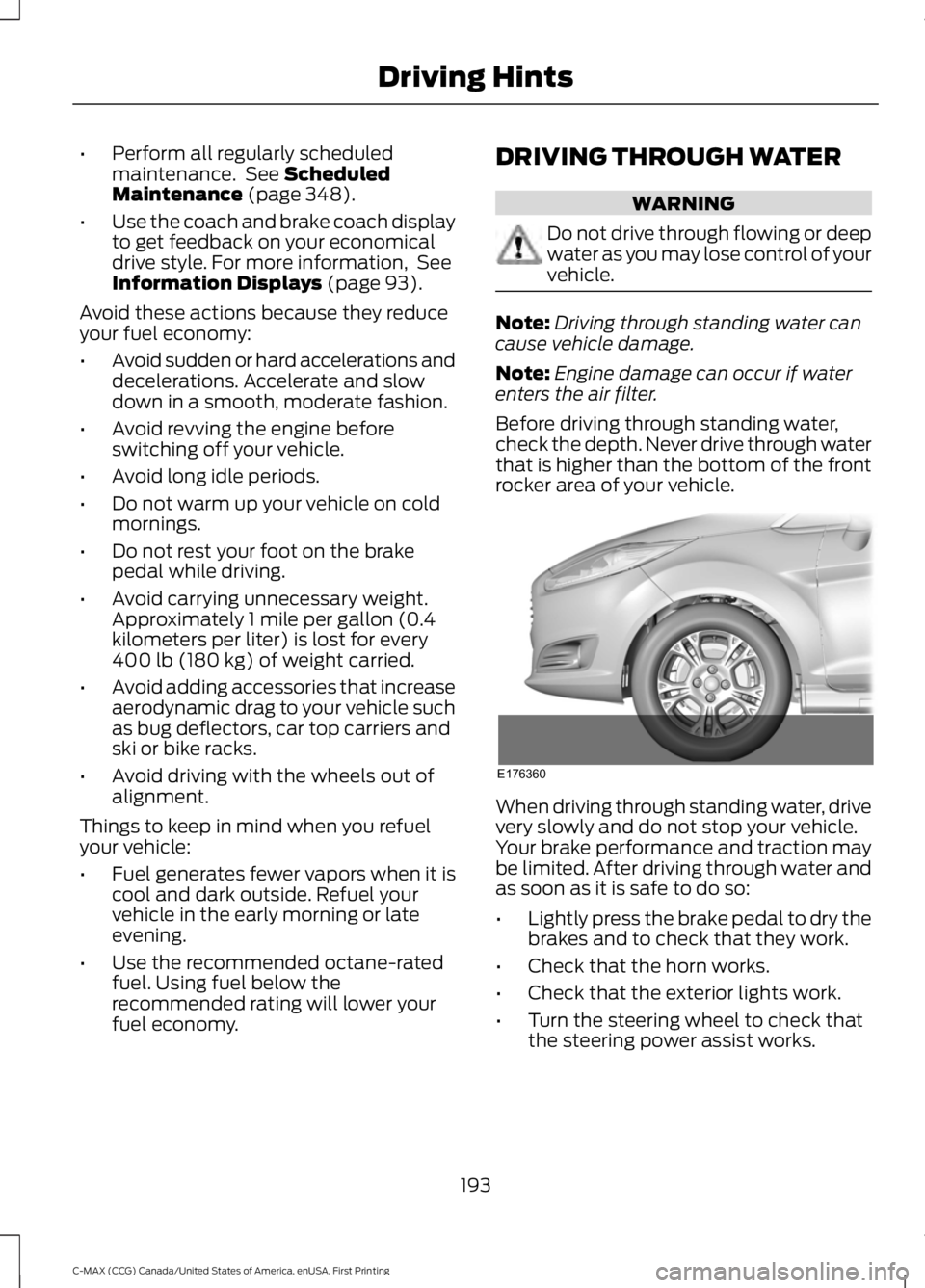
Before driving through standing water,check the depth. Never drive through waterthat is higher than the bottom of the frontrocker area of your vehicle.
When driving through standing water, drivevery slowly and do not stop your vehicle.Your brake performance and traction maybe limited. After driving through water andas soon as it is safe to do so:
•Lightly press the brake pedal to dry thebrakes and to check that they work.
•Check that the horn works.
•Check that the exterior lights work.
•Turn the steering wheel to check thatthe steering power assist works.
193
C-MAX (CCG) Canada/United States of America, enUSA, First Printing
Driving HintsE176360
Page 203 of 395

Crashes
A crash or impact significant enough torequire an emergency response forconventional vehicles would also requirethe same response for an electric orhybrid-electric vehicle.
If possible
•Move your car to a safe, nearbylocation and remain on the scene.
•Roll down the windows before shuttingyour vehicle off.
•Place your vehicle in Park, set theparking brake, turn off the vehicle,activate the hazard lights, and moveyour key(s) at least 16 feet (5 meters)away from the vehicle.
Always
•Call 911 if assistance is needed andadvise that an electric or hybrid-electricvehicle is involved.
•Do not touch exposed electricalcomponents or the enginecompartment, as a shock hazard mayexist.
•Avoid contact with leaking fluids andgases, and remain out of the way ofoncoming traffic until emergencyresponders arrive.
•When emergency responders arrive,tell them that the vehicle involved is anelectric vehicle or hybrid vehicle.
Fires
As with any vehicle, call 911 immediately ifyou see sparks, smoke or flames comingfrom the vehicle.
•Exit the vehicle immediately.
•Advise 911 that an electric orhybrid-electric vehicle is involved.
•As with any vehicle fire, do not inhalesmoke, vapors or gas from the vehicle,as they may be hazardous.
•Remain a safe distance from thevehicle and try to stay clear of thesmoke.
•Stay out of the roadway and stay outof the way of any oncoming trafficwhile awaiting the arrival of emergencyresponders.
Post-Incident
•Do not store a severely damagedvehicle with a lithium-ion battery insidea structure or within 50 feet (15meters) of any structure or vehicle.
•Make sure that passenger and cargocompartments remain ventilated (i.e.open window, door or trunk).
•For vehicles in the United States, notifyFord Motor Company 1-800-392-3673(then follow the prompts on the voiceresponse menu), an authorized Forddealer or service center as soon aspossible as there may be other stepsto secure and discharge thehigh-voltage battery.
•For vehicles in Canada, notify FordMotor Company 1-800-565-3673(then follow the prompts on the voiceresponse menu), an authorized Forddealer or service center as soon aspossible as there may be other stepsto secure and discharge thehigh-voltage battery.
•Call 911 if you observe leaking fluids,sparks, smoke or flames, or heargurgling or bubbling from thehigh-voltage battery.
200
C-MAX (CCG) Canada/United States of America, enUSA, First Printing
Roadside Emergencies
Page 240 of 395

5. Gently pull the lamp assembly awayfrom the vehicle.
6. Remove the bulb holder.
7. Remove the bulb.
BULB SPECIFICATION CHART
Replacement bulbs are specified in thechart below. Headlamp bulbs must bemarked with an authorized “D.O.T.” forNorth America to ensure lampperformance, light brightness and patternand safe visibility. The correct bulbs willnot damage the lamp assembly or void thelamp assembly warranty and will providequality bulb burn time.
Trade numberFunction
9005LLHeadlamps high beam (Halogen)
H11LLHeadlamp low beam (Halogen)
168Sidemarker - front
194Park lamp - front
W21WTurn lamp - front
H10 (9145)Fog lamps
3157KTail/brake lamp
T20Turn lamp - rear
921Backup lamp
W5WLicense plate lamp
W5W* High-mount brake lamp
LED* Interior lamps
* To replace these lamps - see your authorized dealer.
To replace all instrument panel lights - see your authorized dealer
237
C-MAX (CCG) Canada/United States of America, enUSA, First Printing
MaintenanceE162564
Page 253 of 395
General Information
WARNING
Failure to follow these guidelinescould result in an increased risk ofloss of vehicle control, injury or death.
Note:Do not use the kit if you have severelydamaged a tire. Only seal punctures locatedwithin the tire tread with the kit.
Do not attempt to repair punctures largerthan ¼ inch (6 millimeters) or damage tothe tire's sidewall. The tire may notcompletely seal.
Loss of air pressure may adversely affecttire performance. For this reason:
Note:Do not drive the vehicle above50 mph (80 km/h).
Note:Do not drive further than 120 mi(200 km). Drive only to the closestauthorized Ford dealer or tire repair shop tohave your tire inspected.
•Drive carefully and avoid abruptsteering maneuvers.
•Periodically monitor tire inflationpressure in the affected tire; if the tireis losing pressure, have the vehicletowed.
•Read the information in the Tips forUse of the Kit section to make sure safeoperation of the kit and your vehicle.
Tips for Use of the Kit
To ensure safe operation of the kit:
•Read all instructions and cautions fully.
•Before operating the kit, make sureyour vehicle is safely off the road andaway from moving traffic. Switch onthe hazard lights.
•Always set the parking brake to makesure the vehicle does not moveunexpectedly.
•Do not remove any foreign objects,such as nails or screws, from the tire.
•When using the kit, leave the enginerunning (only if the vehicle is outdoorsor in a well-ventilated area) so thecompressor does not drain thevehicle's battery.
•Do not allow the compressor tooperate continuously for more than 15minutes. This will help prevent thecompressor from overheating.
•Never leave the kit unattended duringoperation.
•Sealant compound contains latex.Those with latex sensitivities shoulduse appropriate precautions to avoidan allergic reaction.
•Keep the kit away from children.
•Only use the kit when the ambienttemperature is between -22°F (-30°C)and 158°F (70°C).
•Only use the sealing compound beforethe use-by date. The use-by date is ona label on the sealant canister, whichyou can see through the rectangularviewing window on the bottom of thecompressor. Check the use-by dateregularly and replace the canister afterfour years of non-use.
•Do not store the kit unsecured insidethe passenger compartment of thevehicle as it may cause injury during asudden stop or crash. Always store thekit in its original location.
•After sealant use, an authorized Forddealer must replace the tire pressuremonitoring system sensor and valvestem on the wheel.
•Operating the kit could cause anelectrical disturbance in radio, CD andDVD player operation.
250
C-MAX (CCG) Canada/United States of America, enUSA, First Printing
Wheels and Tires
Page 254 of 395

* When inflation only is requiredfor a tire or other objects, theselector must be in the Airposition.
What to Do When a Tire IsPunctured
Repair a tire puncture within the tire's treadarea in two stages with the kit.
•In the first stage, inflate the tire with asealing compound and air. After youinflate the tire, you will need to drivethe vehicle a short distance (about 4miles [6 kilometers]) to distribute thesealant in the tire.
•In the second stage, check the tirepressure and adjust, if necessary, to thevehicle's specified tire inflationpressure.
First Stage: Inflating the Tire withSealing Compound and Air
WARNINGS
Do not stand directly over the kitwhile inflating the tire. If you noticeany unusual bulges or deformationsin the tire's sidewall during inflation, stopand call roadside assistance.
If the tire does not inflate to therecommended tire pressure within15 minutes, stop and call roadsideassistance.
Do not run the engine during kitoperation unless the vehicle isoutdoors or in a well-ventilated area.
Preparation: Park the vehicle in a safe, leveland secure area, away from moving traffic.
Switch the hazard lights on. Apply theparking brake and switch the engine off.Inspect the flat tire for visible damage.
Sealant compound contains latex. Useappropriate precautions to avoid anyallergic reactions.
Do not remove any foreign object that haspierced the tire. If a puncture is located inthe tire sidewall, stop and call roadsideassistance.
1. Remove the valve cap from the tirevalve.
2. Unwrap the dual purpose hose (blacktube) from the back of the compressorhousing.
3. Fasten the hose to the tire valve byturning the connector clockwise.Tighten the connection securely.
4. Plug the power cable into the 12-voltpower point in the vehicle.
251
C-MAX (CCG) Canada/United States of America, enUSA, First Printing
Wheels and TiresE175978 E175979
Page 353 of 395

Oils, Fluids and Flushing
In many cases, fluid discoloration is anormal operating characteristic and, byitself, does not necessarily indicate aconcern or that the fluid needs to bechanged. However, a qualified expert, suchas the factory-trained technicians at yourdealership, should inspect discolored fluidsthat also show signs of overheating orforeign material contaminationimmediately.
Make sure to change your vehicle’s oils andfluids at the specified intervals or inconjunction with a repair. Flushing is aviable way to change fluid for many vehiclesub-systems during scheduledmaintenance. It is critical that systems areflushed only with new fluid that is the sameas that required to fill and operate thesystem or using a Ford-approved flushingchemical.
Owner Checks and Services
Make sure you perform the following basicmaintenance checks and inspections everymonth or at six-month intervals.
Check every month
Engine oil level.
Function of all interior and exterior lights.
Tires (including spare) for wear and proper pressure.
Windshield washer fluid level.
Check every six months
Battery connections. Clean if necessary.
Body and door drain holes for obstructions. Clean if necessary.
Cooling system fluid level and coolant strength.
Door weatherstrips for wear. Lubricate if necessary.
Hinges, latches and outside locks for proper operation. Lubricate if necessary.
Parking brake for proper operation.
Safety belts and seat latches for wear and function.
Safety warning lamps (brake, ABS, airbag and safety belt) for operation.
Washer spray and wiper operation. Clean or replace blades as necessary.
350
C-MAX (CCG) Canada/United States of America, enUSA, First Printing
Scheduled Maintenance
Page 394 of 395
Using SYNC™ With Your MediaPlayer.............................................................325Accessing Your Play Menu.............................330Connecting Your Digital Media Player to theUSB Port...........................................................325Media Menu Features......................................328Media Voice Commands.................................327System Settings.................................................332What's Playing?.................................................326Using SYNC™ With Your Phone............302Accessing Features Through the PhoneMenu.................................................................306Accessing Your Phone Settings......................311Making a Call......................................................305Pairing a Cell Phone for the FirstTime...................................................................302Pairing Subsequent Cell Phones.................303Phone Options during an Active Call.........305Phone Voice Commands................................303Receiving Calls...................................................305System Settings..................................................312Text Messaging..................................................309Using Traction Control................................167Switching the System Off................................167System Indicator Lights andMessages..........................................................167Using a Switch.....................................................167Using the Information DisplayControls.............................................................167Using Voice Recognition...........................299Initiating a Voice Session................................299System Interaction and Feedback.............300Utilizing the Mediation/ArbitrationProgram (Canada Only)........................205
V
Vehicle Care....................................................241General Information..........................................241Vehicle Certification Label.......................279Vehicle Identification Number................278
Vehicle Storage............................................24612V Battery............................................................247Body........................................................................246Brakes.....................................................................247Cooling System...................................................247Engine....................................................................246Fuel System..........................................................247General..................................................................246Miscellaneous......................................................247Removing Vehicle From Storage..................247Tires.........................................................................247VentilationSee: Climate Control.........................................108VINSee: Vehicle Identification Number............278Voice Control...................................................68
391
C-MAX (CCG) Canada/United States of America, enUSA, First Printing
Index