2016 FIAT FULLBACK lever
[x] Cancel search: leverPage 163 of 312
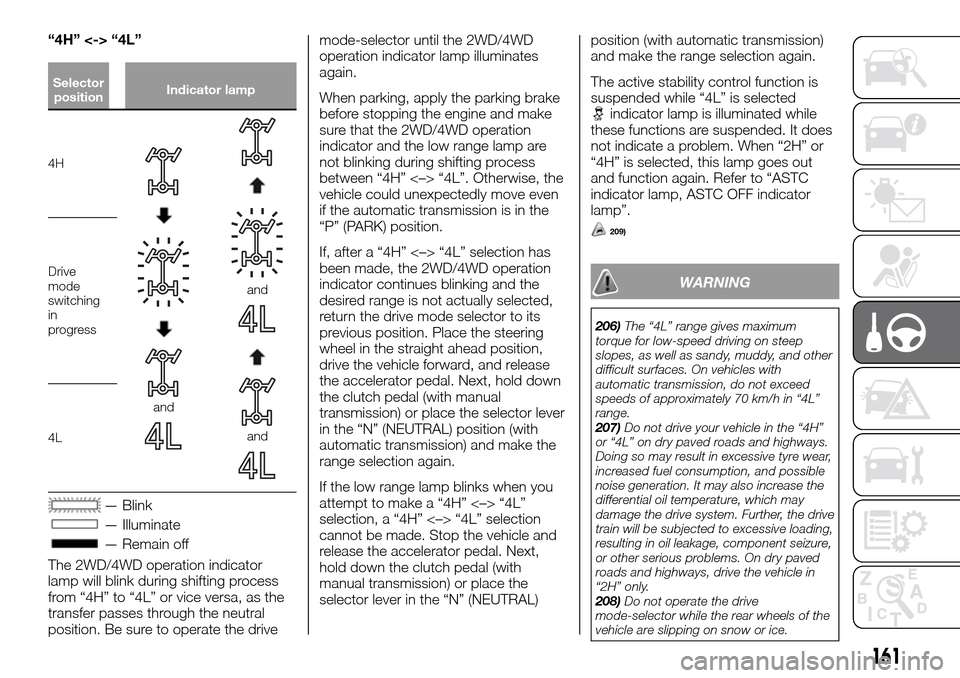
“4H” <-> “4L”
Selector
positionIndicator lamp
4H
and
and
and
Drive
mode
switching
in
progress
4L
— Blink
— Illuminate
— Remain off
The 2WD/4WD operation indicator
lamp will blink during shifting process
from “4H” to “4L” or vice versa, as the
transfer passes through the neutral
position. Be sure to operate the drivemode-selector until the 2WD/4WD
operation indicator lamp illuminates
again.
When parking, apply the parking brake
before stopping the engine and make
sure that the 2WD/4WD operation
indicator and the low range lamp are
not blinking during shifting process
between “4H” <–> “4L”. Otherwise, the
vehicle could unexpectedly move even
if the automatic transmission is in the
“P” (PARK) position.
If, after a “4H” <–> “4L” selection has
been made, the 2WD/4WD operation
indicator continues blinking and the
desired range is not actually selected,
return the drive mode selector to its
previous position. Place the steering
wheel in the straight ahead position,
drive the vehicle forward, and release
the accelerator pedal. Next, hold down
the clutch pedal (with manual
transmission) or place the selector lever
in the “N” (NEUTRAL) position (with
automatic transmission) and make the
range selection again.
If the low range lamp blinks when you
attempt to make a “4H” <–> “4L”
selection, a “4H” <–> “4L” selection
cannot be made. Stop the vehicle and
release the accelerator pedal. Next,
hold down the clutch pedal (with
manual transmission) or place the
selector lever in the “N” (NEUTRAL)position (with automatic transmission)
and make the range selection again.
The active stability control function is
suspended while “4L” is selected
indicator lamp is illuminated while
these functions are suspended. It does
not indicate a problem. When “2H” or
“4H” is selected, this lamp goes out
and function again. Refer to “ASTC
indicator lamp, ASTC OFF indicator
lamp”.
209)
WARNING
206)The “4L” range gives maximum
torque for low-speed driving on steep
slopes, as well as sandy, muddy, and other
difficult surfaces. On vehicles with
automatic transmission, do not exceed
speeds of approximately 70 km/h in “4L”
range.
207)Do not drive your vehicle in the “4H”
or “4L” on dry paved roads and highways.
Doing so may result in excessive tyre wear,
increased fuel consumption, and possible
noise generation. It may also increase the
differential oil temperature, which may
damage the drive system. Further, the drive
train will be subjected to excessive loading,
resulting in oil leakage, component seizure,
or other serious problems. On dry paved
roads and highways, drive the vehicle in
“2H” only.
208)Do not operate the drive
mode-selector while the rear wheels of the
vehicle are slipping on snow or ice.
161
Page 165 of 312

Drive mode-selector operation
The drive mode is shown on the drive
mode selector knob.
Turn the drive mode-selector
Turn the drive mode-selector while
holding it down
The drive mode-selector should be
positioned in accordance with the
following operating conditions:
To shift
fromTo Procedure
2H 4HThe drive
mode-selector can be
operated while the
vehicle is either moving
or stationary. When the
vehicle is not in motion,
shift the selector lever
to the “N” (NEUTRAL)
position before
operating the drive
mode-selector.
When the vehicle is
moving, and only while
it can be steered
straight ahead, shift the
selector lever to the “D”
(DRIVE) position, and
release the accelerator
pedal before operating
the drive mode-selector 4H2H or
4HLc
4HLc 4H
4HLc 4LLcStop the vehicle, shift
the selector lever to the
“N” (NEUTRAL)
position, and operate
the drive
mode-selector. If
operation is made with
the selector lever
placed in any other
position than “N”
(NEUTRAL) position, a
gear noise may be
generated, with a
possible failure to shift
into a proper gear. 4LLc 4HLc
Setting of the drive mode-selector
between 2H, 4H and 4HLc should only
be done at speeds below 100 km/h.
During driving, never attempt to shift
from 4HLc to 4LLc.
When shifting between 2H, 4H and
4HLc in cold weather while the vehicle
is in motion, the transfer gear may
make some noise. In cold weather, try
to shift the gear while the vehicle is
stopped.
When shifting between 4LLc and 4HLc,
the transfer gear may make some
noise.
When the drive mode-selector is set
between 2H, 4H and 4HLc while the
vehicle is stopped, the 2WD/4WD
operation indicator lamp blinks while
the selection is in process. Drive slowly
and normally after confirming that the
lamp is illuminated. (Refer to
“2WD/4WD operation indicator lamp
and low-range indicator lamp”).
When the switch is set between 2H, 4H
and 4HLc while the cruise control is
activated, the transfer gear may make
some noise. When the drive
mode-selector is set between 4HLc
and 4LLc in cold weather, its selection
may not complete. Return the drive
mode-selector to its previous position.
After the engine is warmed up, make
the range selection again.
212)
251AHA103648
163
Page 167 of 312

Switching between 4HL and 4LLc
Drive mode
selector positionIndicator lamp
4HLc
Drive mode
switching in
progress
and
4LLcand
Blink
Illuminate
Remain off
When the drive mode-selector is set
between “2H”, “4H” and “4HLc”, the
front wheel and/or centre differential
lock lamps blink while the selection is in
process. Take the following precautionswhen the indicator lamp is blinking.
Keep the steering wheel in the
straight ahead position while making
range selections. If you attempt to drive
forward with the steering wheel turned,
gear rattling or shock may occur and
the desired range may not actually be
selected.
When the drive mode-selector is set
between “2H”, “4H” and “4HLc”, while
the vehicle is stopped, the front wheel
and/or centre differential lock lamps
blink while the selection is in process.
Drive slowly and normally after
confirming that the lamp is switched.
If the front wheel and/or centre
differential lock lamps blinking after a
“2H” <-> “4H” <-> “4HLc” selection
has been made with the vehicle
moving, hold the steering wheel in the
straight ahead position and slowly
depress the accelerator pedal several
times.
The front and the rear wheel lamps will
blink during shifting process from
“4HLc” to “4LLc” or vice versa, as the
transfer passes through the neutral
position. Be sure to operate the drive
mode-selector until the front and the
rear wheel lamps illuminate again.
When parking, apply the parking brake
before stopping the engine and make
sure that the front and the rear wheel
lamps and the low range lamp are not
blinking during shifting processbetween “4HLc” <-> “4LLc”.
Otherwise, the vehicle could
unexpectedly move even if the
automatic transmission is in the “P”
(PARK) position
If, after a “4HLc” <-> “4LLc” selection
has been made, front and the rear
wheel lamps continue blinking and the
desired range is not actually selected,
return the drive modeselector to its
previous position. Place the steering
wheel in the straight ahead position,
drive the vehicle forward, and release
the accelerator pedal. Next, hold down
the clutch pedal (with manual
transmission) or place the selector lever
in the “N” (NEUTRAL) position (with
automatic transmission) and make the
range selection again.
If the low range lamp blinks when you
attempt to make a “4HLc” <-> “4LLc”
selection, a “4HLc” <-> “4LLc”
selection cannot be made. Stop the
vehicle and release the accelerator
pedal. Next, hold down the clutch pedal
(with manual transmission) or place the
selector lever in the “N” (NEUTRAL)
position (with automatic transmission)
and make the range selection again.
The active stability control function is
suspended while “4LLc” is selected
indicator lamp is illuminated while
these functions are suspended. It does
not indicate a problem. When “2H” or
“4H” or “4HLc” is selected, this lamp
goes out and function again. Refer to
“ASTC indicator lamp, ASTC OFF
indicator lamp”.
213)
165
Page 173 of 312

Driving on sandy or muddy roads
Set the drive mode-selector to “4H” or
“4L” position (Easy select 4WD), “4HLc”
or “4LLc” position (Super select 4WD II)
and then gradually depress the
accelerator pedal for a smooth start.
Keep the pressure on the accelerator
pedal as constant as possible, and
drive at low speed.
115) 116)
218)
Avoid sudden braking, acceleration,
and turning; such operations could
result in the vehicle becoming stuck.
If the vehicle becomes stuck in sandy
or muddy roads, it can often be moved
a rocking motion. Move the selector
lever rhythmically between the “D”
(DRIVE) and “R” (REVERSE) position
(with manual transmission, between 1st
and Reverse), while applying slight
pressure to the accelerator pedal.
It is recommended to start the vehicle
with parking brake partially, but not
completely, applied by slightly pulling
the parking brake lever. After the vehicle
has become free, do not forget to
release the parking brake.
If it is necessary to drive in extremely
muddy conditions, the use of tyre
chains is recommended. Because the
extent of muddy conditions is difficult to
judge and the vehicle could become
bogged down very deeply, operationshould be at a low speed. If possible,
get out of the vehicle and check the
conditions ahead before proceeding.
Driving over roads in coastal areas or
roads on which anti-skid preparations
have been spread can cause rust on
the vehicle; wash the vehicle thoroughly
as soon as possible after such use.
Climbing sharp grades
Set the drive mode-selector to “4L”
position (Easy select 4WD), “4LLc”
position (Super select 4WD II) to
maximize the engine torque.
219) 220)
Choose as smooth a slope as possible
with few stones or other obstacles.
Before attempting to drive up the slope,
walk up it to confirm that the vehicle
can handle the grade.Descending sharp grades
Set the drive mode-selector to “4L”
position (Easy select 4WD), “4LLc”
position (Super select 4WD II), use the
engine brake (downshifting) and
descend slowly.
221)
When descending a sharp grade, if the
brakes are applied suddenly because of
an obstacle encountered, control of the
vehicle could be lost. Before
descending the slope, walk down it and
confirm the path.
Before descending a grade, it is
necessary to choose the appropriate
gear. Avoid changing gears or
depressing the clutch while descending
the grade.
Fiat. is not responsible to the operator
for any damage or injury caused or
liability incurred by the improper and
negligent operation of a vehicle. All
techniques of vehicle operation
described herein depend on the skill
and experience of the operator and
other participating parties and any
deviation from the recommended
operation instructions above is at their
own risk.
171
Page 181 of 312

The set speed driving is deactivated
automatically in any of the following
ways.
When you depress the clutch pedal
(on vehicles with M/T).
When your speed slows to about
15 km/h or more below the set speed
because of a hill, etc.
When your speed slows to about
40 km/h or less.
When the active stability & traction
control (ASTC) starts operating. Refer to
“Active stability & traction control
(ASTC)”.
227)
Also, the set speed driving may be
deactivated as follow:
When the engine speed rises and
approaches the tachometer’s red zone
(the red-coloured part of the
tachometer dial).
127)
To resume the set speed
If the set speed driving is deactivated
by the condition described in “To
deactivate”, you can resume the
previously set speed by push up the
RES + switch (C) while driving at a
speed of about 40 km/h or higher.Under either of the following conditions,
however, using the switch does not
allow you to resume the previously set
speed. In these situations, repeat the
speed setting procedure:
The CRUISE CONTROL ON/OFF
switch is pressed.
The ignition switch is turned OFF or
the operation mode is put in OFF.
Indicator lamp go off.
IMPORTANT
124)When you do not wish to drive at a
set speed, turn off the cruise control for
safety.
125)On vehicles with M/T, do not move the
gearshift lever to the “N” (Neutral) position
while driving at a set speed without
depressing the clutch pedal. The engine will
run too fast and might be damaged.126)Do not use cruise control when driving
conditions will not allow you to stay at the
same speed, such as in heavy traffic or on
roads that are winding, icy, snow-covered,
wet, slippery, on a steep downhill slope.
127)When the set speed driving is
deactivated automatically in any situation
other than those listed above, there may be
a system malfunction. Press the CRUISE
CONTROL ON/OFF switch to turn off the
cruise control and have your vehicle
inspected by a Fiat Dealership.
WARNING
227)On vehicles equipped with A/T,
although the set speed driving will be
deactivated when shifting to the “N”
(NEUTRAL) position, never move the
selector lever to the “N” (NEUTRAL)
position while driving. You would have no
engine braking and could cause a serious
accident.
273AA0110637
179
Page 182 of 312

REAR VIEW CAMERA
(where provided)
The rear-view camera is a system that
shows the view behind the vehicle on a
screen of the Communication System
or the DISPLAY AUDIO.
228) 229) 230)
128)
Range of view of rear-view camera
The range of view of the rear-view
camera is limited to the area shown in
the illustrations. It cannot show the both
sides and the lower part of the rear
bumper, etc. When reversing, be sure
to visually confirm safety around the
vehicle.Location of rear-view camera
The rear-view camera (A) is integrated
into the part near the rear gate handle.How to use the rear-view camera
When you place the gearshift lever or
the selector lever in the “R” position
with the ignition switch in the “ON”
position or the operation mode in ON,
the view behind the vehicle will
automatically appear on the screen of
the DISPLAY AUDIO. When you move
the gearshift lever or the selector lever
to any other position, the screen will
return to its original indication.129)
Because the rear-view camera has a
special lens, the lines on the ground
between parking spaces may not look
parallel on the screen.
In the following situations, the screen
indication may be difficult to see. There
is no abnormality.
Low light (nighttime)
When the light of the sun or the light
from a vehicle’s headlamps shines
directly into the lens
If a fluorescent light shines directly
into the lens, the screen indication may
be flicker. There is no abnormality.
If the camera is hot and is then cooled
by rain or a car wash, the lens can mist
up. This phenomenon does not indicate
a malfunction.
If the atmospheric temperature is
extremely hot or extremely cold, the
274AHA103707
275AHA103723
A
276AHA103710
180
STARTING AND DRIVING
Page 196 of 312

HOW TO CHANGE A
TYRE
132) 133)
Before changing a tyre, first stop your
vehicle in a safe, flat location.
1. Park the vehicle on level and stable
ground, free of loose pebbles, etc.
2. Set the parking brake firmly.
3. On vehicles with manual
transmission, turn the ignition switch to
the “LOCK” position or put the
operation mode in OFF, and move the
gearshift lever to the “R” (Reverse)
position. On vehicles with automatic
transmission, move the selector lever to
the “P” (PARK) position, and turn the
ignition switch to the “LOCK” position
or put the operation mode in OFF.
4. Turn on the hazard flashers and set
up a warning triangle, flashing signal
lamp, etc., at an adequate distance
from the vehicle, and have all your
passengers leave the vehicle.
5. To prevent the vehicle from rolling
when jacking up the vehicle, place
chocks or blocks (A) at the tyre that is
diagonally opposite from the tyre (B)
you are changing.
257) 258)
NOTE The chocks shown in the
illustration do not come with your
vehicle. It is recommended that you
keep ones in the vehicle for use if
needed.
NOTE If chocks are not available, use
stones or any other objects that are
large enough to hold the wheel in
position.
6. Get the jack, jack handle and wheel
nut wrench ready. Refer to “Tools, jack
and jack handle”.Spare wheel information
The spare wheel is stored under the
floor of the cargo bed. Check the air
pressure of the spare tyre frequently
and make sure it is ready for
emergency use at any time.
Maintaining the spare wheel at the
highest specified air pressure will
ensure that it can always be used under
any conditions (city/high-speed driving,
varying load weight, etc.).
259)
To remove the spare wheel
1. Set the jack handle (Club cab) (refer
to “To use the jack handle, Club cab”).
2. Insert the jack handle (A) in the hole
(B) below the rear gate.
A
B
314AHA102162
A
B
315AHA102263
194
IN CASE OF EMERGENCY
Page 203 of 312

TOWING
If your vehicle needs to be towed
If towing is necessary, we recommend
you to have it done by your Fiat
Dealership or a commercial tow truck
service. In the following cases,
transport the vehicle using a tow truck.
The engine runs but the vehicle does
not move, or an abnormal noise is
produced.
Inspection of the vehicle’s underside
reveals that oil or some other fluid is
leaking.
If a wheel gets stuck in a ditch, do not
try to tow the vehicle. Please contact
your Fiat Dealership or a commercial
tow truck service for assistance.
Only when you cannot receive a towing
service from a Fiat Dealership or
commercial tow truck service, tow your
vehicle carefully in accordance with the
instructions given in “Emergency
towing” in this part. The regulations
concerning towing may differ from
country to country. It is recommended
that you obey the regulations of the
area where you are driving your vehicle.Towing the vehicle by a tow truck
138) 139) 140) 141)
281) 282)
Towing with front wheels off the
ground (Type B)
Place the gearshift lever in the “N”
(Neutral) position (manual transmission)
or the selector lever in the “N”
(NEUTRAL) position (automatic
transmission). Release the parking
brake.
142)
Towing with rear wheels off the
ground (Type C)
Place the gearshift lever in the “N”
(Neutral) position (manual transmission)
or the selector lever in the “N”
(NEUTRAL) position (automatic
transmission). Turn the ignition switch to
the “ACC” position or put the operation
mode in ACC and secure the steering
wheel in a straight-ahead position with
a rope or tiedown strap. Never place
the ignition switch in the “LOCK”
position or put the operation mode in
OFF when towing.
Emergency towing
If towing service is not available in an
emergency, your vehicle may be
temporarily towed by a rope secured to
the towing hook. If your vehicle is to be
towed by another vehicle or if your
vehicle tows another vehicle, pay
careful attention to the following points.
B
C
D
E
A
337AHE100108
201