2016 FIAT FULLBACK Temp
[x] Cancel search: TempPage 145 of 312

engine coolant temperature is low. In
such a case, the engine revolutions do
not rise to over 5,000 rpm even if the
accelerator pedal is depressed.
Starting the engine (diesel-powered
vehicles)
Except for vehicles equipped with
the keyless operation system
Insert the ignition key and fasten the
seat belt.
Make sure the parking brake is
applied.
Depress and hold the brake pedal.
On vehicles equipped with M/T,
depress the clutch pedal all the way
and place the gearshift lever in the “N”
(Neutral) position. On vehicles equipped
with A/T, make sure the selector lever is
in the “P” (PARK) position.
Turn the ignition key to the “ON”
position. The diesel preheat indicator
lamp will first illuminate, and then after a
short time go out, indicating that
preheating is completed.
Turn the ignition key to the “START”
position without depressing the
accelerator pedal, and release it when
the engine starts.If the engine is cold, the diesel preheat
indicator lamp is on for a longer time.
When the engine has not been started
within about 5 seconds after the diesel
preheat indicator lamp went out, return
the ignition switch to the “LOCK”
position. Then, turn the switch to the
“ON” position to preheat the engine
again.
When the engine is warm, the diesel
preheat indicator lamp does not come
on even if the ignition key is placed in
the “ON” position. Start the engine by
turning the ignition key right to the
“START” position.
Minor noises may be heard on engine
startup. These will disappear as the
engine warms up.For vehicles equipped with the
keyless operation system
Fasten the seat belt.
Make sure the parking brake is
applied.
Press and hold the brake pedal
down firmly with your right foot.
On vehicles equipped with M/T,
depress the clutch pedal all the way
and place the gearshift lever in the “N”
(Neutral) position. On vehicles equipped
with A/T, make sure the selector lever is
in the “P” (PARK) position.
Press the engine switch. The diesel
preheat indicator lamp will first
illuminate, and then after a short time
go out, indicating that preheating is
completed. The engine will start.
When the engine is not started, it may
become hard to depress the brake
pedal and the vehicle may not be able
to detect the pedal operation. Therefore
the engine may not be started. In such
a case, depress the brake pedal more
firmly than usual.
If the engine is cold, the diesel preheat
indicator lamp is on for a longer time.
Putting the operation mode in ON will
also start preheating the engine. When
the engine has not been started within
about 5 seconds after the diesel
preheat indicator lamp went out, put
the operation mode in OFF. Then,
attempt the engine start procedure to
preheat the engine again.
NNP
228AHA106014
143
Page 147 of 312

Keyless operation key reminder
If the operation mode is in OFF and the
driver’s door is opened with the keyless
operation key in the key slot, the
warning lamp will blink and the outer
buzzer sounds for approximately
3 seconds and the inner buzzer sounds
for approximately 1 minute to remind
you to remove the key.
WARNING
203)Never run the engine in a closed or
poorly ventilated area any longer than is
needed to move your vehicle in or out of
the area. Carbon monoxide gases are
odourless and can be fatal.204)Do not operate the engine switch
while driving except in an emergency. If the
engine is stopped while driving, the brake
servomechanism will cease to function and
braking efficiency will deteriorate. Also, the
power steering system will not function and
it will require greater manual effort to
operate the steering. This could result in a
serious accident.
IMPORTANT
79)Release the ignition key as soon as the
engine starts to avoid damaging the starter
motor.
80)Never attempt to start the engine by
pushing or pulling the vehicle.
81)Do not run the engine at high rpm or
drive the vehicle at high speed until the
engine has had a chance to warm up.
82)If your vehicle is equipped with a
turbocharger, do not stop the engine
immediately after high-speed or uphill
driving. First allow the engine to idle to give
the turbocharger a chance to cool down.
83)It is advisable not to demand maximum
performance from your vehicle (e.g.
excessive acceleration, long distances at
high speeds, excessively intense braking,
etc.) during the initial period of use.
84)A quick burst on the accelerator before
turning off the engine serves absolutely no
practical purpose; it wastes fuel and is
especially damaging to turbocharged
engines.
TURBOCHARGER
OPERATION
(where provided)
Turbocharger
85) 86)
The turbocharger increases engine
power by pushing large amounts of air
into the engine’s cylinders. The finned
parts inside the turbocharger turn at
extremely high speeds and are
subjected to extremely high
temperatures. They are lubricated and
cooled by engine oil. If the engine oil is
not replaced at the specified intervals,
the bearings may seize or emit
abnormal noise.
1. Air compressor 2. Compressed air
3. Cylinder 4. Turbo fin 5. Turbine
6. Exhaust gas
230AHA103505
4
5
6
1
2
3
231AA0020860
145
Page 148 of 312

IMPORTANT
85)Do not run the engine at high speeds
(for example, by revving it or by
accelerating rapidly) immediately after
starting it.
86)Do not stop the engine immediately
after high-speed or uphill driving. First allow
the engine to idle to give the turbocharger a
chance to cool down.
MANUAL
TRANSMISSION
The shift pattern is shown on the
gearshift lever knob. To start off,
depress the clutch pedal all the way
down and shift into 1st or “R” (Reverse)
position. Then gradually release the
clutch pedal while depressing the
accelerator pedal.
205)
87) 88) 89) 90)
During cold weather, shifting may be
difficult until the transmission lubricant
has warmed up. This is normal and not
harmful to the transmission.
If it is hard to shift into 1st, depress the
clutch pedal again; the shift will then be
easier to make.
On vehicles equipped with 6M/T, in
case of hot weather condition or long
time cruising with high speed, a speed
limitation function may work to restrict
the oil temperature rising of the manual
transmission. After the oil temperature
drops to the appropriate level, the
speed limitation function is cancelled.Moving the gearshift lever to the
“R” (Reverse) position
Vehicles equipped with 5M/T
To shift into the “R” (Reverse) position
from 5th gear, move the gearshift lever
to the “N” (Neutral) position, and then
move it to the “R” (Reverse) position.
Vehicles equipped with 6M/T
Depress and hold the gearshift lever to
the “R” (Reverse) position.
91)
232AHA104339
146
STARTING AND DRIVING
Page 154 of 312
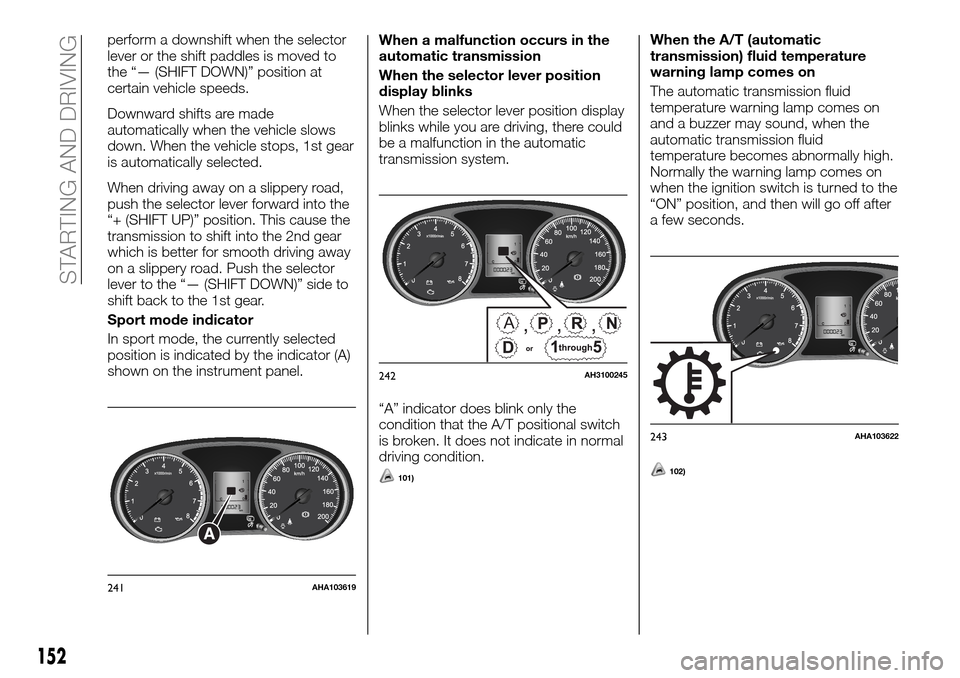
perform a downshift when the selector
lever or the shift paddles is moved to
the “— (SHIFT DOWN)” position at
certain vehicle speeds.
Downward shifts are made
automatically when the vehicle slows
down. When the vehicle stops, 1st gear
is automatically selected.
When driving away on a slippery road,
push the selector lever forward into the
“+ (SHIFT UP)” position. This cause the
transmission to shift into the 2nd gear
which is better for smooth driving away
on a slippery road. Push the selector
lever to the “— (SHIFT DOWN)” side to
shift back to the 1st gear.
Sport mode indicator
In sport mode, the currently selected
position is indicated by the indicator (A)
shown on the instrument panel.When a malfunction occurs in the
automatic transmission
When the selector lever position
display blinks
When the selector lever position display
blinks while you are driving, there could
be a malfunction in the automatic
transmission system.
“A” indicator does blink only the
condition that the A/T positional switch
is broken. It does not indicate in normal
driving condition.
101)
When the A/T (automatic
transmission) fluid temperature
warning lamp comes on
The automatic transmission fluid
temperature warning lamp comes on
and a buzzer may sound, when the
automatic transmission fluid
temperature becomes abnormally high.
Normally the warning lamp comes on
when the ignition switch is turned to the
“ON” position, and then will go off after
a few seconds.
102)
A
241AHA103619
,,,A
242AH3100245
243AHA103622
152
STARTING AND DRIVING
Page 158 of 312

When the vehicle is moving, and only
while it can be steered straight ahead,
release the accelerator pedal beforeo
perating the transfer shift lever.
To shift from 4H to 4L
Stop the vehicle, depress the clutch
pedal to the floor and operate the
transfer shift lever.
To shift from 4L to 4H
Stop the vehicle, depress the clutch
pedal to the floor and operate the
transfer shift lever.
Shifting of the transfer shift lever
between “2H” and “4H” should only be
done at speeds below 100 km/h.
During driving, never attempt to shift
from “4H” to “4L”.
When shifting from “2H” to “4H” in cold
weather while the vehicle is in motion,
the transmission gear may make some
noise. In cold weather, try to shift the
gear while the vehicle is stopped.
There may be a case that the transfer
shift lever feels heavy when it is moved
from “4H” to “2H” with the steering
wheel in turned position. This is normal
and not any indication of trouble.
208)
2WD/4WD operation indicator lamp
When the ignition switch is in the “ON”
position or the operation mode is put in
ON, the 2WD/4WD operation indicator
lamp shows the shifting condition. The
2WD/4WD operation indicator lamp
comes on at each transfer shift lever
position as follows:Shifting between 2H and 4H
Transfer
shift
lever
positionIndicator lamp
2H
Drive
mode
switching
in
progress
4H
— Illuminate
— Remain off
When the transfer shift lever is shifted
between 2H and 4H, the 2WD/4WD
operation indicator lamp does not
switch to illuminate or remain off while
the selection is in process. Take the
following precautions when the
indicator lamp is remains on or off.
247AHA106199
156
STARTING AND DRIVING
Page 159 of 312

Keep the steering wheel in the straight
ahead position while making range
selections. If you attempt to drive
forward with the steering wheel turned,
gear rattling may occur and the desired
range may not actually be selected.
When the transfer shift lever is shifted
between 2H and 4H while the vehicle is
stopped, the 2WD/4WD operation
indicator lamp does not switch to
illuminate or remain off while the
selection is in process. Drive slowly and
normally after confirming that the lamp
is switched.
Do not move the selector lever while
the 2WD/4WD operation indicator lamp
is switched.
If the 2WD/4WD operation indicator
lamp does not switch after a selection
has been made between 2H and 4H
with the vehicle moving, hold the
steering wheel in the straight ahead
position and slowly depress the
accelerator pedal several times.Shifting between 4H and 4L
Transfer
shift lever
positionIndicator lamp
2H
Drive mode
switching in
progress
4H
— Illuminate
— Remain off
The 2WD/4WD operation indicator
lamp will go out momentarily during
shifting process from 4H to 4L or vice
versa, as the transfer shift lever passes
through the neutral position. Be sure to
operate the transfer shift lever until the
2WD/4WD operation indicator lamp
illuminates again.If, after a selection between 4H and 4L
has been made, the 2WD/4WD
operation indicator lamp remains off
and the desired range is not actually
selected, return the transfer shift lever
to its previous position. Place the
steering wheel in the straight ahead
position, drive the vehicle forward, and
release the accelerator pedal. Next,
hold down the clutch pedal make the
range selection again.
209)
157
Page 161 of 312

To shift from ToProcedure
Vehicles with manual transmission Vehicles with automatic transmission
2H 4HThe drive mode-selector can be operated while the
vehicle is either moving or stationary. When the
vehicle is not in motion, shift the gearshift lever to
the “N” (Neutral) position before operating the drive
mode-selector. When the vehicle is moving, and
only while it can be steered straight ahead, release
the accelerator pedal before operating the drive
mode-selector.The drive mode-selector can be operated while the
vehicle is either moving or stationary. When the
vehicle is not in motion, shift the selector lever to
the “N” (NEUTRAL) position before operating the
drive mode-selector. When the vehicle is moving,
and only while it can be steered straight ahead,
shift the selector lever to the “D” (DRIVE) position,
and release the accelerator pedal before operating
the drive mode-selector. 4H 2H
4H 4L
Stop the vehicle, depress the clutch pedal to the
floor and operate the drive mode-selector. Keep
depressing the clutch pedal while 2WD/4WD
operation indicator lamp continues to blink.Stop the vehicle, shift the selector lever to the “N”
(NEUTRAL) position, and operate the drive
mode-selector. If operation is made with the
selector lever placed in any other position than “N”
(NEUTRAL) position, a gear noise may be
generated, with a possible failure to shift into a
proper gear. 4L 4H
Shifting of setting of the drive mode-selector between “2H” and “4H” should only be done at speeds below 100 km/h.
During driving, never attempt to shift from “4H” to “4L”.
When shifting from “2H” to “4H” in cold weather while the vehicle is in motion, the transfer gear may make some noise. In cold
weather, try to shift the gear while the vehicle is stopped.
When shifting between “4H” and “4L”, the transfer gear may make some noise.
When the drive mode-selector is set between “2H” and “4H” while the vehicle is stopped, the 2WD/4WD operation indicator
lamp blinks while the selection is in process. Drive slowly and normally after confirming that the lamp is illuminated. Refer to
“2WD/4WD operation indicator lamp and low-range indicator lamp”.
When the drive mode-selector is set between “2H” and “4H” while the cruise control is activated, the transfer gear may make
some noise.
When the drive mode-selector is set between“4H” and “4L” in cold weather, its selection may not complete. Return the drive
mode-selector to its previous position. After the engine is warmed up, make the range selection again.
208)
159
Page 162 of 312

2WD/4WD operation indicator lamp
and low-range indicator lamp
When the ignition switch is in the “ON”
position or the operation mode is put in
ON, the 2WD/4WD operation indicator
lamp (1) and the low-range indicator
lamp (2) shows the shifting condition.
The 2WD/4WD operation indicator
lamp comes on at each drive mode
selector position as follows:“2H” <-> “4H”
Selector
positionIndicator lamp
2H
Drive
mode
switching
in
progress
4H
— Blink
— Illuminate
— Remain off
When the drive mode selector is set
between 2H <–> 4H, the 2WD/4WD
operation indicator lamp blinks while
the selection is in process. Take thefollowing precautions when the
indicator lamp is blinking.
Keep the steering wheel in the straight
ahead position while making range
selections. If you attempt to drive
forward with the steering wheel turned,
gear rattling or shock may occur and
the desired range may not actually be
selected.
When the drive mode-selector is set
between “2H” <–> “4H” while the
vehicle is stopped, the 2WD/4WD
operation indicator lamp blinks while
the selection is in process. Drive slowly
and normally after confirming that the
lamp is switched.
If the 2WD/4WD operation indicator
lamp continues blinking after a “2H”
<–> “4H” selection has been made with
the vehicle moving, hold the steering
wheel in the straight ahead position and
slowly depress the accelerator pedal
several times.
AB
249AHA103651
160
STARTING AND DRIVING