2016 FIAT FULLBACK differential
[x] Cancel search: differentialPage 206 of 312

142)Never tow an automatic transmission
vehicle with the front wheels up (and the
rear wheels on the ground) (Type B) when
the automatic transmission fluid level is low.
This may cause serious and expensive
damage to the transmission.
143)When the engine is not running, the
brake booster and power steering pump do
not operate. This means higher brake
depression force and higher steering effort
are required. Therefore, vehicle operation is
very difficult.
144)Do not leave the ignition switch in the
“LOCK” position or the operation mode in
OFF. The steering wheel will lock, causing
loss of control.
145)On vehicles with super select 4WD II,
when you are going to tow another vehicle,
set the drive mode-selector to “4H”
position. Selecting “2H” drive may increase
the differential oil temperature, resulting in
possible damage to the driving system.
Further, the drive train will be subjected to
excessive loading possibly leading to oil
leakage, component seizure, or other
serious faults.OPERATION UNDER
ADVERSE DRIVING
CONDITIONS
On a flooded road
Avoid flooded roads. Water could enter
the brake discs, resulting in temporarily
ineffective brakes. In such cases, lightly
depress the brake pedal to see if the
brakes operate properly. If they do not,
lightly depress the pedal several times
while driving in order to dry the brake
pads.
When driving in rain or on a road with
many puddles a layer of water may
form between the tyres and the road
surface. This reduces a tyre’s frictional
resistance on the road, resulting in loss
of steering stability and braking
capability.
To cope with this, observe the following
items:
(a) Drive your vehicle at a slow speed.
(b) Do not drive on worn tyres.
(c) Always maintain the specified tyre
inflation pressures.On a snow-covered or frozen road
When driving on a snow-covered or
frozen road, it is recommended that you
use snow tyres or snow traction device
(tyre chains). Refer to the “Snow tyres”
and “Snow traction device (tyre chains)”
sections.
Avoid high-speed operation, sudden
acceleration, abrupt brake application
and sharp cornering.
Depressing the brake pedal during
travel on snowy or icy roads may cause
tyre slippage and skidding. When
traction between the tyres and the road
is reduced the wheels may skid and the
vehicle cannot readily be brought to a
stop by conventional braking
techniques. Braking will differ,
depending upon whether you have
anti-lock brake system (ABS). If you do
have ABS, brake by pressing the brake
pedal hard, and keeping it pressed. If
you do not have ABS, pump the brake
pedal with short rapid jabs, each time
fully applying and fully releasing for
greatest effect.
Allow extra distance between your
vehicle and the vehicle in front of you,
and avoid sudden braking.
Accumulation of ice on the braking
system can cause the wheels to lock.
Pull away from a standstill slowly after
confirming safety around the vehicle.
292)
204
IN CASE OF EMERGENCY
Page 230 of 312

Thousand of miles9 182736455463728190
Thousand of kilometers15 30 45 60 75 90 105 120 135 150
Years12345678910
Check the brake and clutch pedal play●●●●●●●●●●
Visually inspect conditions and check the
tension of the accessory drive belts●●●●●●●●●●
Visually inspect conditions and check the
tension of the toothed timing drive belts●●●●● ●●●●
Visually check for any fluid leaks from the
front and rear differentials (if leaks are found,
check the oil level)
●●● ●●● ●●
Change front and rear differential oil (5)●●
Change rear limited slip differential oil
(where present) (6)●●●
Visually check for any fluid leaks from the
transfer case (if leaks are found, check the
oil level)
●●●●● ●●●●
Change transfer case oil (8)●
Change engine oil and replace oil filter●●●●●●●●●●
Replace accessory drive belts(7)
(5) To be done only on a mileage basis, independently of the time. In case of heavy use, it is recommended to change every 40,000 km.
(6) To be done only on a mileage basis, independently of the time. In case of heavy use, it is recommended to change every 20,000 km.
(8)To be done only on a mileage basis.
(7) The belt should only be replaced if damage/wear is found during the periodic inspection.
228
SERVICING AND MAINTENANCE
Page 235 of 312

Thousands of miles6 121825313743505662
Thousands of kilometers or10 20 30 40 50 60 70 80 90 100
Years12345678910
Check handbrake lever travel and adjust, if
necessary●●●●●●●●●●
Check the brake and clutch pedal play●●●●●●●●●●
Visually inspect conditions and check the
tension of the accessory drive belts●●●●●●●●●●
Visually check for any fluid leaks from the
front and rear differentials (if leaks are found,
check the oil level)
●●●●●●● ●●
Change front and rear differential oil (10)●
Change rear limited slip differential oil
(where present) (11)●●
Visually check for any fluid leaks from the
transfer case (if leaks are found, check the
oil level)
●●●●●●●●●
Change transfer case oil (8)●
Change engine oil and replace oil filter●●●●●●●●●●
Replace accessory drive belts(3)
(10) to be done only on a mileage basis, independently of the time. In case of heavy use, it is recommended to change every 40,000 km.
(11) to be done only on a mileage basis, independently of the time. In case of heavy use, it is recommended to change every 20,000 km.
(8) to be done only on a mileage basis, independently of the time.
(3) The belt should only be replaced if damage/wear is found during the periodic inspection.
233
Page 240 of 312

Thousands of miles6 121825313743505662
Thousands of kilometers or10 20 30 40 50 60 70 80 90 100
Years12345678910
Visually inspect the integrity of the
suspension system components and their
fixings
●●●●●●●●●●
Check handbrake lever travel and adjust, if
necessary●●●●●●●●●●
Check the brake and clutch pedal play●●●●●●●●●●
Visually inspect conditions and check the
tension of the accessory drive belts●●●●●●●●●●
Visually inspect conditions and check the
tension of the toothed timing drive belts●●●● ●●●●
Visually check for any fluid leaks from the
front and rear differentials (if leaks are found,
check the oil level)
●●●●●●● ●●
Change front and rear differential oil (10)●
Change rear limited slip differential oil
(where present) (11)●●
Visually check for any fluid leaks from the
transfer case (if leaks are found, check the
oil level)
●●●●●●●●●
(10) to be done only on a mileage basis, independently of the time. In case of heavy use, it is recommended to change every 40,000 km.
(11) to be done only on a mileage basis, independently of the time. In case of heavy use, it is recommended to change every 20,000 km.
238
SERVICING AND MAINTENANCE
Page 265 of 312
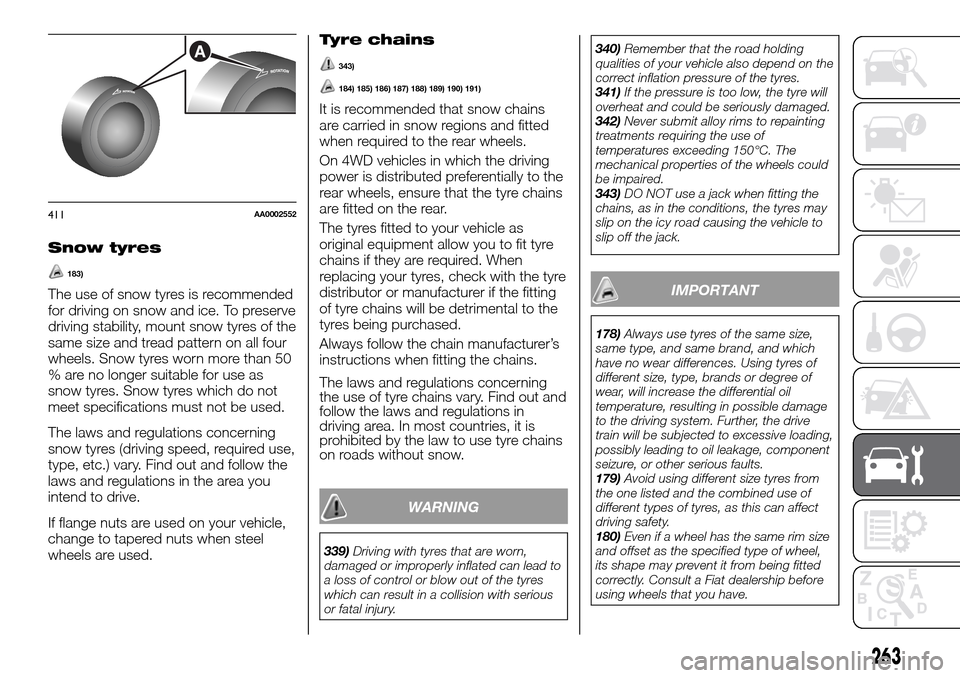
Snow tyres
183)
The use of snow tyres is recommended
for driving on snow and ice. To preserve
driving stability, mount snow tyres of the
same size and tread pattern on all four
wheels. Snow tyres worn more than 50
% are no longer suitable for use as
snow tyres. Snow tyres which do not
meet specifications must not be used.
The laws and regulations concerning
snow tyres (driving speed, required use,
type, etc.) vary. Find out and follow the
laws and regulations in the area you
intend to drive.
If flange nuts are used on your vehicle,
change to tapered nuts when steel
wheels are used.
Tyre chains
343)
184) 185) 186) 187) 188) 189) 190) 191)
It is recommended that snow chains
are carried in snow regions and fitted
when required to the rear wheels.
On 4WD vehicles in which the driving
power is distributed preferentially to the
rear wheels, ensure that the tyre chains
are fitted on the rear.
The tyres fitted to your vehicle as
original equipment allow you to fit tyre
chains if they are required. When
replacing your tyres, check with the tyre
distributor or manufacturer if the fitting
of tyre chains will be detrimental to the
tyres being purchased.
Always follow the chain manufacturer’s
instructions when fitting the chains.
The laws and regulations concerning
the use of tyre chains vary. Find out and
follow the laws and regulations in
driving area. In most countries, it is
prohibited by the law to use tyre chains
on roads without snow.
WARNING
339)Driving with tyres that are worn,
damaged or improperly inflated can lead to
a loss of control or blow out of the tyres
which can result in a collision with serious
or fatal injury.340)Remember that the road holding
qualities of your vehicle also depend on the
correct inflation pressure of the tyres.
341)If the pressure is too low, the tyre will
overheat and could be seriously damaged.
342)Never submit alloy rims to repainting
treatments requiring the use of
temperatures exceeding 150°C. The
mechanical properties of the wheels could
be impaired.
343)DO NOT use a jack when fitting the
chains, as in the conditions, the tyres may
slip on the icy road causing the vehicle to
slip off the jack.
IMPORTANT
178)Always use tyres of the same size,
same type, and same brand, and which
have no wear differences. Using tyres of
different size, type, brands or degree of
wear, will increase the differential oil
temperature, resulting in possible damage
to the driving system. Further, the drive
train will be subjected to excessive loading,
possibly leading to oil leakage, component
seizure, or other serious faults.
179)Avoid using different size tyres from
the one listed and the combined use of
different types of tyres, as this can affect
driving safety.
180)Even if a wheel has the same rim size
and offset as the specified type of wheel,
its shape may prevent it from being fitted
correctly. Consult a Fiat dealership before
using wheels that you have.
A
411AA0002552
263
Page 296 of 312

No. Items Quantity Lubricants
Transfer oil5M/T with Intercooler 2.5 litresTUTELA TRANSMISSION GEARSYNTH
Z3Contractual Technical Reference
N°F001.A16 5M/T without Intercooler 2.3 litres
6M/T, 5A/T Super select 4WD II 1.34 litresTUTELA TRANSMISSION GEARSYNTH
Z4Contractual Technical Reference
N°F002.A16 6M/T, 5A/T Easy select 4WD 1.15 litres
Differential oil2WD 1.5 litresTUTELA TRANSMISSION AXLE Z
Contractual Technical Reference
N°F002.A16 2WD HIi-Rider 2.3 litres
4WD Front 1.2 litres
TUTELA TRANSMISSION AXLE Z-LS
Contractual Technical Reference
N°F003.A16 4WD Rearwithout intercooler1.8 litres
2.3 litres
(2)
with intercooler 2.3 litres
Refrigerant (Air conditioning) 500-540 g
(2) Optional
294
TECHNICAL SPECIFICATIONS
Page 299 of 312

Nr. Item Quantity Lubricants
Transfer oil5 M/T With Intercooler 2.5 litresTUTELA TRANSMISSION GEARSYNTH
Z3Contractual Technical Reference
N°F001.A16 5 M/T Without Intercooler 2.3 litres
6 M/T, 5 A/T
Super select 4WD II1.34 litres
TUTELA TRANSMISSION GEARSYNTH
Z4Contractual Technical Reference
N°F002.A16 6 M/T, 5 A/T
Easy select 4WD1.15 litres
Differential oil 2WD2WD 1.5 litresTUTELA TRANSMISSION AXLE Z
Contractual Technical Reference
N°F002.A16 2WD Hi-Rider 2.3 litres
Differential oil 4WDFront 1.2 litres
TUTELA TRANSMISSION AXLE Z-LS
Contractual Technical Reference
N°F003.A16 Rear — without intercooler 1.8 litres
Rear — with intercooler 2.3 litres
Refrigerant 500–540 gr
297
Page 301 of 312

No. Items Quantity Lubricants
4 Power steering fluid As requiredTUTELA GI/ZContractual Technical
Reference N°F001.A16
6 Engine oilOil pan 4.0 litres
SELENIA MULTIPOWER C3Contractual
Technical Reference N° F129.F11
Oil filter 0.3 litres
7 Washer fluid 4.2 litres
Manual transmission oil 2WD 2.3 litresTUTELA TRANSMISSION GEARSYNTH
Z4Contractual Technical Reference
N°F002.A16 Manual transmission oil 4WD 2.2 litres
Transfer oil 2.3 litresTUTELA TRANSMISSION GEARSYNTH
Z4Contractual Technical Reference
N°F002.A16
Differential oil2WD 1.5 litresTUTELA TRANSMISSION AXLE Z
Contractual Technical Reference
N°F002.A16 2WD Hi Rider 1.8 litres
4WDFront
1.2 litresTUTELA TRANSMISSION AXLE Z-LS
Contractual Technical Reference
N°F003.A16 Rear
1.8 litres
Refrigerant (Air conditioning) 500 540 gr
299