Page 202 of 312

271)Mount the spare wheel with the valve
stem (J) facing outboard. If you cannot see
the valve stem (J), you have installed the
wheel backwards. Operating the vehicle
with the spare wheel installed backwards
can cause vehicle damage and result in an
accident.
272)Be sure to open the release valve
slowly. If it is opened quickly, the vehicle will
drop abruptly and the jack may come out
of position, causing a serious accident.
273)Never use your foot or a pipe
extension for extra force in the wheel nut
wrench. If you do so, you will tighten the
nut too much.
274)The tyre pressure should be
periodically checked and maintained at the
specified pressure while the tyre is stowed.
275)After changing the tyre and driving the
vehicle about 1,000 km, retighten the
wheel nuts to make sure that they have not
come loose.
276)If the steering wheel vibrates when
driving after changing the tyre, we
recommend you to have the tyres checked
for balance.
277)Do not mix one type of tyre with
another or use a different size from the one
listed. This would cause early wear and
poor handling.
278)The spare wheel should always be
securely in position. If a flat tyre is
changed, put the flat tyre in the spare
wheel mounting position with the wheel
outer surface upward, and use the wheel
nut wrench to secure it firmly.279)Never tamper with the inflation valve.
Never introduce tools of any kind between
rim and tyre. Check tyre and spare wheel
pressure regularly, referring to the values
shown in the "Technical specifications"
section.
280)The moving components of the jack
(screw and joints) can also cause injuries:
do not touch them. If you come into
contact with lubricating grease, clean
yourself thoroughly.
IMPORTANT
132)Avoid using different size tyres from
the one listed and the combined use of
different types of tyres, as this can affect
driving safety.
133)Even if a wheel has the same rim size
and offset as the specified type of wheel,
its shape may prevent it from being fitted
correctly. Consult an authorised Fiat
Dealership before using wheels that you
have.
134)When installing or removing the spare
wheel, please observe the followings. If you
do not follow them, it could result in break
the spare wheel carrier. Do not use the
power tool. Use the wheel nut wrench
stowed on the vehicle. Do not apply a force
of 400 N or more at the end of the wheel
nut wrench.
135)Never apply oil to either the wheel
bolts or the nuts or they will tighten too
much.
136)If the release valve is loosened too
much (2 or more turns) in the anticlockwise
direction, the jack’s oil will leak and the jack
cannot be used.137)Close the release valve slowly when
lowering the vehicle, or the valve may be
damaged.
200
IN CASE OF EMERGENCY
Page 214 of 312
Fuse replacement
294) 295) 296) 297) 298)
147)
1. Before replacing a fuse, always turn
off the electrical circuit concerned and
place the ignition switch in the “LOCK”
position or put the operation mode in
OFF.
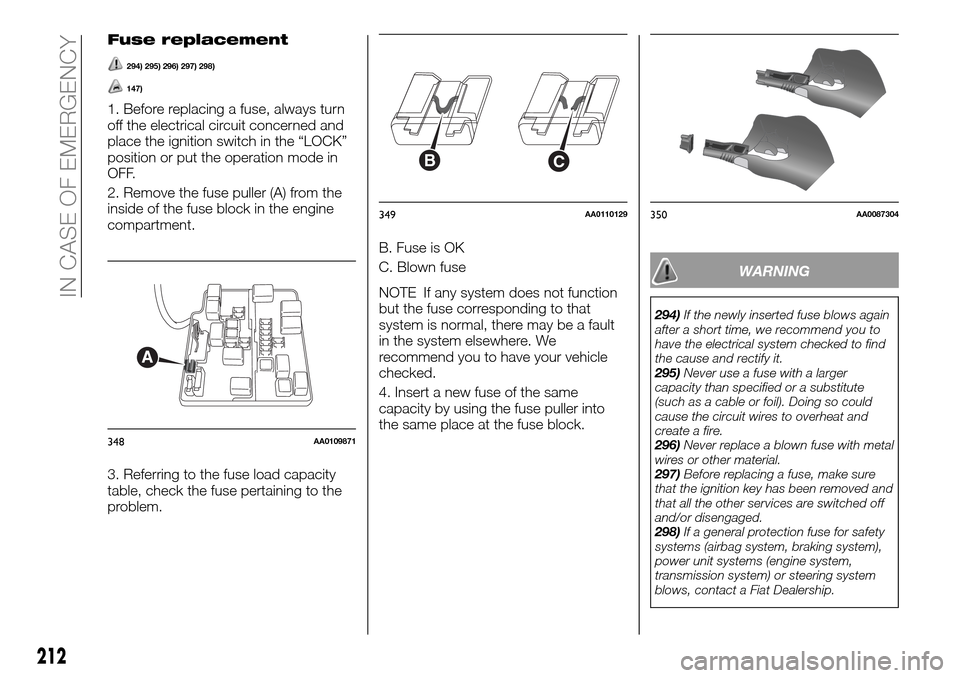
2. Remove the fuse puller (A) from the
inside of the fuse block in the engine
compartment.
3. Referring to the fuse load capacity
table, check the fuse pertaining to the
problem.B. Fuse is OK
C. Blown fuse
NOTE If any system does not function
but the fuse corresponding to that
system is normal, there may be a fault
in the system elsewhere. We
recommend you to have your vehicle
checked.
4. Insert a new fuse of the same
capacity by using the fuse puller into
the same place at the fuse block.
WARNING
294)If the newly inserted fuse blows again
after a short time, we recommend you to
have the electrical system checked to find
the cause and rectify it.
295)Never use a fuse with a larger
capacity than specified or a substitute
(such as a cable or foil). Doing so could
cause the circuit wires to overheat and
create a fire.
296)Never replace a blown fuse with metal
wires or other material.
297)Before replacing a fuse, make sure
that the ignition key has been removed and
that all the other services are switched off
and/or disengaged.
298)If a general protection fuse for safety
systems (airbag system, braking system),
power unit systems (engine system,
transmission system) or steering system
blows, contact a Fiat Dealership.
A
348AA0109871
BC
349AA0110129350AA0087304
212
IN CASE OF EMERGENCY
Page 215 of 312

IMPORTANT
147)If it is necessary to wash the engine
compartment, take care not to directly hit
the fuse box and the window wiper motor
with the water jet
REPLACEMENT OF
LAMP BULBS
299) 300) 301) 302) 303) 304)
Before replacing a bulb, ensure the
lamp is off. Do not touch the glass part
of the new bulb with your bare fingers;
the skin oil left on the glass will
evaporate when the bulb gets hot and
the vapor will condense on the reflector
and dim the surface.
NOTE If you are unsure of how to carry
out the work as required, we
recommend you to consult a specialist.
Be careful not to scratch the vehicle
body when removing a lamp and lens.
When it rains, or when the vehicle has
been washed, the inside of the lens
sometimes becomes foggy. This is the
same phenomenon as when window
glass mists up on a humid day, and
does not indicate a functional problem.When the lamp is switched on, the heat
will remove the fog. However, if water
gathers inside the lamp, we
recommend you to have the lamp
checked.
Bulb location and capacity
When replacing a bulb, use a new bulb
with the same wattage and colour.
Outside
Front
Except for vehicles with high
intensity discharge headlamps
1. Position lamps: 5 W (W5W)
2. Front turn-signal lamps: 21 W
(PY21W/P21W)
3. Headlamps, high/low beam:
60/55 W (H4)
4. Type 1: Front fog lamps: 35 W (H8)
Daytime running lamps: 13 W (P13W).
351AA0030717352AHA104603
213
Page 225 of 312
SERVICING AND MAINTENANCE
Correct maintenance permits the
performance of the car to be
maintained over time, as well as limited
running costs and safeguarding the
efficiency of the safety systems.
This chapter explains how.SERVICE PRECAUTIONS.......224
SCHEDULED SERVICING PLAN . .225
PERIODIC CHECKS..........240
DEMANDING VEHICLE USE.....240
CHECKING LEVELS..........241
CATALYTIC CONVERTER.......245
ENGINE OIL...............245
ENGINE COOLANT...........247
WASHER FLUID.............249
BRAKE FLUID..............249
CLUTCH FLUID.............250
POWER STEERING FLUID......251
BATTERY.................252
WIPER BLADE RUBBER
REPLACEMENT.............254
GENERAL MAINTENANCE......255
VEHICLE CARE PRECAUTIONS. . .255
CLEANING THE INTERIOR OF
YOUR VEHICLE.............256
CLEANING THE EXTERIOR OF
YOUR VEHICLE.............257
TYRES...................260
223
Page 227 of 312

SCHEDULED SERVICING PLAN
PETROL-POWERED ENGINE
Thousand of miles9 182736455463728190
Thousand of kilometers15 30 45 60 75 90 105 120 135 150
Years12345678910
Check tyre conditions/wear and adjust
pressure, if necessary●●●●●●●●●●
Check operation of lighting system
(headlights, direction indicators, hazard
warning lights, boot, passenger
compartment, glove compartment,
instrument panel warning lights, etc.)
●●●●●●●●●●
Check and, if necessary, top up fluid levels
(1)●●●●●●●●●●
Check battery condition●●●●●●●●●●
Change engine coolant(2)
Check exhaust emissions/smokiness
●●●●●●●●●●
Use the diagnosis socket to check
supply/engine management systems
operation, emissions and, for
versions/markets, where provided, engine
oil degradation
●●●●●●●●●●
Perform the "Small Injection Quantity
Learning” procedure●●●●●●●●●●
(1) Always only use the liquids shown in the handbook for topping up after having checked that the system is not damaged.
(2) This should be done every two years or 40,000 km.
225
Page 229 of 312
Thousand of miles9 182736455463728190
Thousand of kilometers15 30 45 60 75 90 105 120 135 150
Years12345678910
Visually inspect conditions and wear of front
disc brake pads and operation of pad wear
indicator
●●●●●●●●●●
Visually inspect condition and wear of the
rear drum brake lining●●●●●●●●●●
Check the front and rear wheel bearing
clearances●●●
Visually check for any fluid leaks from the
automatic transmission (if leaks are found,
check the oil level)
●●●●● ●●●●
Change the automatic transmission oil (4)●
Visually check for any fluid leaks from the
manual transmission (if leaks are found,
check the oil level)
●●●●● ●●●●
Change the manual transmission oil (8)●
Visually inspect the integrity of the
suspension system components and their
fixings
●●●●●●●●●●
Check handbrake lever travel and adjust, if
necessary●●●●●●●●●●
(4) To be done only in case of heavy use, only on a mileage basis, every 100,000 km.
(8)To be done only on a mileage basis.
227
Page 230 of 312

Thousand of miles9 182736455463728190
Thousand of kilometers15 30 45 60 75 90 105 120 135 150
Years12345678910
Check the brake and clutch pedal play●●●●●●●●●●
Visually inspect conditions and check the
tension of the accessory drive belts●●●●●●●●●●
Visually inspect conditions and check the
tension of the toothed timing drive belts●●●●● ●●●●
Visually check for any fluid leaks from the
front and rear differentials (if leaks are found,
check the oil level)
●●● ●●● ●●
Change front and rear differential oil (5)●●
Change rear limited slip differential oil
(where present) (6)●●●
Visually check for any fluid leaks from the
transfer case (if leaks are found, check the
oil level)
●●●●● ●●●●
Change transfer case oil (8)●
Change engine oil and replace oil filter●●●●●●●●●●
Replace accessory drive belts(7)
(5) To be done only on a mileage basis, independently of the time. In case of heavy use, it is recommended to change every 40,000 km.
(6) To be done only on a mileage basis, independently of the time. In case of heavy use, it is recommended to change every 20,000 km.
(8)To be done only on a mileage basis.
(7) The belt should only be replaced if damage/wear is found during the periodic inspection.
228
SERVICING AND MAINTENANCE
Page 232 of 312

DIESEL ENGINE 4N15
Thousands of miles6 121825313743505662
Thousands of kilometers or10 20 30 40 50 60 70 80 90 100
Years12345678910
Check tyre conditions/wear and adjust
pressure, if necessary●●●●●●●●●●
Check operation of lighting system
(headlights, direction indicators, hazard
warning lights, boot, passenger
compartment, glove compartment,
instrument panel warning lights, etc.)
●●●●●●●●●●
Check and, if necessary, top up fluid levels
(1)●●●●●●●●●●
Check battery condition●●●●●●●●●●
Change engine coolant(7)
Adjust the tappet clearance (where there is
no hydraulic clearance adjustment) (8)
●
Check exhaust emissions/smokiness●●●●●●●●●●
Use the diagnosis socket to check
supply/engine management systems
operation, emissions and, for
versions/markets, where provided, engine
oil degradation
●●●●●●●●●●
(1) Always only use the liquids shown in the handbook for topping up after having checked that the system is not damaged.
(7) The engine coolant should be replaced after 8 years or 160,000 km, then every 5 years or 100,000 km
(8) to be done only on a mileage basis, independently of the time.
230
SERVICING AND MAINTENANCE

