2016 FIAT FULLBACK Locking
[x] Cancel search: LockingPage 32 of 312

3 — Undo the link or wire on the other
side in the same manner, and have the
rear gate swing down slowly.
WARNING
11)Make sure the doors are closed:
driving with doors not completely closed is
dangerous.
12)NEVER leave children unattended
inside the car, let alone leave the car with
the doors unlocked in a place that children
can access easily. Children may seriously,
or even fatally, injure themselves. Also
ensure that children do not inadvertently
operate
13)Be careful not to lock the doors while
the key is inside the vehicle.
14)When opening the rear door, confirm
that the occupant of the front seat has
taken off the seat belt before opening the
rear door. If you open the rear door with
the front seat belt being worn, the
occupant of the front seat may be
tightened with the locked seat belt and
could result in serious injury.
15)When closing the rear door, make sure
not being trapped your hands or your
fingers in the doors.
16)Before driving, make sure that the rear
door is securely closed. If a door is ajar, the
door ajar warning lamp will illuminates. If a
door is not completely closed, the rear
door could open while driving and this
could cause an accident such as
occupants being thrown from the vehicle.
17)When opening or closing the rear door,
please observe the followings. If you do not
follow them, it could result in damage to
your vehicle. Do not open or close the rear
door and the front door at the same time.18)Do not open or close the rear door
when the front door is not completely
opened.
19)Do not close the rear door after closing
the front door.
20)When driving with a child in the rear
seat, please use the child protection to
prevent accidental door opening which
may cause an accident.
21)If the child lock was engaged and the
previously described locking procedure
carried out, operating the internal opening
handle will not open the door: in this case,
to open the door, the outside handle must
be used. The door central locking/
unlocking button is not disabled by the
engagement of the emergency lock.
22)Always use this device when carrying
children. After engaging the child lock on
both rear doors, check for effective
engagement by trying to open a door with
the internal handle.
23)Do not stand behind the exhaust pipe
when loading and unloading luggage. Heat
from the exhaust could lead to burns.
24)Pay attention not to catch your fingers
in the rear gate.
25)Do not weight the rear gate.
26)Before driving, make sure that the rear
gate is securely closed. If the rear gate
opens while driving the vehicle, objects
stored in the cargo area could fall out onto
the road.
1
2
35AHA112921
36AHA112934
30
GETTING TO KNOW YOUR VEHICLE
Page 47 of 312
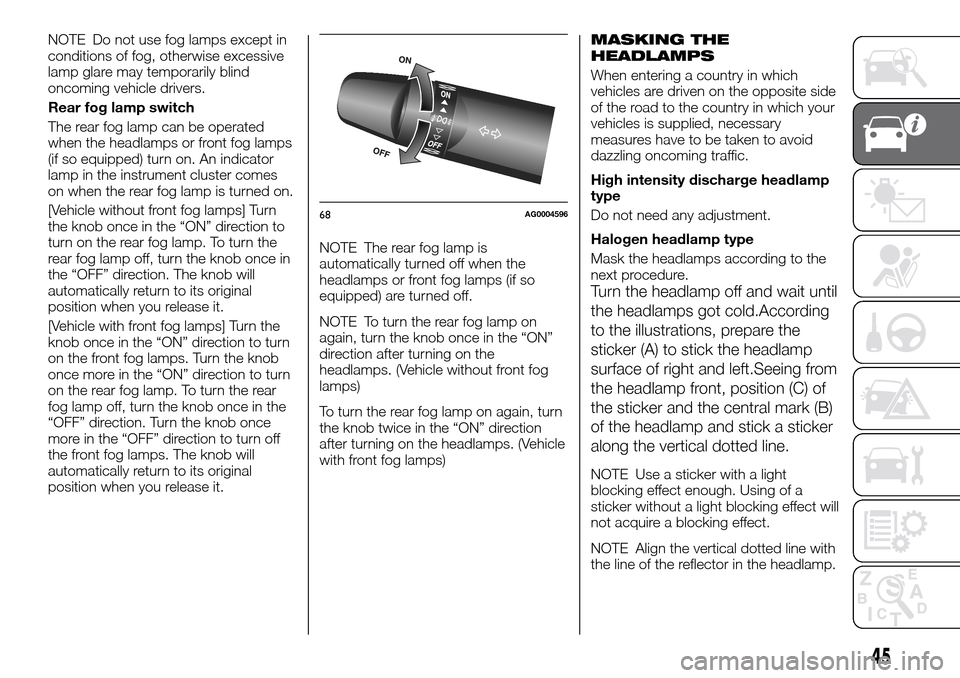
NOTE Do not use fog lamps except in
conditions of fog, otherwise excessive
lamp glare may temporarily blind
oncoming vehicle drivers.
Rear fog lamp switch
The rear fog lamp can be operated
when the headlamps or front fog lamps
(if so equipped) turn on. An indicator
lamp in the instrument cluster comes
on when the rear fog lamp is turned on.
[Vehicle without front fog lamps] Turn
the knob once in the “ON” direction to
turn on the rear fog lamp. To turn the
rear fog lamp off, turn the knob once in
the “OFF” direction. The knob will
automatically return to its original
position when you release it.
[Vehicle with front fog lamps] Turn the
knob once in the “ON” direction to turn
on the front fog lamps. Turn the knob
once more in the “ON” direction to turn
on the rear fog lamp. To turn the rear
fog lamp off, turn the knob once in the
“OFF” direction. Turn the knob once
more in the “OFF” direction to turn off
the front fog lamps. The knob will
automatically return to its original
position when you release it.NOTE The rear fog lamp is
automatically turned off when the
headlamps or front fog lamps (if so
equipped) are turned off.
NOTE To turn the rear fog lamp on
again, turn the knob once in the “ON”
direction after turning on the
headlamps. (Vehicle without front fog
lamps)
To turn the rear fog lamp on again, turn
the knob twice in the “ON” direction
after turning on the headlamps. (Vehicle
with front fog lamps)MASKING THE
HEADLAMPS
When entering a country in which
vehicles are driven on the opposite side
of the road to the country in which your
vehicles is supplied, necessary
measures have to be taken to avoid
dazzling oncoming traffic.
High intensity discharge headlamp
type
Do not need any adjustment.
Halogen headlamp type
Mask the headlamps according to the
next procedure.
Turn the headlamp off and wait until
the headlamps got cold.According
to the illustrations, prepare the
sticker (A) to stick the headlamp
surface of right and left.Seeing from
the headlamp front, position (C) of
the sticker and the central mark (B)
of the headlamp and stick a sticker
along the vertical dotted line.
NOTE Use a sticker with a light
blocking effect enough. Using of a
sticker without a light blocking effect will
not acquire a blocking effect.
NOTE Align the vertical dotted line with
the line of the reflector in the headlamp.
68AG0004596
45
Page 105 of 312

SEAT BELTS
To protect you and your passengers in
the event of an accident, it is the most
important that the seat belts be worn
correctly while driving.
The driver’s and front passenger’s seat
belt equipped with an airbag each have
a pre-tensioner system and the rear
seat belts equipped with a dual stage
airbag system each have a
pre-tensioner system. These belts are
used the same way as a conventional
seat belt.
Refer to “Seat belt pre-tensioner
system and force limiter system”.
104) 105) 106) 107) 108) 109) 110) 111) 112) 113)
3-point type seat belt (with
emergency locking mechanism)
This type of belt requires no length
adjustment. Once worn, the belt
adjusts itself to the movement of
wearer, but in the event of a sudden or
strong shock, the belt automatically
locks to hold the wearer’s body.
NOTE You can check if the belt locks
by pulling it forward quickly.To fasten
1. Pull the seat belt out slowly while
holding the latch plate.
NOTE When the seat belts cannot be
pulled out in a locked condition, pull the
belts once forcefully and then return
them. After that, pull the belts out
slowly once again.
2. Insert the latch plate into the buckle
until a “click” is heard.
114)
59) 60)
To unfasten
Hold the latch plate and push the
button on the buckle.NOTE As the belt retracts
automatically, keep the latch plate held
while retracting so that the belt stows
slowly. Failure to do this could damage
the vehicle.
113)
SEAT BELT INSPECTION
Check the belts for cuts, worn or frayed
webbing and for cracked or deformed
metallic parts. Replace the belt
assembly if defective.
A dirty belt should be cleaned with
neutral detergent in warm water. After
rinsing in water, let it dry in the shade.
Do not attempt to bleach or re-dye the
belts because this affects their
characteristics.
115) 116) 117)
61) 62)
180AA0008466
181AA0008293
103
Page 119 of 312

If it is difficult to latch the tether strap
hook, turn the hook sideways.
6. Push and pull the child restraint
system in all directions to be sure it is
firmly secured.
To remove
Remove the child restraint system in
accordance with the instructions
provided by the child restraint system’s
manufacturer.
Installing a child restraint system to
a 3-point type seat belt (with
emergency locking mechanism)
Installation
1. Put a child restraint system on the
seat in which you wish to install it and
remove the head restraint from the seat.
Refer to “Head restraints”.
2. Route the belt through the child
restraint according to the child restraint
system manufacturer’s instructions,then insert the latch plate into the
buckle.
3. Remove all slack of a lap belt by
pulling the webbing through the belts
adjustment feature. 3 point type seat
belt requires no length adjustment,
remove all slack by using the locking
clip (A).
4. Before putting the child in the
restraint, push and pull the child
restraint in all directions to be sure it is
secure. Do this before each use.
144)
WARNING
141)When installing a child restraint
system, remove the head restraint from the
seat.142)Child restraint anchorages are
designed to withstand only those loads
imposed by correctly fitted child restraints.
Under no circumstances are they to be
used for adult seat belts, harnesses, or for
attaching other items or equipment to the
vehicle.
143)When installing a child restraint
system on the separate seat, adjust the
seatback angle to 1 step rearward from the
first locking position.
144)For some type of child restraint, the
locking clip (A) should be used to help
avoid personal injury during a collision or
sudden manoeuvre. It must be fitted and
used in accordance with the child restraint
manufacturer’s instructions. The locking
clip must be removed when the child
restraint is removed.
IMPORTANT
68)The anchorages are only applicable for
child restraints fitted in the seat.
F
E
197AHA105671
A
198AA0008772
117
Page 128 of 312

176)Do not modify your steering wheel,
seat belt retractor or any other SRS
components. For example, replacement of
the steering wheel, or modifications to the
front bumper or body structure can
adversely affect SRS performance and lead
to possible injury.
177)If your vehicle has received any
damage, we recommend you to have the
SRS inspected to ensure it is in proper
working order.
178)On vehicles with the side airbag, do
not modify your front seats, centre pillar
and centre console. It can adversely affect
SRS performance and lead to possible
injury.
179)If you found any tear, scratch, crack
or damage to the portion where the airbag
is stored, you should have the SRS
inspected by a Fiat Dealership.ACTIVE SAFETY
SYSTEMS
Brake assist system (where
provided)
The brake assist system is a device
assisting drivers who cannot depress
the brake pedal firmly such as in
emergency stop situations and provides
greater braking force.
If the brake pedal is depressed
suddenly, the brakes will be applied
with more force than usual.
180)
NOTE Once the brake assist system is
operational, it maintains great braking
force even if the brake pedal is lightly
released. To stop its operation,
completely remove your foot from the
brake pedal.
NOTE When the brake assist system is
in use while driving, you may feel the
brake pedal attempt to resist, the pedal
moves in small motions in conjunction
with the operation noise, or the vehicle
body and the steering wheel vibrate.
This occurs when the brake assist
system is operating normally and does
not indicate faulty operation. Continue
to depress the brake pedal.
NOTE When the active stability &
traction control (ASTC) indicator lamp is
illuminated, the brake assist system
may not function.Anti-lock brake system (ABS)
(where provided)
The anti-lock brake system (ABS) helps
prevent the wheels from locking up
when braking. This helps maintain
vehicle drivability and steering wheel
handling.
Driving hints
Always keep a safe distance from the
vehicle in front of you. Even if your
vehicle is equipped with the ABS, leave
a greater braking distance when:
Driving on gravel or snow-covered
roads.
Driving with tyre chains installed.
Driving on roads where the road
surface is pitted or has other
differences in surface height.
Driving on uneven road surfaces.
Operation of ABS is not restricted
situations where brakes are applied
suddenly. This system may also prevent
the wheels from locking when you drive
over manholes, steel roadwork plates,
road markings, or any uneven road
surface.
When the ABS is in use, you may feel
the brake pedal pulsation and the
vibrations of the vehicle body and
steering wheel. It may also feel as if the
pedal resists being pressed.
In this situation, simply hold the brake
pedal down firmly. Do not pump the
brake, which will result in reduced
braking performance.
126
SAFETY