2016 FIAT DOBLO COMBI battery
[x] Cancel search: batteryPage 134 of 298

EMERGENCY STARTING
In the case of emergency starting,
never connect the negative lead (–) of
the auxiliary battery to the negative pole
C of the vehicle battery, but rather to
either the dummy pole B or to an
engine/gearbox earth point fig. 147.
99) 100) 101) 102)
WARNING
98)If the battery needs to be replaced,
always contact a Fiat Dealership. Replace
the battery with a new one of the same
type and specifications.
99)Before opening the bonnet, make sure
that the vehicle is switched off and the
key is in the OFF position. Please follow the
instructions on the decal near the front
crossmember. It is advisable to extract the
key when there are other people in the
vehicle.100)The vehicle should always be
evacuated after the key has been removed
or turned to the OFF position. When
refuelling, make sure that the vehicle is
switched off with the key in the OFF
position.
101)For vehicles with robotised gearbox,
in the event of automatic engine stopping
with the vehicle on a slope, the engine
should be restarted by moving the gear
lever towards (+) or (–) without releasing
the brake pedal. For vehicles with
robotised gearbox and Hill Holder function,
in the event of automatic engine stopping
with the vehicle on a slope, the engine
must be restarted by moving the gear lever
towards (+) or (–) without releasing the
brake pedal, so that the Hill Holder
function, active only with the engine
running, becomes available.
102)If climate comfort is to be favoured,
the Start&Stop system can be disabled, for
a continuous operation of the climate
control system.
TPMS (Tyre
Pressure
Monitoring System)
(for versions/markets, where provided)
103) 104) 105) 106) 107) 108) 109) 110) 111)
DESCRIPTION
The tyre pressure monitoring system
(TPMS) warns the driver of low tyre
pressure on the basis of the cold
inflation pressure prescribed for the
vehicle.
Changes in outside temperature may
cause tyre pressure to vary. This means
that a decrease in the outside
temperature corresponds to a decrease
in the tyre pressure.
Tyre pressure must always be adjusted
according to the cold inflation pressure.
Cold tyre inflation pressure is the tyre
pressure after letting the vehicle stand
for at least three hours or a travel
shorter than 1.6 km after an interval of
three hours.
The cold tyre inflation pressure must
not exceed the maximum inflation
pressure value printed on the side of
the tyre.
The tyre pressure also increases while
driving the vehicle: this is a normal
condition and does not require any
adjustment of the pressure.
NOTE
147F0V0043
130
STARTING AND DRIVING
Page 157 of 298

ENGINE COMPARTMENT
FUSE BOX
The fuse box fig. 179 is located on the
right-hand side of the engine, next to
the battery. To remove the protective
cover A fig. 178 and access the fuse
box, undo the two fixing screws B.
27)
178F0V0081
179F0V0089
153
Page 160 of 298
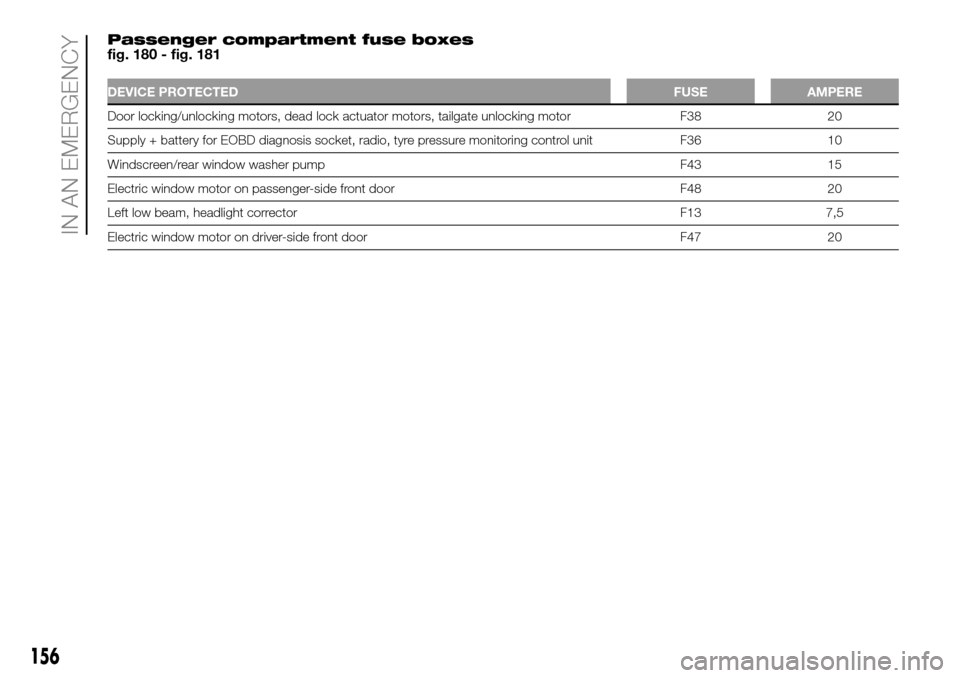
Passenger compartment fuse boxes
fig. 180 - fig. 181
DEVICE PROTECTEDFUSE AMPERE
Door locking/unlocking motors, dead lock actuator motors, tailgate unlocking motor F38 20
Supply + battery for EOBD diagnosis socket, radio, tyre pressure monitoring control unit F36 10
Windscreen/rear window washer pump F43 15
Electric window motor on passenger-side front door F48 20
Left low beam, headlight corrector F13 7,5
Electric window motor on driver-side front door F47 20
156
IN AN EMERGENCY
Page 169 of 298

WARNING
28)The label on the Fix&Go kit’s packaging
gives the information required by the laws
in force. To ensure that the Fix&Go kit is
safe and effective, it is essential to comply
with all the instructions given on the label.
Carefully read the label before use, avoid
improper use. Fix&Go is subject to
expiration and must be replaced
periodically. The kit should be used by
adults and cannot be used by children.
WARNING
129)Show the package and the label to
the personnel charged with handling
the tyre treated with the tyre repair kit.
130)Fix&Go provides a temporary repair,
therefore the tyre must be examined and
repaired by a specialist as soon as
possible. The sealing fluid is effective at
temperatures between -40°C and +50°C. It
is possible to repair tyres which have
been damaged on tread up to a diameter
of 4mm; however, tyres damaged on
their side cannot be repaired. Before using
Fix&Go kit, ensure that the tyre isn't
excessively damaged and that the rim is in
good condition, otherwise do not use it
and contact a Fiat Dealership. Do not
remove foreign bodies from the tyre. Do
not let the compressor turned on for more
than 20 consecutive minutes - overheating
hazard.
EMERGENCY
STARTING
Go to a Fiat Dealership immediately if
warning light
stays on constantly on
the instrument panel.
JUMP STARTING
If the battery is flat, it is possible to start
the engine using an auxiliary battery
with the same capacity or a little higher
than the flat one.
Proceed as follows to start the vehicle
fig. 205:
connect the positive terminals (+
mark near the terminal) of the two
batteries using a suitable lead;
with a second lead, connect the
negative terminal (–) of the auxiliary
battery to an earthing point
on the
engine or the gearbox of the vehicle to
be started;
start the engine;
when the engine has been started,
remove the cables reversing the order
above.
If after a few attempts the engine does
not start, do not persist but contact
the nearest Fiat Dealership.IMPORTANT Do not directly connect
the negative terminals of the two
batteries: any sparks may ignite the
explosive gas which could come out of
the battery. If the auxiliary battery is
installed on another vehicle, avoid any
metal parts on the latter and the vehicle
with the flat battery from accidentally
coming into contact.
29)
131)
BUMP STARTING
Never bump start the engine by
pushing, towing or coasting downhill.
This could cause fuel to flow into the
catalytic converter and damage it
beyond repair.
205F0V0147
165
Page 170 of 298

IMPORTANT Remember that the brake
booster and the electric power steering
system are not active until the engine
is started, so you will need to apply
much more force to the brake pedal or
steering wheel.
WARNING
29)Never use a fast battery-charger for
emergency starting of the engine as this
could damage the electronic systems
of your vehicle, particularly the ignition and
fuel supply control units.
WARNING
131)This procedure must be performed by
qualified personnel as incorrect actions
may cause high-intensity electrical
discharge. Furthermore, battery fluid is
poisonous and corrosive: avoid contact
with skin and eyes. Keep naked flames
away from the battery. No smoking. Do not
cause sparks.
FUEL CUT-OFF
SYSTEM
This intervenes in the case of an impact
causing:
the fuel supply cut-off with the
engine consequently switching off;
the automatic unlocking of the
doors;
the switching on of the interior lights;
switching on of the hazard warning
lights (to deactivate the lights press
the dedicated button on the
dashboard).
132)When the system has been triggered,
the message “Fuel cut off, see
handbook” is displayed on some
versions.
Check carefully for fuel leaks, for
instance in the engine compartment,
under the vehicle or near the tank area.
After a collision, turn the ignition key
to STOP to prevent the battery from
running down.
The following procedure should be
carried out to restore the correct
operation of the vehicle:
turn the ignition key to the MAR
position;
activate the right direction indicator;
deactivate the right direction
indicator;
activate the left direction indicator;
deactivate the left direction indicator;
activate the right direction indicator;
deactivate the right direction
indicator;
activate the left direction indicator;
deactivate the left direction indicator;
turn the ignition key to the OFF
position.
WARNING
132)If, after an impact, you smell fuel or
notice leaks from the fuel supply system,
do not reactivate the system to avoid
the risk of fire.
166
IN AN EMERGENCY
Page 173 of 298

SERVICING AND CARE
Correct maintenance permits the
performance of the car to be
maintained over time, as well as limited
running costs and safeguarding the
efficiency of the safety systems.
This chapter explains how.SCHEDULED SERVICING ...............170
SCHEDULED SERVICING PLAN .....171
PERIODIC CHECKS ........................178
DEMANDING VEHICLE USE ...........178
ENGINE COMPARTMENT ...............179
AIR CLEANER/ POLLEN FILTER .....189
DIESEL FILTER................................189
BATTERY ........................................190
BATTERY RECHARGING ................191
WINDSCREEN/REAR WINDOW
WIPER ............................................192
WHEELS AND TYRES.....................194
RUBBER HOSES ............................195
PROLONGED VEHICLE
INACTIVITY .....................................195
BODYWORK ...................................196
INTERIORS .....................................198
169
Page 175 of 298

SCHEDULED SERVICING PLAN
PETROL VERSIONS
Thousands of kilometres 30 60 90 120 150 180
Months 24 48 72 96 120 144
Check battery charge status and possibly recharge●●●●●●
Check tyre conditions/wear and adjust pressure, if necessary●●●●●●
Check operation of lighting system (headlights, direction
indicators, hazard warning lights, boot, passenger compartment,
glove compartment, instrument panel warning lights, etc.)●●●●●●
Check operation of the windscreen wiper/washer system and
adjust jets, if necessary●●●●●●
Check the position/wear of the windscreen/rear window wiper
blades●●●●●●
Check front disc brake pad condition and wear and operation of
brake pad wear indicator●●●●●●
Check rear drum brake lining condition and wear●●●
Visually inspect condition of: exterior bodywork, underbody
protection, pipes and hoses (exhaust - fuel system - brakes),
rubber elements (boots, sleeves, bushes, etc.)●●●●●●
Check cleanliness of bonnet and luggage compartment locks,
cleanliness and lubrication of linkage●●●●●●
Visually inspect condition of the accessory drive belt(s)●●
Check tension of accessory drive belt (versions without automatic
tensioner)●●
171
Page 176 of 298

Thousands of kilometres 30 60 90 120 150 180
Months 24 48 72 96 120 144
Check handbrake lever travel and adjust, if necessary●●●●●●
Check exhaust emissions/smokiness●●●●●●
Inspect the conditions of toothed timing drive belt●●
Spark plug replacement (*)●●●●●●
Replace accessory drive belt/s●
Replace the toothed timing drive belt (**)●
Replace air cleaner cartridge●●●●●●
Check and, if necessary, top up fluid levels (brakes/hydraulic
clutch, windscreen washer, battery, engine cooling, etc.)●●●●●●
Check operation of engine management systems (using diagnosis
socket)●●●●●●
Check cleanliness of sliding side door lower guides (or every 6
months)●●●●●●
(*) For 1.4 Turbo Petrol versions, in order to guarantee correct operation and prevent serious damage to the engine, it is essential to observe the following: only use
spark plugs specifically certified for these engines; all spark plugs should be of the same type and brand (see the “Engine” paragraph in the "Technical
Specifications" section); strictly comply with the replacement intervals in the Scheduled Servicing Plan; you are advised to contact a Fiat Dealership to have plugs
replaced.
(**) Irrespective of the mileage, the timing drive belt must be changed every 4 years for heavy-duty use (cold climates, town use, long periods of idling) or at least
every 5 years.
172
SERVICING AND CARE