Page 441 of 587
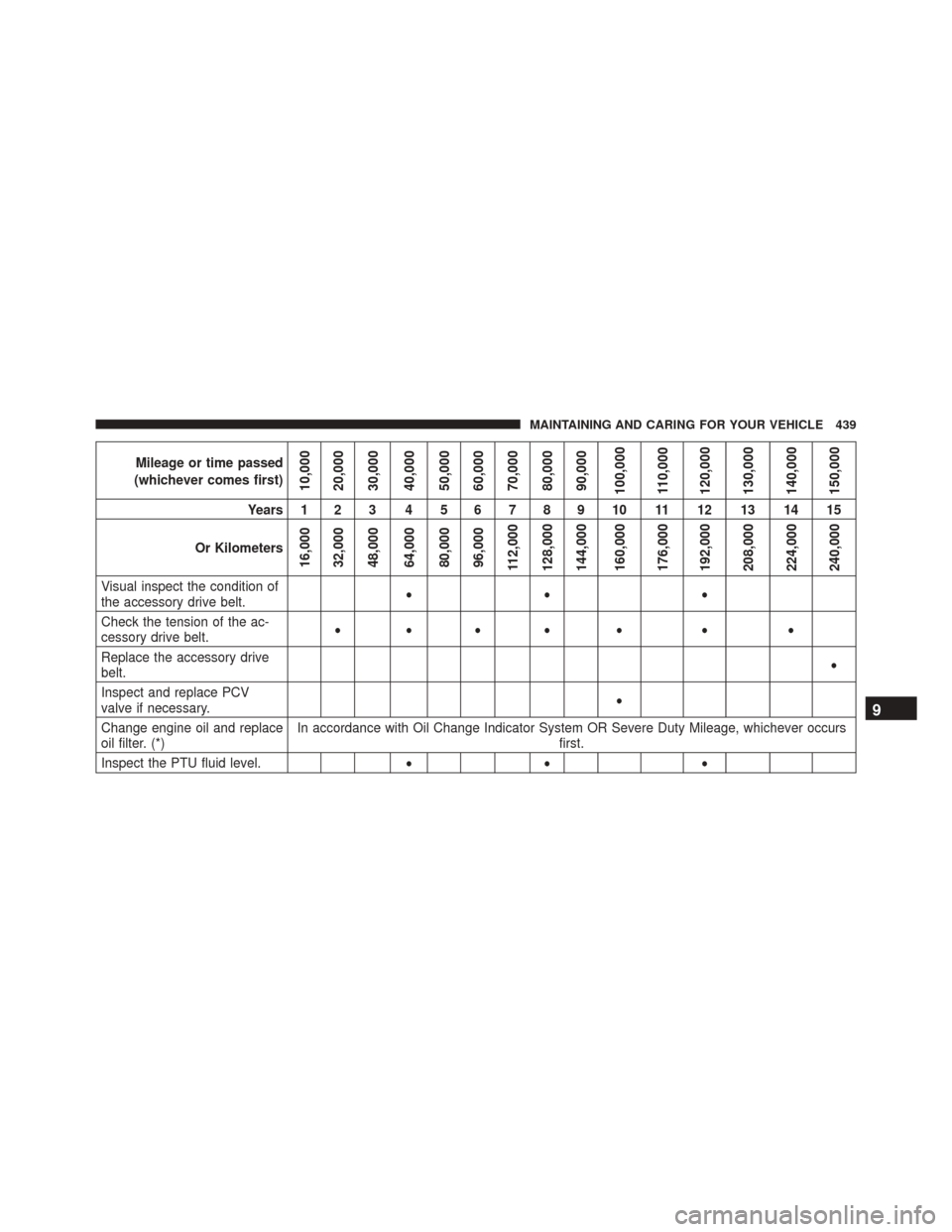
Mileage or time passed
(whichever comes first)
10,000
20,000
30,000
40,000
50,000
60,000
70,000
80,000
90,000
100,000
110,000
120,000
130,000
140,000
150,000
Years 1 2 3 4 5 6 7 8 9 10 11 12 13 14 15
Or Kilometers
16,000
32,000
48,000
64,000
80,000
96,000
112,000
128,000
144,000
160,000
176,000
192,000
208,000
224,000
240,000
Visual inspect the condition of
the accessory drive belt. •• •
Check the tension of the ac-
cessory drive belt. •••• • • •
Replace the accessory drive
belt. •
Inspect and replace PCV
valve if necessary. •
Change engine oil and replace
oil filter. (*) In accordance with Oil Change Indicator System OR Severe Duty Mileage, whichever occurs
first.
Inspect the PTU fluid level. •• •
9
MAINTAINING AND CARING FOR YOUR VEHICLE 439
Page 444 of 587
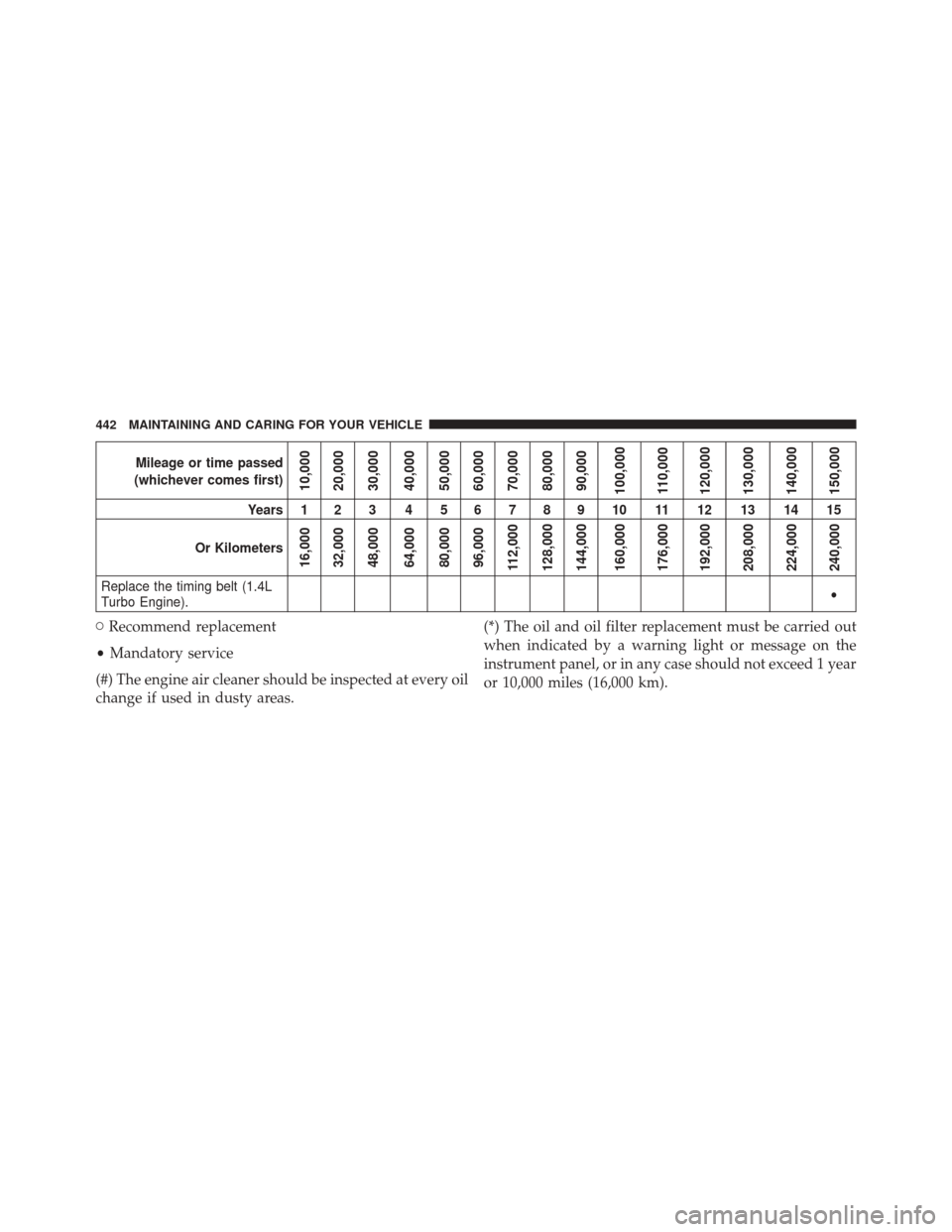
Mileage or time passed
(whichever comes first)
10,000
20,000
30,000
40,000
50,000
60,000
70,000
80,000
90,000
100,000
110,000
120,000
130,000
140,000
150,000
Years 1 2 3 4 5 6 7 8 9 10 11 12 13 14 15
Or Kilometers
16,000
32,000
48,000
64,000
80,000
96,000
112,000
128,000
144,000
160,000
176,000
192,000
208,000
224,000
240,000
Replace the timing belt (1.4L
Turbo Engine). •
�
Recommend replacement
• Mandatory service
(#) The engine air cleaner should be inspected at every oil
change if used in dusty areas. (*) The oil and oil filter replacement must be carried out
when indicated by a warning light or message on the
instrument panel, or in any case should not exceed 1 year
or 10,000 miles (16,000 km).
442 MAINTAINING AND CARING FOR YOUR VEHICLE
Page 446 of 587
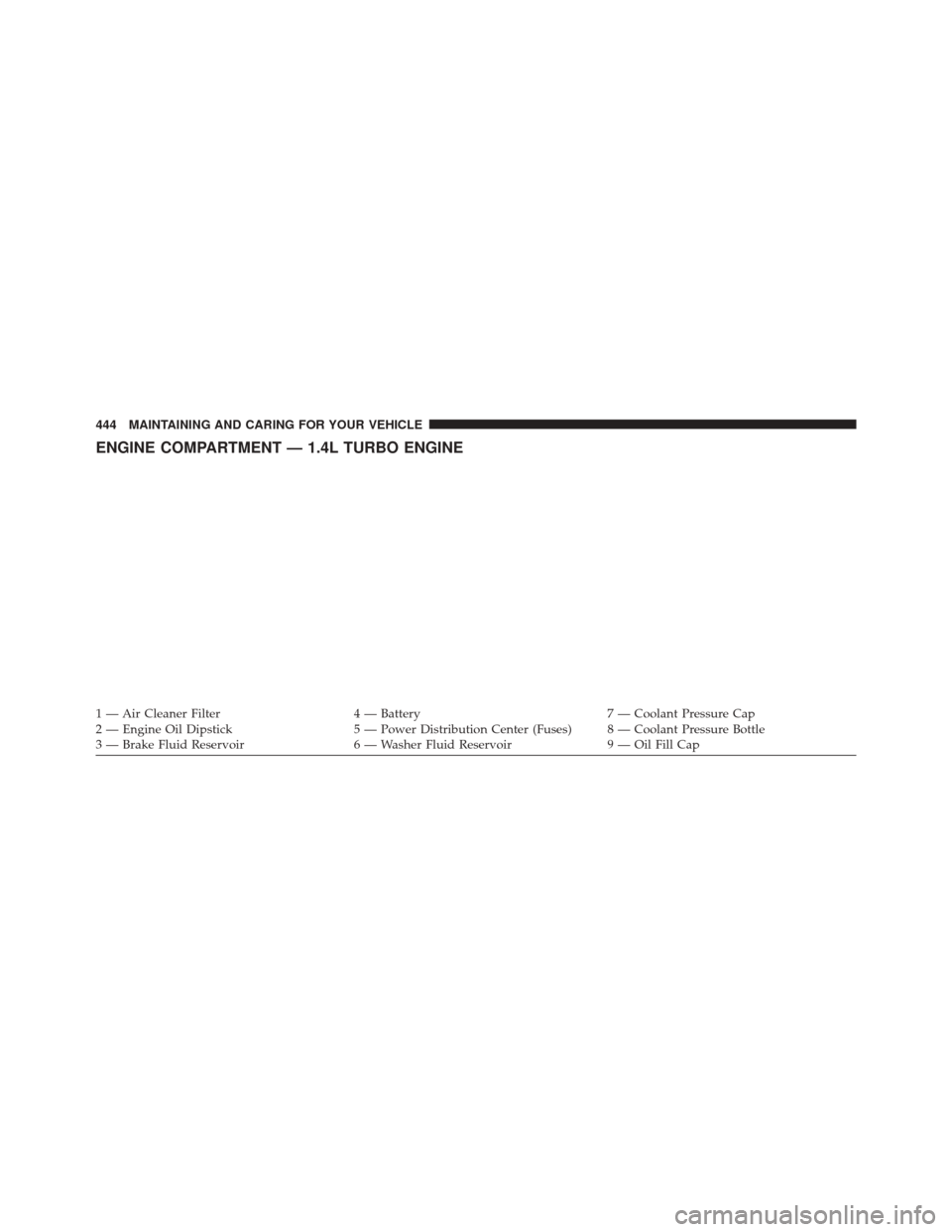
ENGINE COMPARTMENT — 1.4L TURBO ENGINE
1 — Air Cleaner Filter4 — Battery7 — Coolant Pressure Cap
2 — Engine Oil Dipstick 5 — Power Distribution Center (Fuses) 8 — Coolant Pressure Bottle
3 — Brake Fluid Reservoir 6 — Washer Fluid Reservoir9 — Oil Fill Cap
444 MAINTAINING AND CARING FOR YOUR VEHICLE
Page 447 of 587
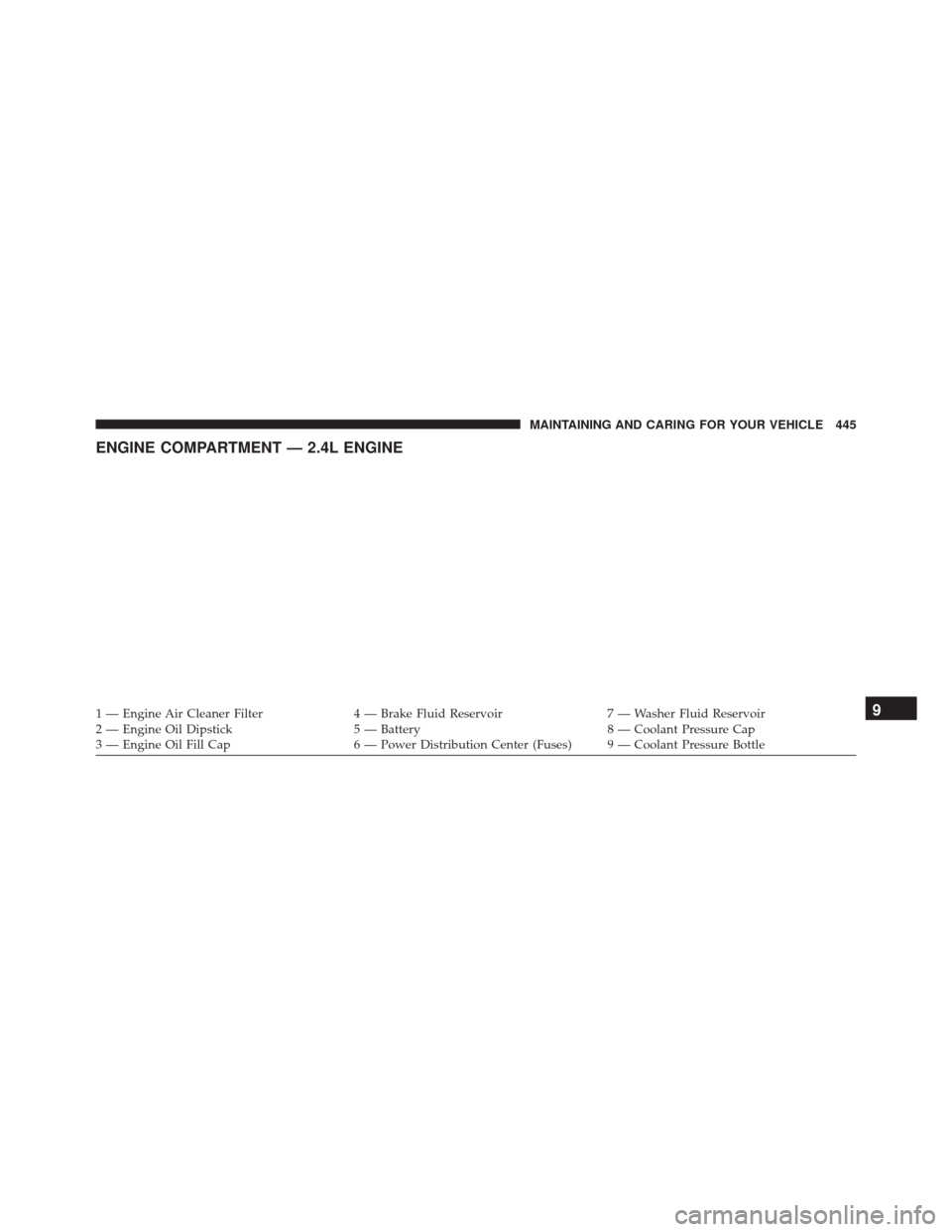
ENGINE COMPARTMENT — 2.4L ENGINE
1 — Engine Air Cleaner Filter4 — Brake Fluid Reservoir7 — Washer Fluid Reservoir
2 — Engine Oil Dipstick 5 — Battery8 — Coolant Pressure Cap
3 — Engine Oil Fill Cap 6 — Power Distribution Center (Fuses) 9 — Coolant Pressure Bottle9
MAINTAINING AND CARING FOR YOUR VEHICLE 445
Page 448 of 587
MAINTENANCE PROCEDURES
The pages that follow contain therequiredmaintenance
services determined by the engineers who designed your
vehicle.
Besides those maintenance items specified in the fixed
maintenance schedule, there are other components which
may require servicing or replacement in the future.
CAUTION!
• Failure to properly maintain your vehicle or per-
form repairs and service when necessary could
result in more costly repairs, damage to other
components or negatively impact vehicle perfor-
mance. Immediately have potential malfunctions
examined by an authorized dealer or qualified
repair center.
(Continued)
CAUTION! (Continued)
•Your vehicle has been built with improved fluids
that protect the performance and durability of your
vehicle and also allow extended maintenance inter-
vals. Do not use chemical flushes in these compo-
nents as the chemicals can damage your engine,
transmission, or air conditioning. Such damage is
not covered by the New Vehicle Limited Warranty.
If a flush is needed because of component malfunc-
tion, use only the specified fluid for the flushing
procedure.
Engine Oil
Checking Oil Level
To assure proper engine lubrication, the engine oil must
be maintained at the correct level. Check the oil level at
regular intervals, such as every fuel stop. The best time to
check the engine oil level is approximately five minutes
446 MAINTAINING AND CARING FOR YOUR VEHICLE
Page 449 of 587
after a fully warmed engine is shut off. Do not check oil
level before starting the engine after it has sat overnight.
Checking engine oil level when the engine is cold will
give you an incorrect reading.
Checking the oil while the vehicle is on level ground, and
approximately five minutes after a fully warmed engine
is shut off, will improve the accuracy of the oil level
readings. Maintain the oil level between the range mark-
ings on the dipstick. The safe range is indicated by a
crosshatch zone. Adding 1 quart (0.9 Liters) of oil when
the reading is at the low end of the indicated range will
result in the oil level at the full end of the indicator range.
CAUTION!
Do not overfill the engine with oil. Overfilling the
engine with oil will cause oil aeration, which can
lead to loss of oil pressure and an increase in oil
(Continued)
CAUTION!(Continued)
temperature. This loss of oil pressure and increased
oil temperature could damage your engine.
Change Engine Oil
The oil change indicator system will remind you that it is
time to take your vehicle in for scheduled maintenance.
Refer to the “Maintenance Schedule” for further informa-
tion.
NOTE:Under no circumstances should oil change inter-
vals exceed 10,000 miles (16,000 km), twelve months or
350 hours of engine run time, whichever comes first. The
350 hours of engine run or idle time is generally only a
concern for fleet customers.
9
MAINTAINING AND CARING FOR YOUR VEHICLE 447
Page 450 of 587
Engine Oil Selection — 1.4L Turbo Engine
For best performance and maximum protection for tur-
bocharged engines under all types of operating condi-
tions, the manufacturer recommends synthetic engine
oils that are API Certified and meet the requirements of
FCA US Material Standard MS-12991.
Engine Oil Selection — 2.4L Engine
For best performance and maximum protection under all
types of operating conditions, the manufacturer only
recommends 0W-20 engine oils that are API Certified and
meet the requirements of FCA US Material Standard
MS-6395.
Engine Oil Viscosity (SAE Grade) — 1.4L Turbo
Engine
MOPAR SAE 5W-40 synthetic engine oil is recommended
for all operating temperatures. This engine oil improveslow temperature starting and vehicle fuel economy. Your
engine oil filler cap also states the recommended engine
oil viscosity grade for your engine.
Lubricants which do not have both the engine oil certi-
fication mark and the correct SAE viscosity grade num-
ber should not be used.
Engine Oil Viscosity (SAE Grade) — 2.4L Engine
MOPAR SAE 0W-20 engine oil is recommended for all
operating temperatures. This engine oil improves low
temperature starting and vehicle fuel economy. Your
engine oil filler cap also states the recommended engine
oil viscosity grade for your engine.
Lubricants which do not have both the engine oil certi-
fication mark and the correct SAE viscosity grade num-
ber should not be used.
448 MAINTAINING AND CARING FOR YOUR VEHICLE
Page 451 of 587
Materials Added To Engine Oil
The manufacturer strongly recommends against the ad-
dition of any additives (other than leak detection dyes) to
the engine oil. Engine oil is an engineered product and its
performance may be impaired by supplemental addi-
tives.
Disposing Of Used Engine Oil And Oil Filters
Care should be taken in disposing of used engine oil and
oil filters from your vehicle. Used oil and oil filters,
indiscriminately discarded, can present a problem to the
environment. Contact your authorized dealer, service
station or governmental agency for advice on how and
where used oil and oil filters can be safely discarded in
your area.
Engine Oil Filter
The engine oil filter should be replaced with a new filter
at every engine oil change.
Engine Oil Filter Selection
This manufacturer’s engines have a full-flow type dispos-
able oil filter. Use a filter of this type for replacement. The
quality of replacement filters varies considerably. Only
high quality filters should be used to assure most efficient
service. MOPAR engine oil filters are high quality oil
filters and are recommended.
Engine Air Cleaner Filter
Refer to the “Maintenance Schedule” for the proper
maintenance intervals.
WARNING!
The air induction system (air cleaner, hoses, etc.) can
provide a measure of protection in the case of engine
backfire. Do not remove the air induction system (air
cleaner, hoses, etc.) unless such removal is necessary
(Continued)
9
MAINTAINING AND CARING FOR YOUR VEHICLE 449