Page 347 of 476
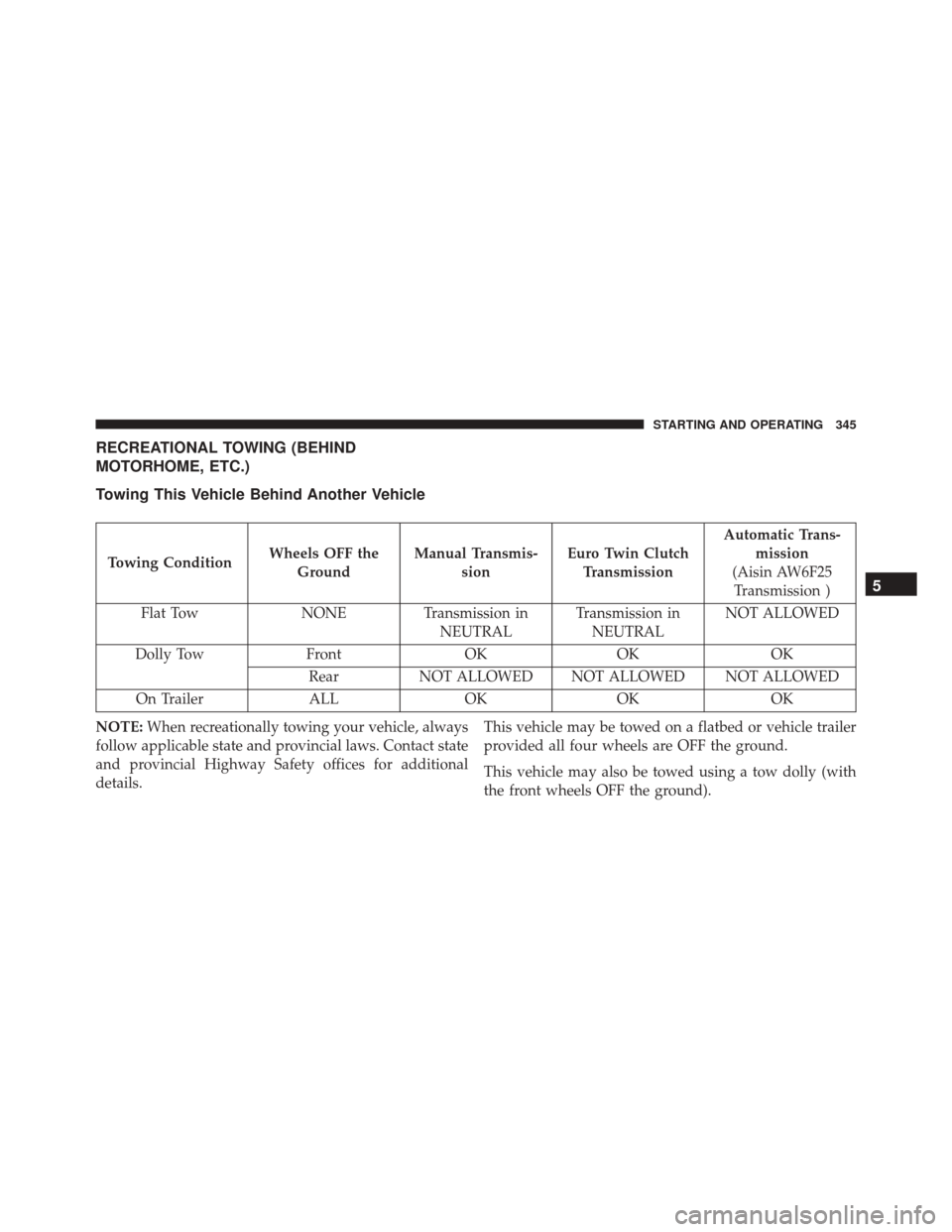
RECREATIONAL TOWING (BEHIND
MOTORHOME, ETC.)
Towing This Vehicle Behind Another Vehicle
Towing ConditionWheels OFF the
Ground Manual Transmis-
sion Euro Twin Clutch
Transmission Automatic Trans-
mission
(Aisin AW6F25 Transmission )
Flat Tow NONETransmission in
NEUTRAL Transmission in
NEUTRAL NOT ALLOWED
Dolly Tow FrontOKOK OK
Rear NOT ALLOWED NOT ALLOWED NOT ALLOWED
On Trailer ALLOKOK OK
NOTE: When recreationally towing your vehicle, always
follow applicable state and provincial laws. Contact state
and provincial Highway Safety offices for additional
details. This vehicle may be towed on a flatbed or vehicle trailer
provided all four wheels are OFF the ground.
This vehicle may also be towed using a tow dolly (with
the front wheels OFF the ground).
5
STARTING AND OPERATING 345
Page 348 of 476
Vehicles equipped with a manual transmission, or a Euro
Twin Clutch transmission, may be flat towed (with all
four wheels on the ground) at any legal highway speed,
for any distance, if the transmission is in NEUTRAL.
To place the Euro Twin Clutch transmission in NEU-
TRAL, follow the procedure below:
1. Turn the key to the ON/RUN position, without start-ing the engine.
2. Press the brake pedal and shift the transmission to NEUTRAL.
3. Turn the key to the OFF position. The key will remain in the ignition switch (it cannot be removed, since the
transmission is not in PARK). Leave the key in the OFF
position while being towed. 4. Release the brake pedal only when the parking brake
is applied, or the vehicle is securely connected to a tow
vehicle.
CAUTION!
•DO NOT flat tow any vehicle equipped with a
conventional automatic transmission. Damage to
the drivetrain will result. If these vehicles require
towing, make sure all drive wheels are OFF the
ground.
• Towing this vehicle in violation of the above re-
quirements can cause severe transmission damage.
Damage from improper towing is not covered un-
der the New Vehicle Limited Warranty.
(Continued)
346 STARTING AND OPERATING
Page 349 of 476
WHAT TO DO IN EMERGENCIES
CONTENTS
�HAZARD WARNING FLASHERS ...........349
� IF YOUR ENGINE OVERHEATS ............349
� WHEEL AND TIRE TORQUE
SPECIFICATIONS ..................... .350
▫ Torque Specifications ...................351
� TIRE SERVICE KIT ..................... .352
� JACKING AND TIRE CHANGING — IF
EQUIPPED .......................... .357
▫ Jack Location ....................... .358
▫ Spare Tire Removal ....................359 ▫
Preparations For Jacking ................360
▫ Jacking Instructions ...................360
▫ Spare Tire Stowage ....................364
� JUMP-STARTING PROCEDURE ............365
▫ Preparations For Jump-Start ..............366
▫ Jump-Starting Procedure ................367
� FREEING A STUCK VEHICLE .............370
� SHIFT LEVER OVERRIDE ................371
� TOWING A DISABLED VEHICLE ...........373
▫ Manual Transmission ...................374
6
Page 356 of 476
WARNING!(Continued)
– If the tire has any sidewall damage.
– If the tire has any damage from driving with
extremely low tire pressure.
– If the tire has any damage from driving on a flat tire.
– If the wheel has any damage.
– If you are unsure of the condition of the tire or the wheel.
• Keep Tire Service Kit away from open flames or
heat source.
• A loose Tire Service Kit thrown forward in a
collision or hard stop could endanger the occupants
of the vehicle. Always stow the Tire Service Kit in
the place provided. Failure to follow these warn-
ings can result in injuries that are serious or fatal to
you, your passengers, and others around you.
(Continued)
WARNING! (Continued)
•Take care not to allow the contents of Tire Service
Kit to come in contact with hair, eyes, or clothing.
Tire Service Kit sealant is harmful if inhaled,
swallowed, or absorbed through the skin. It causes
skin, eye, and respiratory irritation. Flush immedi-
ately with plenty of water if there is any contact
with eyes or skin. Change clothing as soon as
possible, if there is any contact with clothing.
• Tire Service Kit Sealant solution contains latex. In
case of an allergic reaction or rash, consult a phy-
sician immediately. Keep Tire Service Kit out of
reach of children. If swallowed, rinse mouth imme-
diately with plenty of water and drink plenty of
water. Do not induce vomiting! Consult a physician
immediately.
Insert the power plug into the vehicle power outlet
socket. Start the vehicle engine.
354 WHAT TO DO IN EMERGENCIES
Page 361 of 476
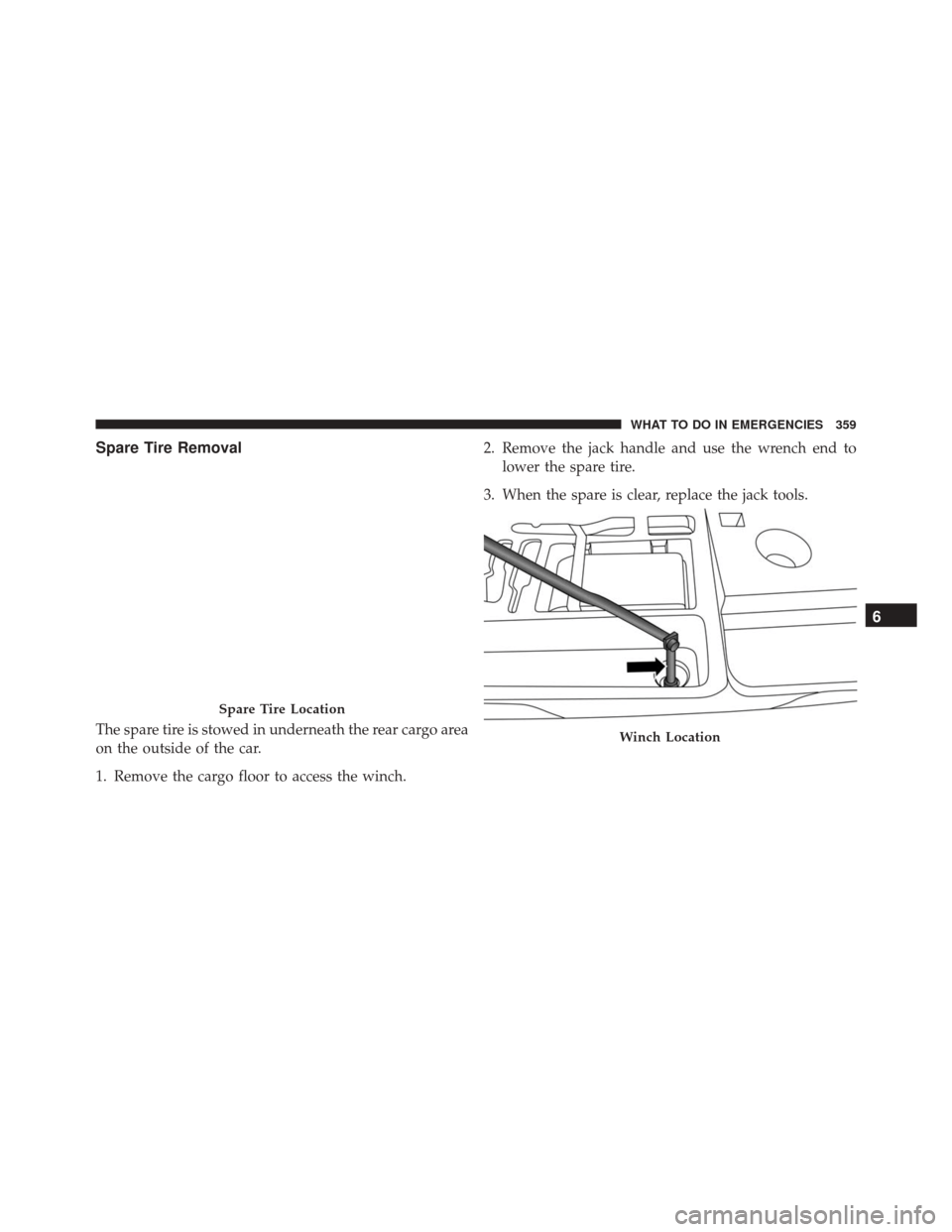
Spare Tire Removal
The spare tire is stowed in underneath the rear cargo area
on the outside of the car.
1. Remove the cargo floor to access the winch.2. Remove the jack handle and use the wrench end to
lower the spare tire.
3. When the spare is clear, replace the jack tools.
Spare Tire Location
Winch Location
6
WHAT TO DO IN EMERGENCIES 359
Page 365 of 476
engage the jack saddle with the lift area of the sill
flange, centering the jack saddle between the locating
notches on the sill flange.
5. Raise the vehicle just enough to remove the flat tire and install the spare tire.
WARNING!
Raising the vehicle higher than necessary can make
the vehicle less stable. It could slip off the jack and
hurt someone near it. Raise the vehicle only enough
to remove the tire.
6. Remove the wheel bolts and tire.
7. Mount the spare tire.
CAUTION!
Be sure to mount the spare tire with the valve stem
facing outward. The vehicle could be damaged if the
spare tire is mounted incorrectly.
NOTE: •For vehicles so equipped, do not attempt to install a
center cap or wheel cover on the compact spare.
• Refer to “Compact Spare Tire” and to “Limited-Use
Spare” under “Tires—General Information” in
“Starting and Operating” for additional warnings,
cautions, and information about the spare tire, its
use, and operation.
8. Install the wheel bolts with the threaded end of the wheel bolt toward the wheel. Lightly tighten the
wheel bolts.
6
WHAT TO DO IN EMERGENCIES 363
Page 366 of 476

WARNING!
•To avoid the risk of forcing the vehicle off the jack,
do not tighten the lug nuts fully until the vehicle
has been lowered. Failure to follow this warning
may result in personal injury.
• To avoid possible personal injury, handle the
wheel covers with care to avoid contact with any
sharp edges.
9. Lower the vehicle to the ground by turning the jack handle counterclockwise.
10. Finish tightening the wheel bolts. Push down on the wrench while at the end of the handle for increased
leverage. Tighten the wheel bolts in a star pattern
until each wheel bolt has been tightened twice. Refer
to Torque Specifications in this section for proper lug
nut torque. If in doubt about the correct tightness, have them checked with a torque wrench by your
authorized dealer or at a service station.
11. Stow the jack, tools and flat tire.
WARNING!
A loose tire or jack thrown forward in a collision or
hard stop could endanger the occupants of the ve-
hicle. Always stow the jack parts and the spare tire in
the places provided. Have the deflated (flat) tire
repaired or replaced immediately.
Spare Tire Stowage
Rotate the jack wrench tool on the winch drive nut
clockwise (the flat tire must not be connected to the
winch) until effort becomes heavy and an audible click is
heard indicating the winch is properly stowed.
364 WHAT TO DO IN EMERGENCIES
Page 367 of 476
Cover the flat tire with the Emergency Spare Tire Bag and
stow the flat tire into the trunk.
CAUTION!
The winch mechanism is designed for use with the
jack wrench extension tool only. Use of air wrench or
power tool may damage the winch.
JUMP-STARTING PROCEDURE
If your vehicle has a discharged battery, it can be jump-
started using a set of jumper cables and a battery in
another vehicle or by using a portable battery booster
pack. Jump-starting can be dangerous if done improperly
so please follow the procedures in this section carefully.
NOTE:When using a portable battery booster pack,
follow the manufacturer ’s operating instructions and
precautions.
WARNING!
Do not attempt jump-starting if the battery is frozen.
It could rupture or explode and cause personal injury.
CAUTION!
Do not use a portable battery booster pack or any
other booster source with a system voltage greater
than 12 Volts or damage to the battery, starter motor,
alternator or electrical system may occur.
6
WHAT TO DO IN EMERGENCIES 365