Page 598 of 707
WARNING!
A loose tire or jack thrown forward in a collision or
hard stop could endanger the occupants of the ve-
hicle. Always stow the jack parts and the spare tire in
the places provided. Have the deflated (flat) tire
repaired or replaced immediately.
10. Place the deflated (flat) tire and compact spare tire cover assembly in the rear cargo area. Do not stow
the deflated tire in the compact spare tire location.
Have the full-sized tire repaired or replaced, as soon
as possible.
11. Stow the cable and wheel spacer before driving the vehicle. Reassemble the winch handle extensions to
form a “T” and fit the winch T-handle over the drive
nut. Rotate the nut to the right until the winch
mechanism clicks at least three times. NOTE:
Refer to the “Spare Tire Tools” section for in-
structions on assembling the T-handle.
12. Stow the jack, jack handle and winch handle tools back in the stowage compartment.
13. Check the compact spare tire pressure as soon as possible. Correct the tire pressure, as required.
Securing The Compact Spare Tire
1. Assemble the winch handle extensions to form aT-handle and fit the winch T-handle over the drive
nut. Rotate the nut to the left until the winch mecha-
nism stops turning freely. This will allow enough slack
in the cable to allow you to pull the wheel spacer out
from under the vehicle.
596 WHAT TO DO IN EMERGENCIES
Page 599 of 707
WARNING!
A loose compact spare tire/cover assembly, thrown
forward in a collision or hard stop could endanger
the occupants of the vehicle. Always stow the com-
pact spare tire with the cover assembly in the place
provided.
CAUTION!
The winch mechanism is designed for use with the
winch T-handle only. Use of an air wrench or other
power tools is not recommended and can damage the
winch.
2. Assemble the winch handle extensions to form the spare tire hook, and pull the wheel spacer from under
the vehicle. 3. Turn the compact spare tire so that the valve stem is
down, and place the tire into the compact spare
tire/cover assembly. Slide the wheel spacer through
the center of the wheel and compact spare tire/cover
assembly, so that the two retainer tabs snap out and
engage the compact spare tire cover on the opposite
side.
CAUTION!
The compact spare tire/cover assembly must be used
when the compact spare tire is stored. Failure to use
this cover could drastically reduce the life of the
compact spare tire.6
WHAT TO DO IN EMERGENCIES 597
Page 600 of 707
WARNING!
Verify that both retainer tabs of the wheel spacer have
been properly extended through the center of the
wheel and compact spare tire/cover assembly. Failure
to properly engage both retainer tabs could result in
loss of the compact spare tire and cover assembly,
which will cause vehicle damage and may cause loss of
vehicle control and serious personal injury.
4. Using the winch T-handle, rotate the drive nut to theright until the compact spare tire/cover assembly is
drawn into place against the underside of the vehicle.
5. Continue to rotate the nut to the right until you hear the winch mechanism click three times. It cannot be
overtightened. Check under the vehicle to ensure the
compact spare tire/cover assembly is positioned cor-
rectly against the underside of the vehicle.
CAUTION!
The winch mechanism is designed specifically to
stow a compact spare tire only. Do not attempt to use
the winch to stow the full size deflated tire, or any
other full-size tire, as the tire may not be held
securely. Vehicle damage may result.
Road Tire Installation
Vehicles Equipped With Wheel Covers
1. Mount the road tire on the axle.
2. To ease the installation process for steel wheels withwheel covers, install two lug nuts on the mounting
studs which are on each side of the valve stem. Install
the lug nuts with the cone shaped end of the nut
toward the wheel. Lightly tighten the lug nuts.
598 WHAT TO DO IN EMERGENCIES
Page 601 of 707
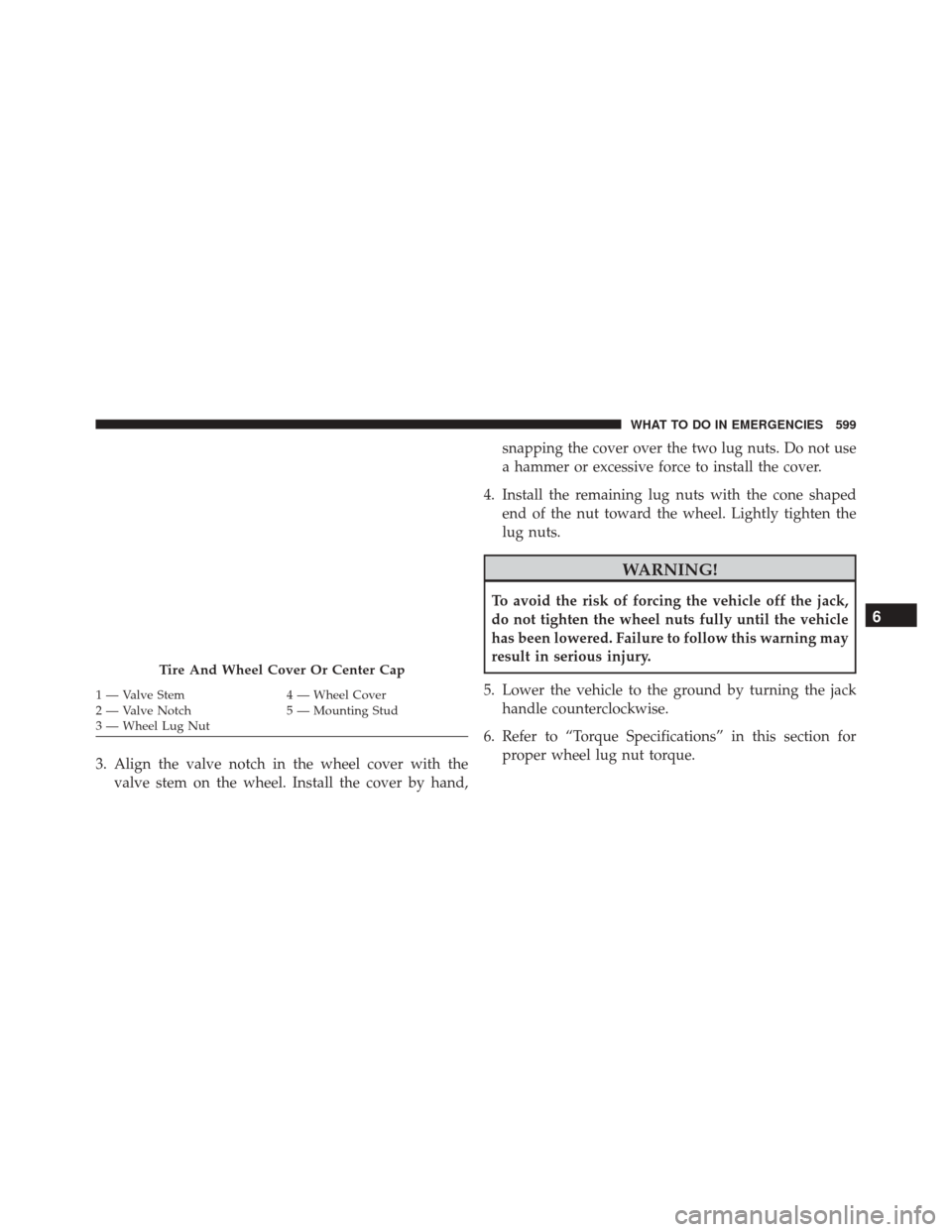
3. Align the valve notch in the wheel cover with thevalve stem on the wheel. Install the cover by hand, snapping the cover over the two lug nuts. Do not use
a hammer or excessive force to install the cover.
4. Install the remaining lug nuts with the cone shaped end of the nut toward the wheel. Lightly tighten the
lug nuts.
WARNING!
To avoid the risk of forcing the vehicle off the jack,
do not tighten the wheel nuts fully until the vehicle
has been lowered. Failure to follow this warning may
result in serious injury.
5. Lower the vehicle to the ground by turning the jack handle counterclockwise.
6. Refer to “Torque Specifications” in this section for proper wheel lug nut torque.
Tire And Wheel Cover Or Center Cap
1 — Valve Stem 4 — Wheel Cover
2 — Valve Notch 5 — Mounting Stud
3 — Wheel Lug Nut
6
WHAT TO DO IN EMERGENCIES 599
Page 602 of 707
7. After 25 miles (40 km) check the lug nut torque with atorque wrench to ensure that all lug nuts are properly
seated against the wheel.
Vehicles Without Wheel Covers
1. Mount the road tire on the axle.
2. Install the remaining lug nuts with the cone shapedend of the nut toward the wheel. Lightly tighten the
lug nuts.
WARNING!
To avoid the risk of forcing the vehicle off the jack,
do not tighten the wheel nuts fully until the vehicle
has been lowered. Failure to follow this warning may
result in serious injury.
3. Lower the vehicle to the ground by turning the jack handle counterclockwise. 4. Refer to “Torque Specifications” in this section for
proper wheel lug nut torque.
5. After 25 miles (40 km) check the lug nut torque with a torque wrench to ensure that all lug nuts are properly
seated against the wheel.
JUMP-STARTING
If your vehicle has a discharged battery it can be jump-
started using a set of jumper cables and a battery in
another vehicle or by using a portable battery booster
pack. Jump-starting can be dangerous if done improperly
so please follow the procedures in this section carefully.
NOTE: When using a portable battery booster pack
follow the manufacturer ’s operating instructions and
precautions.
600 WHAT TO DO IN EMERGENCIES
Page 609 of 707
5. Insert the screwdriver or similar tool into the accesshole, and push and hold the override release lever
forward. 6. Move the shift lever to the NEUTRAL position.
7. The vehicle may then be started in NEUTRAL.
8. Reinstall the shift lever override access cover.
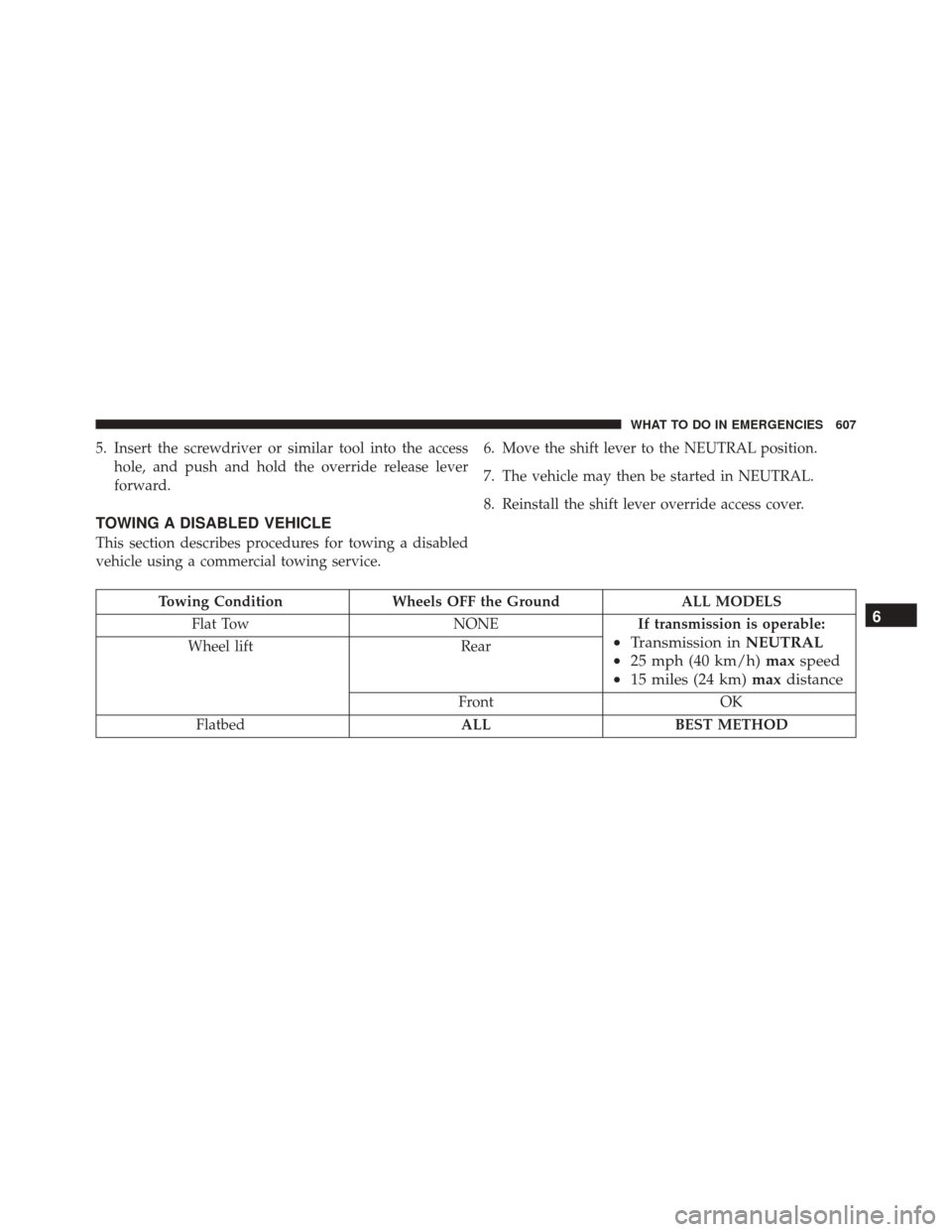
TOWING A DISABLED VEHICLE
This section describes procedures for towing a disabled
vehicle using a commercial towing service.
Towing Condition
Wheels OFF the Ground ALL MODELS
Flat Tow NONEIf transmission is operable:
•Transmission in NEUTRAL
• 25 mph (40 km/h) maxspeed
• 15 miles (24 km) maxdistanceWheel lift Rear
Front OK
Flatbed ALLBEST METHOD
6
WHAT TO DO IN EMERGENCIES 607
Page 610 of 707

Proper towing or lifting equipment is required to prevent
damage to your vehicle. Use only tow bars and other
equipment designed for this purpose, following equip-
ment manufacturer ’s instructions. Use of safety chains is
mandatory. Attach a tow bar or other towing device to
main structural members of the vehicle, not to bumpers
or associated brackets. State and local laws regarding
vehicles under tow must be observed.
If you must use the accessories (wipers, defrosters, etc.)
while being towed, the ignition must be in the ON/RUN
position, not the ACC position.
If the key fob is unavailable or the vehicle’s battery is
discharged, refer to�Shift Lever Override� in this section
for instructions on shifting the transmission out of PARK
for towing.CAUTION!
• Do not use sling type equipment when towing.
Vehicle damage may occur.
• When securing the vehicle to a flatbed truck, do not
attach to front or rear suspension components.
Damage to your vehicle may result from improper
towing.
• Do not push or tow this vehicle with another
vehicle as damage to the bumper fascia and trans-
mission may result.
608 WHAT TO DO IN EMERGENCIES
Page 611 of 707
The manufacturer recommends towing your vehicle with
all four wheels OFF the ground using a flatbed. If flatbed
equipment is not available, and the transmission is
operable, the vehicle may be flat towed (with all four
wheels on the ground) under the following conditions:
•The transmission must be in NEUTRAL.
• The towing distance must not exceed 15 miles (24 km).
• The towing speed must not exceed 25 mph (40 km/h).
If the transmission is not operable, or the vehicle must
be towed faster than 25 mph (40 km/h) or farther than 15
miles (24 km), it must be towed with the front wheels
OFF the ground (using a flatbed truck, or wheel lift
equipment with the front wheels raised).CAUTION!
• Towing faster than 25 mph (40 km/h) or farther than
15 mi (24 km) with front wheels on the ground can
cause severe transmission damage. Damage from
improper towing is not covered under the New
Vehicle Limited Warranty.
• Towing this vehicle in violation of the above re-
quirements can cause severe transmission damage.
Damage from improper towing is not covered un-
der the New Vehicle Limited Warranty.
6
WHAT TO DO IN EMERGENCIES 609