2016 DODGE CHARGER SRT traction control
[x] Cancel search: traction controlPage 449 of 634
speeds greater than 30 mph (48 km/h), see your autho-
rized dealer as soon as possible to have the problem
diagnosed and corrected.
The “ESC Activation/Malfunction Indicator Light” (lo-
cated in the instrument cluster) starts to flash as soon as
the tires lose traction and the ESC system becomes active.
The “ESC Activation/Malfunction Indicator Light” also
flashes when TCS is active. If the “ESC Activation/
Malfunction Indicator Light” begins to flash during ac-
celeration, ease up on the accelerator and apply as little
throttle as possible. Be sure to adapt your speed and
driving to the prevailing road conditions.
NOTE:
•The “ESC Activation/Malfunction Indicator Light”
and the “ESC OFF Indicator Light” come on momen-
tarily each time the ignition switch is turned ON. •
Each time the ignition is turned ON, the ESC system
will be ON even if it was turned off previously.
• The ESC system will make buzzing or clicking sounds
when it is active. This is normal; the sounds will stop
when ESC becomes inactive following the maneuver
that caused the ESC activation.
The “ESC OFF Indicator Light” indicates the
customer has elected to have the Electronic
Stability Control (ESC) in a reduced mode.
Electronic Roll Mitigation (ERM)
This system anticipates the potential for wheel lift by
monitoring the driver ’s steering wheel input and the
speed of the vehicle. When ERM determines that the rate
of change of the steering wheel angle and vehicle’s speed
are sufficient to potentially cause wheel lift, it then
applies the appropriate brake and may also reduce
5
STARTING AND OPERATING 447
Page 468 of 634
WARNING!
Do not use Summer tires in snow/ice conditions. You
could lose vehicle control, resulting in severe injury
or death. Driving too fast for conditions also creates
the possibility of loss of vehicle control.
Snow Tires
Some areas of the country require the use of snow tires
during the Winter. Snow tires can be identified by a
“mountain/snowflake” symbol on the tire sidewall.If you need snow tires, select tires
equivalent in size and type to the origi-
nal equipment tires. Use snow tires
only in sets of four; failure to do so
may adversely affect the safety and
handling of your vehicle. Snow tires generally have lower speed ratings than what
was originally equipped with your vehicle and should
not be operated at sustained speeds over 75 mph
(120 km/h). For speeds above 75 mph (120 km/h) refer to
original equipment or an authorized tire dealer for
recommended safe operating speeds, loading and cold
tire inflation pressures.
While studded tires improve performance on ice, skid
and traction capability on wet or dry surfaces may be
poorer than that of non-studded tires. Some states pro-
hibit studded tires; therefore, local laws should be
checked before using these tire types.
Run Flat Tires — If Equipped
Run Flat tires allow you the capability to drive 50 miles
(80 km) at 50 mph (80 km/h) after a rapid loss of inflation
pressure. This rapid loss of inflation is referred to as the
Run Flat mode. A Run Flat mode occurs when the tire
inflation pressure is of/or below 14 psi (96 kPa). Once a
466 STARTING AND OPERATING
Page 475 of 634
WARNING!(Continued)
•Never use a tire with a smaller load index or
capacity, other than what was originally equipped
on your vehicle. Using a tire with a smaller load
index could result in tire overloading and failure.
You could lose control and have a collision.
• Failure to equip your vehicle with tires having
adequate speed capability can result in sudden tire
failure and loss of vehicle control.
CAUTION!
Replacing original tires with tires of a different size
may result in false speedometer and odometer read-
ings.
TIRE CHAINS (TRACTION DEVICES)
Due to limited clearance, tire chains or traction devices
are not recommended.
TIRE ROTATION RECOMMENDATIONS
Tires on the front and rear axles of vehicles operate at
different loads and perform different steering, driving,
and braking functions. For these reasons, they wear at
unequal rates.
These effects can be reduced by timely rotation of tires.
The benefits of rotation are especially worthwhile with
aggressive tread designs such as those on all season type
tires. Rotation will increase tread life, help to maintain
mud, snow, and wet traction levels, and contribute to a
smooth, quiet ride.
5
STARTING AND OPERATING 473
Page 608 of 634
significantly from the norm due to variations in driving
habits, service practices, and differences in road charac-
teristics and climate.
Traction Grades
The Traction grades, from highest to lowest, are AA, A, B,
and C. These grades represent the tire’s ability to stop on
wet pavement, as measured under controlled conditions
on specified government test surfaces of asphalt and
concrete. A tire marked C may have poor traction perfor-
mance.
WARNING!
The traction grade assigned to this tire is based on
straight-ahead braking traction tests, and does not
include acceleration, cornering, hydroplaning, or
peak traction characteristics.
Temperature Grades
The temperature grades are A (the highest), B, and C,
representing the tire’s resistance to the generation of heat
and its ability to dissipate heat, when tested under
controlled conditions on a specified indoor laboratory
test wheel. Sustained high temperature can cause the
material of the tire to degenerate and reduce tire life, and
excessive temperature can lead to sudden tire failure. The
grade C corresponds to a level of performance, which all
passenger vehicle tires must meet under the Federal
Motor Vehicle Safety Standard No. 109. Grades B and A
represent higher levels of performance on the laboratory
test wheel, than the minimum required by law.
WARNING!
The temperature grade for this tire is established for
a tire that is properly inflated and not overloaded.
(Continued)
606 IF YOU NEED CONSUMER ASSISTANCE
Page 617 of 634

Electric Remote Mirrors.....................122
Electronic Brake Control System ...............435
Anti-Lock Brake System ..................436
Electronic Roll Mitigation .................447
Traction Control System ...................442
Electronic Power Distribution Center (Fuses) ......562
Electronic Speed Control (Cruise Control). . .170, 171, 174
Electronic Stability Control (ESC) ..............442
Electronic Throttle Control Warning Light ........265
Emergency Deck Lid Release ..................45
Emergency, In Case Of Freeing Vehicle When Stuck ................513
Jump Starting ...................... .508, 511
Overheating .......................... .494
Emergency Trunk Release ....................45
Emission Control System Maintenance ..........527
Engine ............................. .524, 525
Air Cleaner .......................... .534
Block Heater ......................... .403Checking Oil Level
..................... .531
Compartment ......................... .525
Compartment Identification ................524
Coolant (Antifreeze) ...............544, 583, 584
Cooling ............................. .544
Exhaust Gas Caution .................100, 485
Fails To Start ......................... .402
Flooded, Starting ...................... .402
Fuel Requirements ..................... .481
Jump Starting ...................... .508, 511
Oil....................... .531, 581, 583, 584
Oil Change Interval ..................... .531
Oil Filler Cap ......................... .531
Oil Filter ............................ .533
Oil Selection ...................... .531, 581
Overheating .......................... .494
Starting ............................. .399
Engine Oil Viscosity ...................... .531
Enhanced Accident Response Feature ............71
10
INDEX 615
Page 622 of 634
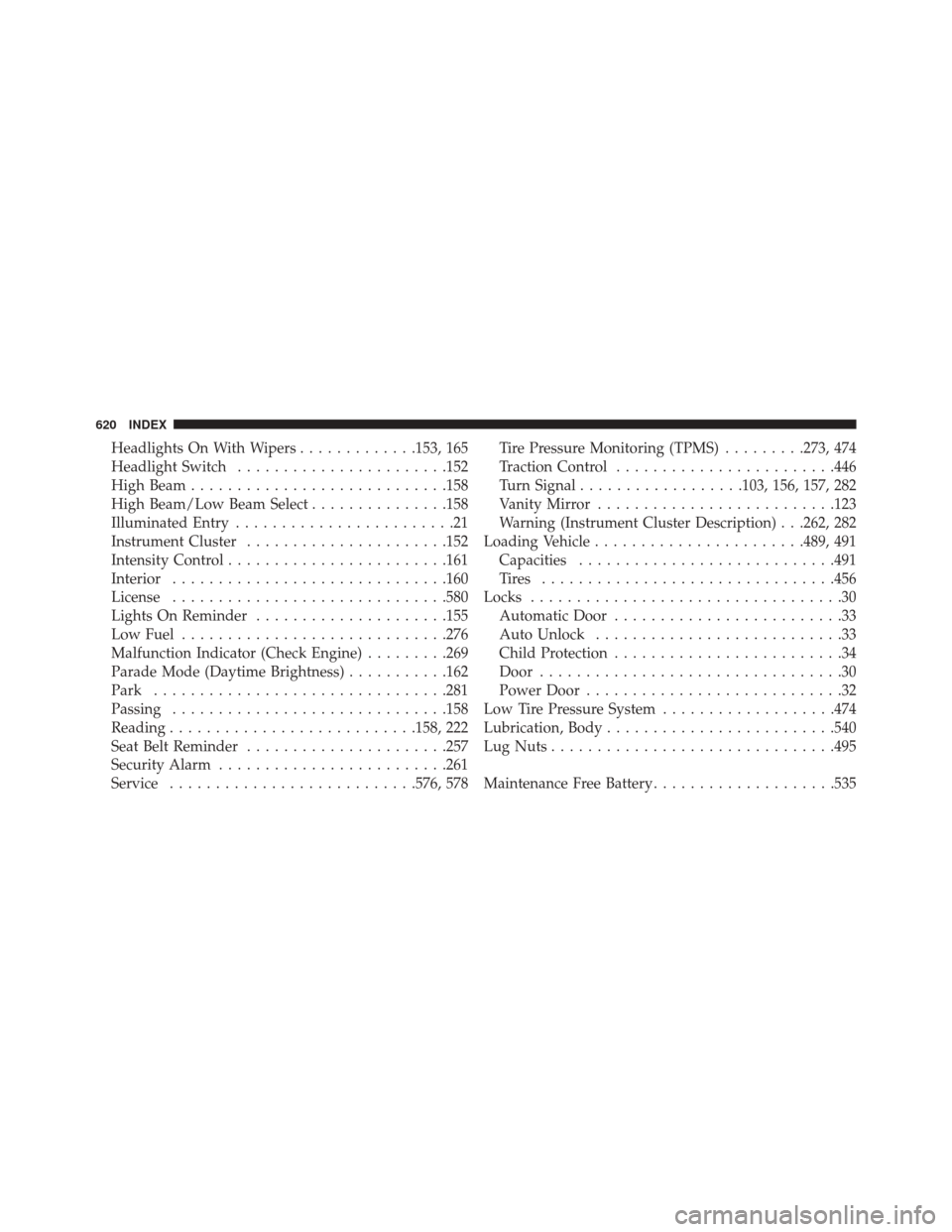
Headlights On With Wipers.............153, 165
Headlight Switch ...................... .152
High Beam ........................... .158
High Beam/Low Beam Select ...............158
Illuminated Entry ........................21
Instrument Cluster ..................... .152
Intensity Control ....................... .161
Interior ............................. .160
License ............................. .580
Lights On Reminder .....................155
Low Fuel ............................ .276
Malfunction Indicator (Check Engine) .........269
Parade Mode (Daytime Brightness) ...........162
Park ............................... .281
Passing ............................. .158
Reading .......................... .158, 222
Seat Belt Reminder ..................... .257
Security Alarm ........................ .261
Service .......................... .576, 578Tire Pressure Monitoring (TPMS)
.........273, 474
Traction Control ....................... .446
Turn Signal ..................103, 156, 157, 282
Vanity Mirror ......................... .123
Warning (Instrument Cluster Description) . . .262, 282
Loading Vehicle ...................... .489, 491
Capacities ........................... .491
Tires ............................... .456
Locks ..................................30
Automatic Door .........................33
Auto Unlock ...........................33
Child Protection .........................34
Door .................................30
Power Door ............................32
Low Tire Pressure System ...................474
Lubrication, Body ........................ .540
Lug Nuts .............................. .495
Maintenance Free Battery ....................535
620 INDEX
Page 630 of 634
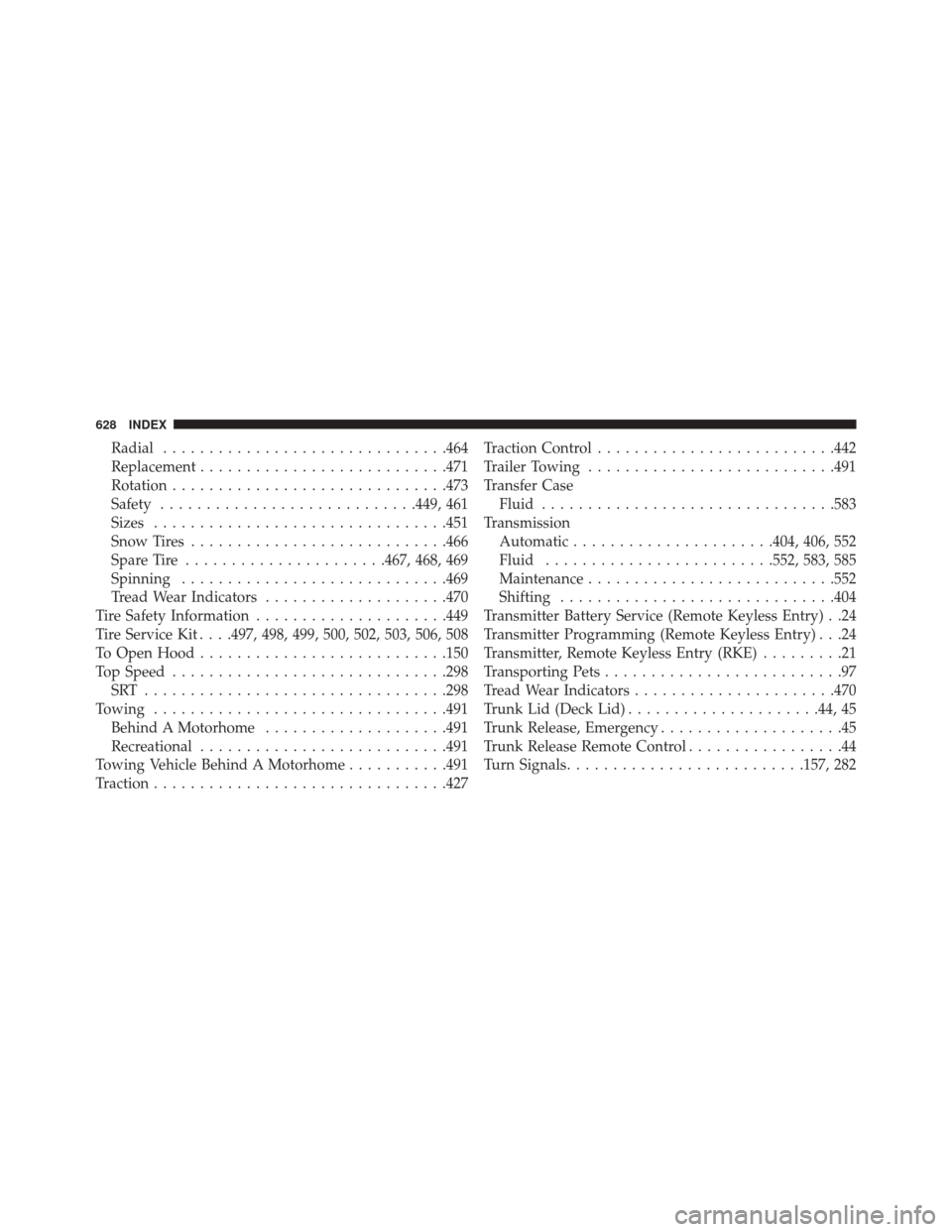
Radial.............................. .464
Replacement .......................... .471
Rotation ............................. .473
Safety ........................... .449, 461
Sizes ............................... .451
Snow Tires ........................... .466
Spare Tire ..................... .467, 468, 469
Spinning ............................ .469
Tread Wear Indicators ....................470
Tire Safety Information .....................449
Tire Service Kit . . . .497, 498, 499, 500, 502, 503, 506, 508
To Open Hood .......................... .150
Top Speed ............................. .298
SRT ................................ .298
Towing ............................... .491
Behind A Motorhome ....................491
Recreational .......................... .491
Towing Vehicle Behind A Motorhome ...........491
Traction ............................... .427Traction Control
......................... .442
Trailer Towing .......................... .491
Transfer Case Fluid ............................... .583
Transmission Automatic ..................... .404, 406, 552
Fluid ........................ .552, 583, 585
Maintenance .......................... .552
Shifting ............................. .404
Transmitter Battery Service (Remote Keyless Entry) . .24
Transmitter Programming (Remote Keyless Entry) . . .24
Transmitter, Remote Keyless Entry (RKE) .........21
Transporting Pets ..........................97
Tread Wear Indicators ..................... .470
Trunk Lid (Deck Lid) .....................44, 45
Trunk Release, Emergency ....................45
Trunk Release Remote Control .................44
Turn Signals ......................... .157, 282
628 INDEX