Page 492 of 661
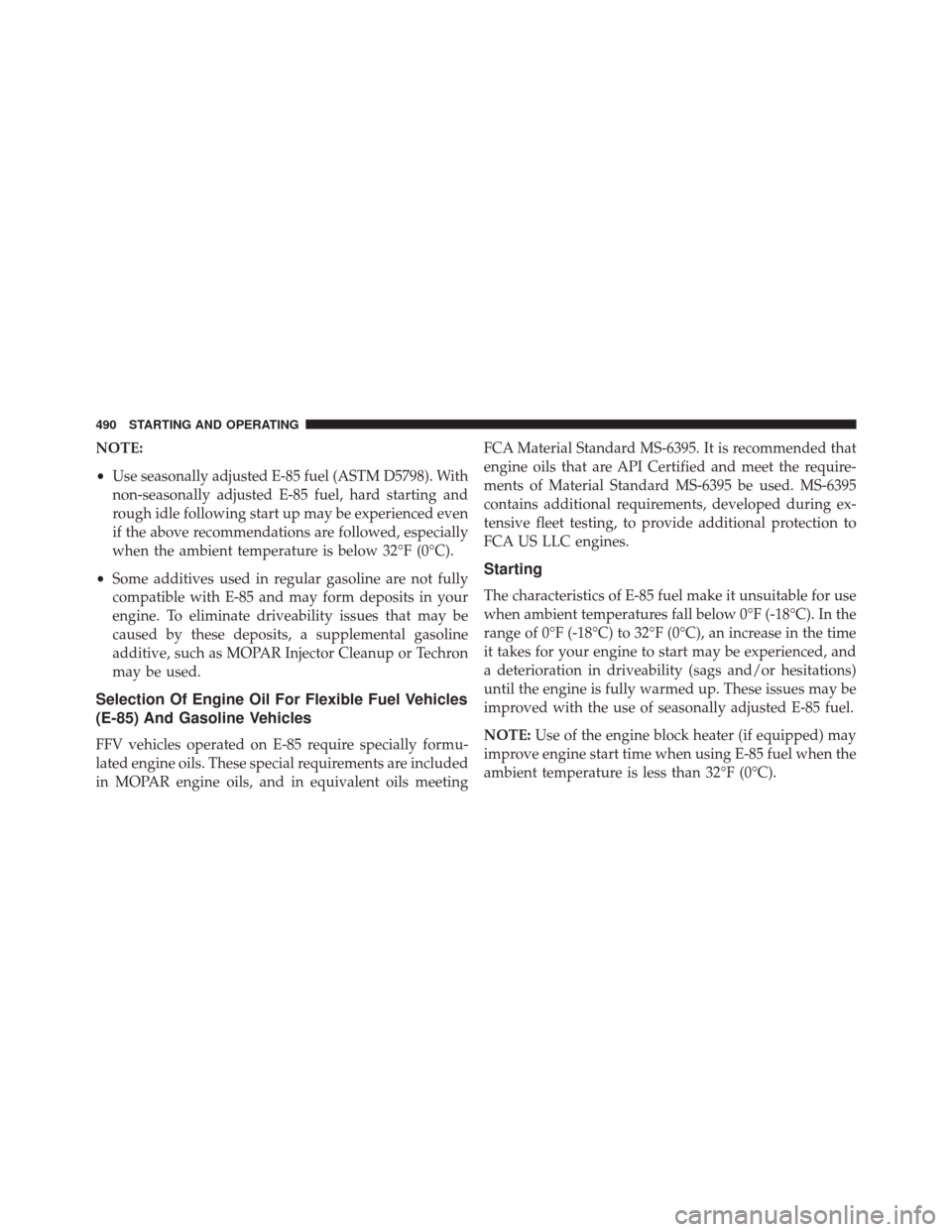
NOTE:
•Use seasonally adjusted E-85 fuel (ASTM D5798). With
non-seasonally adjusted E-85 fuel, hard starting and
rough idle following start up may be experienced even
if the above recommendations are followed, especially
when the ambient temperature is below 32°F (0°C).
• Some additives used in regular gasoline are not fully
compatible with E-85 and may form deposits in your
engine. To eliminate driveability issues that may be
caused by these deposits, a supplemental gasoline
additive, such as MOPAR Injector Cleanup or Techron
may be used.
Selection Of Engine Oil For Flexible Fuel Vehicles
(E-85) And Gasoline Vehicles
FFV vehicles operated on E-85 require specially formu-
lated engine oils. These special requirements are included
in MOPAR engine oils, and in equivalent oils meeting FCA Material Standard MS-6395. It is recommended that
engine oils that are API Certified and meet the require-
ments of Material Standard MS-6395 be used. MS-6395
contains additional requirements, developed during ex-
tensive fleet testing, to provide additional protection to
FCA US LLC engines.
Starting
The characteristics of E-85 fuel make it unsuitable for use
when ambient temperatures fall below 0°F (-18°C). In the
range of 0°F (-18°C) to 32°F (0°C), an increase in the time
it takes for your engine to start may be experienced, and
a deterioration in driveability (sags and/or hesitations)
until the engine is fully warmed up. These issues may be
improved with the use of seasonally adjusted E-85 fuel.
NOTE:
Use of the engine block heater (if equipped) may
improve engine start time when using E-85 fuel when the
ambient temperature is less than 32°F (0°C).
490 STARTING AND OPERATING
Page 515 of 661
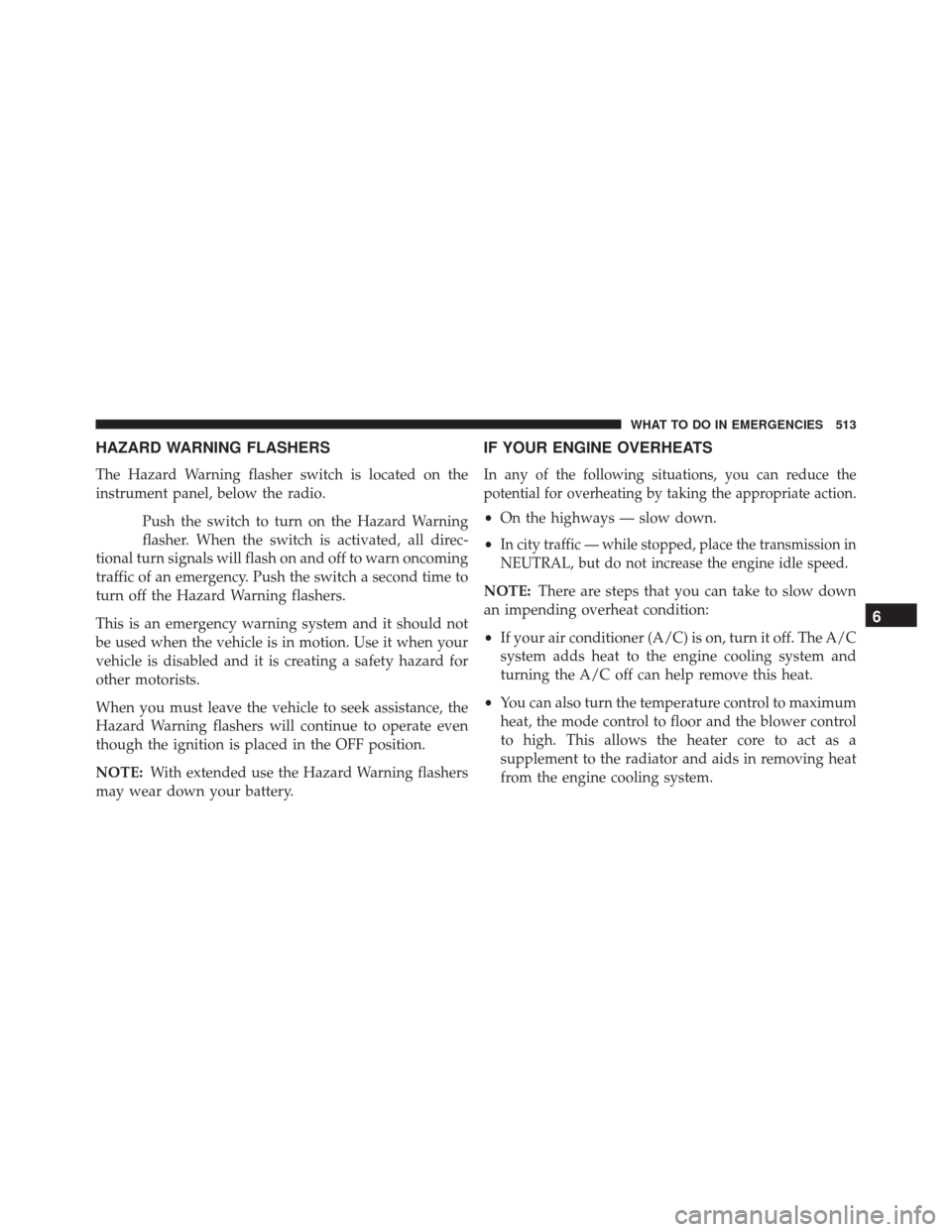
HAZARD WARNING FLASHERS
The Hazard Warning flasher switch is located on the
instrument panel, below the radio.Push the switch to turn on the Hazard Warning
flasher. When the switch is activated, all direc-
tional turn signals will flash on and off to warn oncoming
traffic of an emergency. Push the switch a second time to
turn off the Hazard Warning flashers.
This is an emergency warning system and it should not
be used when the vehicle is in motion. Use it when your
vehicle is disabled and it is creating a safety hazard for
other motorists.
When you must leave the vehicle to seek assistance, the
Hazard Warning flashers will continue to operate even
though the ignition is placed in the OFF position.
NOTE: With extended use the Hazard Warning flashers
may wear down your battery.
IF YOUR ENGINE OVERHEATS
In any of the following situations, you can reduce the
potential for overheating by taking the appropriate action.
• On the highways — slow down.
•
In city traffic — while stopped, place the transmission in
NEUTRAL, but do not increase the engine idle speed.
NOTE: There are steps that you can take to slow down
an impending overheat condition:
• If your air conditioner (A/C) is on, turn it off. The A/C
system adds heat to the engine cooling system and
turning the A/C off can help remove this heat.
• You can also turn the temperature control to maximum
heat, the mode control to floor and the blower control
to high. This allows the heater core to act as a
supplement to the radiator and aids in removing heat
from the engine cooling system.
6
WHAT TO DO IN EMERGENCIES 513
Page 539 of 661
WARNING!
•Take care to avoid the radiator cooling fan when-
ever the hood is raised. It can start anytime the
ignition switch is ON. You can be injured by
moving fan blades.
• Remove any metal jewelry such as watch bands or
bracelets that might make an inadvertent electrical
contact. You could be seriously injured.
• Batteries contain sulfuric acid that can burn your
skin or eyes and generate hydrogen gas which is
flammable and explosive. Keep open flames or
sparks away from the battery.
1. Set the parking brake, shift the automatic transmission into PARK and place the ignition in the OFF position.
2. Turn off the heater, radio, and all unnecessary electri- cal accessories. 3. If using another vehicle to jump-start the battery, park
the vehicle within the jumper cables reach, set the
parking brake and make sure the ignition is OFF.
WARNING!
Do not allow vehicles to touch each other as this
could establish a ground connection and personal
injury could result.
Jump-Starting Procedure
WARNING!
Failure to follow this jump-starting procedure could
result in personal injury or property damage due to
battery explosion.
6
WHAT TO DO IN EMERGENCIES 537
Page 613 of 661
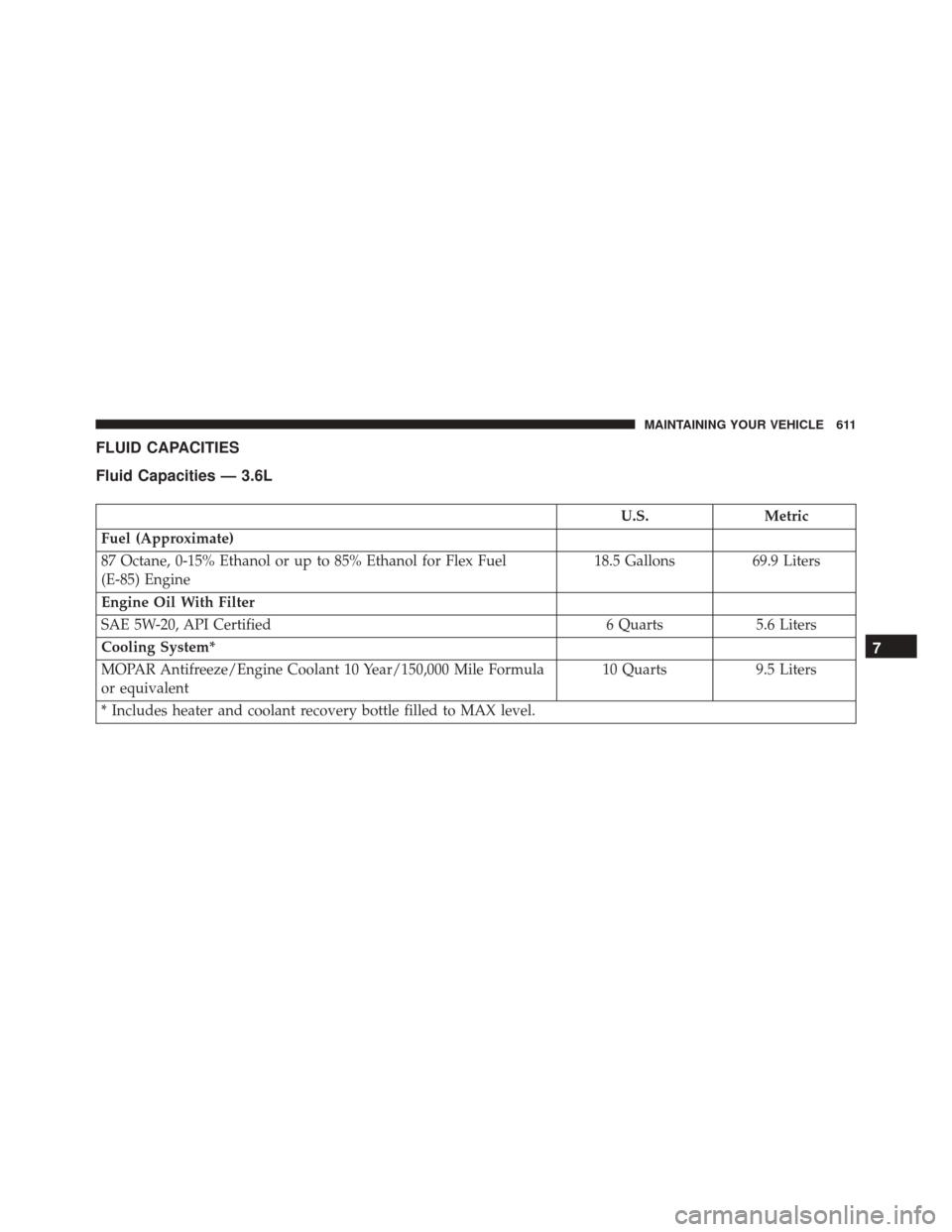
FLUID CAPACITIES
Fluid Capacities — 3.6L
U.S.Metric
Fuel (Approximate)
87 Octane, 0-15% Ethanol or up to 85% Ethanol for Flex Fuel
(E-85) Engine 18.5 Gallons
69.9 Liters
Engine Oil With Filter
SAE 5W-20, API Certified 6 Quarts5.6 Liters
Cooling System*
MOPAR Antifreeze/Engine Coolant 10 Year/150,000 Mile Formula
or equivalent 10 Quarts
9.5 Liters
* Includes heater and coolant recovery bottle filled to MAX level.
7
MAINTAINING YOUR VEHICLE 611
Page 614 of 661
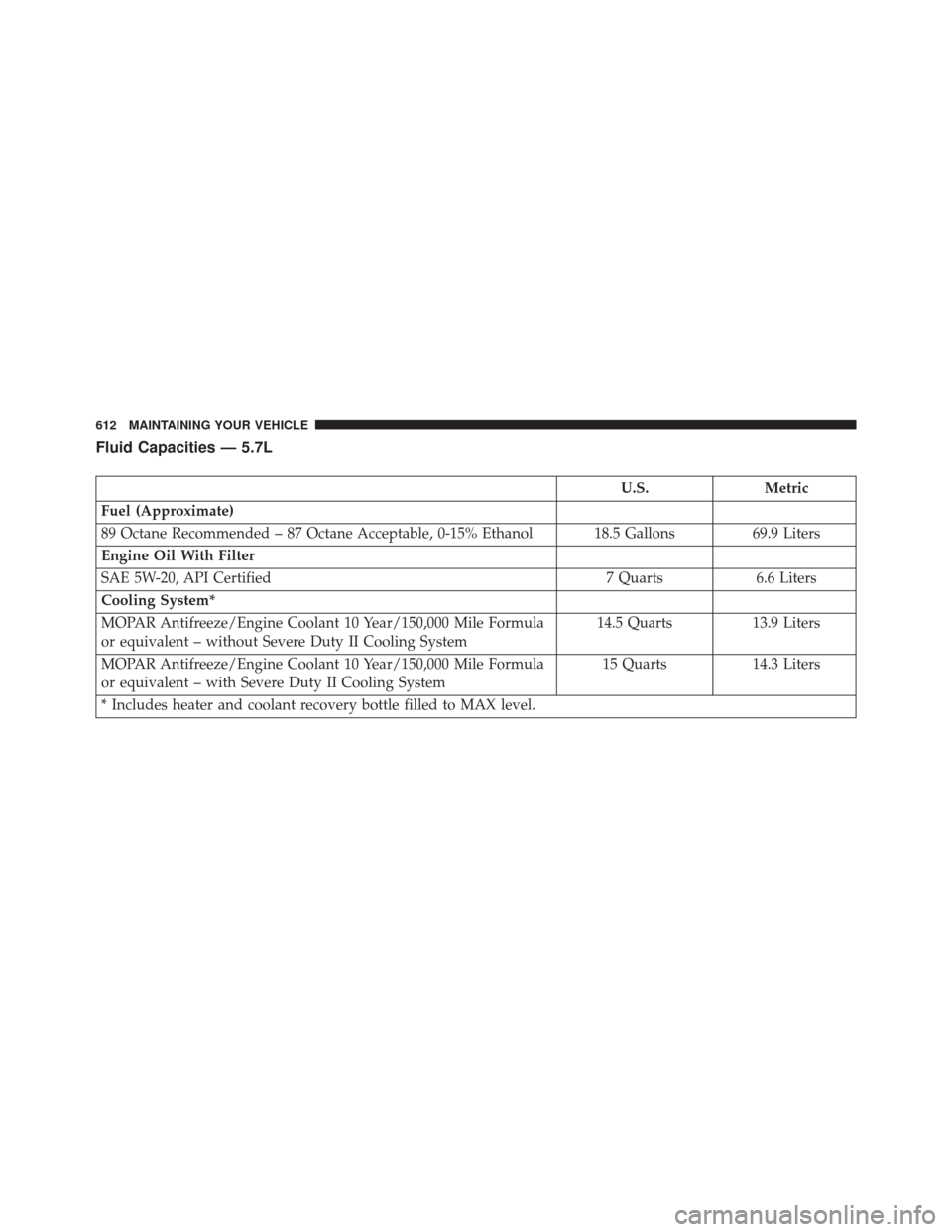
Fluid Capacities — 5.7L
U.S.Metric
Fuel (Approximate)
89 Octane Recommended – 87 Octane Acceptable, 0-15% Ethanol 18.5 Gallons 69.9 Liters
Engine Oil With Filter
SAE 5W-20, API Certified 7 Quarts6.6 Liters
Cooling System*
MOPAR Antifreeze/Engine Coolant 10 Year/150,000 Mile Formula
or equivalent – without Severe Duty II Cooling System 14.5 Quarts
13.9 Liters
MOPAR Antifreeze/Engine Coolant 10 Year/150,000 Mile Formula
or equivalent – with Severe Duty II Cooling System 15 Quarts
14.3 Liters
* Includes heater and coolant recovery bottle filled to MAX level.
612 MAINTAINING YOUR VEHICLE
Page 643 of 661

DrivingThrough Flowing, Rising, Or Shallow Standing
Water ............................... .430
E-85 Fuel .............................. .488
Electrical Power Outlets .....................245
Electric Rear Window Defrost .................254
Electric Remote Mirrors .....................121
Electronic Brake Control System ...............437
Anti-Lock Brake System ..................438
Electronic Roll Mitigation .................449
Traction Control System ...................444
Electronic Power Distribution Center (Fuses) ......591
Electronic Speed Control (Cruise Control). .176, 177, 180
Electronic Stability Control (ESC) ..............444
Electronic Throttle Control Warning Light ........275
Emergency Deck Lid Release ..................47
Emergency, In Case Of Freeing Vehicle When Stuck ................539 Jacking
.............................. .516
Jump Starting ..................... .535, 537
Overheating .......................... .513
Towing ............................. .544
Emergency Trunk Release ....................47
Emission Control System Maintenance ..........555
Engine ................................ .553
Air Cleaner .......................... .563
Block Heater ......................... .414
Break-In Recommendations .................99
Checking Oil Level ..................... .559
Compartment ...................... .552, 553
Compartment Identification ................552
Coolant (Antifreeze) ...........573, 613, 614, 615
Cooling ............................. .573
Exhaust Gas Caution .................100, 488
Fails To Start ......................... .413
Flooded, Starting ...................... .413
Fuel Requirements ..................... .483
10
INDEX 641
Page 646 of 661
GVWR................................ .496
Hazard Driving Through Flowing, Rising, Or Shallow
Standing Water ........................ .430
Hazard Warning Flasher ....................513
Headlights ............................. .609
Automatic ........................... .155
Cleaning ............................ .588
Delay ............................... .157
High Beam/Low Beam Select Switch .........160
Lights On Reminder .....................158
On With Wipers .....................155, 168
Passing ............................. .160
Switch .............................. .154
Time Delay ........................... .157
Washers ............................. .570
Headlight Washers ....................... .570
Head Restraints ...................... .143, 145Head Rests
......................... .143, 145
Heated Mirrors .......................... .122
Heated Seats ............................ .137
Heater ................................ .364
Heater, Engine Block ...................... .414
High Beam/Low Beam Select (Dimmer) Switch . . . .160
Hill Start Assist .......................... .441
Hitches Trailer Towing ........................ .500
Holder, Coin ............................ .251
Hood Release ........................... .152
Ignition Key..................................12
Illuminated Entry ..........................21
Immobilizer (Sentry Key) ....................16
Information Center, Vehicle ..................296
Inside Rearview Mirror ..................112,113
Instrument Cluster ........261, 264, 272, 277, 288, 291
644 INDEX