Page 239 of 651
Battery Charge Warning Light
Red TelltaleLight What It Means
Battery Charge Warning Light
This light illuminates when the battery is not charging properly. If it stays on while the
engine is running, there may be a malfunction with the charging system. Contact your
authorized dealer as soon as possible. This indicates a possible problem with the electrical
system or a related component.
If jump starting is required, refer to “Jump Starting Procedures” in “What To Do In
Emergencies.”
4
UNDERSTANDING YOUR INSTRUMENT PANEL 237
Page 276 of 651

•If the menu is exited before the end of codes is reached
- when the driver re-enters the list will be restarted
from the beginning.
• When no codes are present or the last code is reached
= (P0000) and this message is displayed:
• “No Further or End of Diagnostic Codes.”
Battery Saver On/Battery Saver Mode Message —
Electrical Load Reduction Actions — If Equipped
This vehicle is equipped with an Intelligent Battery
Sensor (IBS) to perform additional monitoring of the
electrical system and status of the vehicle battery.
In cases when the IBS detects charging system failure, or
the vehicle battery conditions are deteriorating, electrical
load reduction actions will take place to extend the
driving time and distance of the vehicle. This is done by
reducing power to or turning off non-essential electrical
loads. Load reduction is only active when the engine is running.
It will display a message if there is a risk of battery
depletion to the point where the vehicle may stall due to
lack of electrical supply, or will not restart after the
current drive cycle.
When load reduction is activated, the message “Battery
Saver On” or “Battery Saver Mode” will appear in the
Electronic Vehicle Information Center (EVIC) or Driver
Information Display (DID).
These messages indicate the vehicle battery has a low
state of charge and continues to lose electrical charge at a
rate that the charging system cannot sustain.
NOTE:
•
The charging system is independent from load reduc-
tion. The charging system performs a diagnostic on the
charging system continuously.
274 UNDERSTANDING YOUR INSTRUMENT PANEL
Page 277 of 651

•If the Charging System Light is on it may indicate a
problem with the charging system. Refer to “Charging
System Light” in “Understanding Your Instrument
Panel” for further information.
The electrical loads that may be switched off (if
equipped), and vehicle functions which can be effected
by load reduction:
• Heated Seat/Vented Seats/Heated Wheel
• Heated/Cooled Cup Holders
• Rear Defroster And Heated Mirrors
• HVAC System
• 115V AC Power Inverter System
• Audio and Telematics System Loss of the battery charge may indicate one or more of
the following conditions:
•
The charging system cannot deliver enough electrical
power to the vehicle system because the electrical
loads are larger than the capability of charging system.
The charging system is still functioning properly.
• Turning on all possible vehicle electrical loads (e.g.
HVAC to max settings, exterior and interior lights,
overloaded power outlets +12V, 115V AC, USB ports)
during certain driving conditions (city driving, tow-
ing, frequent stopping).
• Installing options like additional lights, upfitter elec-
trical accessories, audio systems, alarms and similar
devices.
• Unusual driving cycles (short trips separated by long
parking periods).
4
UNDERSTANDING YOUR INSTRUMENT PANEL 275
Page 514 of 651
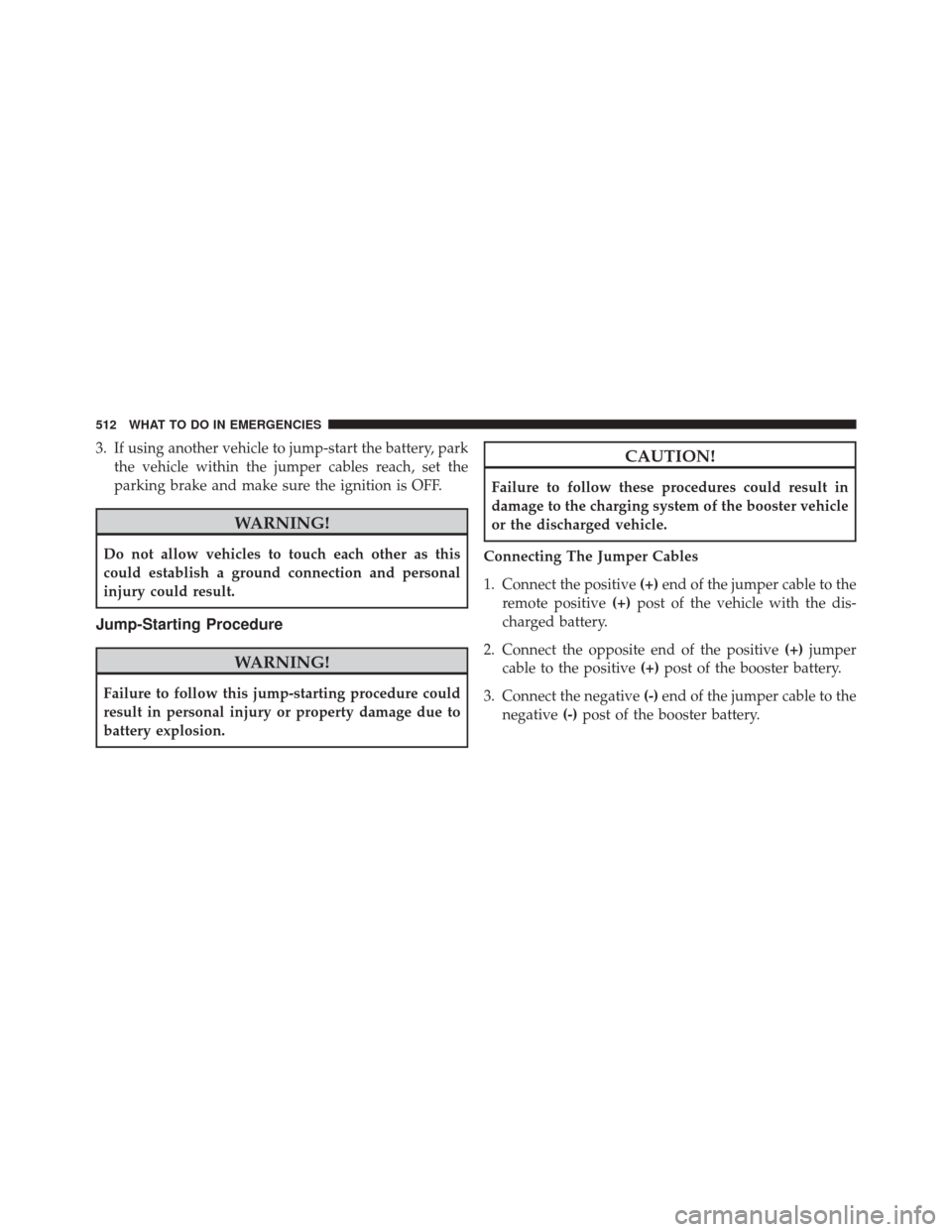
3. If using another vehicle to jump-start the battery, parkthe vehicle within the jumper cables reach, set the
parking brake and make sure the ignition is OFF.
WARNING!
Do not allow vehicles to touch each other as this
could establish a ground connection and personal
injury could result.
Jump-Starting Procedure
WARNING!
Failure to follow this jump-starting procedure could
result in personal injury or property damage due to
battery explosion.
CAUTION!
Failure to follow these procedures could result in
damage to the charging system of the booster vehicle
or the discharged vehicle.
Connecting The Jumper Cables
1. Connect the positive (+)end of the jumper cable to the
remote positive (+)post of the vehicle with the dis-
charged battery.
2. Connect the opposite end of the positive (+)jumper
cable to the positive (+)post of the booster battery.
3. Connect the negative (-)end of the jumper cable to the
negative (-)post of the booster battery.
512 WHAT TO DO IN EMERGENCIES
Page 515 of 651

4. Connect the opposite end of the negative(-)jumper
cable to the remote negative (-)post of the vehicle with
the discharged battery.
WARNING!
Do not connect the jumper cable to the negative (-)
post of the discharged battery. The resulting electri-
cal spark could cause the battery to explode and
could result in personal injury. Only use the specific
ground point, do not use any other exposed metal
parts.
5. Start the engine in the vehicle that has the booster battery, let the engine idle a few minutes, and then
start the engine in the vehicle with the discharged
battery. 6. Once the engine is started, remove the jumper cables
in the reverse sequence:
Disconnecting The Jumper Cables
1. Disconnect the negative (-)end of the jumper cable
from the remote negative (-)post of the vehicle with
the discharged battery.
2. Disconnect the opposite end of the negative (-)jumper
cable from the negative (-)post of the booster battery.
3. Disconnect the positive (+)end of the jumper cable
from the positive (+)post of the booster battery.
4. Disconnect the opposite end of the positive (+)jumper
cable from the remote positive (+)post of the vehicle
with the discharged battery.
If frequent jump-starting is required to start your vehicle
you should have the battery and charging system in-
spected at your authorized dealer.
6
WHAT TO DO IN EMERGENCIES 513
Page 629 of 651

Alarm (Security Alarm)..................19, 235
Alarm System (Security Alarm) ................19
Alterations/Modifications, Vehicle ...............7
Antifreeze (Engine Coolant) .....550, 585, 586, 587, 588
Disposal ............................. .553
Anti-Lock Brake System (ABS) ................414
Anti-Lock Warning Light ....................250
Appearance Care ........................ .560
Arming System (Security Alarm) ...............19
Assist, Hill Start ......................... .417
Auto Down Power Windows ..................41
Automatic Door Locks ......................34
Automatic Headlights ..................... .140
Automatic High Beams .....................140
Automatic Temperature Control (ATC) .......340, 348
Automatic Transmission ..............394, 558, 559
Adding Fluid ......559, 589, 591, 593, 594, 596, 597
Autostick ............................ .402
Fluid And Filter Changes ..................559 Fluid Change
......................... .559
Fluid Level Check ...................... .558
Fluid Type ............589, 591, 593, 594, 596, 597
Special Additives ...................... .558
Automatic Transmission Limp Home Mode .......400
Autostick .............................. .402
Operation ............................ .402
Auto Unlock, Doors ........................34
Axle Fluid ..............589, 591, 593, 594, 596, 597
Axle Lubrication .........589, 591, 593, 594, 596, 597
Battery ............................ .237, 539
Charging System Light ...................237
Keyless Transmitter Replacement (RKE) ........25
Location ............................. .539
Belts, Seat ...............................96
Body Mechanism Lubrication .................545
B-Pillar Location ......................... .434
Brake Assist System ...................... .417
10
INDEX 627