2016 DACIA SANDERO STEPWAY Fuel
[x] Cancel search: FuelPage 67 of 174

ENG_NU_817-10_B90_Dacia_2
On versions with")
JauneNoirNoir texte
2.7
ENG_UD22287_11
Conseils : antipollution, économies de carburant, conduite (B90 - U9\
0 - L90 Ph2 - F90 Ph2 - R90 Ph2 - H79 - Dacia)
ENG_NU_817-10_B90_Dacia_2
On versions with an automatic gear-
box, it is preferable to keep the gear
lever in position D.
–
D
o not try to maintain the same
speed up a hill, accelerate no more
than you would on the level. Keep
your foot in the same position on the
accelerator pedal.
–
Double
declutching and accelerating
before switching off are unnecessary
in modern vehicles.
–
P
oor weather conditions, flooded
roads. Do not drive through water if it
is higher than the lower edge of the
wheel rim.Exhaust gas monitoring
system
The exhaust gas monitoring system de-
tects operating faults in the vehicle’s
antipollution system. These faults may
cause mechanical damage or the re-
lease of harmful substances.
ÄThis warning light on the in-
strument panel will indicate if
there are any faults in the system:
This comes on when the ignition is
switched on and goes out after three
seconds.
–
I
f it comes on continuously, consult
an approved dealer as soon as pos-
sible.
–
If
it flashes, reduce the engine speed
until the light stops flashing. Contact
an approved dealer as soon as pos-
sible.
Driving– Drive carefully for the first few miles until the engine reaches its normal
operating temperature, rather than
let it warm up while the vehicle is sta-
tionary.
ADVICE: antipollution, fuel economy and driving (2/3)
Driving problems
On the driver ’s side, only
use mats specially adapted
for the vehicle and attached
to prefitted devices. Check regularly
to make sure they are secure. Do
not overlay several mats.
Risk of pedals jamming .
– Speed is expensive.
–
Sporty
driving uses a lot of fuel: drive
with a light right foot.
–
Study
the road ahead so that you are
able to brake as little as possible, it
can be sufficient just to lift off the ac-
celerator.
–
A
void sudden acceleration.
–
Do
not overrev the engine in the in-
termediate gears. Always use the
highest gear possible without labour-
ing the engine.
Page 68 of 174

ENG_NU_817-10_B90_Dacia_2
ADVICE: antipollution, fuel economy a")
2.8
ENG_UD22287_11
Conseils : antipollution, économies de carburant, conduite (B90 - U9\
0 - L90 Ph2 - F90 Ph2 - R90 Ph2 - H79 - Dacia)
ENG_NU_817-10_B90_Dacia_2
ADVICE: antipollution, fuel economy and driving (3/3)
– In vehicles fitted with air condi-
tioning, it is normal to observe an
increase in fuel consumption (es-
pecially in urban conditions) when
it is used. For vehicles fitted with
manual air conditioning, switch off
the system when it is not required.
Advice for reducing consumption
and therefore helping to preserve
the environment:
If the vehicle has been parked in the
sun, open the doors for a few mo-
ments to let the hot air escape before
starting the engine.
–
N
ever fill the fuel tank right to the
brim to avoid overflow.
–
D
o not leave an empty roof rack
fitted to the vehicle.
–
It
is better to fit a trailer for bulky ob-
jects.
–
W
hen towing a caravan, fit a wind
deflector and adjust it carefully.
Advice on use
– Electricity is fuel; switch off all the electrical components which are not
really needed.
However (safety first), keep your
lights on when the visibility is bad
(“see and be seen”).
–
U
se the air vents. Driving with the
windows open at 60 mph (100 km/h)
will increase fuel consumption by
4%. –
A
void using the vehicle for door-to-
door journeys (short journeys, with
long stops in-between) because in
these conditions, the engine never
reaches its ideal temperature.
Tyres
Increased fuel consumption could be
the result of:
–
insuf
ficient pressure,
–
using non-recommended tyres.
Page 69 of 174

2.9
ENG_UD25716_1
Environnement (sans marque) (X44 - X45 - X77 - X81 - X85 - X90 - X91 \
- X83 - X61 - TEST - X95 - J95")
environment .......................................... (up to the end of the DU)
2.9
ENG_UD25716_1
Environnement (sans marque) (X44 - X45 - X77 - X81 - X85 - X90 - X91 \
- X83 - X61 - TEST - X95 - J95 - R95 - F90 Ph2 - X33 - X47 - X43 - X38 - H79 - X62 - X32 -\
X09 -
ENG_NU_817-10_B90_Dacia_2
Environment
ENVIRONMENT
Emissions
Your vehicle has been designed to emit
fewer greenhouse gases (CO2) while in
use, and therefore to consume less fuel
(eg. 140 g/km, equivalent to 5.3 l/100
km for a diesel vehicle).
Our vehicles are also equipped with a
particle filter system including a cata-
lytic converter, an oxygen sensor and
an active carbon filter (the latter pre-
vents vapour from the fuel tank being
released into the open air).
For certain diesel vehicles, this system
also has a particle filter to reduce the
volume of soot particles emitted.
Please make your own
contribution towards
protecting the environment
too
– Worn parts replaced in the course of
routine vehicle maintenance (vehi-
cle battery, oil filter, air filter, batter-
ies, etc.) and oil containers (empty or
filled with used oil) must be disposed
of through specialist organisations. –
A
t the end of the vehicle’s service
life, it should be sent to approved
centres to ensure that it is recycled.
–
In
all cases, comply with local legis-
lation.
Recycling
Your vehicle is 85% recyclable and
95% recoverable.
To achieve these objectives, many of
the vehicle components have been de-
signed to enable them to be recycled.
The materials and structures have
been carefully designed to allow these
components to be easily removed and
reprocessed by specialist companies.
In order to preserve raw material re-
sources, this vehicle incorporates nu-
merous parts made from recycled plas-
tics or renewable materials (vegetable
or animal-derived materials such as
cotton or wool).
Your vehicle has been designed with
respect for the
environment in mind for
its entire service life: during production,
use and at the end of its life.
This commitment is illustrated by the of
the manufacturer eco² signature.Manufacture
Your vehicle has been manufactured at
a factory which complies with a policy
to reduce the environmental impact
on the surrounding areas (reduction of
water and energy consumption, visual
and noise pollution, atmospheric emis-
sions and waste water; sorting and re-
using waste).
Page 80 of 174
air conditioning ..................................... (up to the end of the DU)
heating and air conditioning system ..... (up to the end of the DU)
heating system ..................................... (up to the end of the DU)
air conditioning ..................................... (up to the end of the DU)
ventilation ............................................. (up to the end of the DU)
temperature regulation ......................... (up to the end of the DU)
3.4
ENG_UD25116_1
Chauffage - Ventilation - Air conditionné (B90 - L90 Ph2 - Dacia)
ENG_NU_817-10_B90_Dacia_3
Jaune NoirNoir texte
Heating, Ventilation, Air conditioning
HEATING, VENTILATION, AIR CONDITIONING (1/2)
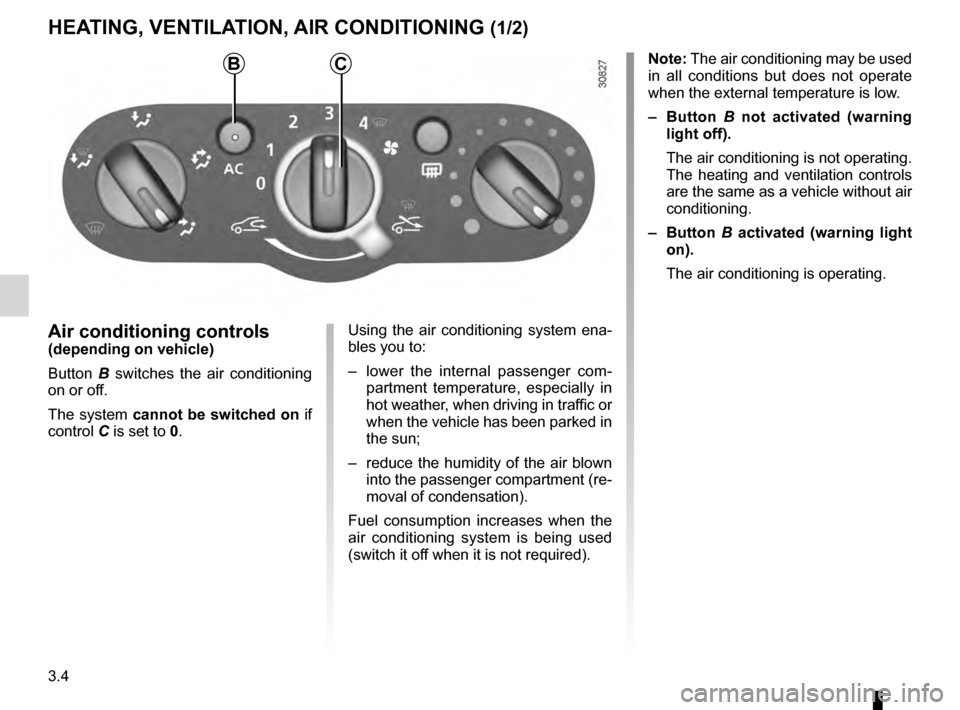
Air conditioning controls(depending on vehicle)
Button
B
switches the air conditioning
on or off.
The system cannot be switched on if
control
C is set to 0. Using the air conditioning system ena-
bles you to:
–
l
ower the internal passenger com-
partment temperature, especially in
hot weather, when driving in traffic or
when the vehicle has been parked in
the sun;
–
reduce
the humidity of the air blown
into the passenger compartment (re-
moval of condensation).
Fuel consumption increases when the
air conditioning system is being used
(switch it off when it is not required). Note: The air conditioning may be used
in all conditions but does not operate
when the external temperature is low.
–
B
utton
B
n
ot activated (warning
light off).
The air conditioning is not operating.
The heating and ventilation controls
are the same as a vehicle without air
conditioning.
–
B
utton
B
a
ctivated (warning light
on).
The air conditioning is operating.
CB
Page 85 of 174

air conditioning ..................................... (up to the end of the DU)
heating system ..................................... (up to the end of the DU)
heating and air conditioning system ..... (up to the end of the DU)
ventilation heating and air conditioning system (up to the end of the DU)
air conditioning ...................................................... (current page)
3.9
ENG_UD18246_14
Air conditionné : informations et conseils utilisation (B90 - U90 - \
L90 Ph2 - F90 Ph2 - R90 Ph2 - H79 - Dacia)
ENG_NU_817-10_B90_Dacia_3
Air conditioning: information and advice on use
AIR CONDITIONING: information and advice on use
Fuel consumption
You will normally notice an increase
in fuel consumption (especially
when driving in town) when the air
conditioning is operating.
For vehicles fitted with air condition-
ing with no automatic mode, switch
off the system when it is not re-
quired.
Advice for reducing consumption
and helping to preserve the envi-
ronment
Drive with the air vents open and
the windows closed.
If the vehicle has been parked in
the sun, open the doors for a few
moments to let the hot air escape
before starting the engine. Operating faults
As a general rule, contact your ap-
proved dealer in the event of an op-
erating fault.
–
R
eduction in de-icing, demist-
ing or air conditioning per-
formance.
This may be caused by the pas-
senger compartment filter car-
tridge becoming clogged.
–
No cold air is being produced .
C
heck that the controls are set
correctly and that the fuses are
sound. Otherwise, switch off the
system.
Do not open the refriger-
ant fluid circuit. The fluid
may damage eyes or skin.Presence of water under the ve-
hicle. After prolonged use of the air
conditioning system, it is normal for
water to be present under the vehi-
cle. This is caused by condensation.Maintenance
Refer to the Maintenance Service
Booklet for your vehicle for the in-
spection frequency.
Page 109 of 174
tyre pressures ....................................... (up to the end of the DU)
tyres ...................................................... (up to the end of the DU)
tyre pressure......................................... (up to the end of the DU)
4.11
ENG_UD19741_9
Pressions de gonflage des pneumatiques à froid (B90 - U90 - L90 Ph2 \
- F90 Ph2 - R90 Ph2 - Dacia)
ENG_NU_817-10_B90_Dacia_4
Tyre pressures
TyRE PRESSURE
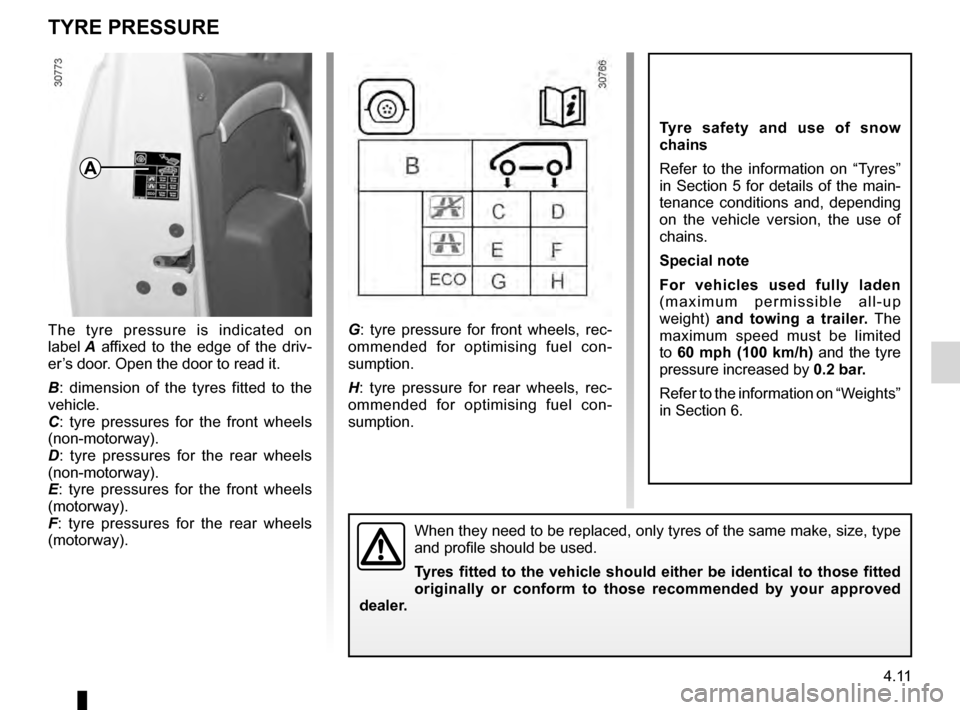
The tyre pressure is indicated on
label A
affixed to the edge of the driv-
er’s door. Open the door to read it.
B : dimension of the tyres fitted to the
vehicle.
C : tyre pressures for the front wheels
(non-motorway).
D : tyre pressures for the rear wheels
(non-motorway).
E : tyre pressures for the front wheels
(motorway).
F : tyre pressures for the rear wheels
(motorway). G
: tyre pressure for front wheels, rec-
ommended for optimising fuel con-
sumption.
H : tyre pressure for rear wheels, rec-
ommended for optimising fuel con-
sumption.
Tyre safety and use of snow
chains
Refer to the information on “Tyres”
in Section 5 for details of the main-
tenance conditions and, depending
on the vehicle version, the use of
chains.
Special note
For vehicles used fully laden
( m a x i m u m p e r m i s s i b l e a l l - u p
weight) and towing a trailer. The
maximum speed must be limited
to 60 mph (100 km/h) and the tyre
pressure increased by 0.2 bar.
Refer to the information on “Weights”
in Section 6.
When they need to be replaced, only tyres of the same make, size, type
and profile should be used.
Tyres fitted to the vehicle should either be identical to those fitted
originally or conform to those recommended by your approved
dealer.
A
Page 138 of 174

ENG_NU_817-10_B90_Dacia_5
FUSES (3/3)
Allocation of fuses
(the presence of certain fuses DEPENDS ON THE VEHICLE EQUIPMENT LEVEL)\
Symbol Allocation
QLeft-han")
5.24
ENG_UD22587_8
Fusibles (B90 - Dacia)
ENG_NU_817-10_B90_Dacia_5
FUSES (3/3)
Allocation of fuses
(the presence of certain fuses DEPENDS ON THE VEHICLE EQUIPMENT LEVEL)\
Symbol Allocation
QLeft-hand main beam
headlight
LLeft-hand dipped beam
headlight
TRight-hand dipped
beam headlight
VRight-hand side light
YLeft-hand side light
FRear fog light
ḼElectric rear windows
Symbol Allocation
qEngine immobiliser
ËReversing light
uPower-assisted steering
iAutomatic gearbox
GAS fuel
Page 156 of 174

engine specifications ............................ (up to the end of the DU)
technical specifications ......................... (up to the end of the DU)
fuel grade ............................................... (up to the end of the DU)
engine technical specifications ................... (up to the end of the DU)
6.4
ENG_UD18029_4
Caractéristiques moteur (B90 - Dacia)
ENG_NU_817-10_B90_Dacia_6
Engine specifications
ENGINE SPECIFICATIONS
Versions 1.2 16V1.41.61.6 16V 1.5 dCi
Engine type
(see engine plate) D4F
K7JK7M K4M K9K Turbo
Cubic capacity (cc) 1,1491,390 1,5981,461
Type of fuel
Octane rating It is
essential that you use unleaded petrol of the octane rating stated on
the label inside the fuel filler flap.
If not available, for a limited time only, use unleaded fuel:
–
with an octane rating of 91 for a label with the ratings 95 or 98
;
–
with an octane rating of 87 for a label showing 91, 95 or 98. Diesel.
The label
located in the fuel filler flap
indicates the
authorised fuels.
Spark plugs Only use the spark plugs specified for your vehicle’
s engine.
The type should be marked on a label affixed inside the engine compart-
ment. If it is not, contact an approved dealer.
Fitting spark plugs which are not to specification may damage the engine.