2016 DACIA SANDERO STEPWAY wheel
[x] Cancel search: wheelPage 62 of 174

running in ............................................................... (current page)
ignition switch ........................................................ (current page)
engine immobiliser (switch) ................................... (current page)
driving .................................................................... (current page)
starting ................................................................... (current page)
2.2
ENG_UD18236_9
Rodage / Contacteur de démarrage (B90 - U90 - L90 Ph2 - Dacia)
ENG_NU_817-10_B90_Dacia_2
Running in, Ignition switch
RUNNING IN, IGNITION SWITCH
Petrol version
For the first 600 miles (1,000 km), do
not exceed 78 mph (130 km/h) in the
highest gear, or 3,000 to 3,500 rpm.
You may only expect top performance
from your vehicle after approximately
1,800 miles (3,000 km).
S e r v i c e i n t e r v a l s : r e f e r t o t h e
Maintenance Service Booklet for the
vehicle.
Diesel version
For the first 900 miles (1,500 km), do
not exceed 2,500 rpm. After complet-
ing this mileage you may drive faster,
although you may only expect top per-
formance after approximately 3,600
miles (6,000 km).
Do not accelerate hard while the engine
is still cold and do not let the engine
over-rev.
S e r v i c e i n t e r v a l s : r e f e r t o t h e
Maintenance Service Booklet for the
vehicle.
Stop and steering lock
position St
To lock: remove the key and turn the
steering wheel until the steering column
locks.
To unlock: turn the key and the steering
wheel slightly.
Accessories position A
When the ignition is switched off, any
accessories (radio, etc.) will continue to
function.
Ignition on position M
The ignition is switched on:
–
p
etrol version: the engine may be
started.
–
d
iesel version: the engine is pre-
heating.
Start position D
If the engine fails to start at the first
attempt, the key must be turned back
before the starter can be activated
again.
Release the key as soon as the engine
starts.
Page 67 of 174

ENG_NU_817-10_B90_Dacia_2
On versions with")
JauneNoirNoir texte
2.7
ENG_UD22287_11
Conseils : antipollution, économies de carburant, conduite (B90 - U9\
0 - L90 Ph2 - F90 Ph2 - R90 Ph2 - H79 - Dacia)
ENG_NU_817-10_B90_Dacia_2
On versions with an automatic gear-
box, it is preferable to keep the gear
lever in position D.
–
D
o not try to maintain the same
speed up a hill, accelerate no more
than you would on the level. Keep
your foot in the same position on the
accelerator pedal.
–
Double
declutching and accelerating
before switching off are unnecessary
in modern vehicles.
–
P
oor weather conditions, flooded
roads. Do not drive through water if it
is higher than the lower edge of the
wheel rim.Exhaust gas monitoring
system
The exhaust gas monitoring system de-
tects operating faults in the vehicle’s
antipollution system. These faults may
cause mechanical damage or the re-
lease of harmful substances.
ÄThis warning light on the in-
strument panel will indicate if
there are any faults in the system:
This comes on when the ignition is
switched on and goes out after three
seconds.
–
I
f it comes on continuously, consult
an approved dealer as soon as pos-
sible.
–
If
it flashes, reduce the engine speed
until the light stops flashing. Contact
an approved dealer as soon as pos-
sible.
Driving– Drive carefully for the first few miles until the engine reaches its normal
operating temperature, rather than
let it warm up while the vehicle is sta-
tionary.
ADVICE: antipollution, fuel economy and driving (2/3)
Driving problems
On the driver ’s side, only
use mats specially adapted
for the vehicle and attached
to prefitted devices. Check regularly
to make sure they are secure. Do
not overlay several mats.
Risk of pedals jamming .
– Speed is expensive.
–
Sporty
driving uses a lot of fuel: drive
with a light right foot.
–
Study
the road ahead so that you are
able to brake as little as possible, it
can be sufficient just to lift off the ac-
celerator.
–
A
void sudden acceleration.
–
Do
not overrev the engine in the in-
termediate gears. Always use the
highest gear possible without labour-
ing the engine.
Page 71 of 174

power-assisted steering......................................... (current page)
driving .................................................................... (current page)
power-assisted steering......................................... (current page)
handbrake.............................................................. (current page)
2.11
ENG_UD18241_6
Frein à main / Direction assistée (B90 - L90 Ph2 - F90 Ph2 - R90 \
Ph2 - Dacia)
ENG_NU_817-10_B90_Dacia_2
Handbrake
To release
Pull lever
1
up slightly, press button
2
and then lower the lever to the floor.
Handbrake/Power-assisted steering
HANDBRAKE, POWER-ASSISTED STEERING
To apply
Pull lever
1 upwards and make sure the
vehicle is immobilised.
Depending on the gradient
and/or vehicle load, it may
be necessary when station-
ary to apply the brake by
at least a further two notches and
engage a gear (1
st or reverse gear).
Never switch off the igni-
tion when travelling down-
hill, and avoid doing so in
normal driving (assistance
is not provided).
Make sure that the hand-
brake is properly released
when driving (red indicator
light off), otherwise over-
heating, or even damage, may
occur.
1
2
Power-assisted steering
With the engine running, do not leave
the steering wheel at full lock while sta-
tionary as this may damage the power-
assisted steering pump.
With the engine switched off, or if there
is a system fault, it is still possible to
turn the steering wheel. The force re-
quired will be greater.
Page 72 of 174

driving ................................................... (up to the end of the DU)
ABS ...................................................... (up to the end of the DU)
anti-lock braking system: ABS .............. (up to the end of the DU)
2.12
ENG_UD18242_8
Dispositifs de correction et d’assistance à la conduite (B90 - U9\
0 - L90 Ph2 - F90 Ph2 - R90 Ph2 - Dacia)
ENG_NU_817-10_B90_Dacia_2
Jaune NoirNoir texte
ABS (anti-lock braking
system)
Under heavy braking, the ABS prevents
the wheels from locking, allowing the
stopping distance to be managed and
keeping control of the vehicle.
Under these circumstances, the vehi-
cle can be steered to avoid an obstacle
whilst braking. In addition, this system
can increase stopping distances, par-
ticularly on roads with low surface grip
(wet ground etc.).
You will feel a pulsation through the
brake pedal each time the system is
activated. The ABS does not in any way
improve the vehicle's physical perform-
ance relating to the road surface and
roadholding. It is still essential to follow
the rules of good driving practice (such
as driving at a safe distance from the
vehicle in front etc.).
Driver correction devices/aids
DRIVER CORRECTION DEVICES/AIDS (1/2)
Depending on the vehicle, this is com-
posed of:
–
t
h e A B S ( a n t i - l o c k b r a k i n g
system);
–
emergency brake assist.
These functions are an ad-
ditional aid in the event of
critical driving conditions,
enabling the vehicle behav-
iour to be adapted to suit the driving
conditions.
However, the functions do not take
the place of the driver. They do
not increase the vehicle’s limits
and should not encourage you
to drive more quickly. Therefore,
they can under no circumstances
replace the vigilance or responsibil-
ity of the driver when manoeuvring
the vehicle (the driver must always
be ready for sudden incidents which
may occur when driving).
In an emergency, apply firm and
continuous pressure to the brake
pedal. There is no need to pump
it repeatedly. The ABS will modu-
late the force applied in the braking
system.
Page 76 of 174

2.16
ENG_UD22554_10
Boîte automatique (B90 - L90 Ph2 - F90 Ph2 - R90 Ph2 - Dacia)
ENG_NU_817-10_B90_Dacia_2
Parking the vehicleWhen the vehicle is stopped, move the
lever to position P while keeping your
foot on the brake pedal: the gearbox is
in neutral and the drive wheels are me-
chanically locked by the driveshaft.
Apply the handbrake.
AUTOMATIC TRANSMISSION (3/3)
An impact to the under-
side of the vehicle while
manoeuvring (e.g.: strik-
ing a post, raised kerb or
other street furniture) may result in
damage to the vehicle (e.g.: defor-
mation of an axle).
To avoid any risk of accident, have
your vehicle checked by an ap-
proved Dealer.
2
6
Operating faults
If a vehicle with an automatic gear-
box breaks down, please refer to the
information on “Towing” in Section 5.
When setting off, if the lever is locked
in position P even though you are
pressing the brake pedal, the lever can
be released manually. To do this, unclip
the base of the lever, press recess
6 ,
visible
on the gear lever gaiter, and the
unlocking button
2
.
–
I
f the road contour and bends in
the road do not allow you to stay in
automatic mode (e.g.: in mountain-
ous areas), it is recommended that
you switch to manual mode.
This will prevent the automatic gear-
box from changing gears repeatedly
when climbing, and permit engine
braking on long descents.
–
I
n cold weather
, start the engine
and wait a few seconds before
moving the selector lever from posi-
tion P or N and engaging it in D or R
to prevent the engine stalling.
–
V
ehicles not fitted with traction
control: on a slippery surface or
surface with a low level of adhesion,
change to manual mode and select
second gear (or even third) before
starting the engine to avoid wheel-
spin when accelerating.
In very cold weather , the system
may prevent the gears from being
shifted in manual mode until the
gearbox reaches the right tempera-
ture.
For safety reasons, do not
switch off the ignition before
the vehicle has come to a
complete standstill.
Page 109 of 174
tyre pressures ....................................... (up to the end of the DU)
tyres ...................................................... (up to the end of the DU)
tyre pressure......................................... (up to the end of the DU)
4.11
ENG_UD19741_9
Pressions de gonflage des pneumatiques à froid (B90 - U90 - L90 Ph2 \
- F90 Ph2 - R90 Ph2 - Dacia)
ENG_NU_817-10_B90_Dacia_4
Tyre pressures
TyRE PRESSURE
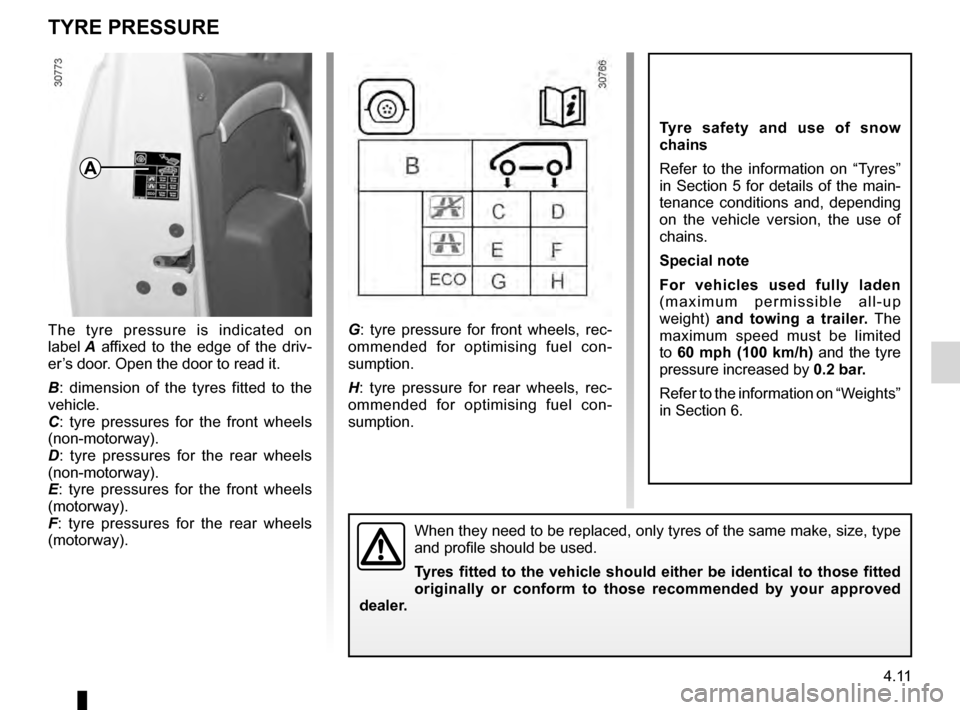
The tyre pressure is indicated on
label A
affixed to the edge of the driv-
er’s door. Open the door to read it.
B : dimension of the tyres fitted to the
vehicle.
C : tyre pressures for the front wheels
(non-motorway).
D : tyre pressures for the rear wheels
(non-motorway).
E : tyre pressures for the front wheels
(motorway).
F : tyre pressures for the rear wheels
(motorway). G
: tyre pressure for front wheels, rec-
ommended for optimising fuel con-
sumption.
H : tyre pressure for rear wheels, rec-
ommended for optimising fuel con-
sumption.
Tyre safety and use of snow
chains
Refer to the information on “Tyres”
in Section 5 for details of the main-
tenance conditions and, depending
on the vehicle version, the use of
chains.
Special note
For vehicles used fully laden
( m a x i m u m p e r m i s s i b l e a l l - u p
weight) and towing a trailer. The
maximum speed must be limited
to 60 mph (100 km/h) and the tyre
pressure increased by 0.2 bar.
Refer to the information on “Weights”
in Section 6.
When they need to be replaced, only tyres of the same make, size, type
and profile should be used.
Tyres fitted to the vehicle should either be identical to those fitted
originally or conform to those recommended by your approved
dealer.
A
Page 111 of 174

maintenance:bodywork ........................................ (up to the end of the DU)
washing ................................................ (up to the end of the DU)
paintwork maintenance ................................... (up to the end of the DU)
anti-corrosion protection ........................................ (current page)
4.13
ENG_UD26811_2
Entretien de la carrosserie (peinture mate) (X44 - X77 - J77 - X85 - \
B90 - X61 - TEST - X77 ph2 - X95 - B95 - D95 - K95 - J95 - R95 - L90 Ph2 - F90 Ph2 - R90\
Ph2 - X62
ENG_NU_817-10_B90_Dacia_4
Bodywork maintenance
BOdyWORk MAINTENANCE (1/2)
you should
Wash your car frequently, with the
engine off, with cleaning products rec-
ommended by the manufacturer (never
use abrasive products). Rinse thor-
oughly beforehand with a jet:
–
s
pots of tree resin and industrial
grime;
–
mud
in the wheel arches and under-
neath the body which forms damp
patches;
–
b
ird droppings , which cause a
chemical reaction with the paint that
rapidly discolours paintwork and
may even cause the paint to peel
off;
w
ash the vehicle immediately to
remove these marks since it is im-
possible to remove them by polish-
ing;
–
salt,
particularly in the wheel arches
and underneath the body after driv-
ing in areas where the roads have
been gritted.
Remove any plant matter (resin, leaves,
etc.) from the vehicle regularly.
What you should not doDo not degrease or clean mechani-
cal components (e.g. the engine com-
partment), underneath the body, parts
with hinges (e.g. inside the doors) and
painted plastic external fittings (e.g.
bumpers) using high-pressure clean-
ing equipment or by spraying on prod-
ucts not approved by our Technical
Department. Doing this could give rise
to corrosion or operational faults.
Wash the vehicle in bright sunlight or
freezing temperatures.
Do not scrape off mud or dirt without
pre-wetting.
Allow dirt to accumulate on the exterior.
Allow rust to form following minor im-
pacts.
Do not use solvents not approved by
our Technical Department to remove
stains as this could damage the paint-
work.
Do not drive in snow or muddy condi-
tions without washing the vehicle, par-
ticularly under the wheel arches and
body.
A well-maintained vehicle will last
longer. It is therefore recommended to
maintain the exterior of the vehicle reg-
ularly.
Your vehicle has been treated with very
effective anti-corrosion products. It is
nevertheless subject to various outside
influences.
Corrosive agents in the atmosphere
–
a
tmospheric pollution (built-up and
industrial areas),
–
s
aline atmospheres (near the sea,
particularly in hot weather),
–
s
easonal and damp weather condi-
tions (e.g. road salt in winter, water
from road cleaners, etc.).
Minor impacts
Abrasive action
Dust and sand in the air, mud, road grit
thrown up by other vehicles, etc.
You should take a number of minor pre-
cautions in order to safeguard your ve-
hicle against such risks.
Page 115 of 174

5.1
ENG_UD26897_12
Sommaire 5 (B90 - Dacia)
ENG_NU_817-10_B90_Dacia_5
Section 5: Practical advice
Tools .. . . . . . . . . . . . . . . . . . . . . . . . . . . . . . . . . . . . . . . . . . . . . . . . . . . . . . . . . . . . . . . . . . . . . . . . 5.2
Puncture
.
. . . . . . . . . . . . . . . . . . . . . . . . . . . . . . . . . . . . . . . . . . . . . . . . . . . . . . . . . . . . . . . . . . . . .
5.3
T
yre inflation kit
.
. . . . . . . . . . . . . . . . . . . . . . . . . . . . . . . . . . . . . . . . . . . . . . . . . . . . . . . . . . . . . . . .
5.4
Wheel trims, Wheels
. . . . . . . . . . . . . . . . . . . . . . . . . . . . . . . . . . . . . . . . . . . . . . . . . . . . . . . . . . . . .
5.7
Changing a wheel
.
. . . . . . . . . . . . . . . . . . . . . . . . . . . . . . . . . . . . . . . . . . . . . . . . . . . . . . . . . . . . . .
5.9
T
yres (tyre and wheel safety, use in winter)
.
. . . . . . . . . . . . . . . . . . . . . . . . . . . . . . . . . . . . . . . . . .
5.1
1
Changing bulbs
.
. . . . . . . . . . . . . . . . . . . . . . . . . . . . . . . . . . . . . . . . . . . . . . . . . . . . . . . . . . . . . . . .
5.14
Front lights
. . . . . . . . . . . . . . . . . . . . . . . . . . . . . . . . . . . . . . . . . . . . . . . . . . . . . . . . . . . . . . .
5.14
Fog lights
.
. . . . . . . . . . . . . . . . . . . . . . . . . . . . . . . . . . . . . . . . . . . . . . . . . . . . . . . . . . . . . . .
5.15
Rear lights
.
. . . . . . . . . . . . . . . . . . . . . . . . . . . . . . . . . . . . . . . . . . . . . . . . . . . . . . . . . . . . . .
5.16
Side indicator lights
.
. . . . . . . . . . . . . . . . . . . . . . . . . . . . . . . . . . . . . . . . . . . . . . . . . . . . . . .
5.18
Interior lights
. . . . . . . . . . . . . . . . . . . . . . . . . . . . . . . . . . . . . . . . . . . . . . . . . . . . . . . . . . . . . .
5.19
Fuses
. . . . . . . . . . . . . . . . . . . . . . . . . . . . . . . . . . . . . . . . . . . . . . . . . . . . . . . . . . . . . . . . . . . . . . . . .
5.22
Battery
. . . . . . . . . . . . . . . . . . . . . . . . . . . . . . . . . . . . . . . . . . . . . . . . . . . . . . . . . . . . . . . . . . . . . . . .
5.25
Radio frequency remote control unit: battery. . . . . . . . . . . . . . . . . . . . . . . . . . . . . . . . . . . . \
. . . . . . .
5.27
Wiper blades
.
. . . . . . . . . . . . . . . . . . . . . . . . . . . . . . . . . . . . . . . . . . . . . . . . . . . . . . . . . . . . . . . . . .
5.28
T
owing: breakdown
.
. . . . . . . . . . . . . . . . . . . . . . . . . . . . . . . . . . . . . . . . . . . . . . . . . . . . . . . . . . . . .
5.29
T
owing: towbar. . . . . . . . . . . . . . . . . . . . . . . . . . . . . . . . . . . . \
. . . . . . . . . . . . . . . . . . . . . . . . . . . . . .
5.31
Fitted audio equipment
.
. . . . . . . . . . . . . . . . . . . . . . . . . . . . . . . . . . . . . . . . . . . . . . . . . . . . . . . . . .
5.32
Accessories
. . . . . . . . . . . . . . . . . . . . . . . . . . . . . . . . . . . . . . . . . . . . . . . . . . . . . . . . . . . . . . . . . . . .
5.33
Operating faults
. . . . . . . . . . . . . . . . . . . . . . . . . . . . . . . . . . . . . . . . . . . . . . . . . . . . . . . . . . . . . . . . .
5.34